If annual bills keep catching you off guard, turn each known bill into a monthly or payday-sized amount before its due date arrives. List the bill, confirm the next due date and amount, then divide what you still need by the number of contributions left. The bill becomes a planned budget line instead of a surprise.
The Consumer Financial Protection Bureau (CFPB) advises reviewing several months of spending records to catch less frequent costs such as insurance, tuition, gifts, and vacations (checked October 2026). The Federal Deposit Insurance Corporation (FDIC) also says to include annual or semiannual expenses, such as taxes or insurance premiums, in a budget (checked October 2026). Your own statements are more useful here than a national average.
Find the bills hiding outside your monthly routine
Start with checking and credit card statements, email receipts, renewal notices, and the bill folders where you keep paperwork. The CFPB’s spending guidance recommends looking across several months, because one month’s transactions may not show the less frequent costs. Search for charges with a yearly or twice-yearly pattern, then check the original notice before adding a number to your plan.
Scan categories that can renew or recur: car or renters insurance, vehicle registration, membership renewals, software, professional fees, school costs, and seasonal travel. These are prompts, not a standard list. Keep only expenses that apply to your household, and add an item if it appears in your records even if it does not fit a familiar category.
For each item, record four things: what it is, the next due date, the amount on the latest notice, and where you found that amount. If the price may change before renewal, mark it as an estimate and schedule a reminder to check the next notice. Do not treat last year’s charge as a confirmed future bill.
Also note how you pay it: automatic debit, card charge, or a manual payment, and which account the payment uses. That tells you where cash will leave and helps you keep the bill reminder separate from the actual transaction.
Use the amount still needed, not just last year’s total
Check whether you have already set aside money for the bill. If you have, subtract that balance from the amount due. Divide the remainder by the number of monthly deposits or paychecks you can make before payment.
For example, suppose your next annual insurance bill is $720 and you have $120 reserved for it. If six monthly deposits remain before the due date, the gap is $600, so the monthly amount is $100. If you budget by two paychecks each month, you could instead assign $50 from each paycheck. The amounts are an illustration; replace them with your bill, existing balance, and actual dates.
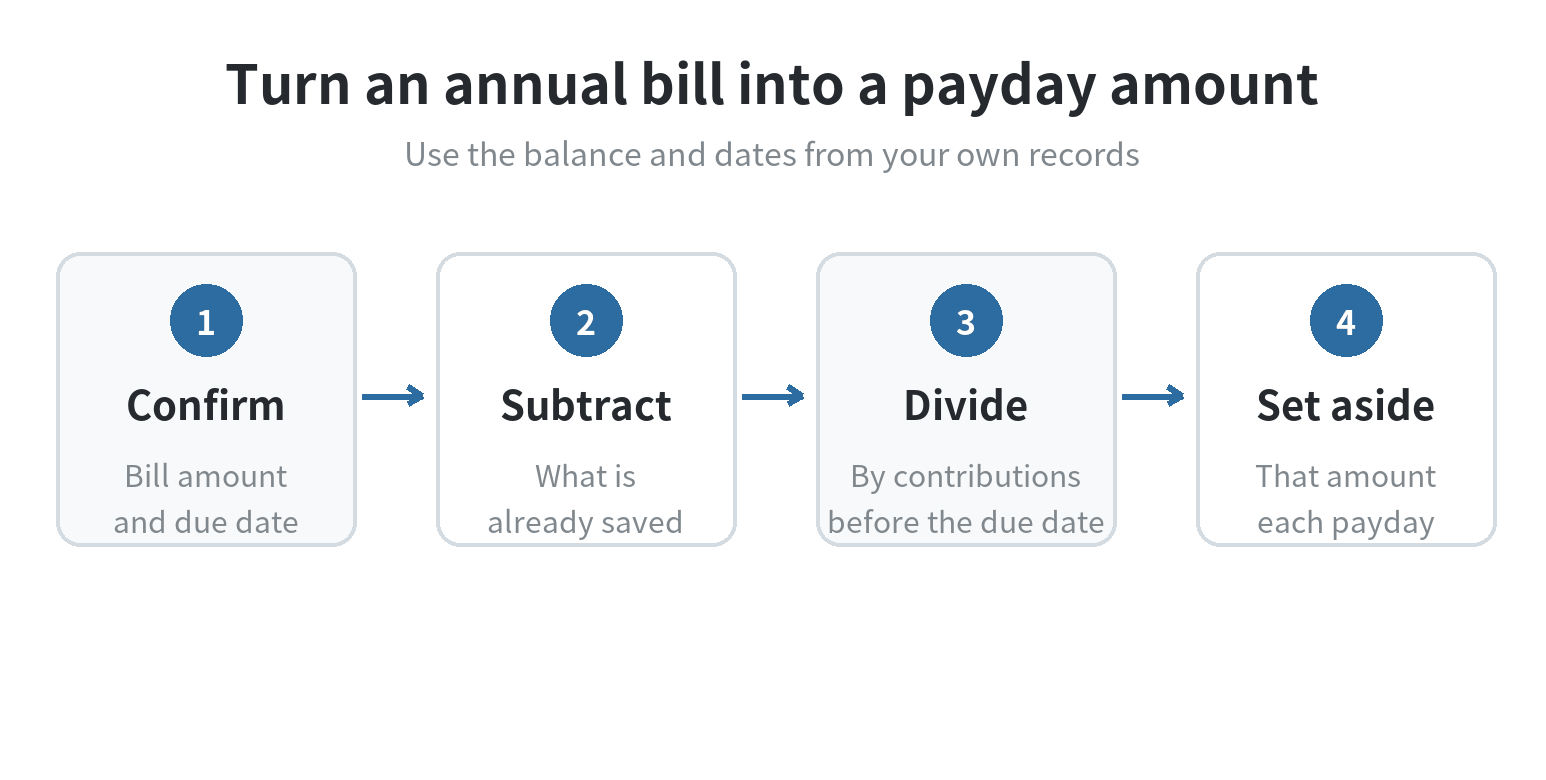
Count the contributions that will actually happen before the bill is due. If payday falls after the due date, that paycheck cannot fund this payment. For bills with different dates, calculate each line separately rather than dividing one combined annual total by twelve. That keeps a bill due in March from being funded with money that will not arrive until April.
Give every planned bill its own name
Keep annual-bill money separate in your budget from ordinary monthly spending. You can use a labeled line in a spreadsheet or notebook, a separate savings balance, or another method you can track. The key is that the running amount for “car insurance” stays visible and does not look like available grocery or entertainment money.
A cash-flow calendar can help map income and expenses to their expected dates. If an automatic transfer fits your cash flow, check the checking balance before it runs so the transfer does not collide with rent or another scheduled payment.
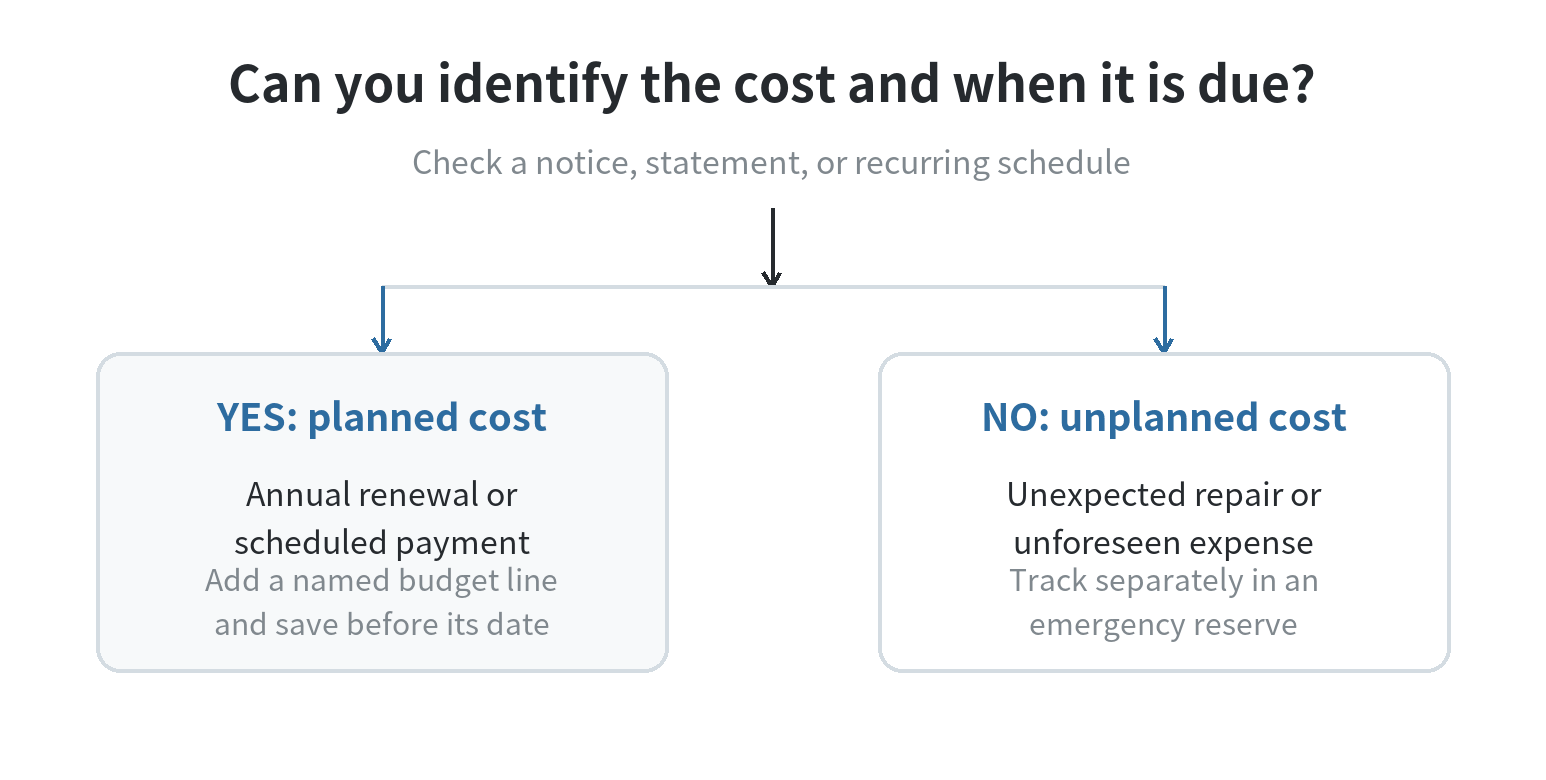
Separate predictable costs from genuinely unplanned expenses. A renewal notice with a known date belongs on the annual-bill list. A surprise repair or an unexpected loss of income belongs in a different reserve. CFPB describes emergency savings as money for unplanned expenses, while its spending guidance treats recurring insurance, seasonal costs, and gifts as items to find in past records.
When a due date is closer than your savings plan
If the full amount cannot be saved before the next due date, do not make the monthly formula pretend otherwise. Write down the amount already available, the remaining gap, and the number of paychecks before payment. Then decide which current budget line can cover the gap without putting rent, utilities, food, or required debt payments at risk.
Ask the company that bills you whether it offers a different due date or payment schedule. The CFPB’s cash-flow materials describe contacting a company to ask about changing a due date or splitting a large payment; availability depends on the company and the bill. Get any new dates and amounts in writing, and update the calendar before changing your savings schedule.
If you cannot cover the bill, contact the provider before the deadline and ask what options apply to your account. Record the representative’s answer, any fees, and the next action date. A payment arrangement changes when money leaves your account, so update the budget for each installment rather than continuing to plan around the old due date.
Check the calendar for crowded months
Put each annual bill on the month it is due, then place paydays and regular bills beside it. This reveals when a bill may land in the same week as rent, a car payment, or another renewal. The CFPB recommends tracking bill amounts and due dates on a calendar and comparing them with the overall budget (checked October 2026).
If the totals work for the month but the dates do not, ask whether a provider can move a due date. The CFPB notes that aligning due dates with income can help manage cash flow. Do not move money twice in your records: when you transfer a contribution into the bill reserve, record it as reserved, then record the payment from that reserve when the bill is paid.
For bills that cluster together, see how to plan for a month when several bills are due at once. If your pay amount changes from month to month, the irregular-income budgeting article covers setting a cash-flow baseline around variable pay.
Reset the number after each renewal
When the bill arrives, compare the actual amount with your estimate and the reserve balance. Pay from the reserved amount, then update the next due date and the latest confirmed cost. If the bill went up, recalculate the next contribution using the amount still needed and the time remaining; if it went down, leave the extra visible until you assign it elsewhere.
Keep the notice or statement with your budget record. That gives you a clear source for the next planning cycle and makes it easier to tell a real price change from an old estimate. The FDIC recommends updating expense lists as costs change and including anticipated annual or semiannual expenses in the plan (checked October 2026).
FAQ
Should I save for an annual bill in a separate account?
A separate account can make the reserved balance easier to see, but a clearly labeled budget line can also work. Choose a method that lets you identify what is reserved and check the balance before paying the bill.
What if an annual bill has no fixed amount yet?
Use the latest notice as a temporary estimate and mark it for review. When the provider issues a new notice, replace the estimate and recalculate the remaining contribution amount before the due date.
How should I handle a bill that changes to monthly payments?
Replace the old annual contribution with the actual monthly due dates and amounts once the new schedule is confirmed. Keep any remaining reserved balance assigned to that bill until you know whether it is needed for a final installment or adjustment.
Last updated: 2026-10.