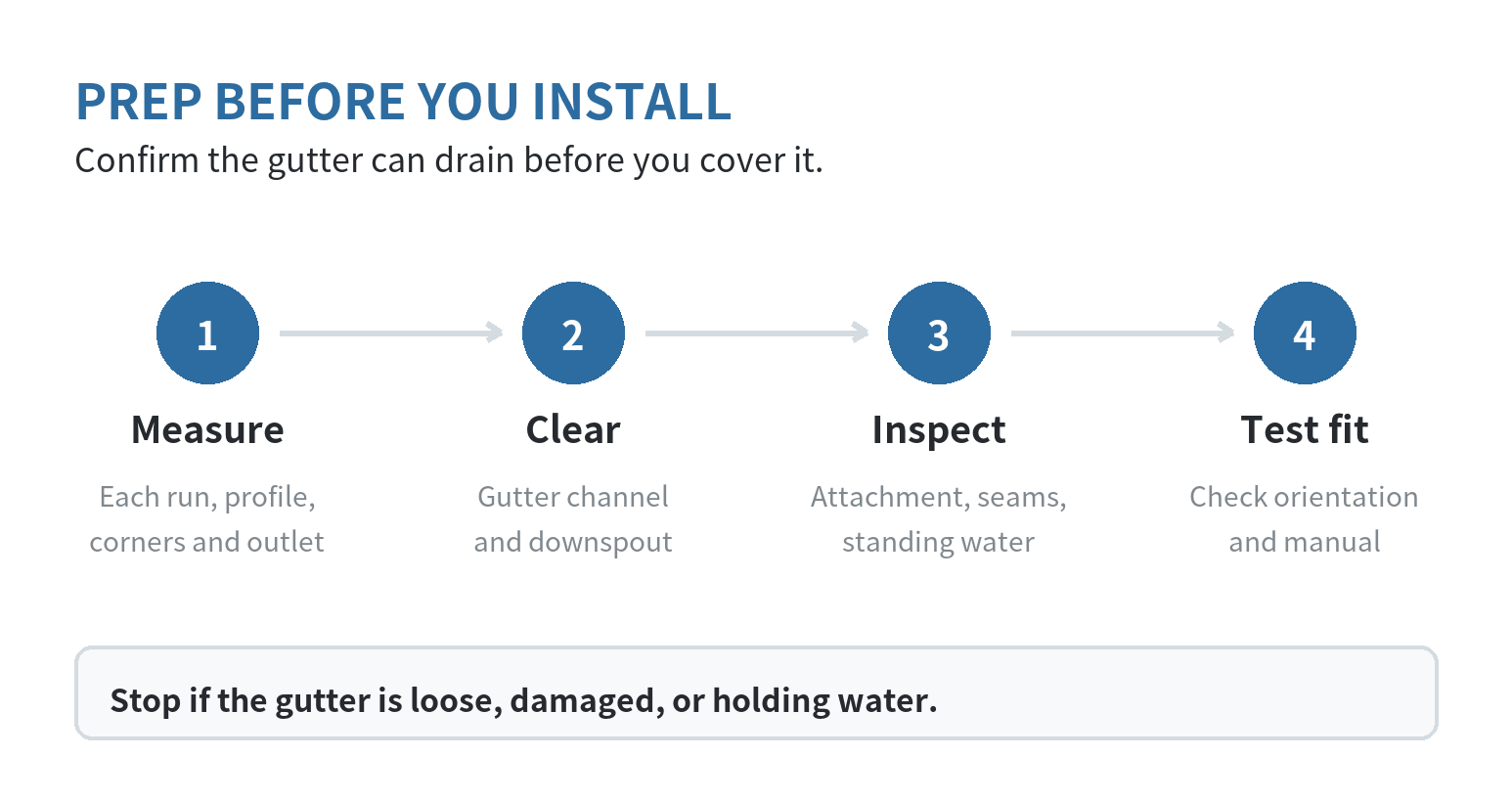
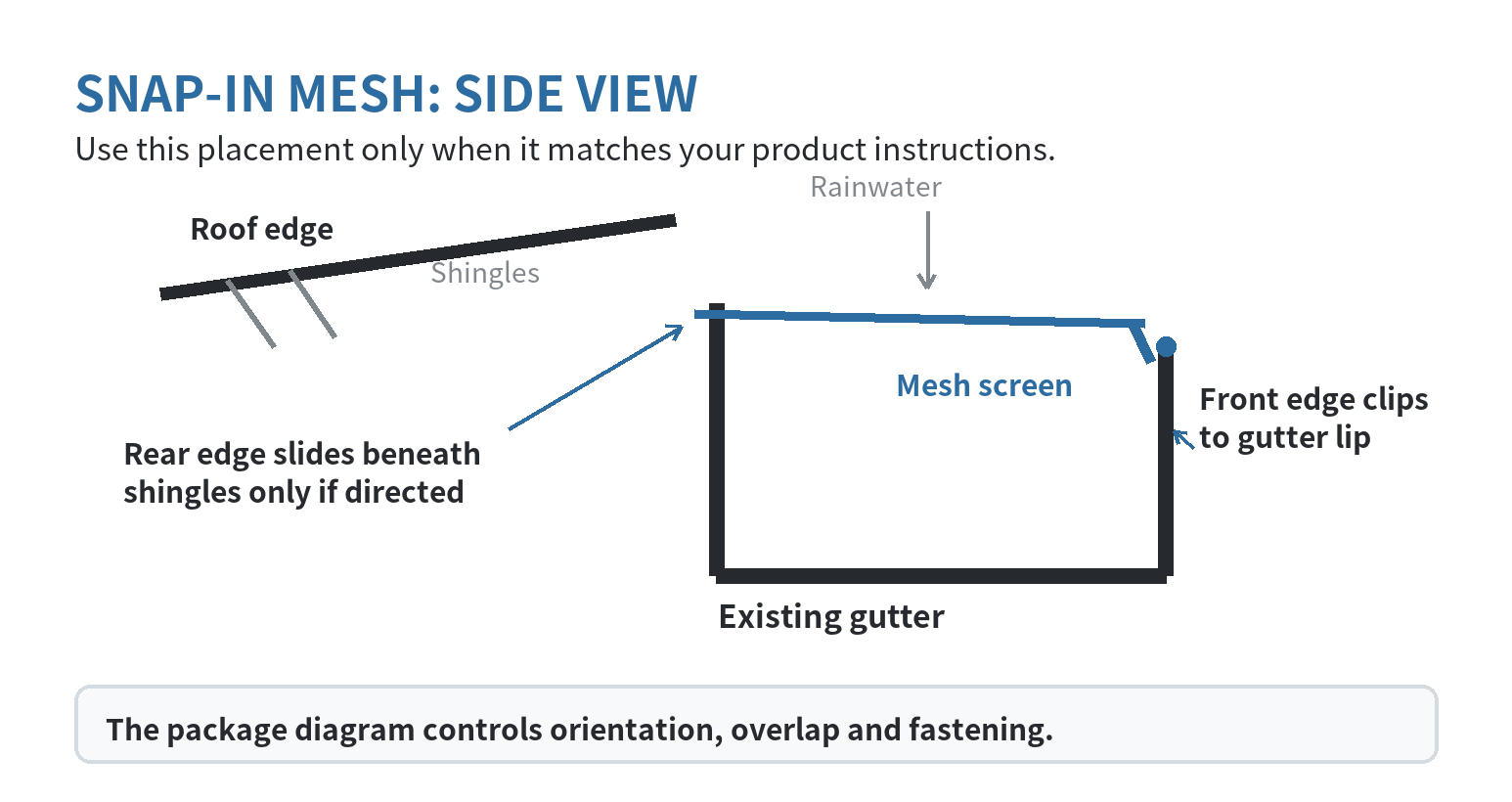
Install a gutter guard only after you have measured the gutter, cleared the channel and downspout, and checked that the gutter is still firmly attached. For a snap-in mesh section, the basic fit is straightforward: secure its front edge to the gutter lip, then position the back edge as the product manual directs. The exact attachment varies by design, so use the instructions packaged with your guard rather than forcing one method onto every style.
Home Depot’s guide to DIY gutter clean-up and gutter guard installation describes clearing the gutter and downspout first, sliding the guard under the shingles, snapping it over the gutter, and trimming it to fit (checked October 2026). Lowe’s guide to installing gutter screens also calls for measuring, cleaning, checking the roof pitch and following the specific product instructions (checked October 2026). These steps are a planning guide; the manual for your guard controls its fastening, overlaps and roof-edge placement.
Check the gutter before choosing a guard
Start from the ground. Look for loose sections, sagging, separated joints, rust-through, cracks, or a downspout that has pulled away. A cover will not correct a gutter that is detached or unable to drain. Home Depot’s gutter-cleaning guide advises checking for damage, secure attachment, leaks and standing water before treating the gutter as ready for service (checked October 2026). Repair the gutter or arrange an assessment before adding a guard if you find a structural or drainage problem.
Identify what reaches the gutter. Broad leaves and twigs behave differently from small seeds, buds or evergreen needles. A mesh opening that stops one kind of debris may let another through, or collect it on the surface. Lowe’s guide to installing gutter screens notes that buds, seeds and evergreen needles can pass through some screen openings (checked October 2026). Use that observation to compare the guard’s opening and material with the debris you see, rather than relying on a broad “leaf protection” label.
Gutter screens use a mesh, slotted or perforated surface over the channel. Covered guard designs instead use a solid or crowned surface that directs rainwater toward an edge and into the gutter. Those designs attach differently, so this walkthrough focuses on add-on sections that sit on an existing gutter; a one-piece curved replacement system is a separate installation. These category descriptions follow Lowe’s guide to installing gutter screens and comparison pages published by Leafguard, GutterGlove, and All Weather Armour (checked October 2026).
Measure each run and mark the awkward spots
Use a tape measure to record each straight run from end to end, then note the gutter opening and shape. Check corners, roof valleys that discharge into the gutter, downspout openings, end caps and any change in gutter width. Measure runs separately because a corner or outlet can change how a section must be cut. Lowe’s guide to installing gutter screens recommends measuring each gutter’s width, depth and length (checked October 2026).
Compare those measurements with the package information for the exact guard. Home Depot’s gutter guard installation walkthrough lists a fit range for its featured product, not a universal gutter size (checked October 2026). Check the shape as well as the width: a screen designed for a K-style gutter may not seat correctly on a half-round profile. If the dimensions or profile do not match the label, pause and verify compatibility before cutting.
Mark corners, outlets, ends and changes in direction on a simple roofline sketch. Use it as a cut list, and confirm the manual’s corner detail before trimming. Keep the downspout opening clear.
Clean and test the drainage path first
Set up access on firm, level ground and keep your body centered between the ladder rails. Do not reach sideways to cover more distance; climb down and reposition the ladder. If the roof is steep, the building is tall, the ground is uneven, or you cannot keep a stable position, have the work assessed by a qualified installer. A guard project does not make an unsafe ladder setup acceptable.
Remove leaves and compacted material, then flush the gutter toward the downspout. Check that water exits the outlet instead of backing up. Home Depot’s gutter-cleaning guide recommends clearing the channel, flushing it and checking downspout flow before finishing gutter maintenance (checked October 2026). If water remains standing, a seam leaks, or the gutter is loose, resolve that issue before covering the channel; a screen can make a hidden blockage harder to see.
Match the pieces to your run map and set out the cutting tool, gloves and eye protection listed by the manufacturer. A snap-in guard’s instruction sheet, posted on Home Depot’s site, names tin snips and a tape measure, and says to clean the gutter and downspout before installation (checked October 2026). Cut from a stable position, with edges pointed away from your hands.
Fit one section before continuing along the roofline
Read the manual before attaching anything. It should tell you which side faces up, whether the rear edge slides under shingles, how the front edge engages, whether sections overlap, and what to do at corners and outlets. Product sheets can differ even when two guards look alike: a snap-in guard’s instruction sheet posted on Home Depot’s site says to clip the front lip and slide the rear side under the shingle, while a separate solid-cover product’s instruction sheet describes a different edge and corner treatment (checked October 2026).
Test-fit one straight section at a reachable location. Confirm that it sits flat, reaches the intended edges and does not pinch, lift or distort the shingles. Check that the opening above the gutter remains unobstructed and that the guard does not cover the downspout. If the piece rocks or leaves a gap, stop and recheck the profile, orientation and size instead of bending it into place.
Once the sample section fits, install the remaining straight pieces using the same orientation. Keep each joint aligned and use only the overlap or fastener method named in that product’s instructions. Lowe’s guide to installing gutter screens gives one example of overlapping adjacent sections by at least one-half inch, while a snap-in guard’s instruction sheet posted on Home Depot’s site describes its own cut-and-join method (checked October 2026). Treat that measurement as product-specific, not a general rule.
Finish corners, outlets and cut ends carefully
Follow the supplied diagram for corner cuts, overlaps or corner pieces; inside and outside corners may need different cuts. Keep the downspout opening clear. If a roof valley sends concentrated runoff into a short section, check the instructions for that arrangement.
Cut the final piece to length only after checking its position. Smooth or orient the cut edge as the manufacturer directs, then secure the section with the specified clip, screw or other fastener. Do not add screws simply because they seem helpful: the gutter material, guard design and local conditions affect the right attachment. Where the instructions call for a fastener or you cannot make a secure fit without altering the roof edge, stop and get product-specific advice.
Check the finished run and plan for access
From a stable position, look for lifted edges, gaps, loose clips, bent sections and blocked outlets. Correct a crooked section only from safe access. If the manual allows a water check, use a gentle flow and watch whether it enters the gutter and exits the downspout; do not spray under the shingles.
A guard changes where debris collects; it does not remove the need to look at the gutter system. Lowe’s guide to installing gutter screens recommends checking for blockage or damage in spring and fall and removing debris as needed (checked October 2026). Put the next inspection on your calendar and note which sections need ground-level observation. For related access planning, see the site’s ladder setup overview and roofline safety guide.
FAQ
Can I install gutter guards without lifting roof shingles?
Some screen styles attach at the gutter lip without tucking under shingles, but the mounting method depends on the product. Check the package diagram before choosing a guard, and do not pry up shingles unless the instructions require that placement.
Should a gutter guard cover the downspout opening?
No. Keep the outlet open so water and debris can reach the downspout. Use the product’s outlet detail to trim or position the guard without leaving a loose edge over the opening.
Can I put a guard over a gutter that holds standing water?
Fix the drainage problem first. Standing water can indicate a blockage, leak or slope issue, and a cover will make the channel less visible during inspection.
Do gutter guards mean I never need to inspect the gutters?
No. Debris can collect on top of a guard or block part of the channel. Follow the product’s maintenance directions and inspect the visible run for buildup or damage.
Last updated: 2026-10