When your paycheck changes each month, build the budget around money already in hand and the bills due before the next deposit. Set a lean monthly baseline from a low, workable income month, then use a calendar to place each deposit beside its due dates. Treat a large month as a chance to cover future gaps, not as permission to raise every spending limit.
The Consumer Financial Protection Bureau (CFPB) recommends a cash-flow budget for irregular income because it maps when money arrives and when it must cover expenses; checked September 30, 2026. The Federal Trade Commission’s Consumer.gov budget guide says to list income and expenses, then compare them; for people not paid every month, it suggests using last year’s income divided by 12 as a monthly estimate, checked September 30, 2026. Use that annual estimate as a reference point, then stress-test it against your actual low months.
Set a baseline your low months can carry
Collect recent pay records, client payment records, benefit notices, and bank deposits. Record take-home amounts and the dates they became available. Keep taxes already withheld out of the spendable-pay figure; for self-employment, use the amount left after the tax and business set-asides you already make. Do not count an invoice as cash until it clears.
Now sort household costs into three groups:
- Must-pay bills: housing, utilities, insurance, minimum debt payments, and required transportation.
- Flexible essentials: groceries, fuel, and household supplies, where a limit can be adjusted.
- Irregular costs: annual renewals, car repairs, school costs, gifts, and other bills that do not arrive monthly.
Choose a baseline that is supported by dependable income or a low month you can reasonably plan around. If your income has no dependable floor, do not pretend a monthly average is guaranteed cash. Keep the must-pay list visible and give each new deposit a job as it arrives.
For example, imagine a freelancer received $2,200, $3,100, and $1,800 after business set-asides in three recent months. Those amounts are illustrative, not a national average. If the $1,800 month is a plausible planning month, use it to check whether essential bills fit. If they total $1,550, the remaining $250 is a tight margin for flexible spending and irregular costs, so a low-income month calls for a narrower plan than a high-income month.
Put the dates beside the dollars
A monthly total can hide a timing problem: rent may be due before the client pays. Make a calendar with the opening checking balance, expected deposit dates, bill due dates, and planned variable spending. After each line, calculate the new balance. If the balance dips below the amount needed for the next must-pay bill, the budget has a timing gap even if the month’s total income exceeds total expenses.
The CFPB’s cash-flow tool breaks the month into weeks so you can see when money is expected and when it must be used. Its September 30, 2026 guidance also says to track income and spending, review the pattern, then set future targets. A simple spreadsheet or paper calendar works: you need the dates and balances, not a special app.
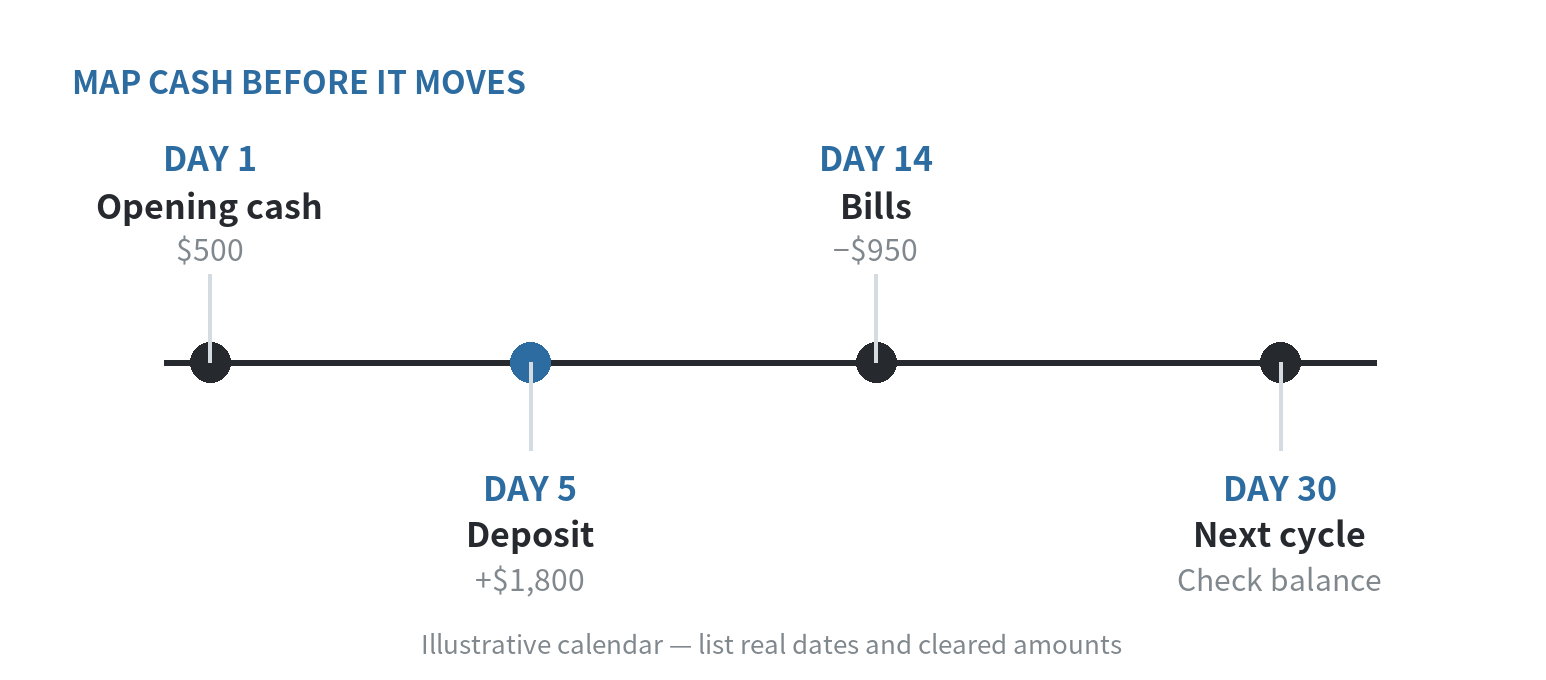
Say the month opens with $500, a $1,800 deposit arrives on the 5th, and $1,200 rent is due on the 1st. The rent cannot be funded by money that arrives four days later; the opening balance is short by $700 before that deposit. Mark that gap in advance. You might ask the landlord or biller whether a different due date is available, shift flexible spending, or draw on a buffer built in earlier months. Do not enter a hoped-for payment as though it were already in checking.
If one bill date causes the shortfall, ask the company whether it can move the due date and record the confirmed date. The CFPB describes asking creditors about due-date changes as one possible cash-flow adjustment, checked September 30, 2026. A date change only helps if the new date lines up with funds you can count on.
Give each deposit an order of work
When a deposit clears, run it through the same sequence. First protect bills due before the next likely payment. Next fund food, transportation, and other essentials for that period. Then set aside money toward known periodic bills. If those jobs are covered, add to a cash buffer for future low-income weeks. Leave optional spending until you can see what remains.
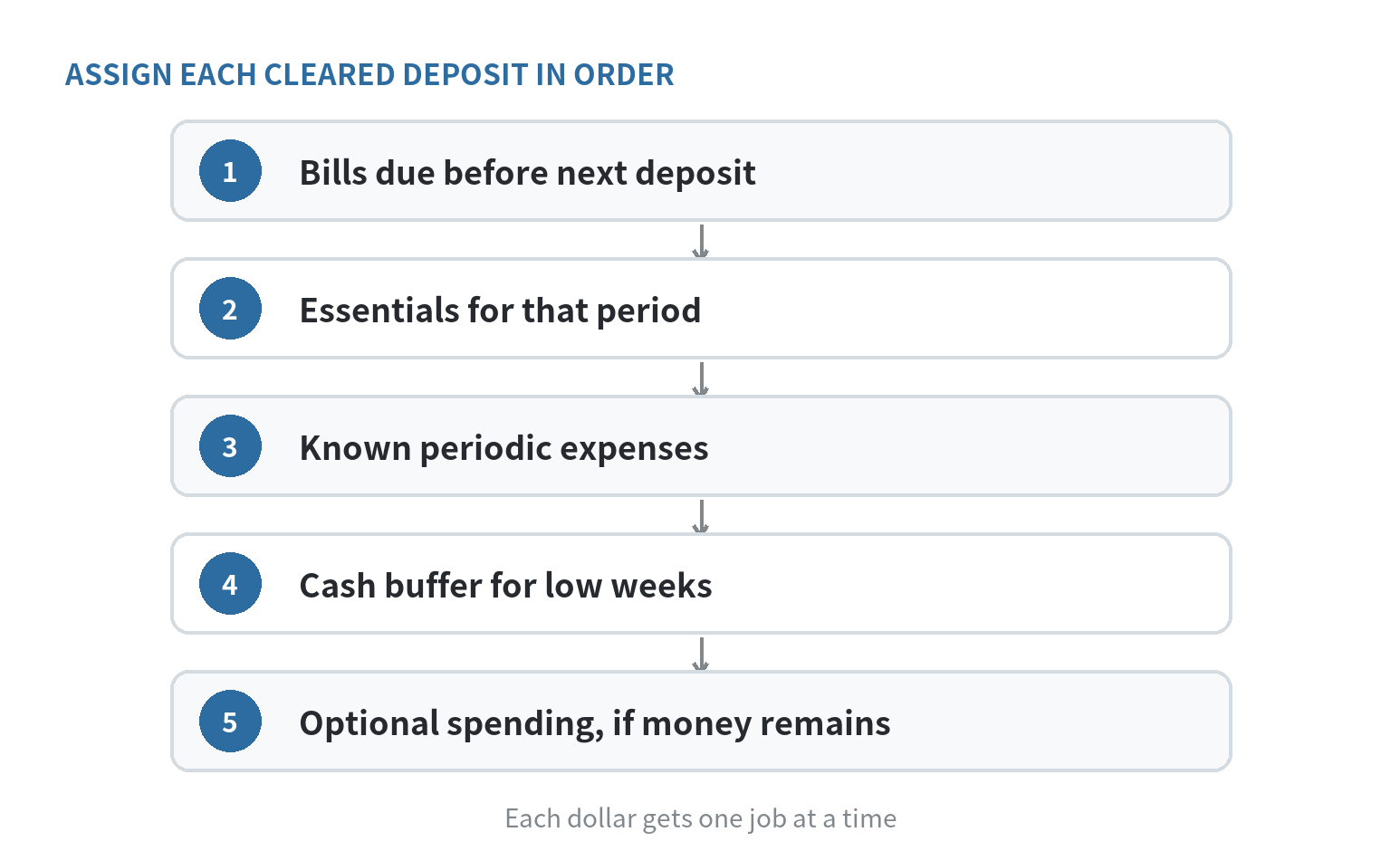
For instance, if a $900 payment clears and $600 is needed for bills before another deposit, reserve that $600 first. From the remaining $300, assign amounts to essentials and periodic bills based on your own list. If those categories use $220, the last $80 can go to the buffer or optional spending, depending on how much cash is already reserved for the next bill cycle. This is a sample allocation, not a recommended percentage.
For a related way to record transactions on a phone, see the simple phone budget tracker walkthrough. If you are deciding where a reserve belongs in your plan, the emergency-fund budgeting overview covers that adjacent task.
Keep high-income months from setting a false normal
Extra income can disappear quickly when it is treated as regular spending money. Before increasing a flexible category, check the next month’s essential bills and any upcoming annual or seasonal costs. If the money is still unassigned, strengthen the cash buffer or use it for a goal already in your budget. This helps smooth the calendar without assuming that next month will match this one.
Suppose a strong month brings $3,100 and the next month is projected at $1,800. If $300 of the strong month is not needed for its current bills, label that amount for a future gap instead of folding it into a permanent dining or entertainment limit. Keep that reserve separate in your records, even if you keep the money in the same checking account; a note or spreadsheet column can show which dollars are already spoken for.
A buffer is not the same as money available to spend. Track its starting amount, additions, and withdrawals. When it pays a bill during a slow month, record the bill and the buffer withdrawal together. Once income returns, refill the gap before treating the full deposit as available for wants. For other ways to plan monthly spending with a phone, see iPro’s monthly budget setup article.
Review the plan when money or dates change
Update the calendar whenever a deposit clears for a different amount, a client delays payment, or a bill changes. Replace estimates with actual amounts and recalculate the balance through the next deposit. At month-end, compare the plan with the transactions: note which essentials were higher, which expected deposits arrived late, and which periodic cost needs its own line next month.
If a deposit is late, pause optional spending and recalculate against money available now. Contact the biller before a due date if you cannot cover it, and ask about its available payment arrangements. Do not solve a timing gap by counting the same dollars twice—for example, assigning one deposit to rent and also to groceries before another deposit arrives.
The system is working when you can answer three questions from your calendar: what cash is available today, which bill comes next, and how much of the balance already has a job. When any answer changes, update the plan before spending from the new balance.
FAQ
Should I use gross pay or take-home pay for an irregular-income budget?
Use money available to spend after required withholding and planned set-asides. Gross pay includes amounts that will not reach your spending account, so it can overstate the cash available for bills.
What if a client pays after the bill due date?
Budget from the cash already available and flag the bill as a timing gap. Ask the biller whether it can move the due date or discuss an arrangement before the deadline; add a future buffer for recurring gaps.
How do I budget when one month has no income?
Use the cash-flow calendar to list the bills and essentials due during that month, then identify which available funds are already reserved for them. If the plan does not cover the total, contact billers and local assistance programs early rather than recording expected income as received.
How should I handle a seasonal expense that arrives once a year?
Write down its expected amount and due month, then reserve part of the amount from earlier deposits when cash allows. Keep that set-aside separate in your budget from everyday spending.
Last updated: 2026-09