For a planting bed, start with wood or bark mulch; for a surface where you want a longer-lasting cover and do not need the mulch to break down into soil, consider rubber.
Dyed bark or wood mulch adds color to a plant-based material, so check the bag label for the material and dye details.
The current mulch listings group products under wood and rubber, with bark, shredded pieces, nuggets, color, and straw as types or filters.
The catalog can narrow a search, but material is a better clue to how mulch behaves after spreading. Minnesota Extension classifies wood chips and shredded bark as organic mulch.
Utah State University Extension distinguishes decomposing organic mulch from longer-lasting inorganic cover. Both sources were checked October 6, 2026.
Read the material before the color
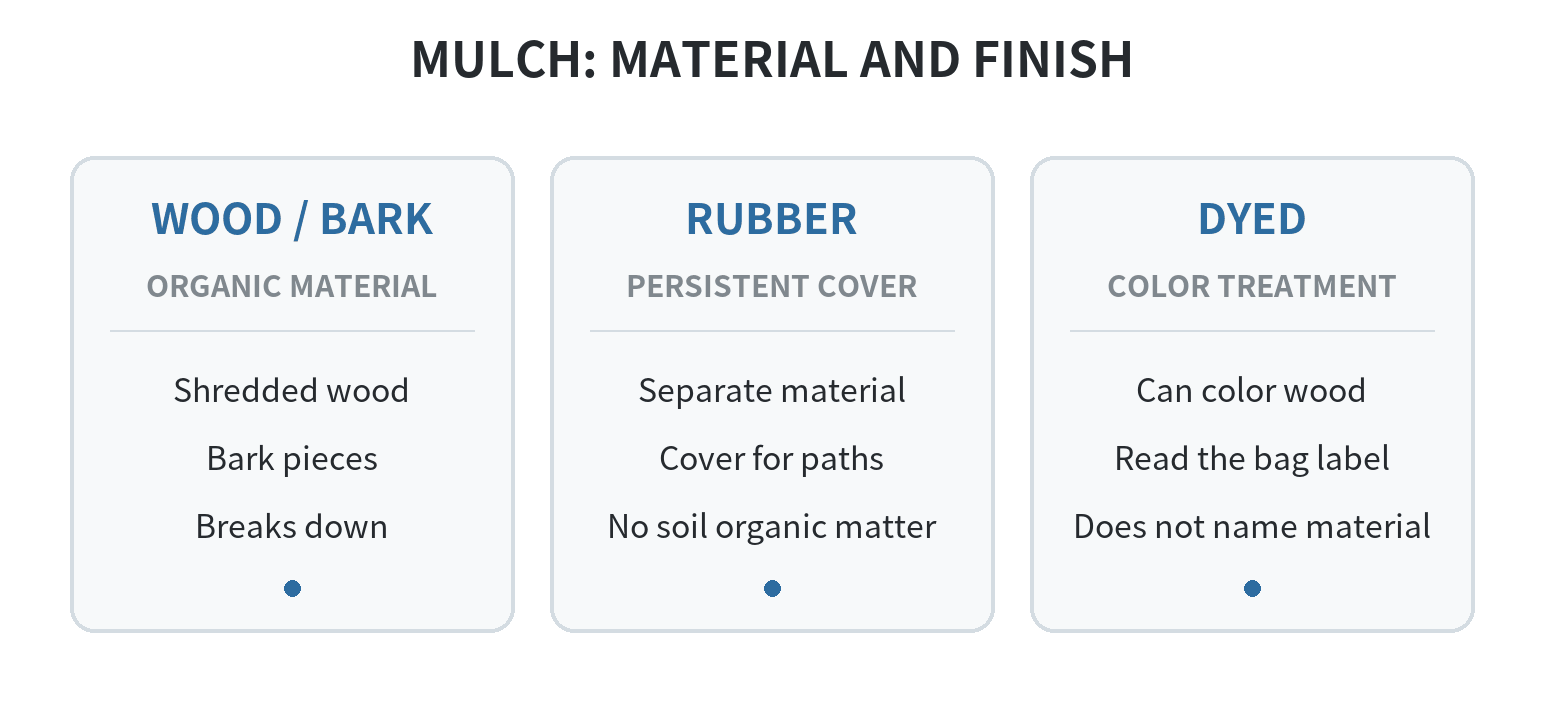
Wood and bark mulches are plant-based. As they decompose, they add organic matter to soil.
That makes them useful in beds where the surface material should become part of the soil over time.
University of Minnesota Extension describes wood chips and shredded bark as organic mulch that decomposes (checked October 6, 2026).
“Wood mulch” can cover more than one texture. Shredded wood gives an even surface, while bark pieces and nuggets are chunkier.
The current garden catalog lists shredded and bark options, including mini nuggets. Choose the texture that fits the bed and check the package for its stated material.
The live selection can differ by location.
Rubber mulch is a different category from bark or wood mulch.
The garden guide describes rubber products for ground cover and paths, and notes that rubber does not improve soil as organic mulch does when it decomposes.
The University of Florida’s IFAS Extension classifies rubber mulch as inorganic and says it does not break down or provide nutrition back to soil.
That trade-off can make sense in a path or decorative strip where soil enrichment is not the goal.
For a growing bed, decide whether the lasting surface is worth giving up the organic matter that decomposing plant material adds.
Choose a use, then match the mulch
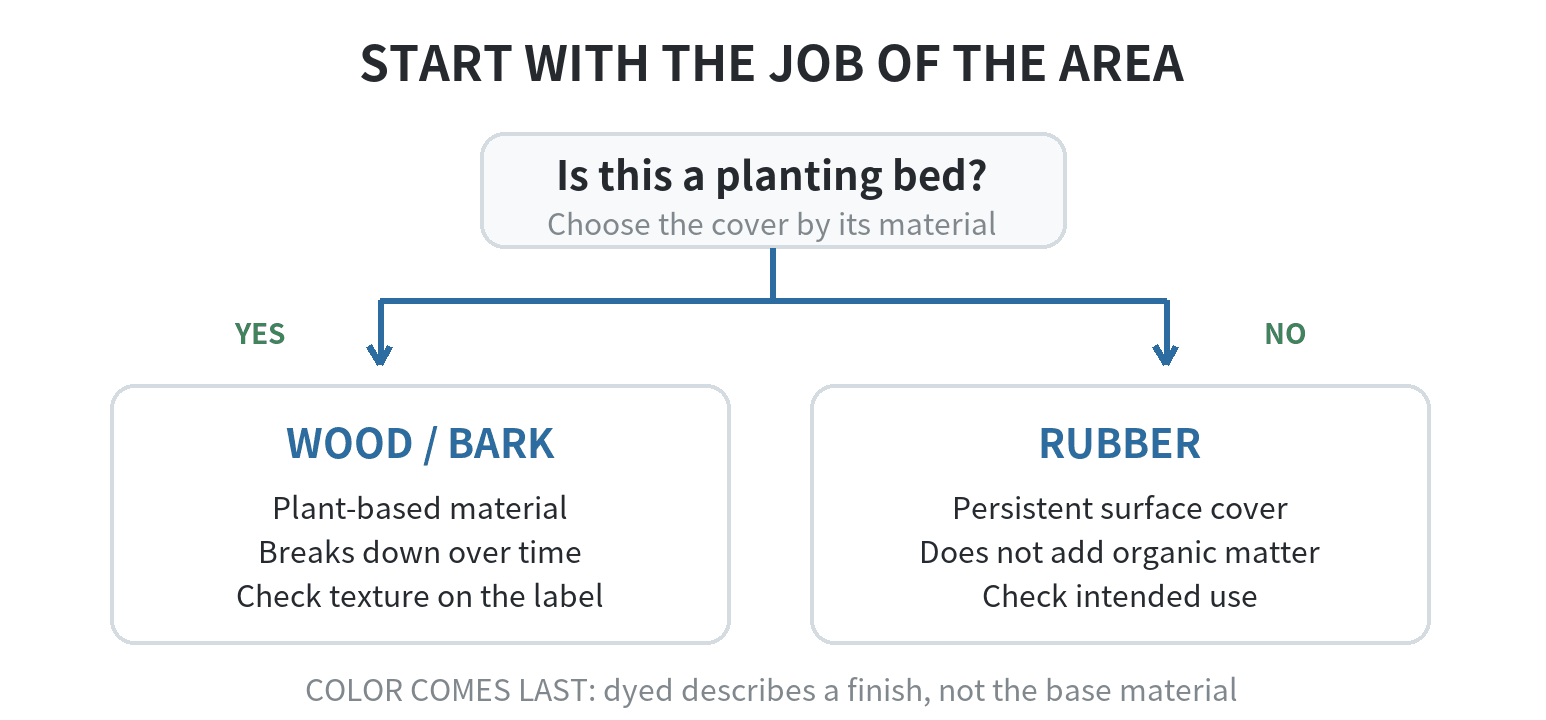
Begin with the job of the area. For a tree or shrub bed, wood chips or shredded bark fit the goal of adding organic matter as the material breaks down.
The Minnesota Extension’s mulching guidance names wood chips and shredded bark for trees, shrubs, and perennial beds (checked October 6, 2026).
Keep the mulch on the soil surface instead of mixing it into the bed; Utah State Extension distinguishes surface mulching from amending soil by incorporating organic matter.
For a walkway or strip where you want a steady-looking cover, compare the feel, shape, and installation directions on the package.
Rubber stays as a surface material instead of turning into soil organic matter through decomposition.
If the area is a play space, choose material labeled for that purpose and follow its instructions.
A general landscape mulch label does not establish that it meets a playground surfacing standard.
For a bed where color is the deciding factor, dyed wood keeps the underlying material in the wood-mulch family.
The catalog lists black, brown, and red mulch colors, and its garden guide describes colored wood mulch.
Iowa State University Extension also describes some bark and wood mulches as colored or dyed for decorative use (checked October 6, 2026).
Color does not tell you whether the contents are shredded wood, bark, or rubber.
Read the material description and dye details on the package, especially if the bed is used for growing edible plants.
Here is a quick way to narrow the choice: ask whether you want the mulch to decompose into the soil, whether the area is a planting bed or a path, and whether color is a requirement.
If the first answer is yes and it is a bed, compare wood or bark. If you want a persistent cover away from a growing bed, compare rubber.
If color matters, choose a finish only after confirming the material underneath it.
Check the label for the details a category cannot answer
A broad category name will not answer every question about a bag. Look for the material description, texture, color treatment, and any stated use.
If the listing says “colored mulch” without making the contents clear, open the product details or inspect the bag label before deciding.
The catalog separates bagged mulch from bulk mulch and lists filters for material, color, texture, and product form.
Use those filters to narrow the options, then read the individual listing for its exact contents and stated use.
Two brown products can be made from different materials and behave differently once used in a bed.
For dyed wood products, the garden guide advises checking the bag specifications for the dye used.
It also notes that color from newly spread dyed mulch may seep onto nearby hard surfaces when heavily watered at first.
If the bed borders a pale walkway or concrete, plan the spreading and initial watering around the product’s label and the guide’s care notes.
That is a surface-staining concern, not a reason to assume all colored mulch has the same ingredients.
For wood mulch, check whether the package describes shredded wood, bark, or nuggets.
Minnesota Extension classifies wood chips and shredded bark as organic material that decomposes. Utah State Extension says organic mulch needs replenishing as it decomposes.
The label helps set expectations: plant-based mulch changes over time, while rubber is a longer-lived cover without the soil contribution of decomposing material.
Estimate coverage without guessing
Measure the length and width of each bed in feet and multiply them to get its area in square feet.
Choose the depth based on the product directions and the plants in the bed, then convert that plan into volume: area multiplied by depth in feet equals cubic feet.
Example: a 10-by-12-foot bed is 120 square feet; a 2-inch layer takes 20 cubic feet. The garden guide uses area and depth to estimate volume.
This is a calculation example, not a recommendation for every plant or material.
The garden guide suggests a 2-to-4-inch layer, with separate advice for dense materials and coarse bark. Utah State University Extension also varies depth by texture.
Check the product directions and the plants in the bed. Do not treat one depth as universal.
Minnesota Extension recommends leaving a 6-inch mulch-free ring around tree trunks (checked October 6, 2026). Keep mulch away from stems and trunks.
To estimate bag count, divide the needed cubic feet by the volume printed on the bag, then round up to a whole bag.
If the package lists coverage in square feet instead, confirm the depth used for that coverage before comparing it with your measurements.
A bag’s advertised area can look larger or smaller simply because the stated layer depth differs.
If your bed includes path lights, the site’s outdoor lighting overview can help with the layout around the bed.
For surrounding lawn work, see the site’s lawn-care tools overview.
For a planting bed, the practical starting point is wood or bark, with texture and package details deciding the final choice.
Reserve rubber for areas where a lasting ground cover matters more than adding organic matter, and treat dyed as a color variation whose label still needs checking.
The work becomes easier when the material, use, and coverage are clear before spreading begins.
Last updated: 2026-10
FAQ
Can I use colored mulch in an edible garden bed?
Check the material source and the product’s stated ingredients before choosing it.
Some wood-chip products come from lumber or pallets, Iowa State University Extension says (checked October 6, 2026).
Does rubber mulch stay unchanged permanently outdoors?
No. The garden guide says rubber mulch is not fade-proof and can change color and composition when exposed to the elements (checked October 6, 2026).
Should fine mulch and chunky bark be spread at the same depth?
No.
Utah State University Extension varies its guidance by texture: it gives one depth range for fine, dense material and another for coarse, fluffy mulch (checked October 6, 2026).
Follow the specific product directions and plant guidance for the bed.
What should I look for if mulch will go beside a concrete walk?
Wait before watering newly spread colored mulch beside concrete.
The garden guide recommends planning for dry weather for 24 to 48 hours after spreading to reduce the chance of dye seeping onto nearby hard surfaces (checked October 6, 2026).