If your bills land before your next paycheck, plan around the dates money actually arrives, then move or split bills where the company allows it. A monthly budget can balance on paper and still leave your checking account short for a week. Put every payday and bill on one calendar, assign each paycheck a job, and ask billers about changes before relying on them.
Map the pinch point before changing anything
Start with your last statements, pay stubs, and bank activity. Record each take-home deposit date, each bill’s due date, its usual amount, and how you pay it. Include rent, utilities, insurance, loan payments, subscriptions, and any bill that changes month to month. Use the amount currently due when it varies; a low estimate can make a crowded week look affordable when it is not.
Then arrange the entries by date, not by category. The Consumer Financial Protection Bureau’s bill calendar uses this approach: list what each bill is for, its amount, and its due date, then compare the schedule with income. Checked September 30, 2026, the Bureau’s due-date worksheet also asks readers to map weekly inflows and outflows before requesting a change.
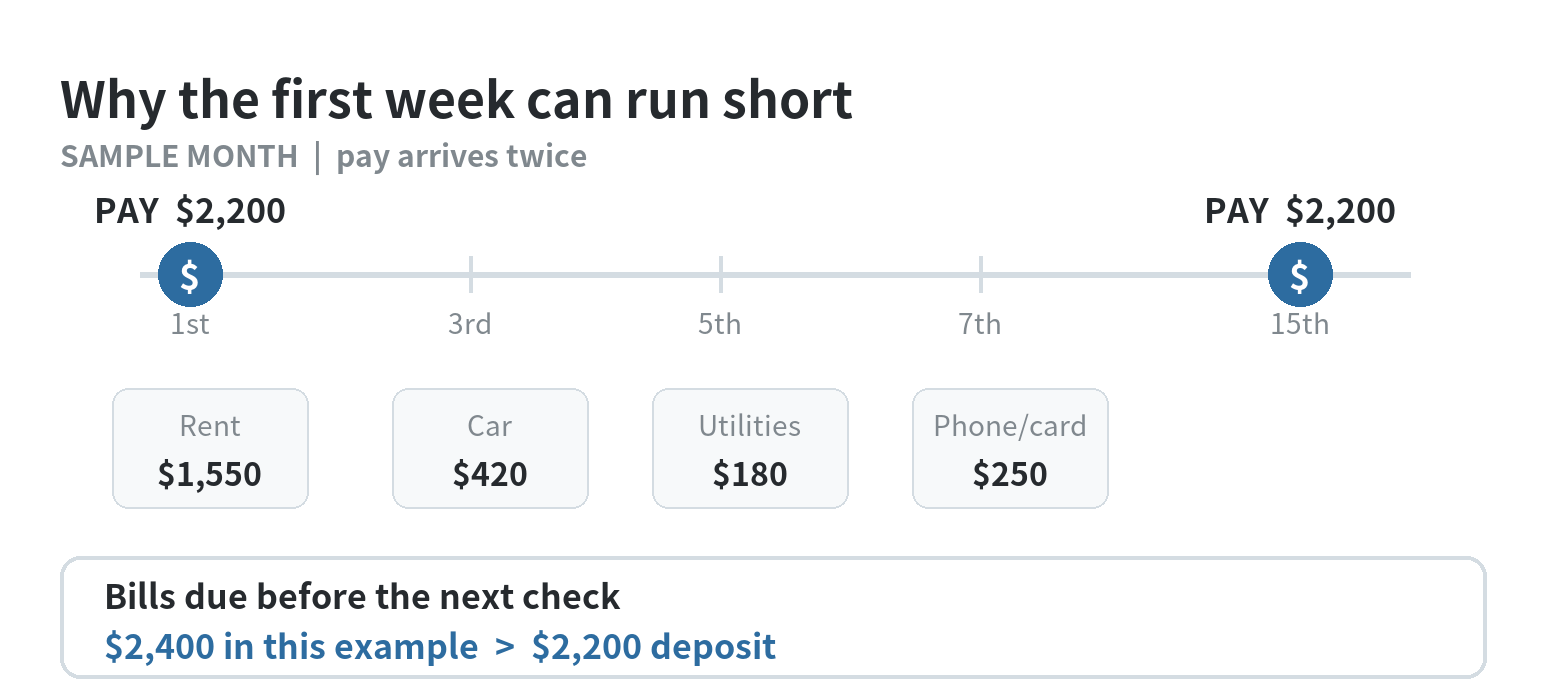
For example, picture take-home pay of $4,400 a month, arriving as two $2,200 deposits on the 1st and 15th. Rent of $1,550, a $420 car payment, $180 in utilities, a $90 phone bill, and a $160 card payment are all due from the 1st through the 7th. That early group totals $2,400, more than the first deposit. The monthly total is not the immediate problem; the dates are.
Use your own cleared deposit dates, not the date printed on a work schedule. If the deposit date shifts for a weekend or holiday, mark the date the money is available in your account. Keep variable bills as ranges or use the latest statement amount, and mark an annual or quarterly bill in the month it is actually due.
Give each paycheck a bill list
Make two columns for a twice-monthly schedule, or one column per actual payday if your pay cycle differs. Assign each bill to the paycheck that arrives before its due date. Add everyday spending and the amount you need to carry into the following pay period; the full paycheck cannot be promised to bills if groceries, fuel, and other basics still come from it.
| Sample deposit | First bills to cover | Amount assigned |
|---|---|---|
| 1st: $2,200 | Rent $1,550; car $420; utilities $180; phone $90; card $160 | $2,400 |
| 15th: $2,200 | Insurance $260; loan $210; internet $70 | $540 |
This first pass exposes the problem: the early bills exceed the first deposit by $200, even though the later check has room after its scheduled bills. The listed monthly bills total $2,940, leaving $1,460 from the $4,400 take-home amount before food and other spending. The table is a sample, not a spending target. Replace every amount and date with yours, then total essentials and scheduled bills for each interval. If a column exceeds the deposit plus money already set aside, solve that shortfall before adding optional spending.
Keep a separate “next due” note for bills that fall just before payday. Money set aside from an earlier check can cover that gap. If you are building that cushion from zero, choose a small amount that fits after essentials and add to it each payday; it may take more than one cycle. Avoid counting the same dollars both as a bill reserve and as money available for daily spending.
If you prefer to keep the calendar and running totals on your phone, see our guide to building a simple budget tracker and use a bills-due column beside the spending entries.
Ask for a date that fits your cash flow
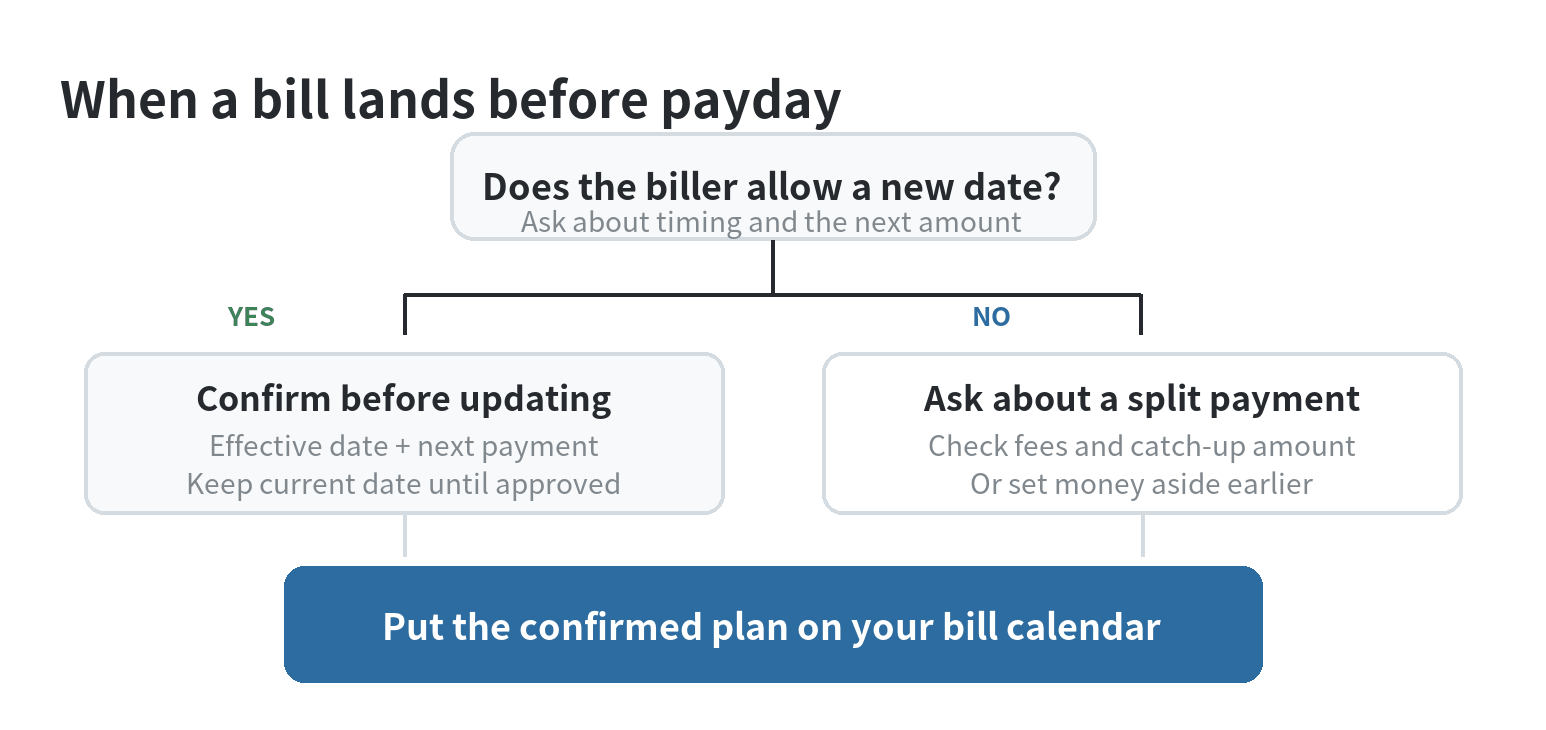
Contact the biller for the dates that create the tightest gap. Ask whether the due date can move, what date is available, when the change takes effect, and what the next payment amount and due date will be. The CFPB’s worksheet says not every company allows a change and warns that the first bill after a later date may be higher. Checked September 30, 2026, its instructions recommend confirming those transition details before you plan around the new date.
Pick a date after a deposit has cleared and leave a little time for processing. A requested date is not the same as an approved change: keep paying under the current schedule until the biller confirms the new one. If a date cannot move, ask whether the company accepts two partial payments on agreed dates. The CFPB lists splitting a large payment as a possible cash-flow option, but the biller has to agree.
For a credit card, the CFPB’s Regulation Z page says a card issuer may honor a due-date change request; it also describes the monthly due-date rule for card statements. That rule does not promise a particular requested date or apply to every kind of bill. Ask the issuer how a change affects the next statement and check the statement when it arrives.
When the dates cannot move
Use earlier paychecks to fund the bill cluster gradually. If $2,400 is due in the first week, divide that upcoming total across the checks before that week and move each share into a bill-only balance. In the sample, two earlier deposits could each contribute $1,200 toward the next month’s cluster; use a different split if your pay frequency or expenses call for it. This requires planning ahead, because the first month may not have enough cash to create the reserve immediately.
Another option is to ask whether a large payment can be split, or whether the provider offers a different billing cycle. Before agreeing, ask whether the arrangement adds fees, changes the next amount, or creates a larger catch-up payment. Write the answer and effective date beside the bill entry, then update your calendar once the change is confirmed.
Automatic payments need their own timing check. The CFPB explains that a company can debit an authorized payment from checking, so compare the scheduled date with the balance available then; checked September 30, 2026. Leave manual reminders for bills you pay yourself. If the dates still leave you short, contact the biller before the due date and ask what options apply to your account. Do not build the plan around an unconfirmed extension.
Review the calendar when the month changes
At the start of each month, check the next few weeks rather than copying the prior month blindly. Update variable bills from current statements, add one-time expenses, and verify any approved due-date change. The Federal Trade Commission’s consumer.gov budget guide likewise recommends gathering bills and pay stubs, listing monthly amounts, and using the month’s spending to plan the next one; checked September 30, 2026. Our monthly budgeting overview covers tracking categories after the bill schedule is set.
A simple review takes three passes: confirm deposits, cover bills due before the next deposit, then decide what remains for ordinary spending and savings. If the first pass is short, the calendar has done its job: it shows the exact week and amount that need attention. You can then request a date change, agree on a split payment, or reserve money earlier instead of discovering the mismatch when a payment is due.
FAQ
Should I use my credit card to bridge a bill-date gap?
Only use a payment method you can manage under its own due date and terms. A card can move when cash leaves checking, but it does not erase the bill; add the card payment to the same calendar and review the statement amount.
What if I am paid every other week instead of twice a month?
Build the calendar from the actual paydays on your pay stub. A biweekly schedule will not land on the same dates each month, so assign bills to the deposit that comes before each due date and check the next month separately.
Can I split rent into two payments?
Ask your landlord or property manager whether they will accept two agreed payment dates and whether the arrangement changes any fee or due-date terms. Do not assume that a split is accepted until you have confirmation.
How should I handle a bill whose amount changes each month?
Use the latest statement or a cautious amount based on your own recent bills, then replace it when the new statement arrives. Keep the payment date on the calendar even when the amount is not final.
Last updated: 2026-09