
Budget for kids’ sports fees from the full season cost, not just registration.
Ask for written required and optional charges. Add the costs your family will cover, then divide the unfunded amount by the paydays before each bill is due.
Aspen Institute Project Play’s youth-sports spending analysis includes registration, travel and lodging, camps, and private instruction.
Little League’s parent guide says Tee Ball registration fees vary by local league and describes costs the fee may help cover.
Both sources were checked October 1, 2026.
Ask for the season total before setting a target
Request the fee schedule for the exact team, age group, season, and location.
A program page may show registration alone. Ask what else is required.
Check whether the quote includes uniforms, league fees, facility charges, event entry, and required equipment.
Get each amount and due date in writing.
A short message can ask: “Could you send the full required cost through the last scheduled game, with due dates?”
Then ask the organization to list optional events separately and say what equipment it provides.
Ask whether it offers installments, refunds, or financial assistance, and what terms apply.
Little League’s parent guide applies to its Tee Ball program.
It says local registration fees vary and names uniforms, equipment, and field maintenance among operating costs.
It also lists gear parents may need to provide. Ask your child’s own organization what its fee covers.
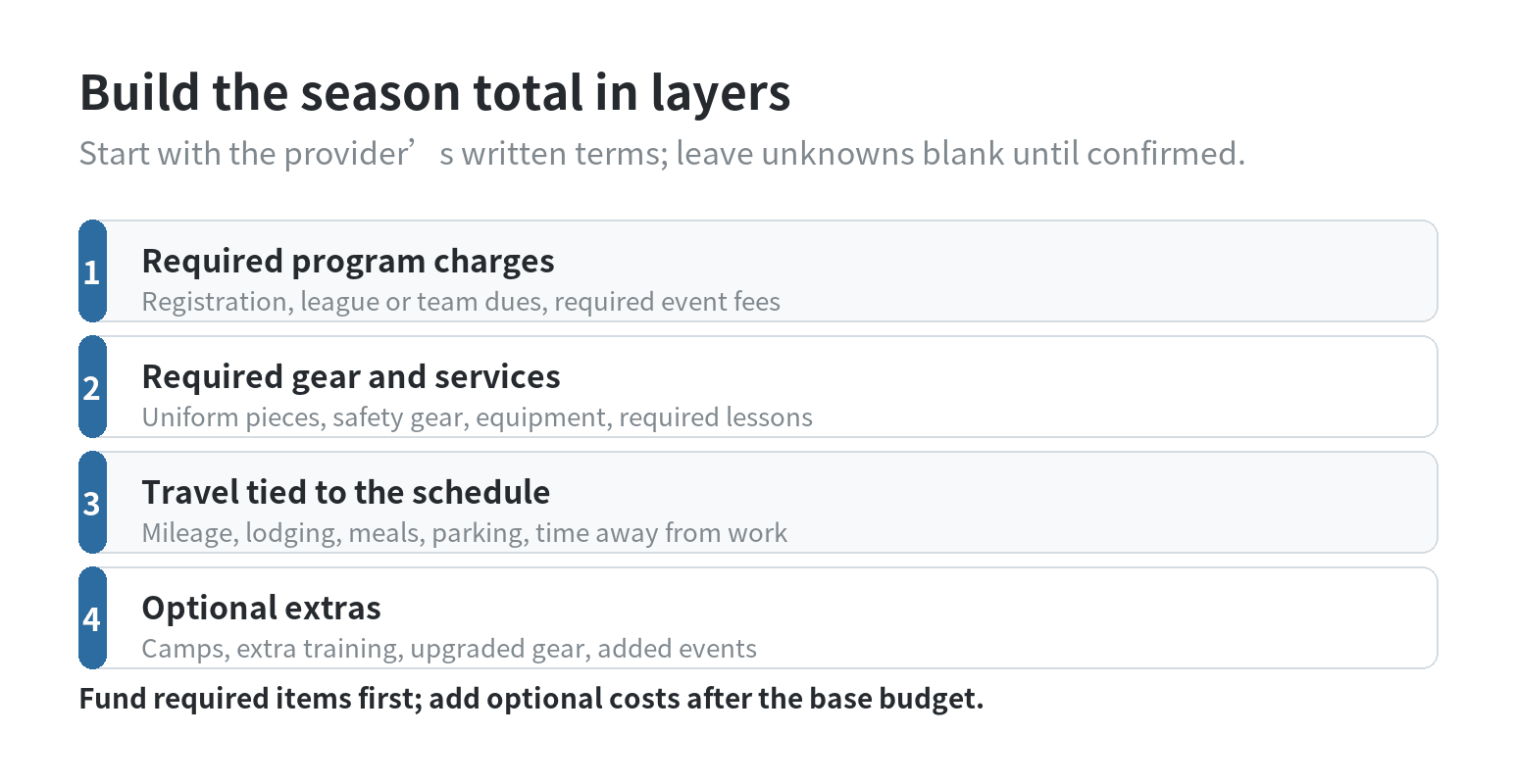
Separate charges that land on different dates
Put each confirmed charge on its own line so registration does not hide the rest of the season’s costs.
Record the amount, due date, and whether the item is required.
- Program charges: registration, team or league dues, and required tournament or event fees.
- Gear and services: uniforms, shoes, protective equipment, replacements, or required lessons.
- Travel: driving, lodging, meals, parking, and childcare tied to away games.
- Optional extras: camps, added coaching, upgraded gear, and events the family can decline.
Ask what the organization supplies and what your child must bring.
If siblings can share gear, record only the purchase you need to make.
If equipment is outgrown or needs replacing, give that cost its own estimate.
For travel, use the schedule you have. Count listed trips and estimate miles to each venue.
Check your own vehicle or transit costs. Leave lodging and meals blank until you have a usable estimate.
Do not treat an unconfirmed guess as a quote.
For an overnight trip, list the dates and expected nights separately from driving costs.
Do not count meals, parking, or childcare unless they apply to your trip plan.
If another adult may drive, agree on how fuel or lodging will be split before the reservation.
Keep optional travel plans outside the required total until your family decides to attend.
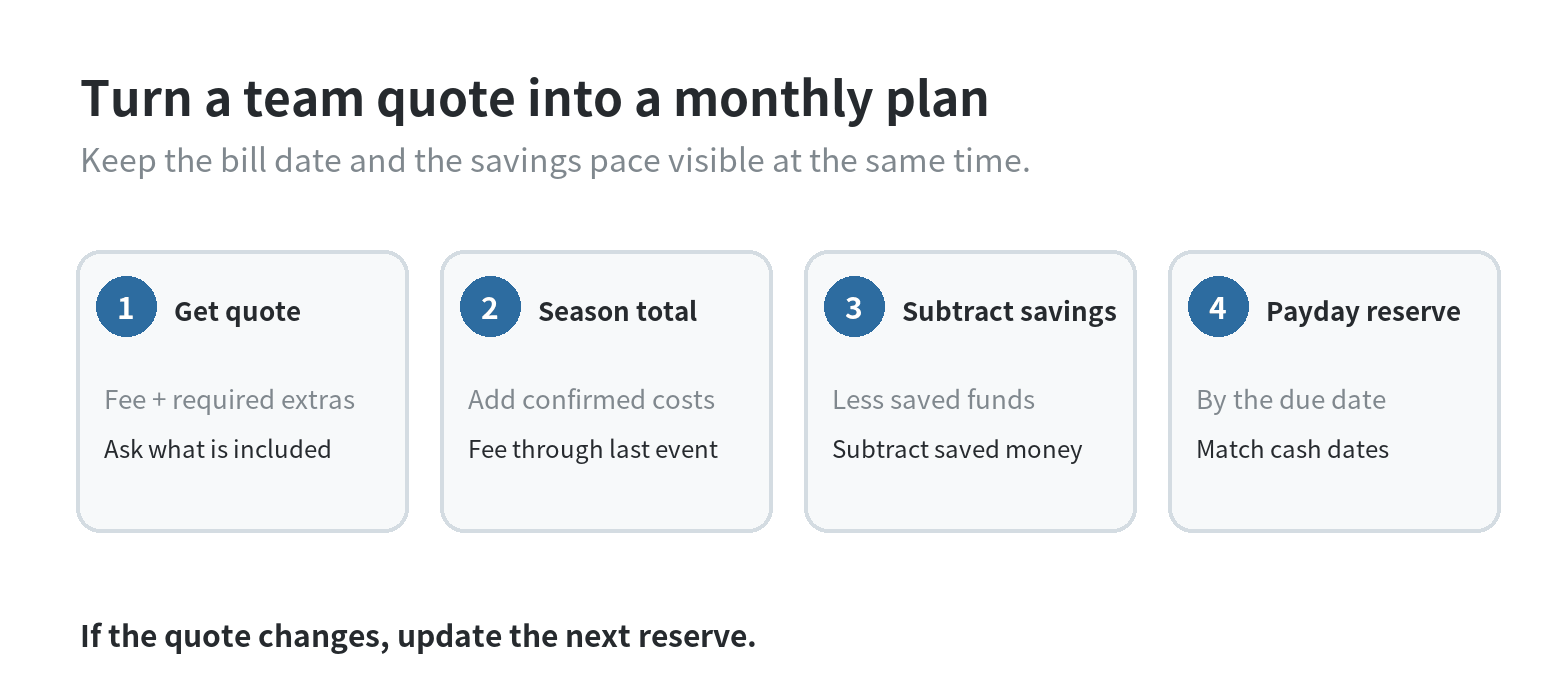
Turn a season quote into a paycheck amount
For a bill due before the season, use this calculation:
(Confirmed season costs − money already set aside) ÷ paydays remaining before the bill = amount to reserve from each payday.
Here is a fictional example of the calculation.
A family gets a written quote of $840 for team charges and required gear.
Its own trip plan adds $180 for travel, bringing the working total to $1,020.
The family has $220 reserved and four paydays before the first large payment.
The remaining $800 works out to $200 from each payday.
That $200 is a planning amount based on the example’s assumptions.
If the team adds an event or travel changes, update the total and recalculate from the next payday.
Keep program charges and travel in separate savings categories if that makes each bill easier to track.
For another fictional example, a $600 balance is due in three months, with six paydays before the deadline.
Setting aside $100 per payday covers that example balance by the due date.
If a check is already committed to rent or utilities, write down which later check will carry a larger share.
This keeps the same dollars from being assigned to two bills.
For a year-round view, list each sport’s confirmed season total and due date.
Add the amounts expected in the same budget year.
Divide an annual charge by twelve only if you have twelve months before it is due and can keep that money reserved.
A season that starts soon needs a catch-up plan based on the paydays remaining.
Keep the provider’s due amount separate from your reserve pace.
The reserve is money you are setting aside; it does not change the date the team expects payment.
If paychecks differ in size, write the planned amount beside each actual payday.
Use a smaller contribution from a check already assigned to essential bills, then identify where the balance will come from.
If the amount cannot be covered before the deadline, contact the organization before the due date.
When the season amount will not fit
Compare the due dates with cash available after housing, food, utilities, and other required bills.
If the first payment comes before enough paydays remain, ask whether the organization offers installments.
Also ask about scholarships, equipment lending, or a lower-cost program option.
Check eligibility, deadlines, and whether help applies to registration, gear, or travel.
Keep the answer in writing and replace your estimate with the confirmed terms.
If assistance is pending, leave it out of the available amount until confirmed.
Keep the full charge visible until the organization confirms what it will cover and when.
Ask whether equipment lending requires a deposit or return date.
For scholarships, record the application date and the expected decision date the program gives you.
If an answer arrives after a payment deadline, ask how to handle the bill while the request is pending.
A timing gap means the total fits your plan but arrives before enough paydays to reserve it.
Ask whether the due date or installment schedule can change.
A lasting shortfall means the season total crowds out required bills.
Before paying a nonrefundable amount, review optional events, the number of seasons, or another program.
Check the child’s calendar before adding a second sport.
Look for overlapping tournament dates, gear needs, and travel.
Write both schedules beside the household’s available contribution before adding another registration.
Then decide whether shared gear, carpools, or declining an optional event fits the plan.
If two adults share the sports expense, agree on each contribution and payment date.
Use the split and payment-date method in this shared-expense budget to keep the household’s arrangement clear.
If the season fee is billed by term, this lesson-fee example shows the reserve calculation for another child activity.
Review the number when the schedule changes
Save the original quote and enter each payment when it clears.
After a game or event, compare the plan with receipts for travel, gear, and fees.
Mark a one-time purchase as paid instead of carrying it into next season’s budget.
When registration opens again, start with the new written fee schedule.
Use last season’s records as a checklist, not as the new price.
Remove costs that will not recur and add confirmed changes.
Set the new reserve by counting backward from the first due date.
Keep a separate budget category for the seasonal bill and review its balance with other bills.
Track what is still due, what is already reserved, and the date the rest must be ready.
FAQ
Should sports fees come from an emergency fund?
A scheduled season fee is easier to track as a planned expense with its own reserve. Keep emergency savings for costs that are unexpected in your household rather than treating a known registration date as a surprise.
How should I budget if my child may play more than one sport?
Make a separate season estimate for each sport, then put each known registration and event date on one family calendar. Decide which seasons overlap before committing to optional costs.
What if a team asks for money before sharing the full fee list?
Ask which amount is due now, whether it is refundable, and what required charges may follow. Keep later costs marked unconfirmed until the organization provides them in writing.
How do I budget for equipment that may need replacing?
Use the equipment list from the coach or organization and check what your child already has. Put a replacement in the plan when you know the required item and have a current quote or price.
Last updated: October 2026
Last updated: 2026-10