Budget shared household expenses by agreeing on what counts as shared, choosing a split, and recording when money moves.
Start with take-home income and actual bills. Then check what each person has left for personal expenses.
An equal split is simple. An income-based split can make a large shared bill less lopsided.
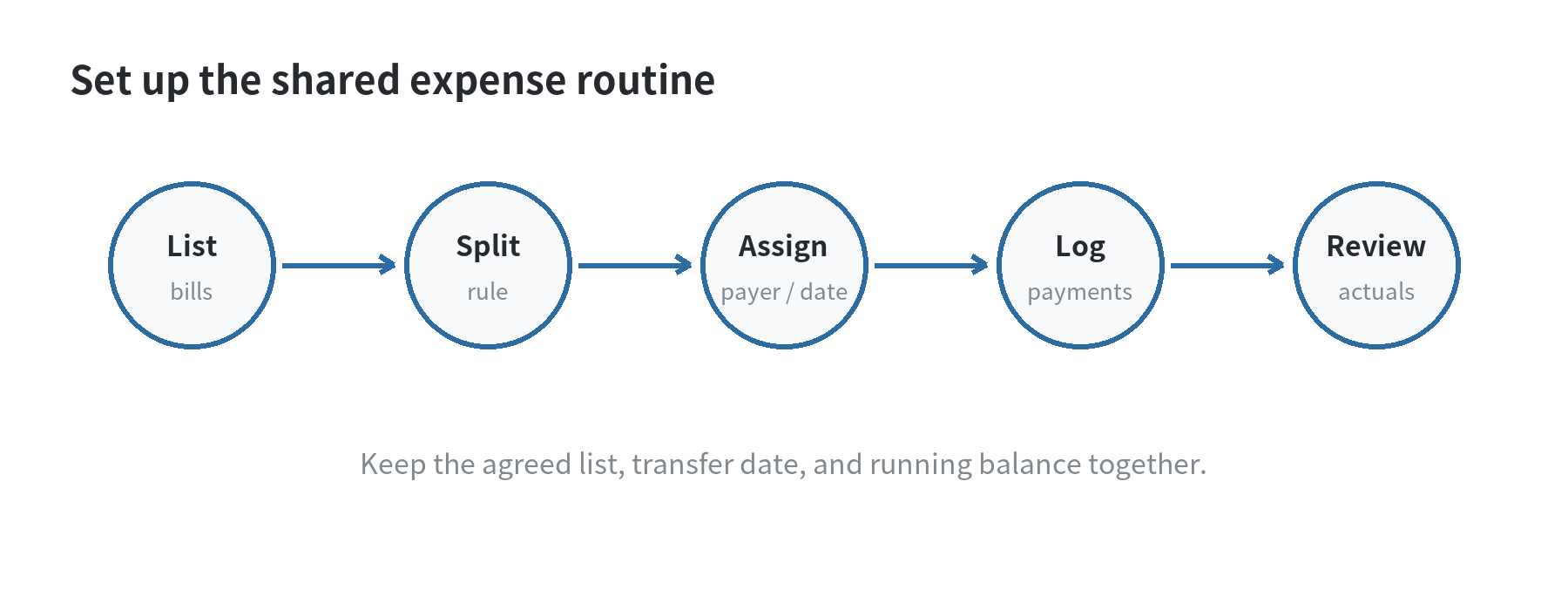
List expenses from statements and bills. Choose one contribution rule, then set a date to compare planned costs with what you paid.
The CFPB’s cash flow budget tool recommends tracking income, resources, and expenses. It carries each week’s ending balance into the next.
The Federal Trade Commission’s consumer.gov guide recommends recording spending and reviewing it for the next month.
Both sources were checked September 30, 2026.
Decide which bills belong to the household
Before dividing dollars, make a shared list and a separate personal list.
Rent, utilities, internet, shared groceries, and supplies might go on the shared list.
Personal phone plans, individual debt payments, clothing, hobbies, and separate meals can stay outside it.
The people in the home decide which costs they will cover together.
Use recent statements or receipts to enter real amounts.
Keep categories distinct. A grocery run for shared meals is different from one person’s takeout.
A utility bill is also different from a personal streaming subscription.
The FTC’s consumer.gov worksheet separates housing, food, transportation, personal expenses, debt payments, and savings. Checked September 30, 2026.
Use its categories as prompts. Your household decides which costs to share.
| Shared line | What to put in the monthly amount | Boundary to settle |
|---|---|---|
| Housing | Rent or mortgage amount the household has agreed to cover | Decide whether renter’s insurance or fees belong here |
| Utilities and internet | Recent bills, with seasonal changes noted | List service accounts and bill due dates |
| Food and supplies | Shared grocery and household purchases | Mark personal purchases separately |
| Transportation or care | Only costs the household has explicitly agreed to share | Agree on a use-based amount or leave it personal |
Choose a split rule before the first transfer
There are three practical starting points.
An equal split gives each adult the same dollar amount. An income-proportional split follows each person’s share of take-home income.
A use-based split assigns a cost to the people who use or benefit from it.
A room-specific service or a vehicle used by one person could fit this method.
A household can combine rules by category. Write down which rule applies to each line.
An equal split is easy to calculate. The same payment takes a larger portion of a lower income.
Income proportions account for that difference and still cover the shared bill total.
Use-based splits can fit uneven usage, but need clear records and an agreed definition of use.
Choose a method both people can explain and repeat without renegotiating each receipt.
Run the numbers with your own take-home pay
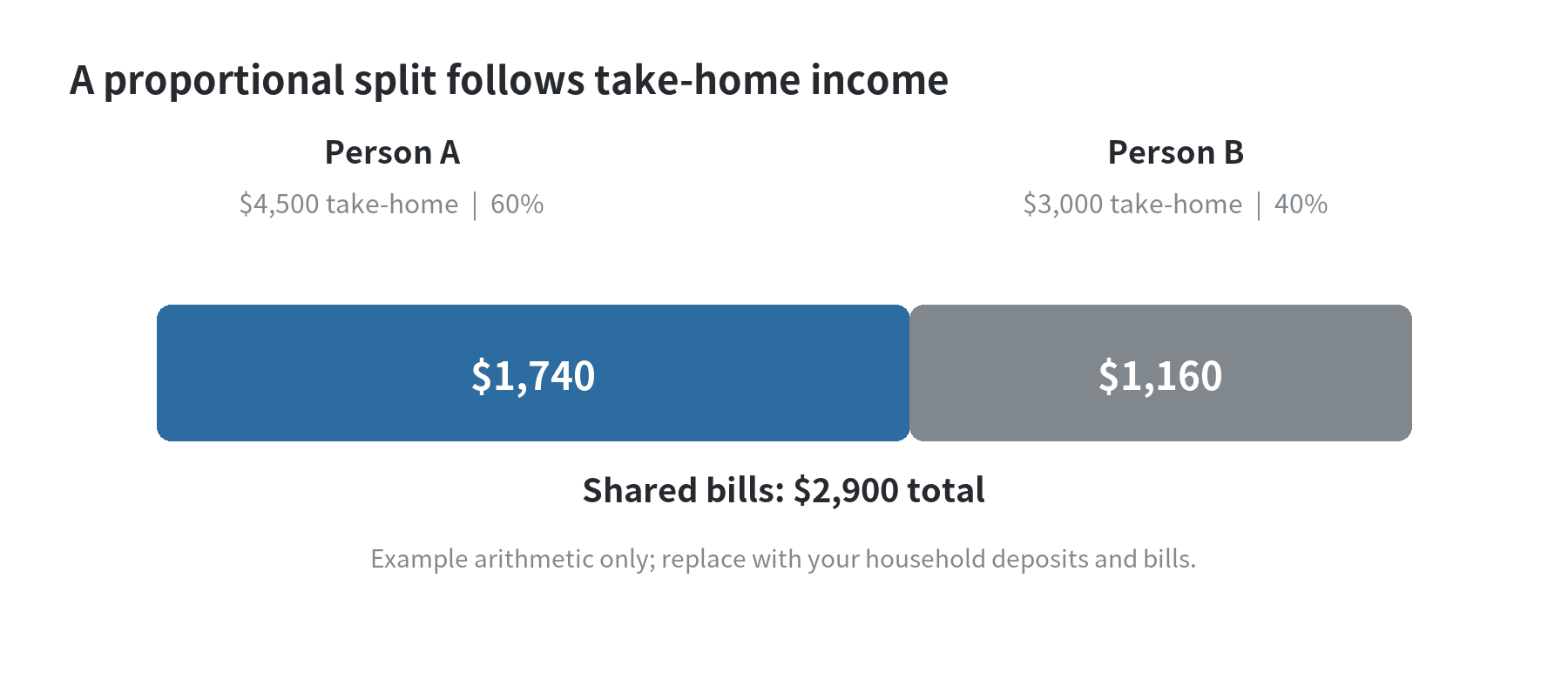
Imagine one person brings home $4,500 a month and the other brings home $3,000. Their combined take-home income is $7,500.
In this example, the first person earns 60% of that amount. The second earns 40%.
Suppose shared monthly bills are $1,800 for housing, $300 for utilities and internet, and $650 for groceries and supplies.
Add $150 for shared transportation. The shared total is $2,900.
| Method | Person with $4,500 take-home | Person with $3,000 take-home | Check |
|---|---|---|---|
| Equal | $1,450 | $1,450 | $2,900 total |
| Income-proportional | $1,740 (60%) | $1,160 (40%) | $2,900 total |
With the proportional split, the first person has $2,760 left before personal expenses. The second has $1,840.
With an equal split, those amounts would be $3,050 and $1,550.
These are arithmetic examples, not targets. Replace every income and bill with your own deposits and statements.
Then check whether each person can cover personal obligations and savings goals.
If one income changes, recalculate the proportions instead of leaving one person with the difference.
If the new payment crowds out an agreed personal obligation, revisit the shared list, split rule, or timing together.
Make irregular bills visible before they arrive
Monthly totals can hide timing problems. Put the bill amount and due date beside expected pay dates.
Note seasonal expenses, such as car insurance or heating. For an annual bill, divide it by the months left before it is due.
That calculation gives you a monthly planning amount. Keep it separate in the ledger, even if the cash stays in one account.
The CFPB’s Bill Calendar asks readers to record each bill’s amount and due date and check the calendar weekly.
Its cash flow tool moves one week’s ending balance into the next week’s starting balance. Checked September 30, 2026.
This timing view shows whether a contribution is due before the next paycheck arrives.
A monthly total can balance on paper while the account is short when rent clears.
When a utility amount changes, enter the bill received and update the next plan.
Before adding a repair or trip to shared spending, decide whether it belongs to everyone.
Don’t divide an unexpected charge after one person has already paid it without discussing it.
If someone’s work hours fall, pick a start date and recalculate from the next budget cycle.
Keep bills already paid under the old agreement.
If a bill is due before payday, agree who will cover it and when the other contribution will arrive.
Record that temporary arrangement beside the bill.
If the revised budget is short, decide together what to adjust.
You could pause a nonessential shared purchase, use money already set aside, or change another category.
Write down the decision so the shortfall is not charged to one person by default.
Choose a payment setup that leaves a clear record
A shared account is one option, but it is not required for a shared budget.
Separate accounts can work with a shared spreadsheet or ledger. Record the bill, payer, agreed share, transfer date, and settlement status.
If using a joint account, discuss access, alerts, overdraft handling, and how to handle a remaining balance if the arrangement changes.
Pick one person to enter each bill, or take turns by category. Save the bill or receipt with its entry.
If one person pays by card, record the full charge as paid by that person. Enter the other person’s contribution separately.
Do not count both the original bill and its reimbursement as new household spending.
For a phone-based log, see how to track expenses on your phone.
A budgeting app can display categories. The household still has to agree on boundaries and split rules.
The site’s overview of budgeting apps for managing money covers the tracking side.
When actual spending does not match the plan
Find the line that changed before adjusting every contribution.
A larger utility charge may call for a new planning amount.
A personal purchase on the shared card may need to move to that person’s own ledger.
If shared groceries ran over because the household added guests or bought a special meal, decide whether that was a one-time choice.
If the category now covers a different routine, update the shared amount for the next cycle.
For a bill that looks wrong, compare the statement with the previous month. Contact the provider using the information on the bill.
Keep the disputed amount visible in the ledger until the household agrees on how to handle it.
Change one category at a time when you can. That makes the next month’s review more useful because you can see which adjustment affected the total.
Use a short check-in to adjust the plan
At the start of the month, compare expected bills with the shared list. Log actual charges and reimbursements as they arrive.
At month-end, compare the planned total with the paid total. Carry forward any bill that has not arrived.
The FTC’s consumer.gov guide describes monthly planning, spending records, and review for the next plan. Checked September 30, 2026.
Keep the check-in focused on decisions. Was a category personal or shared? Did an amount change?
Does the split still fit the income picture? If the answer changes, write down the new rule and start date.
This gives both people the same plan and avoids treating an old receipt as a permanent precedent.
Bring the next conversation back to take-home income, shared bills, payment dates, and each person’s contribution.
Those records show what is funded and what still needs a decision.
FAQ
Should household contributions be based on gross pay or take-home pay?
Use take-home pay for a monthly spending plan because it is the deposit available for bills.
If pay varies, agree on a conservative amount from that person’s records. Revisit the share when income changes.
How should a household split groceries when people eat separately?
Separate shared staples and meals from individual snacks or meals.
Keep receipts or use separate checkout totals. Enter the agreed shared portion in the monthly ledger.
What if one person pays a shared bill on a credit card?
Record the purchase once under the shared category. Enter the reimbursement as settlement, not a second expense.
Agree whether the payer waits for reimbursement or pays the card from their own account.
Can roommates use the same approach as couples?
Yes. Roommates can list shared rent, utilities, and supplies, then set a split rule and record due dates.
Keep personal debt, individual subscriptions, and personal purchases outside the ledger unless everyone agrees otherwise.
Last updated: 2026-09