Choose the anchor locations and attachment method before settling on a shade sail. Each corner pulls on a support, and wind adds force to that system; a fabric label cannot tell you whether a wall, post, or footing can carry it. Then compare the fabric’s stated UV and shade ratings with the test method and color you are considering.
Start with the attachment points, not the sail dimensions
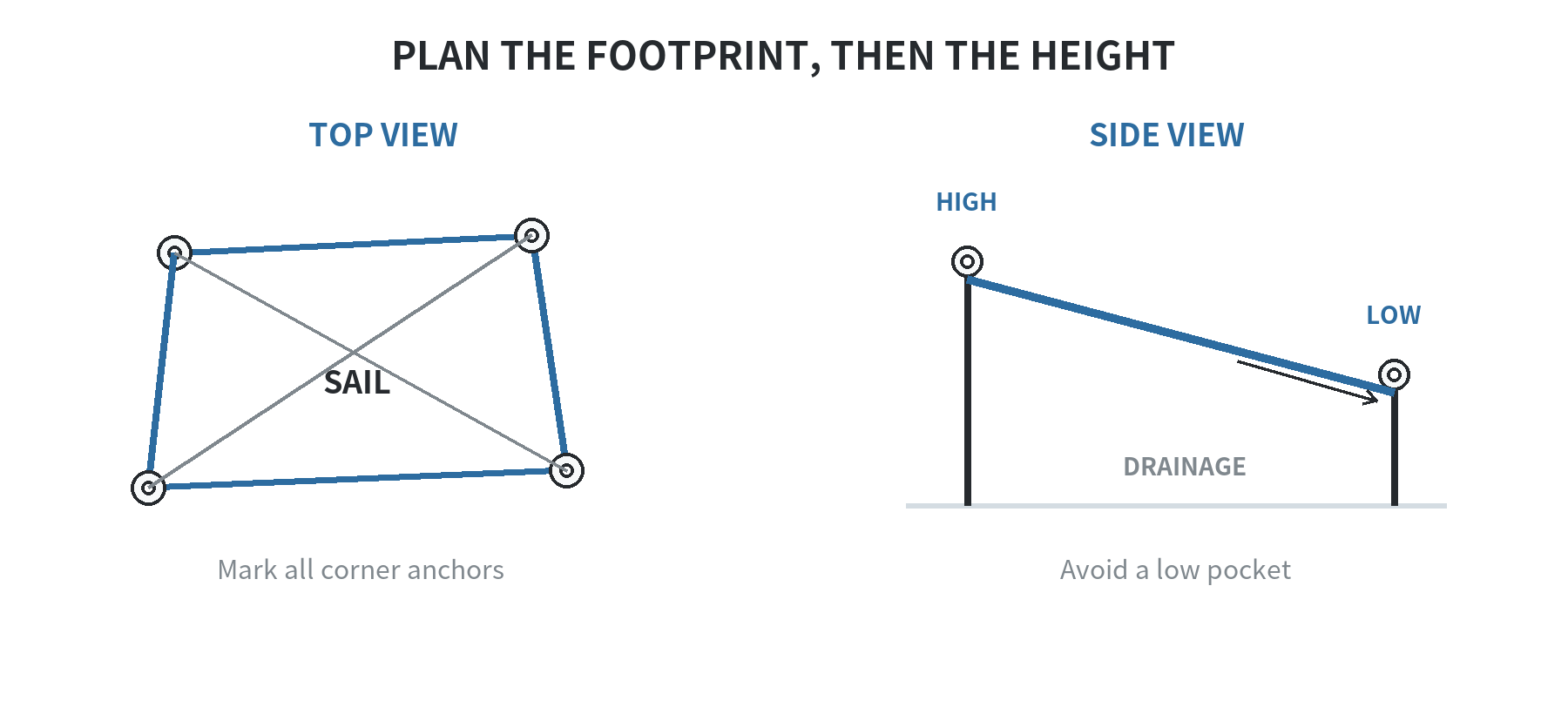
Walk the area and mark the places where a corner could connect. Include the wall or post, the ring or eye, and enough room for the connector and tensioning hardware. A sail has a curved edge, and the hardware occupies space beyond the corner. Measuring from the outside of a finished attachment eye gives a more useful span than measuring from siding to post center.
Sketch the usable area from above. Draw a straight line from the intended sail center through each corner ring to estimate where its support belongs. Shade Sails LLC’s measuring and installation guidance uses that center-to-corner line and recommends setting the attachment points before taking final measurements. Trivantage’s installation sequence likewise places design and attachment planning before final installation.
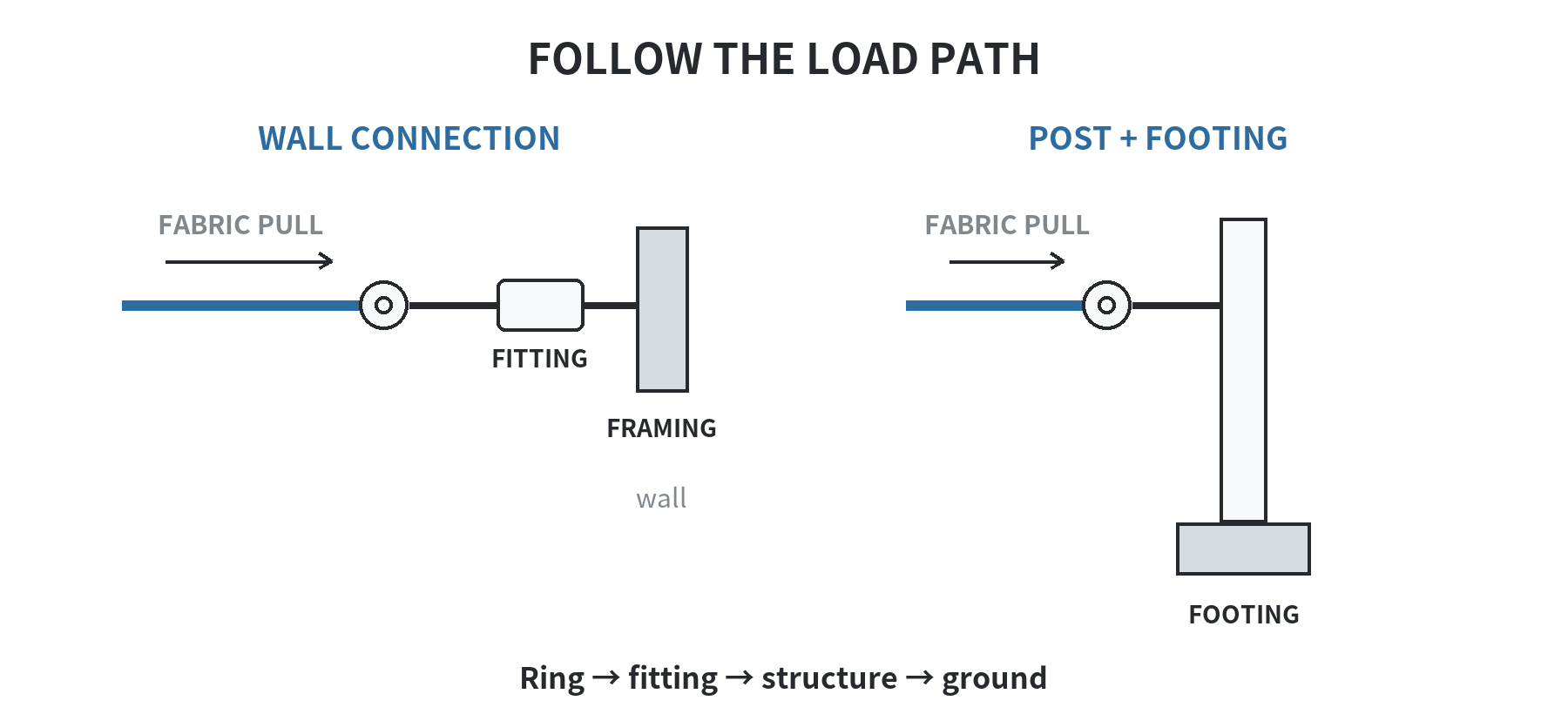
The anchor is a load path: fabric pulls on the corner ring, the connector transfers that pull to a bracket or eye, and the bracket transfers it into a structural member, post, and footing. A hook in thin siding, a gutter, or trim does not establish that the framing behind it can take the load. Shade Sails LLC warns against relying on fascia without reinforcement; Shade Space says to attach only to a structure designed for a tensioned sail. Trivantage’s technical guide describes the concentrated loads at connection points and recommends engineering the attachment points and supports.
That is why a hardware kit is not a structural design. A kit can supply compatible turnbuckles, shackles, or eyes, but it cannot confirm the condition of your wall framing, soil, post height, or local wind exposure. If a support would attach to a house, deck, masonry wall, or existing pergola, identify the structural member and have the connection checked before drilling. For new posts, the footing and post size depend on the span, height, sail size, and site conditions; use the sail maker’s instructions and a qualified local professional where the design is uncertain.
If the project includes a freestanding frame, the site’s pergola planning article covers footprint and post placement as a separate planning issue.
Use the shape and height to plan the footprint
A triangular sail needs three connection points; a four-sided sail needs four. Put the planned corners on your sketch, then check whether the shape actually shades the table, door, or seating area at the time of day you use it. The cloth and its hardware need clearance from roof edges, gutters, branches, and nearby structures so movement does not cause rubbing.
Height changes the shape as well as the appearance. For a four-corner sail, placing opposite corners at different heights can create a twisted, three-dimensional surface. Trivantage describes that form as a way to distribute tension through the fabric; Shade Sails LLC likewise recommends a high-and-low layout. Flat triangles and other flat sails need a slope so rain does not collect in a low pocket. Their published minimum slope recommendations differ, so use the model’s own instructions rather than treating one general diagram as a universal specification.
On paper, label the high and low supports and draw arrows showing where water should drain. Look for a basin in the middle, a low edge that directs runoff toward a doorway, or a corner that would sit against a wall. A mesh sail is not a solid waterproof roof: Tenshon and Trivantage describe water passing through knitted shade fabric. If you need a dry covered area, check whether the product is designed for that purpose instead of assuming a shade sail will keep rain out.
The site’s yard and patio lighting article can help you map fixtures and walking routes around the area, so the sail’s proposed posts do not land where a light, path, or door needs to be.
Tension the sail evenly, then inspect the connections
Use the attachment order in the exact sail’s manual. A turnbuckle changes the distance between a corner and its anchor, allowing adjustment; a shackle or ring joins hardware that must stay connected. The connector’s material and load rating need to suit the sail and exposure. Coolaroo’s shade-sail guidance says correct installation and tension at each anchor point matter, while Shade Sails LLC’s instructions call for pulling evenly at the corners.
Bring the sail into position gradually. Keep each corner aligned with its support, take up slack across the sail in stages, and watch whether tension is spreading evenly rather than pulling one point tight while the opposite edge hangs loose. Do not copy a tension number from an unrelated sail: manufacturers publish different products and methods, and a fitting’s capacity does not prove that the building or post is adequate.
Stop if a post bends, a bracket shifts, a fastener turns in its hole, a seam stretches, or a corner ring deforms. Those are signs that a connection or support needs attention. Do not try to correct a moving anchor by tightening harder. Have the support checked and follow the manufacturer’s procedure before loading it again.
Before each use season, look over the fabric, stitching, corner reinforcement, rings, turnbuckles, and anchor hardware. The FAQ from Shade Sails LLC says to check turnbuckles for proper tension and tighten when needed. Coolaroo advises removing its sails in severe storms or high winds; follow the instructions for your particular model and local weather conditions. A sail that can be removed should be taken down when its manual calls for it.
Read the fabric rating as a label with a method
Product descriptions may list UV block, shade factor, or both. They describe different properties: UV block is about ultraviolet radiation measured by a stated test, while shade factor describes visible light reduction. Neither number identifies the strength of the anchor system. Tenshon lists different UV blocking figures across its fabric colors, and Shade Sails LLC also says that color affects UV blocking and shade factor. Compare the exact color and fabric data sheet, not a headline maximum from a different fabric.
Ask what test method produced the percentage and whether the result is for the color and fabric in the product you are evaluating. ARPANSA says Australia’s AS 4174:2018 is used for knitted and woven shade fabrics and reports an Ultraviolet Effectiveness percentage. It also explains that AS/NZS 4399:2020 excludes shade fabrics and shade structures from its scope, so a clothing UPF label is not a substitute rating for a shade sail.
Read the rest of the fabric specification alongside the UV figure: fiber type, knit construction, edge reinforcement, stitching, and warranty scope. Tenshon describes its shade fabric as knitted HDPE mesh and notes that mesh openings allow some water through. A high UV percentage does not by itself establish waterproofing, wind suitability, fire classification, or expected service life. Each claim needs its own specification and test basis.
Before you decide on a fabric, keep a short record: product name, color, UV test method, shade factor if listed, whether water passes through, installation manual, and warranty coverage. If a listing provides only a percentage without identifying the tested material or method, ask the manufacturer for the data sheet and report. That leaves you comparing like with like instead of treating unrelated percentages as a single scale.
FAQ
Can I attach a shade sail to a deck railing?
Only if the railing and its connection to the deck are designed for the sail’s loads. A railing that is built to guide people is not automatically a suitable sail support; ask a qualified professional to assess the structure and attachment.
Does a higher UV-block percentage mean the area below will be darker?
Not necessarily. UV block and shade factor describe different measurements, and manufacturers report color-specific results. Compare both values for the exact fabric and color rather than inferring visible brightness from the UV figure alone.
Can I leave a shade sail installed through winter?
Check the instructions for your model and the expected conditions at your site. Some manufacturer guidance calls for removal in severe storms, high winds, or snow conditions; a seasonal fabric rating does not establish that the installed structure is designed for those loads.
What should I ask for when a listing gives only a UV percentage?
Request the fabric data sheet and the test method, including which color and material the result covers. Also ask separately about shade factor, water permeability, and the installation manual, since those properties are not established by a UV-block number.