You can build an emergency fund and pay down debt in one budget: cover essentials and required debt payments,
then split what remains between a starter reserve and extra payment on one chosen debt.
Adjust the split when your bills, income, or cash cushion changes.
The CFPB defines emergency savings as money for unplanned costs outside routine monthly spending,
and recommends setting a goal from costs you have faced.
The Federal Reserve also describes it as a buffer for income changes and unexpected costs. Both official sources were checked October 1, 2026.
Start with money already spoken for
Use take-home pay, not gross salary. List essential bills and required debt minimums with their due dates.
Review several months of statements for nonmonthly costs such as insurance, car maintenance, school expenses, or annual fees.
CFPB advises including less frequent expenses in your monthly picture (spending assessment, checked October 1, 2026).
Give those irregular costs a monthly line in your plan. If an annual bill is $600, divide it by 12 and set aside $50 per month;
this is planned-expense budgeting using the statement review CFPB describes (CFPB spending assessment). Keep it separate from emergency savings.
Otherwise, an annual renewal can look like a surprise even though its timing and amount were already on your calendar.
Next, compare the list with income that actually arrives.
The CFPB calls the timing of money coming in and going out cash flow; a budget can look balanced on paper while a bill comes due before payday.
Put due dates next to pay dates and identify the tightest point in the month.
Ask a creditor whether it can change a due date if moving it would make the schedule easier to manage.
The CFPB lists due-date changes as one way to adjust cash flow.
Make a short calendar that pairs each pay date with the bills due before the next deposit.
Put housing, utilities, food, transportation, insurance, and minimum debt payments on it first.
That view shows whether the problem is a true monthly shortfall or a timing gap between income and a due date.
If the total works but a payment lands before payday, ask the creditor whether the due date can move.
Then check the next cycle to see whether the change fits your other bills.
A different due date does not reduce the amount owed, so keep the payment in the plan.
CFPB’s cash-flow tool includes contacting creditors to change bill due dates.
For bills that arrive unevenly, reserve part of each paycheck in the planned-expense line.
When the bill arrives, pay it from that line and leave the emergency balance alone.
This keeps a predictable renewal or service bill from competing with an actual surprise.
Set a first reserve goal from your own risks
Pick a first savings goal based on a bill that would be difficult to handle from one paycheck: a car repair needed to keep commuting,
a home repair, or an uncovered expense. Use an amount from your own history, estimate only the part you might need to pay yourself,
and write down why that is your first milestone (CFPB emergency-fund guide).
You can later set a larger goal based on essential costs and income risks (CFPB emergency-fund guide).
Choose a split for the dollars left over
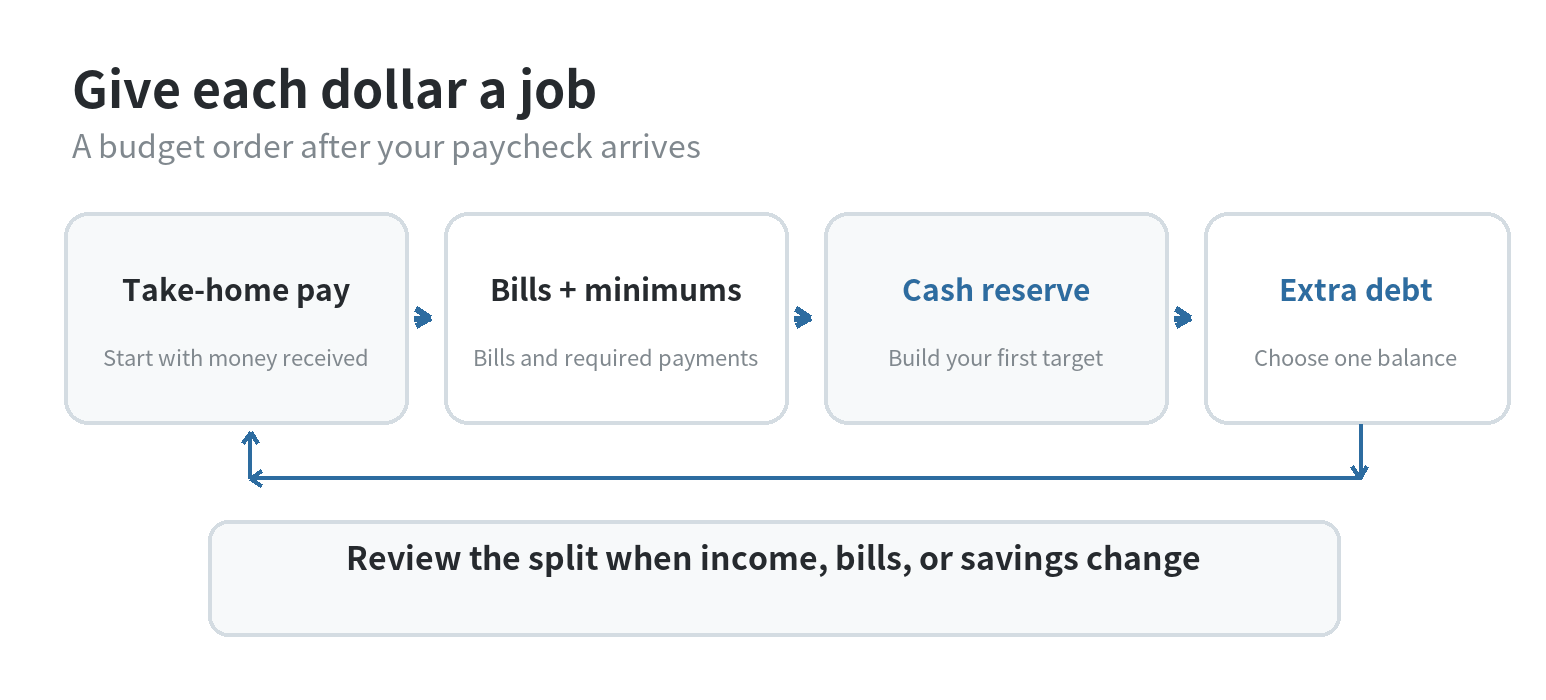
After essentials and minimums, decide how much of the remaining amount goes to savings and how much goes to extra debt payment,
using the CFPB cash-flow approach.
The split is a budget choice; the CFPB recommends setting a goal that fits your own situation (emergency-fund guide).
A thin cash cushion or an income that changes from month to month may call for more going to savings at first (CFPB cash-flow guidance).
A reserve that already covers the kinds of shocks you expect can make room for a larger extra payment.
Here is a sample monthly budget using the CFPB’s method of comparing real spending with take-home pay (CFPB spending assessment): take-home
income is $4,000;
essentials and planned irregular bills use $2,300; required debt payments use $500; and $1,200 remains.
The household could direct $400 to emergency savings, $700 to one chosen debt, and leave $100 in checking for timing differences,
following the CFPB spending assessment method. Replace the sample lines with your own statements.
Give each dollar a job before the month starts, but leave room for the calendar to change.
A checking buffer can absorb a bill that clears before a deposit; savings is for a cost you did not plan.
If the checking balance falls below the amount needed for bills already scheduled, pause extra debt payments until those obligations are covered.
When a debt is paid off, keep the old payment visible in the budget for the next cycle.
You can send it toward the next balance or rebuild savings after using the reserve.
Assigning it deliberately prevents the freed cash from disappearing into untracked spending.
On a low-cash month, do not force the same split.
Pay essentials and required minimums first, then send an affordable amount to savings or extra debt.
If minimum payments are no longer affordable, the CFPB says to add up income and expenses and contact the card company right away;
explain what you can afford and when you might resume regular payments (CFPB guidance for credit card bills, last reviewed September 2, 2026).
Point extra debt money at one balance
Keep paying the required minimum on each account, then direct extra money to one debt at a time, as the CFPB debt action plan describes.
With the smallest-balance method, put extra money toward the smallest debt; after it is paid, roll that payment into the next-smallest balance.
With the highest-interest method, choose the debt with the highest rate first, then move the extra payment to the next-highest rate.
The first can make the list of balances shorter sooner; the second targets debt with higher interest and fees first.
Neither method changes the minimums due on the other accounts.
Before choosing, list each balance, its minimum due, interest rate, and any terms that could change what an extra payment does.
Keep the required payments current across the list.
Then direct only the extra amount to the selected balance, and update the list when that balance is cleared.
The highest-rate approach sends extra money toward the debt charging the most interest.
It can reduce the time spent carrying expensive debt, but a large balance may take longer to disappear.
Choose the method you can follow while keeping all minimums and essential costs covered.
| Approach | Where extra money goes | Trade-off to consider |
|---|---|---|
| Smallest balance | Lowest balance, then the next lowest | Can make visible progress, but a higher-rate balance may remain |
| Highest interest rate | Highest rate, then the next highest | Targets costly interest first, but the first balance may take longer to clear |
These are payoff methods described in the CFPB’s Your Money, Your Goals debt action plan (checked October 1, 2026).
If you use a promotional rate, a secured debt, or an account with a penalty or changing terms,
read the agreement and account notices before deciding which balance to pay.
Review the plan when a bill or paycheck changes
Keep the reserve in a place you can access when an unplanned bill arrives, and keep it distinct from money for scheduled expenses.
CFPB guidance suggests choosing a place that is safe and accessible and setting personal rules for what counts as an emergency.
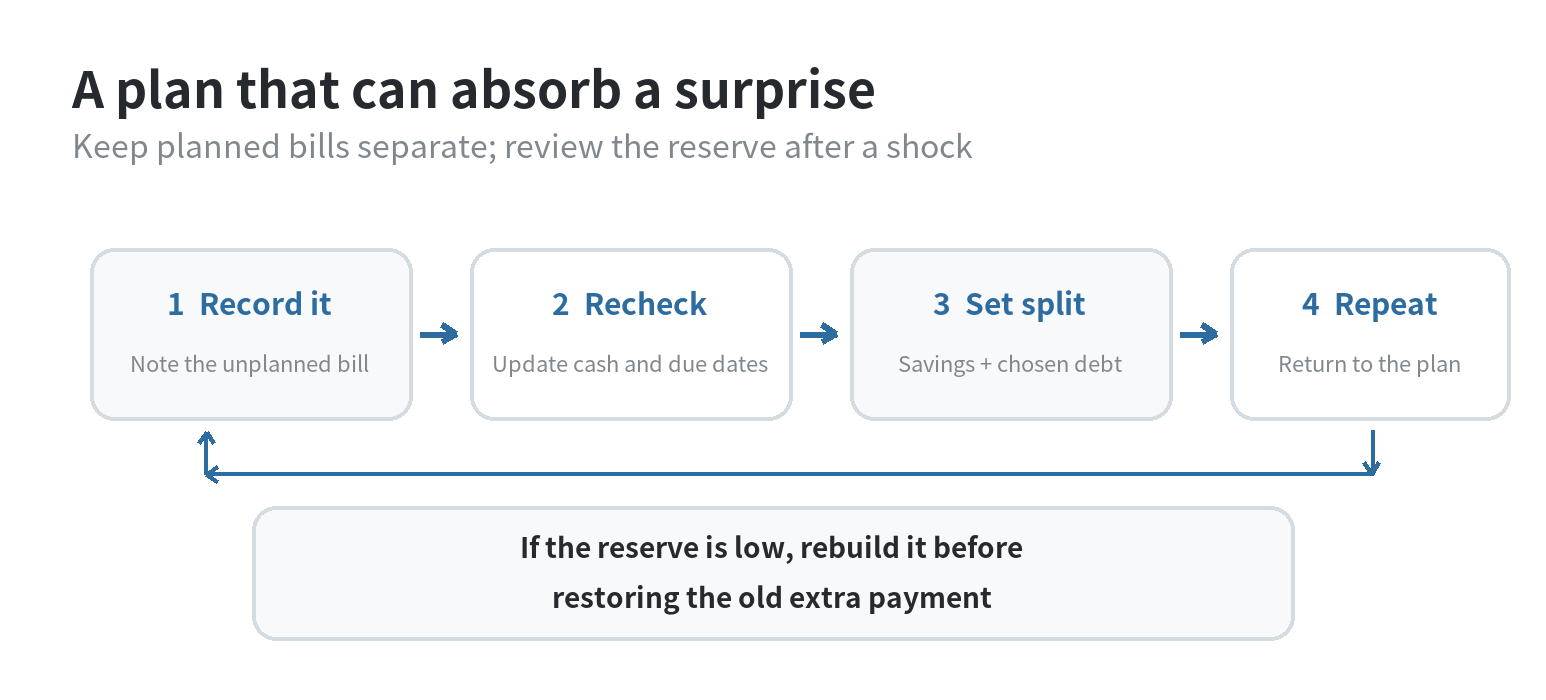
When you use the reserve, record the expense, lower the balance in your plan,
and temporarily direct some or all of the former extra debt payment back to savings if you need to rebuild it.
Check the plan after a major expense, a change in take-home pay, or a debt payoff.
When one balance is gone, its old minimum payment becomes available for your next debt or your reserve.
If income is irregular, make the plan from money received rather than expected invoices, and revise it when a payment arrives.
The CFPB specifically lists cash-flow tracking and one-time money as possible ways to build savings,
while warning readers to monitor balances if they automate transfers so they avoid overdrafts.
For paycheck timing, see Budgeting on Biweekly Pay; for changing income, see Budgeting With Irregular Income.
FAQ
Should I pause emergency savings after I use it for a repair?
No. Add the repair to your plan,
then send some of the amount you had assigned to extra debt payments back to savings if the remaining reserve is too low for your next likely
bill. CFPB guidance says to rebuild savings after spending it on an emergency (CFPB emergency-fund guide, checked October 1, 2026).
How should I budget when freelance income arrives on different dates?
Build the plan around money received and due dates, then assign new income after essential bills and debt minimums are covered.
CFPB describes cash flow as the timing of income and expenses and suggests tracking it to identify when money is available (CFPB cash-flow
guidance, checked October 1, 2026).
Can I keep my emergency savings in the same checking account as bill money?
You can, but separating the reserve may make it easier to see what is available for bills.
CFPB says to choose a place that is accessible and less tempting for nonemergency spending;
a dedicated savings account is one option (CFPB emergency-fund guide, checked October 1, 2026).
Last updated: 2026-10