
Give your work clothes budget its own line, then size it from your dress code, what you already own, and the care each item needs.
Start with recent clothing receipts and a closet check; do not borrow a national “average” that may have little to do with your job.
The Consumer Financial Protection Bureau suggests tracking spending for at least two weeks or a month (CFPB spending tracker guidance, checked October 1, 2026).
The record can help you see where your money goes.
Use that record to build a work-clothes budget that fits your pay schedule.
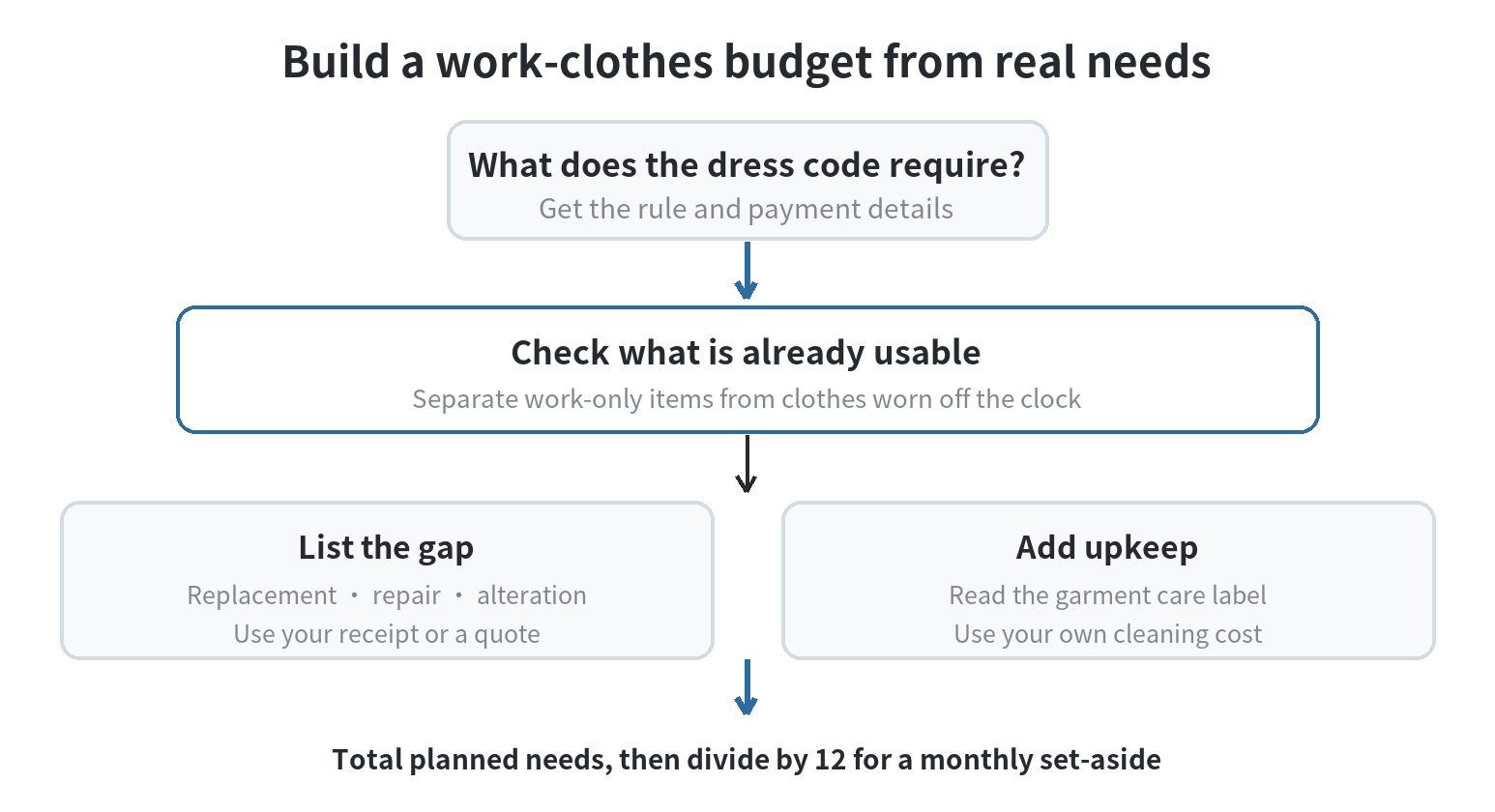
Separate required workwear from clothes you also wear off the clock
First, write down what your job actually requires: a uniform, a color or clothing type, protective pieces, or a general neat appearance.
Ask your manager or HR what the rule means in practice, who supplies required items, and whether cleaning or replacement is covered.
Keep the answers with your budget notes.
Make two lists: items you need only for work, and ordinary clothes you can also wear outside work.
A pair of plain pants worn at the office and on weekends is not a full work-only expense.
If you would have bought it anyway, budget only the extra cost of meeting the dress code, if there is one.
For each item, note its current condition, whether it fits the written policy, and what role it fills.
This keeps “I might need something” from turning into an unplanned shopping trip.
It also shows if the real gap is a specific item, such as a second pair of work pants, rather than a whole new wardrobe.
Turn the closet check into a number you can fund
Build a list with four columns: item or task, why it is needed, when you expect to handle it, and your own estimated cost.
Include replacements, alterations, repairs, shoes if your dress code requires them, and cleaning.
Use a current quote or the price you actually paid for each line.
If you do not have one, leave the estimate blank until you check; do not fill the gap with a made-up average.
The Bureau of Labor Statistics groups clothing, footwear, and dry-cleaning under “apparel and services” (BLS Consumer Expenditure summary, checked October 1, 2026).
That is a broad Consumer Expenditure Survey category, not a workwear budget for your job.
That broad household category does not tell you what your own job’s dress code will cost, so use your receipts and quotes for the workwear line.
| Example item | Reason | Example cost | Timing |
|---|---|---|---|
| Work pants | Replace a worn pair | $72 | Month 1 |
| Alteration | Adjust a new pair | $18 | Month 1 |
| Shirts | Fill a gap in the work rotation | $60 | Month 2 |
| Cleaning reserve | Set aside for care costs | $20 per month | Monthly |
Replace them with the amounts from your own receipts and local quotes.
If you need a quote, ask for the full price of the item or service.
Include any alteration, cleaning, delivery, or required accessory charge before adding it to the plan.
Next, total the expenses you expect over the year and divide by twelve for a monthly set-aside.
In this example, the pants, alteration, and shirts total $150.
Add twelve months of the $20 cleaning reserve, or $240, for a sample annual plan of $390.
The monthly target is $32.50.
Your own total may be lumpy: you might need a replacement this month and nothing next month.
For a paycheck budget, divide the monthly target by the number of checks you receive in a normal month.
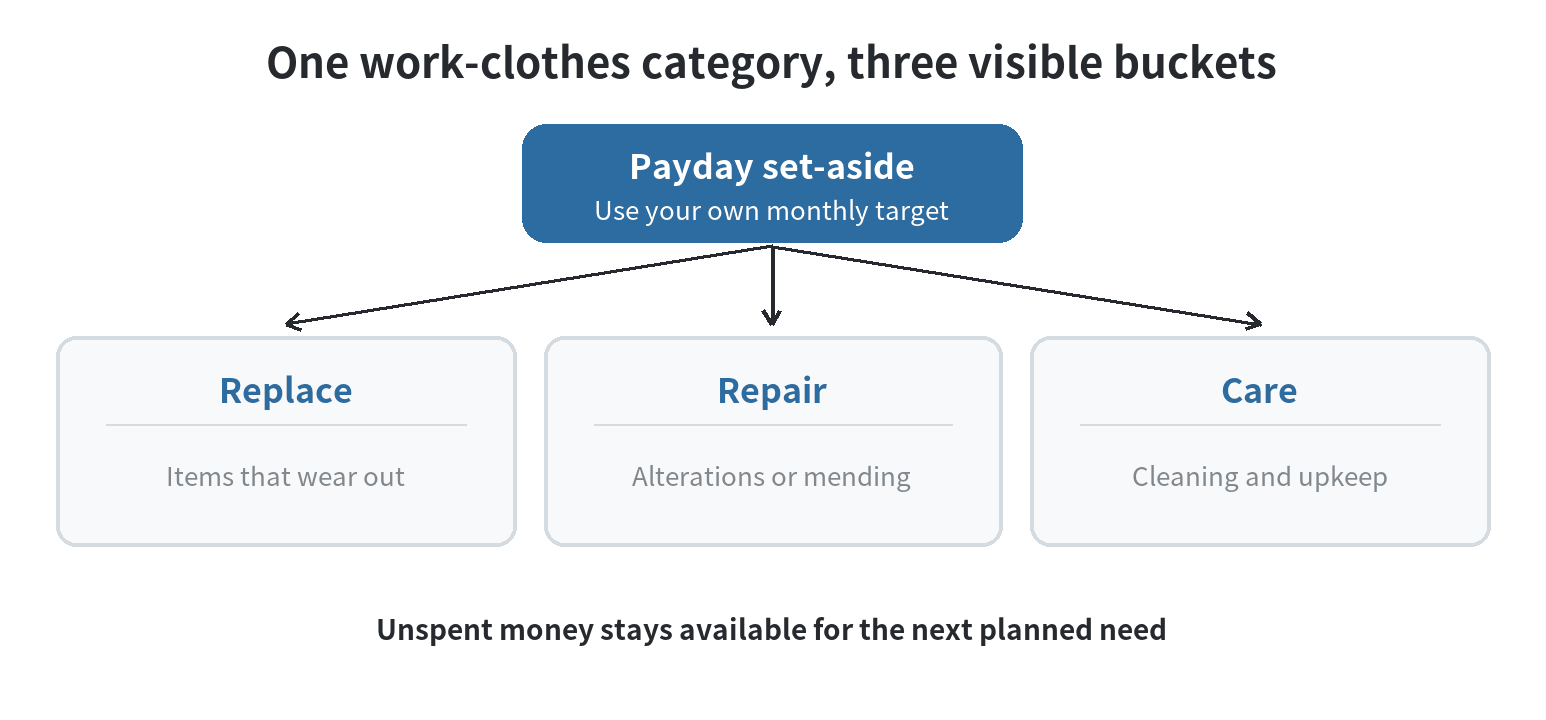
Move that share into a separate clothing category each payday.
If your checks vary, use the amount left after bills and essential expenses, then build the clothing balance before replacing a non-urgent item.
A pay-period budget template can help you place the transfer beside your other paycheck assignments.
If an expense is due before the category has enough, mark the due date and the amount still needed.
Decide whether the purchase can wait, whether a repair can bridge the gap, or whether your employer can provide the required item.
Keep rent, utilities, and other committed bills out of the work-clothes calculation.
After you make a purchase, subtract the actual amount from the clothing balance and save the receipt.
When the next estimate is due, compare the planned figure with what you paid.
Change the monthly target when the dress code, replacement plan, or real care cost changes.
A sale or unusual purchase does not need to reset every line.
Include care costs before choosing what to replace
The purchase price is only one part of the clothing line.
The Federal Trade Commission says covered manufacturers and importers must provide care instructions (FTC care-label guidance, checked October 1, 2026).
Read the label before you count an item as an inexpensive replacement: washing, drying, ironing, or dry-cleaning can add time or recurring charges.
Write a separate care line for clothes that need a paid service.
To estimate it, check your own receipts or request a current quote for the items and frequency your job requires.
If you wash and press clothes at home, track the extra products or service you actually use.
Do not assign the entire household laundry bill to workwear.
Compare items by their expected cost over the time you plan to use them, but use real figures for both options.
For example, add the quoted purchase price, expected alteration, and the care cost you can document.
If you lack a reliable cleaning estimate, ask the cleaner for a quote before comparing.
A lower tag price alone does not tell you which choice costs less to maintain.
For a useful quote, describe the garment and the service you need rather than asking for a general estimate.
Ask whether the amount covers the full job and whether a fitting or extra work would be billed separately.
Record the date and the business that gave the quote, then replace it with the receipt after the work is done.
Set a replacement trigger before shopping: a uniform item is damaged or fails the written rule.
You can also set a limit for repairs and replace the item if a quote exceeds it.
Keep optional upgrades on a separate list.
That gives you a clear reason to use the budget instead of treating a new season or a tempting display as an automatic need.
Keep clothing money ready for the month it is needed
Work clothes rarely arrive as a perfectly even monthly bill.
Keep the unspent part of the category in your budget so it can cover a later replacement.
When you spend from it, record what the item was for and update the remaining balance.
If a job change or new dress code creates a large one-time need, list that separately from the ongoing monthly amount.
When money is tight, rank the list by what blocks you from meeting the written dress code or doing the job.
Repair or alter a usable item if the quote is lower than replacement and the result still meets the rule.
Delay optional additions that do not solve a current gap.
If an employer says an item is mandatory, ask what support or reimbursement applies before paying out of pocket.
Keep the policy, your inventory, quotes, and receipts together.
If a manager later clarifies what counts as acceptable, update the list before spending.
A written note also helps distinguish an employer-required purchase from an ordinary clothing choice when you review the category.
Review the category when your role, schedule, or dress code changes, and when a major item wears out.
The CFPB also recommends reviewing tracked spending to spot expenses you may want to change (CFPB spending review questions, checked October 1, 2026).
A separate annual-expense category can help with costs that do not arrive every month.
See this guide to budgeting for irregular bills for more on that approach.
FAQ
Should work clothes come from a clothing budget or a work-expense budget?
Use the category that lets you see the true cost of meeting your job’s dress code.
If you also use an item off the clock, record the work-specific share separately from ordinary clothing purchases.
How can I budget for work clothes when my employer changes the dress code?
Ask for the updated rule in writing, then compare it with what you own.
Add only the new gaps and any related care costs to a one-time transition list before changing your regular monthly target.
What should I do if I need work clothes before I have saved enough?
Ask your manager or HR whether the employer supplies the required item, reimburses it, or allows a lower-cost option that meets the rule.
Then separate the urgent requirement from replacements you can schedule later.
How do I budget for work clothes with a seasonal uniform?
Put the expected seasonal items and their care costs on a calendar, then divide the total by the paychecks before they are needed.
Replace the estimates with current quotes when the season approaches.
Last updated: October 2026.
Last updated: 2026-10