Build your budget around money that has actually reached your account, then use strong commission months to prepare for the weaker ones. Start with a modest monthly floor based on your own deposit history, list bills by due date, and give each deposit a job before treating any of it as spending money.
That approach helps separate two problems that can look alike: earning too little across a month and having enough income arrive after a bill is due. The CFPB’s Your Money, Your Goals toolkit includes income tracking, a bill calendar, and a cash flow budget; checked September 2026, those tools focus on recording both amounts and timing.
Use deposits, not a hoped-for commission
A commission shown as pending is not cash available for rent or groceries. Start with the amount deposited after payroll deductions if you are an employee. If you are paid as a contractor, use the amount left for household use after business costs and obligations you have planned separately.
Write down each deposit date and amount from your bank records or pay statements. Include base pay, commissions, bonuses, and other income as separate lines. The CFPB’s Income and Benefits Tracker tells users to record net income by week and note income that arrives at predictable times and amounts. Consumer.gov says people who are not paid monthly can total last year’s income and divide by 12 for a monthly estimate; both sources were checked September 2026.
A monthly average is useful for seeing the broad picture, but it does not mean that the same amount will arrive each month. Keep the actual deposit dates beside the estimate. If you have not worked a full year, use the records you do have and keep the plan conservative; do not fill gaps with a best-case sales forecast.
Choose a floor your own records can support
Look across the months in your records and identify a lower, repeatable take-home amount. Do not use the biggest month as your baseline. If your income has changed because you switched roles, territories, or compensation plans, separate those periods instead of mixing old and new pay into one misleading number.
Now list the bills and basic costs that have to fit inside that floor: housing, utilities, food, transportation, insurance, minimum debt payments, and any recurring care costs. Use statements and receipts to estimate flexible essentials. Add less frequent costs, such as annual renewals, car repairs, school expenses, or travel you have already planned, as separate monthly amounts based on your own bills.
Here is a made-up example to show the arithmetic. Say your lower take-home month is $2,400 and your essential monthly costs add up to $2,250. The plan leaves $150 in that month. A $3,600 month leaves $1,350 after those same essentials. Those figures are examples, not typical commission amounts; replace them with your own deposits and expenses.
| Example month | Net deposits | Essentials | Left after essentials |
|---|---|---|---|
| Lower month | $2,400 | $2,250 | $150 |
| Higher month | $3,600 | $2,250 | $1,350 |
If your lower month cannot cover the essential list, the worksheet has surfaced a real gap. Check that you used take-home deposits rather than gross commission, then review which expenses can change, whether a bill date can move, and what assistance or payment options the provider offers. Do not balance the page by counting a commission that has not arrived.
Give every deposit an order of work
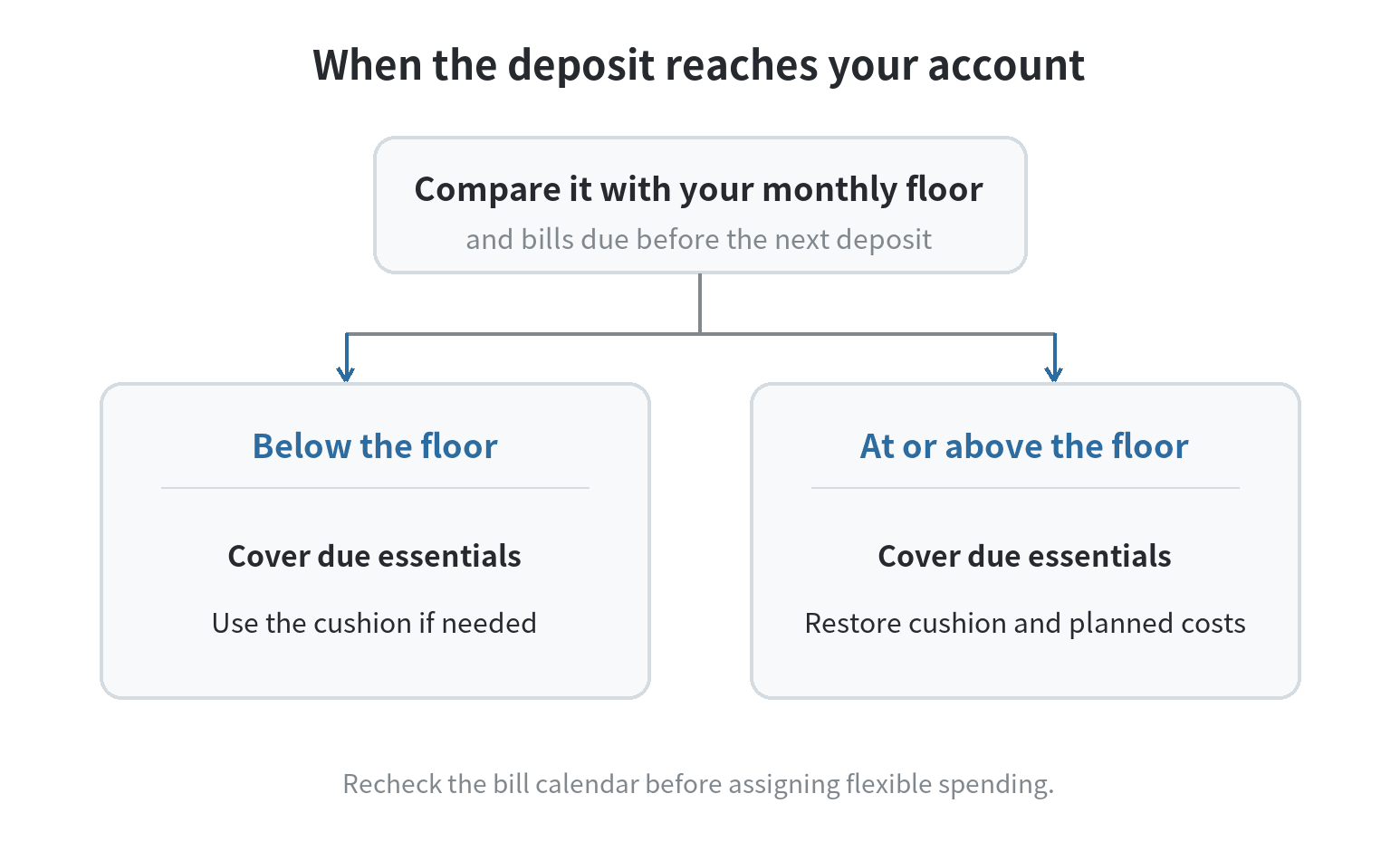
When a deposit lands, compare it with the bills due before the next expected deposit. The CFPB’s bill calendar guidance recommends recording each bill, amount, and due date, then checking the calendar alongside your budget (checked September 2026). Use that calendar to decide which dollars already have a commitment.
For a small calendar example, say $1,100 arrives on the 3rd and rent of $900 is due on the 5th. Mark the rent as committed as soon as the deposit arrives; the other $200 still has to cover any groceries, utilities, or bills due before the next deposit. A monthly total can look adequate while the order of dates leaves a bill short.
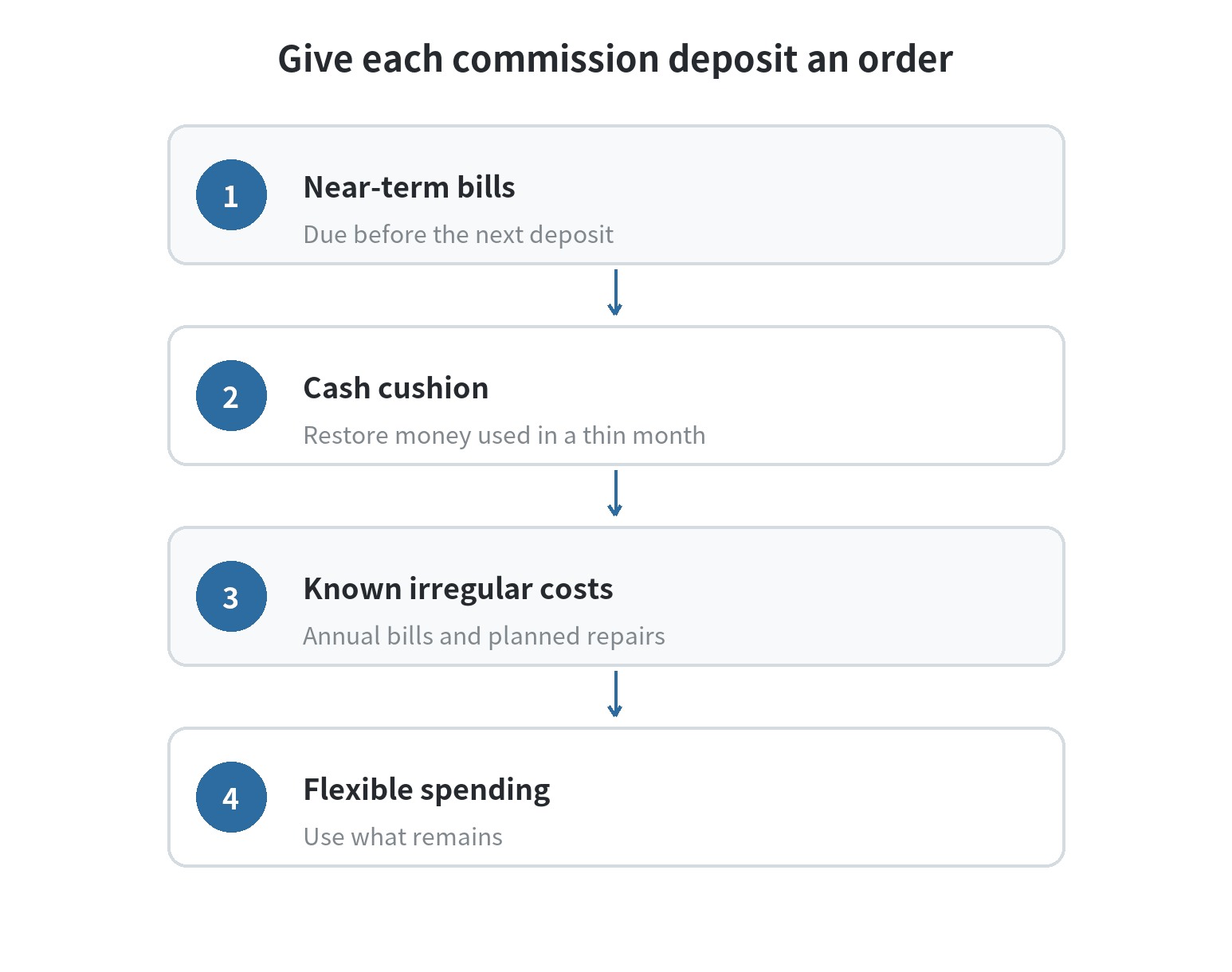
- Cover bills due before the next deposit and set aside money for essential day-to-day costs.
- Rebuild the cash cushion you used in a lower month or for a delayed deposit.
- Reserve money for irregular costs you have already listed, such as an annual premium or a planned repair.
- Only then assign what remains to flexible spending or savings goals.
This order prevents a high month from turning into a higher permanent spending plan. Keep the cushion in a separate savings or checking space if that makes it easier to see what is available; the key is to record it as committed cash, not as extra spending room. A separate account is optional, and the plan works on paper or in a spreadsheet too.
Plan for a thin month before it starts
Use your bill calendar to find the period when essential bills cluster before a commission is due. Move flexible spending away from that stretch when possible. If a provider allows a due-date change, ask whether shifting it would match your deposit pattern; the CFPB notes that timing between income and bills can affect cash flow.
Set a cushion target from your own shortfall rather than choosing a generic dollar amount. For example, write down what bills would still be due if the next deposit were smaller than planned, and what money you would need to cover the difference. Build toward that figure from higher-month leftovers. If the cushion is used, return it to the front of the allocation order on later deposits.
If a month is already short, pause optional purchases and update the calendar with the cash currently available. Contact a creditor or service provider before a missed due date to ask about its options. Keep notes of the amount discussed and any date or payment arrangement offered.
Review the plan against real statements
At month-end, compare the plan with what actually came in and went out. The CFPB recommends reviewing income sources, spending, and bill timing when building a budget; consumer.gov also says to track spending and use the results to plan the next month (checked September 2026). If the difference came from a late deposit, adjust timing. If it came from groceries or fuel costing more than your estimate, update that line from your records.
Keep the original plan visible as well as the revised one. That makes it easier to tell whether a short month came from lower commission, a late payment, a one-time expense, or a budget number that no longer fits. A short note beside the changed line can explain the difference: “deposit arrived later,” “car repair,” or “utility estimate too low.”
If tracking on a phone would help, see our guides to budgeting apps for managing money and tracking freelance income on a phone. Keep the numbers personal: a tool can sort deposits and bills, but only your statements show what actually arrived and what your household spent.
For a working first draft, write down the lowest month you can support from your records, total essential bills, and mark due dates against expected deposits. Then assign the next commission deposit in order: near-term bills, daily essentials, cushion, planned irregular costs, and flexible spending. Update the plan when a pay statement or bill changes.
FAQ
Should I budget from gross commission or the amount deposited?
Use take-home deposits for household spending. If you are self-employed, separate business costs and obligations you have planned before deciding what is available for personal bills.
What if I have only worked on commission for a few months?
Use the deposit and spending records you have, mark the plan as provisional, and avoid treating a strong month as a guaranteed baseline. Revise it as new pay statements come in.
How should I budget a commission that arrives after the sale?
Count it when it reaches your account, not when a sale is pending. Until then, schedule bills against cash already available and ask the payer for its documented payment timing if you need to plan around it.
Where should I put money left over in a high-commission month?
First restore any cushion used for a lower month, then reserve money for known irregular expenses. Assign the remainder to your chosen goals or flexible spending after those commitments are covered.
Last updated: 2026-09