If you get paid weekly, treat a fifth paycheck as money for the fifth week first. Assign what remains to a named goal.
Keep monthly bills in a four-check plan so they do not depend on a fifth payday.
The example below uses a made-up $900 take-home check. Replace it with your deposited amount and actual bill dates.
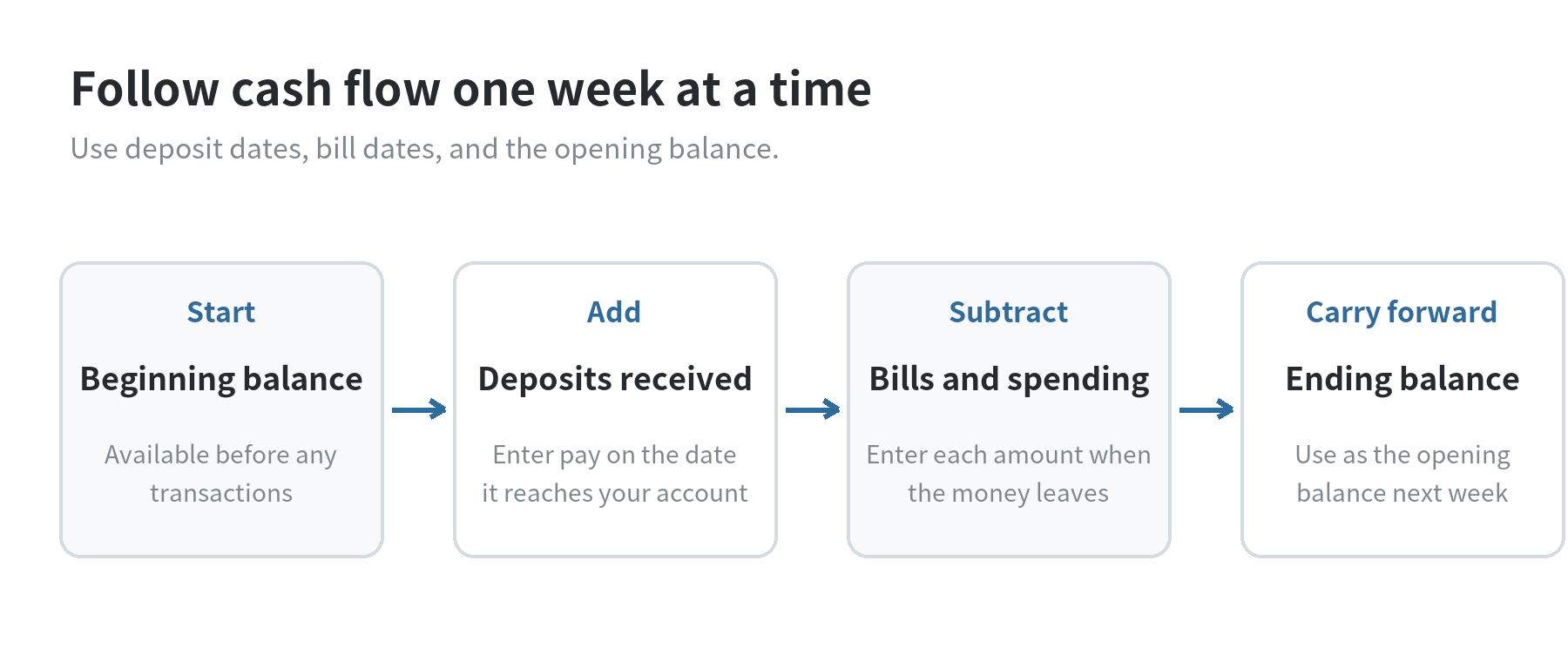
The CFPB’s cash-flow budgeting tool says to enter each week’s income and expenses and carry the balance forward (checked September 30, 2026).
The calendar matters as much as monthly totals.
Why the fifth check needs its own job
A calendar month does not line up neatly with weekly payday cycles. A month may contain four or five scheduled paydays, so a plan tied to particular dates can leave a gap.
Count your actual deposit dates instead of estimating from one month’s income. The CFPB’s bill calendar records bills against calendar dates.
There are two useful views of weekly income. For an annual estimate, FDIC Money Smart converts a weekly amount to monthly by multiplying by 52 and dividing by 12.
The FDIC lists that formula in its income and expense guide (checked September 30, 2026).
For spending decisions, a cash-flow calendar shows when money arrives and bills leave. Use the annualized figure to compare income with monthly expenses.
Use the calendar to match a check to a bill date.
This plan uses four checks as the recurring monthly base and gives each fifth check a separate assignment.
The fifth check is still needed for that week’s food, transportation, and other routine costs.
Money left after those costs can handle less frequent bills or a goal you chose in advance.
Set up the four-check base with your own amounts
Start with deposited pay, not gross pay. The FDIC’s Money Smart income guide distinguishes earnings from take-home pay after deductions (checked September 30, 2026).
Read recent pay statements and list the amount that lands in checking. Then collect bills, due dates, and weekly spending needs.
For a sample month, assume take-home pay is $900 each Friday. Suppose rent is $1,300, utilities are $160, phone and internet are $100, and insurance is $240.
Those fixed monthly bills total $1,800. Set aside $450 from each of the first four checks toward them.
To put dates on the example, assume deposits arrive on Fridays, October 2, 9, 16, 23, and 30, 2026.
The Government of Canada’s calendar lists those October Fridays (checked September 30, 2026); your employer’s schedule may differ.
If $1,300 rent is due October 1, it must come from the reserve carried over from September. The first October deposit arrives the next day.
Now assign the rest of each base check. In this example, $270 covers weekly spending, $120 funds planned irregular costs, and $60 remains as a checking cushion.
Those are sample choices, not national spending levels. If your weekly costs are $340, use that amount and reduce another category or raise the reserve.
| Each of the first four checks | Example amount | Job |
|---|---|---|
| Monthly-bill reserve | $450 | Build toward $1,800 in listed monthly bills |
| Weekly spending | $270 | Food, transportation, and routine purchases |
| Irregular-cost fund | $120 | Known bills that do not arrive every month |
| Checking cushion | $60 | Leave available for timing differences |
The table uses up the $900 sample check. Your categories may differ, but each dollar should have one role.
The FDIC payment-calendar exercise maps bill due dates onto a calendar, while the CFPB cash-flow tool records income and expenses by date and carries the balance forward (checked September 30, 2026).
That helps when rent is due before the first monthly check. You need an opening balance or a reserve from an earlier pay period.
Give the fifth Friday check a short priority list
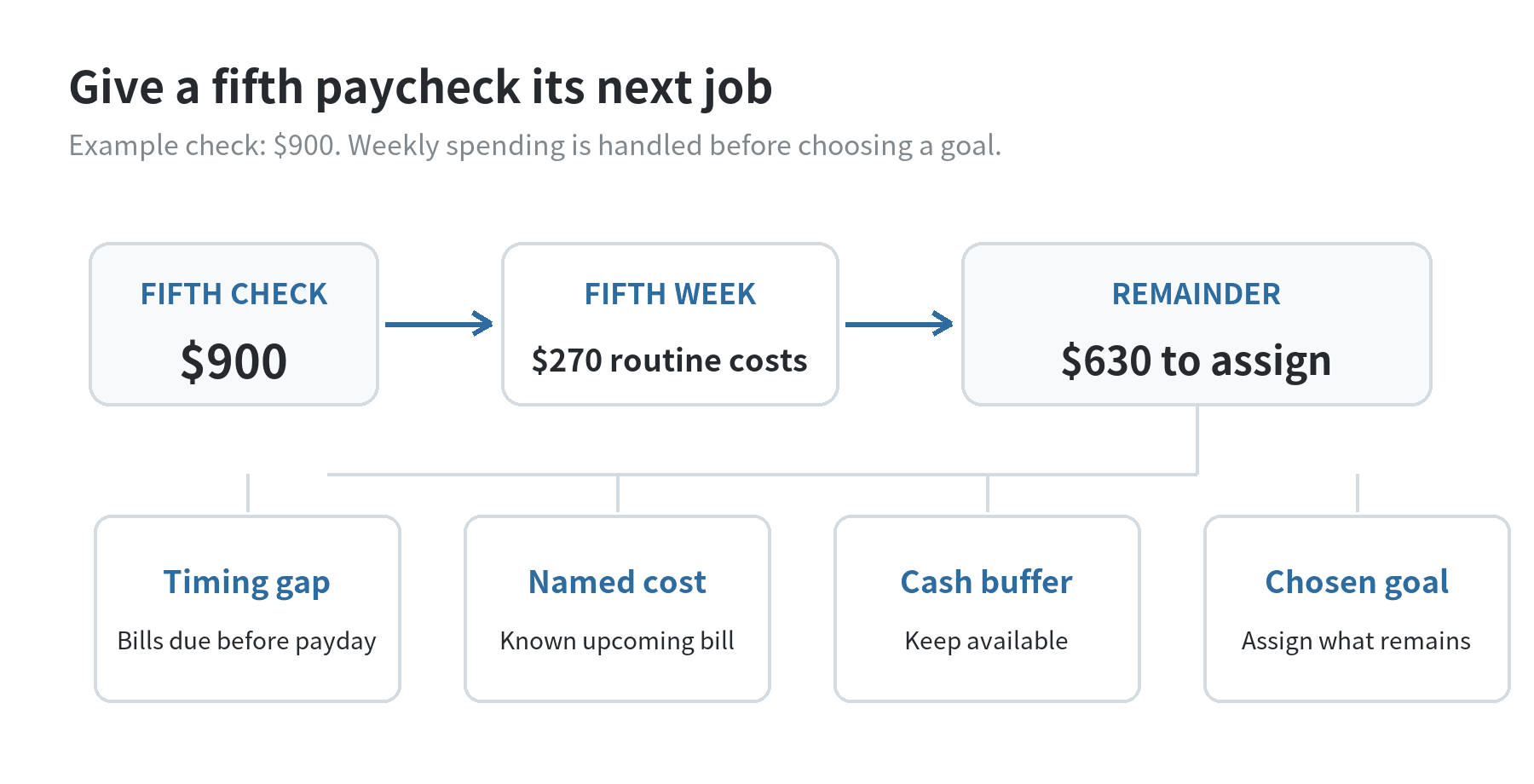
In a five-payday month, keep the weekly spending amount intact. In the example, the fifth week needs $270 for routine expenses, leaving $630 from the $900 check.
Decide where that remainder goes before payday. Otherwise, it is easy to mix it with the next month’s rent money.
- Cover that week. Set aside the same weekly amount your plan already uses. If this week has a known larger expense, use its real amount.
- Fill a timing gap. If a bill is due before the next deposit or your monthly-bill reserve is short, direct money there first. A calendar can show whether a bill date and payday are out of sync.
- Fund a named irregular cost. Check the next few months for annual premiums, school costs, or scheduled maintenance. Add only the amount needed for a specific expense.
- Choose one remaining goal. If the near-term bills and planned costs are funded, decide whether the remaining cash will stay as a cash buffer, pay down a balance, or support another household goal.
If the full $630 remains after the fifth week’s $270, you could assign $300 to an upcoming annual bill, $200 to a cash buffer, and $130 to a debt payment.
Those allocations are arithmetic examples. The order depends on the due dates and obligations on your calendar.
Check dates before moving money
Write each expected payday, bill due date, and weekly spending plan on one calendar. Use the deposit date shown by your employer or bank.
Record the starting balance, add deposits when they arrive, then subtract bills and spending when they leave.
If a week ends below zero on paper, the plan has found a timing problem. See whether a biller can move a due date, split a periodic bill, or help you build a reserve.
The CFPB cash-flow tool suggests comparing expense and income dates, then considering whether an expense can move after payday.
Its bill calendar asks you to list each bill, amount, and due date (checked September 30, 2026).
Use dates and terms from your providers. Do not schedule a payment based only on the day you initiate it.
The site’s guides to tracking bill dates on a phone and building a simple budget tracker cover those tools.
Keep the method usable in a four-check month
A four-check month follows the same plan: four deposits fund monthly bills, routine spending, and the planned irregular-cost amount.
Avoid borrowing from the next month’s bill reserve because a fifth check will arrive later.
If a check is delayed or smaller, review due dates and pause optional allocations first.
At month’s end, compare the calendar with your bank activity.
Update bills whose amounts changed, adjust weekly spending to match your records, and carry forward the ending balance.
The FTC’s consumer budget guidance recommends using bills and pay stubs, then reviewing spending during the month (checked September 30, 2026).
A fifth paycheck is easier to assign when the regular plan reflects your actual deposits and due dates.
Turn an annual bill into a monthly reserve
List expenses that arrive once or a few times a year, such as a vehicle registration or an insurance premium. Record the amount and due month from the bill itself.
For an annual bill, the FDIC budgeting guide converts the total to a monthly amount by dividing by 12. A hypothetical $600 bill becomes $50 per month.
If the same bill is due in six months and you are starting from zero, divide the remaining amount by the number of months left. The $600 example needs $100 a month until its due date.
With four base checks each month, that example means reserving $25 from each check. Recheck the fund balance after each payment so the same bill is not funded twice.
A due date closer than expected can change the amount needed per check. Use the number of checks before that bill date, not the fifth-check pattern from a different month.
FAQ
Should I budget by the pay period end date or the actual payday?
Use the deposit date for the cash-flow calendar. The FDIC Money Smart worksheet lists pay-period dates and pay date separately in its pay statement exercise.
What if my paycheck changes from week to week?
Build fixed bills around the lowest take-home amount you can document. Use higher checks to fill reserves and planned costs.
Keep a deposit record and update the plan when your hours or deductions change.
How can I line up weekly and monthly household paychecks in one budget?
List both deposit dates on one calendar and enter each amount when it arrives. Keep shared bills and due dates in the same plan to reflect when money comes in.
Last updated: 2026-09