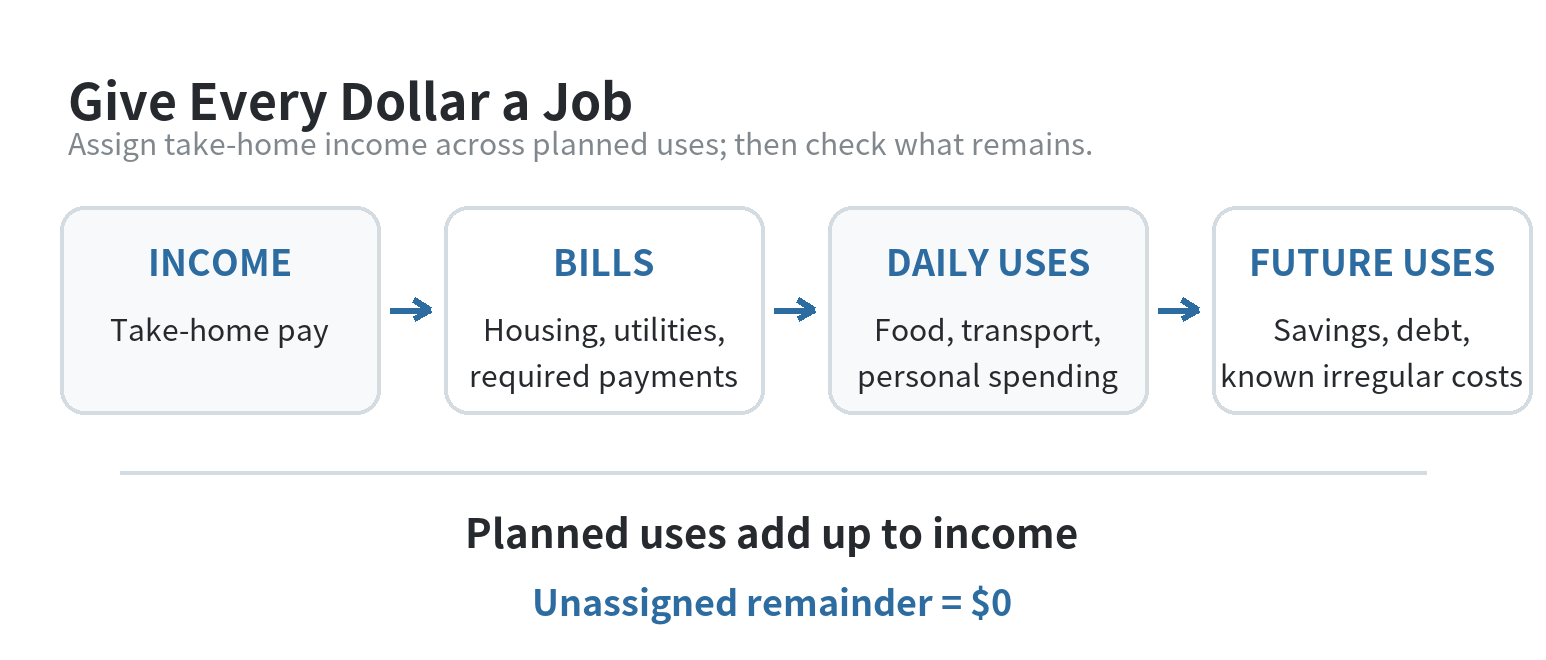
Zero-based budgeting means assigning your take-home income to bills, spending, savings, and debt payments until planned uses equal income. Start with the amount that actually reaches your household, list the jobs it needs to cover, and adjust the amounts until nothing is left unassigned. “Zero” is the plan’s remainder, not a target checking-account balance.
Start with the money you can plan
Use take-home pay rather than gross salary so the plan matches the deposit available for household decisions. If your pay varies, begin with income you can count on and add extra income only after it arrives. A University of Oklahoma MoneyCoach guide describes the method as income minus outgo equaling zero; UF/IFAS Extension likewise defines it as assigning every dollar to expenses or savings. Read the University of Oklahoma MoneyCoach budgeting guide and UF/IFAS Extension’s budgeting overview.
For a steady paycheck, add the take-home deposits meant to fund the coming budget period. For irregular work, list confirmed income first and make a second plan for money that is not yet certain. The CFPB’s cash-flow materials track both when income arrives and when expenses are due, which helps you see timing as well as monthly totals. See the CFPB cash-flow budget tools.
Give each dollar a job, including savings
List rent or mortgage, utilities, insurance, groceries, transportation, minimum debt payments, and flexible spending. Add planned savings contributions and costs that do not arrive each month, such as gifts, annual renewals, or car maintenance. Utah State University Extension recommends using receipts and account statements to build expense estimates, and says to include savings and goal contributions in the plan. USU Extension explains how to assemble a budget.
For a predictable annual cost, write down the expected total and spread it across the months before it is due. USU Extension describes dividing estimated special expenses by 12 for a basic monthly budget; for example, a made-up $360 annual bill becomes $30 per month when planned across 12 months. If the due date is closer, divide by the number of budget periods remaining instead. USU Extension explains its special-expense calculation.
The following is a made-up monthly example, not an estimate of what a household should spend. The categories and amounts are placeholders; replace them with your own recent transactions, bills, and priorities.
| Planned use | Example amount |
|---|---|
| Housing | $1,450 |
| Utilities | $240 |
| Groceries | $550 |
| Transportation | $420 |
| Insurance and phone | $310 |
| Debt payment | $250 |
| Irregular-expense fund | $300 |
| Other savings | $250 |
| Personal spending | $350 |
| Unassigned buffer | $80 |
| Total planned income | $4,200 |
In this sample, the planned uses add up to $4,200. The final $80 buffer has a defined job: absorb a small bill variation or stay available for a named purpose. If you prefer to give every dollar a specific category, divide it between the categories that matter to you. Savings counts as a job; the method does not require spending the whole paycheck. For a deeper example of setting aside money for planned goals, see the site’s guide to sinking funds for planned saving.
Make the leftover amount visible
Use one subtraction: take-home income minus planned uses. If the result is positive, some money still needs a category. You could assign it to a goal, a future irregular bill, extra debt payment, or flexible spending. The site’s emergency-fund and debt-payoff budget guide explores those two goals in more detail. If the result is negative, planned uses exceed income. Change a flexible category, lower a planned savings amount, or revisit a bill; do not hide the gap by writing a smaller grocery or utility amount than your records support.
Work from statements and receipts when you do not know a category’s starting amount. The CFPB describes a spending tracker as a way to identify actual spending before building a budget, and its toolkit includes spending, income, bill-calendar, and cash-flow worksheets. See the CFPB spending-tracker guidance. Your first draft can use a cautious estimate, then you can revise it when you have current transaction data.
Keep irregular costs distinct from surprise costs. A renewal with a known due date belongs in a planned category; an unplanned expense is a different cash-flow problem. Naming a category now spreads a known cost across budget periods instead of letting it appear as an unexplained leftover later.
Match the plan to your pay dates
A monthly total can balance while the calendar still leaves you short before payday. Put each paycheck and bill on its due date, then map which deposit will cover each bill. The CFPB cash-flow budget breaks a month into weeks and records when money comes in and when it must go out. Its cash-flow worksheet shows the timing view.
For example, suppose the rent is due before the second paycheck arrives. The monthly budget may include enough for rent, but the first deposit still has to leave cash available for that date. Assign dollars to the rent category when income arrives, then track the category balance rather than treating the full bank balance as spendable. A calendar or a written list can do this; the important part is making the pay date and bill date visible together.
If the expected income does not cover bills that fall before the next deposit, mark the gap by date. Decide whether a bill can be moved, whether a previous balance is available, or whether another expense needs a different date. The plan should show the timing problem before an automatic payment or due date arrives.
When the month changes, move dollars on purpose
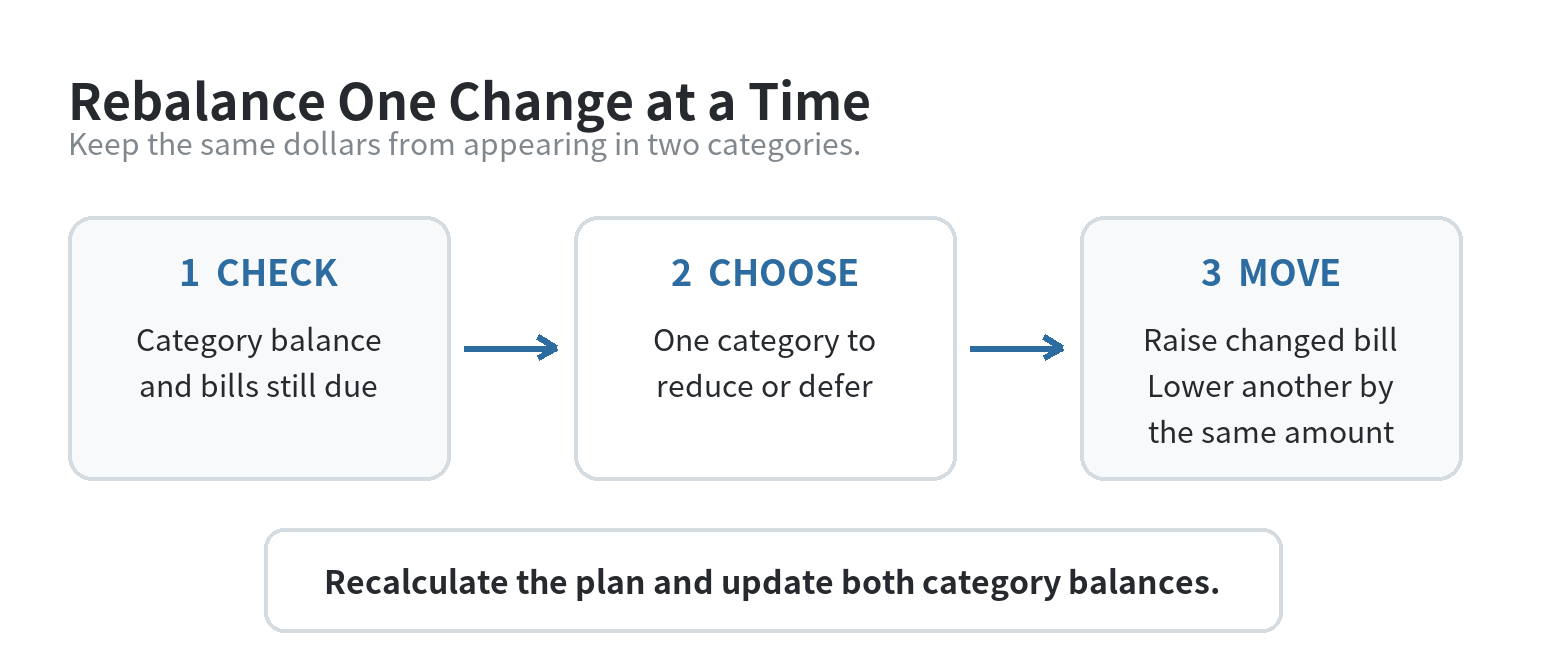
A budget is a plan you can update when the facts change. If a utility bill comes in above the amount set aside, first check the category balance and the remaining bills due before your next deposit. Then choose a specific category to reduce or a planned use to defer. Record both sides of the change so the new plan still adds up; do not count the same dollar twice.
Suppose the example household spends $35 more on utilities than planned. It can reduce the personal-spending category by $35, use part of the buffer, or make another deliberate adjustment. The arithmetic is simple: add $35 to utilities and subtract $35 from the chosen category. The next month, use the bill and transaction record to decide whether the original utility amount still fits.
When income is lower than expected, rebuild the plan around money already received and bills still due. Put housing, food, utilities, transportation, and required payments on the calendar before assigning money to optional purchases. A zero-based budget makes the trade-off explicit; it cannot make a shortfall disappear.
Keep the routine light enough to repeat
At the start of a budget period, enter expected income and assign it. As transactions clear, update the category balances. Before changing an amount, look at what is still due and when the next deposit arrives. At the end of the period, compare planned and actual amounts, then carry useful information into the next draft.
A spreadsheet, paper ledger, or budgeting tool can all hold the same basic list: income, planned uses, actual spending, and the remaining amount by category. Choose the format you will keep current. For shared household expenses, agree on who records a bill and whether a transfer between people is an expense or just reimbursement, so the same purchase is not entered twice.
Use the plan to answer a practical question before spending: which category will this come from, and does that category still have room after the bills already scheduled? If the answer is unclear, pause and update the plan first. Every dollar with a job is easier to account for than a balance that has not been assigned.
FAQ
Does zero-based budgeting mean my bank account should be empty?
No. Zero is the amount left unassigned in your plan, not the cash balance in your account. Money assigned to next month’s rent, a savings goal, or an irregular bill still has a job. The University of Oklahoma MoneyCoach guide and UF/IFAS Extension both describe the method as assigning income across expenses, savings, and other planned uses. University of Oklahoma MoneyCoach.
Can savings count as a job in a zero-based budget?
Yes. A savings contribution can be a planned use alongside bills and everyday categories. UF/IFAS Extension’s definition explicitly includes expenses or savings. UF/IFAS Extension explains the definition.
What should I do if my paycheck changes from month to month?
Build the first plan from income you can confirm, then add money to categories when additional pay arrives. A cash-flow calendar can show whether the dates of income and bills leave a short gap between deposits. The CFPB toolkit includes income tracking and cash-flow tools for planning those dates. View the CFPB Your Money, Your Goals toolkit.
Last updated: October 2026
Last updated: 2026-10