If you are paid weekly, build your budget around the dates money lands and bills leave—not around a four-week month. List each paycheck, reserve part of it for monthly bills, and give the remaining money a job for that week. The Consumer Financial Protection Bureau recommends recording bill amounts and due dates on a calendar and checking it weekly; the FDIC describes a budget as a plan for income, expenses, and savings.
Start with the deposit that actually reaches your account
Use net pay: the amount available after payroll deductions. Pull your pay statements and bills, then write down the amount deposited and its date. The FTC’s Consumer.gov budget guide starts with bills and pay stubs, lists income and expenses, and subtracts expenses from income. If hours or take-home pay vary, use a lower dependable amount for the basic plan and treat anything above it as extra only after the current bills are covered.
Do not build a monthly plan by multiplying one check by four and assuming every month will have the same number of deposits. For a workable first draft, total the checks you expect during the specific month, then use the calendar to assign each one. The example below uses four $700 deposits in a month; it is a made-up planning example, not an income average.
Give every paycheck a date and a job
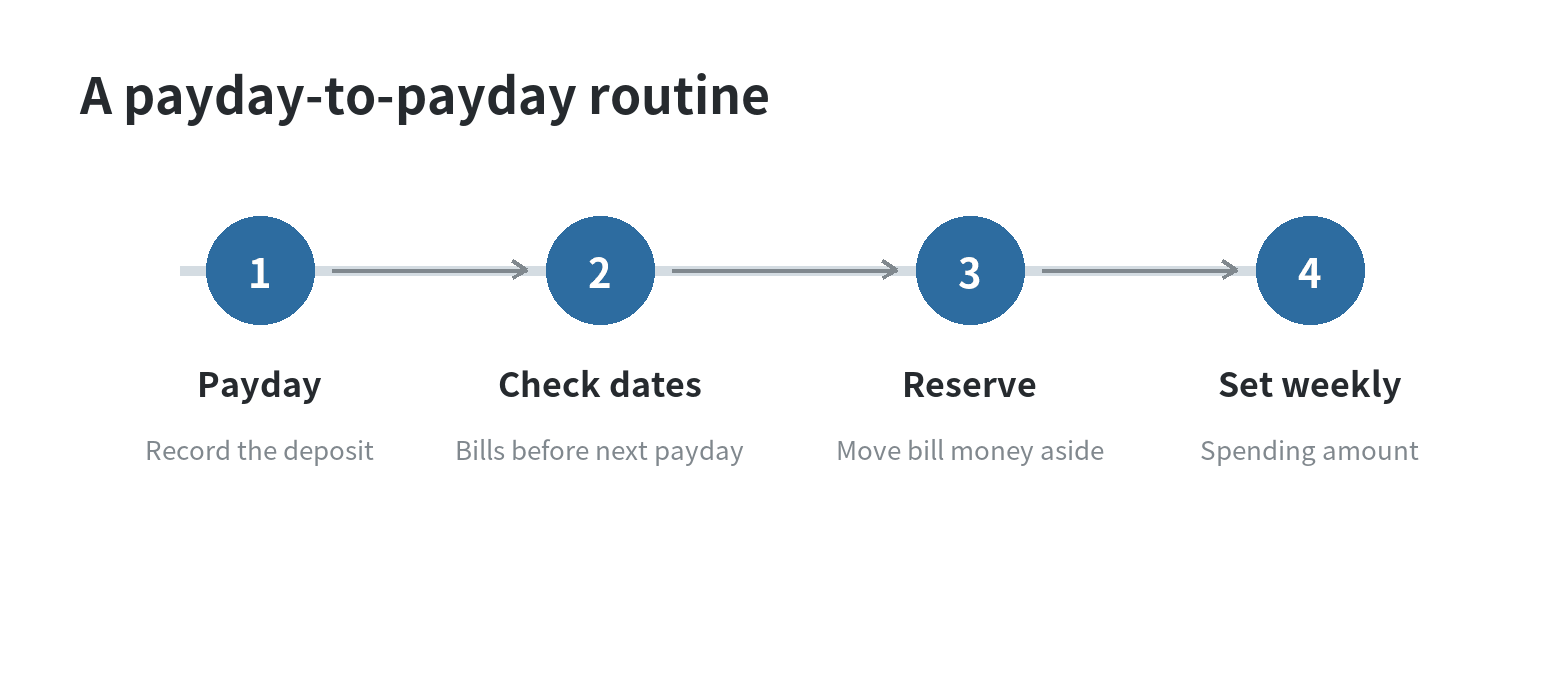
Write each deposit date on a calendar, then add rent, utilities, debt payments, insurance, and other due dates. The CFPB bill-calendar instructions say to record each bill, amount, and due date, then keep the calendar somewhere you can review it weekly. That view catches a timing problem that a monthly total can hide: enough money may be planned for the month, while too many bills fall before the next deposit.
For each payday, first cover bills due before the next payday and any essentials needed to get through that week. Then move a planned share into a separate bill holding place, whether that is a second account, an envelope, or a line in your ledger. Keep spending money distinct from reserved bill money so the same dollars do not get assigned twice.
Turn monthly bills into weekly set-asides
A monthly bill can be funded in small pieces from weekly checks. For a simple starting estimate, divide the bill by four and reserve that amount from each of four checks. A $1,000 rent payment, for example, would call for $250 from each of four $700 checks. The rent money is not spare cash when it sits in the account; it is already committed to the next due date.
A bill calendar helps account for the actual payday dates, because weekly deposits do not fall four times in every calendar month. Adjust the reserve when the calendar includes another deposit. Give that check a job—such as getting ahead on next month’s rent or rebuilding a bill reserve—before treating any of it as flexible spending.
If a bill comes due before you have built its reserve, protect the due date first. Start by assigning the next check to the bill that arrives soonest, then use later checks to rebuild the reserve. Contact the biller if the due date repeatedly lands before the money is available; the CFPB says you can ask creditors and utility companies about due dates that better fit your income.
Try the plan with four $700 paychecks
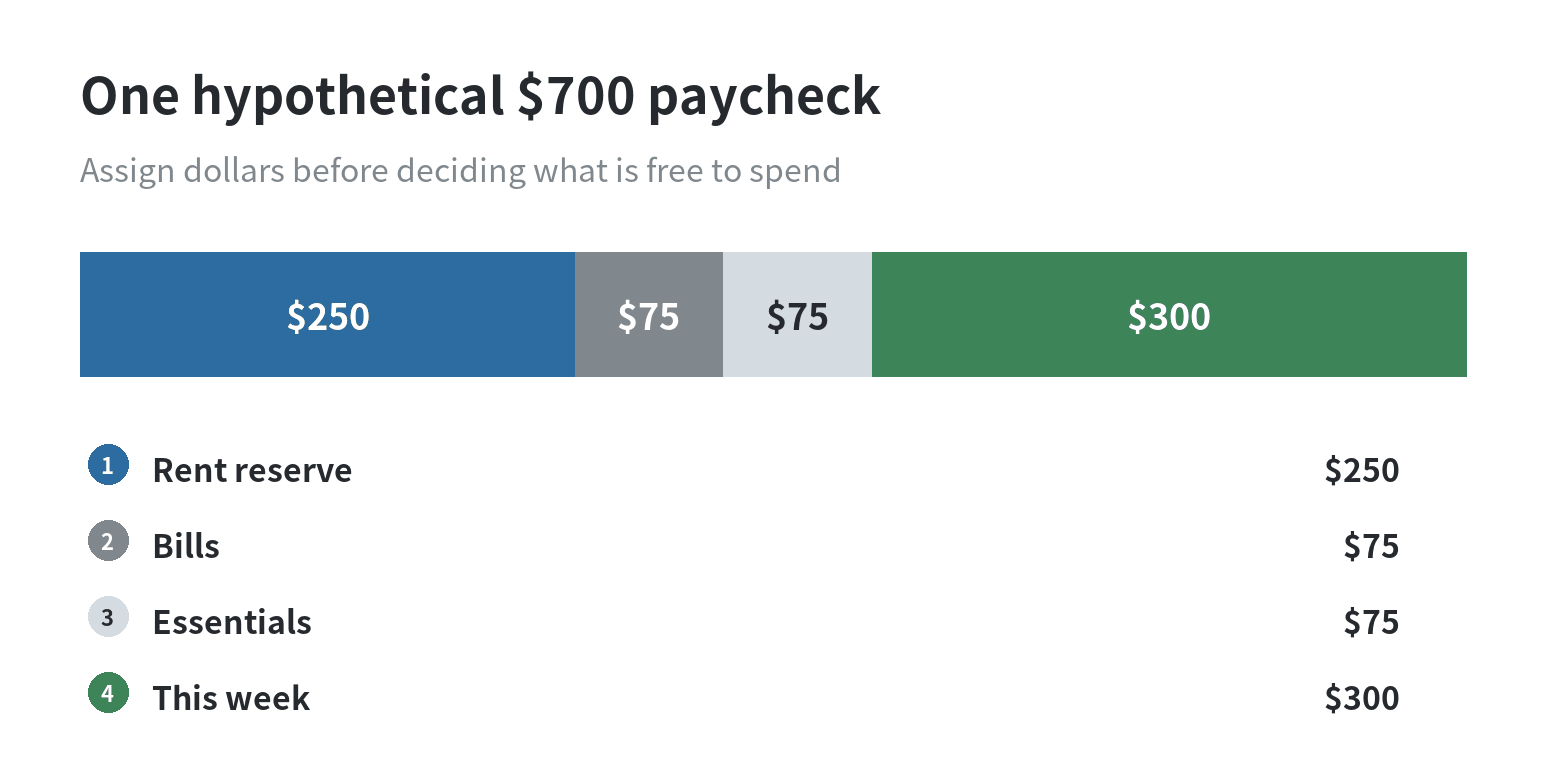
Suppose your take-home deposit is $700 each Friday and you are mapping a month with four deposits. Your plan might reserve $250 from each check for rent, $75 for utilities and phone, and $75 for transportation and groceries that are paid from a monthly bill or refill schedule. That leaves $300 per check for weekly food, household needs, savings, and flexible spending. These are sample figures; replace them with your statements and actual due dates.
| Each $700 check | Planned amount | Purpose |
|---|---|---|
| Rent reserve | $250 | Build toward $1,000 |
| Utilities and phone | $75 | Monthly bills |
| Transit and recurring essentials | $75 | Known scheduled costs |
| Available for this week | $300 | Groceries, savings, and flexible spending |
If your real utility bill changes by season or your grocery shopping is not a monthly charge, use recent statements to estimate the amount and timing. Keep the amount assigned to groceries in the week it is meant to cover instead of treating the whole monthly total as available on the first payday.
For a bill that changes, such as electricity, do not treat the latest invoice as a fixed monthly amount. Put recent bills side by side and choose a reserve that can handle a higher-cost month in your household. If the next bill is lower, leave the unused amount in the reserve for another cycle. If it is higher, cover the difference from the reserve and adjust the next set-aside. The FTC’s budget guide recommends starting with bills and their amounts; your own statements give you a household-specific estimate.
Handle an extra payday and a short week deliberately
When a calendar month includes an extra weekly deposit, decide its job before it arrives. Check the next month’s bills, replenish a reserve that is below target, cover a known annual or irregular expense, or add to savings. Do not make it part of the regular monthly plan until you know which bills it needs to support. For a worked plan focused on that extra deposit, see our guide to budgeting a five-paycheck month.
A short paycheck needs a different order. Compare the cash available with the dates of housing, utilities, transportation to work, food, and required minimum payments. Put the due dates beside the amounts, then contact a biller before the due date if the schedule will not work. The CFPB recommends reviewing cash flow week by week and asking creditors or utility companies about due dates that fit income timing.
If the same week is short in each cycle, the problem may be timing, a budget line that is too low, or a gap between dependable income and required expenses. Track what happened for a full pay cycle, then change one assumption at a time: shift a bill date if the provider allows it, lower a flexible category, or use a reserve to bridge the timing gap and schedule how it will be refilled.
Review the calendar before the next deposit
Before each payday, check the balance in your bill reserve, mark which payments cleared, and look at the next set of due dates. The FDIC’s budgeting materials separate income, expenses, and savings; keeping those categories visible makes it easier to spot when a bill reserve is being used for everyday spending. If the numbers do not balance, revise the plan before assigning money to optional purchases.
After a few pay cycles, compare your estimates with actual deposits and transactions. Change a weekly set-aside when the bill amount or schedule changes, and keep irregular costs on a separate list so they do not surprise the weekly spending plan. A budget that follows paydays can be adjusted as your real calendar changes.
If you prefer to start from a monthly take-home figure, our guide to budgeting on a $4,000 monthly income shows a different way to organize the same household decisions.
FAQ
How do I save for a yearly bill when I am paid weekly?
Divide the expected bill by the paydays remaining before it is due, then reserve that share from each check. If a $520 premium is due after 26 weekly deposits, setting aside $20 from each deposit covers the sample amount by the due date.
Can I keep my bill reserve in the same checking account as weekly spending?
Yes, if you keep a clear record of how much is already committed. Subtract upcoming bills from the account balance before treating the remainder as available, or use a separate account or ledger line to show the reserved amount.
How should a household budget when two people are paid on different days?
Put both deposit dates and all shared bills on one calendar, then assign each bill to the deposit that arrives before its due date. Record who is responsible for moving or paying each amount so one person does not assume the other has covered it.
What if my weekly paycheck arrives on different weekdays?
Use the deposit date shown in your account each time rather than relying on a fixed weekday. Update the calendar when the money arrives and assign it to the bills due before the next expected deposit.
Last updated: 2026-10