
A workable family budget starts with the money your household actually brings home and the bills it actually pays. List both adults’ take-home income, map the costs of raising children, then give irregular expenses a place before assigning what remains. A national average cannot tell you what your rent, childcare, commute, or school calendar costs.
Start with the money that reaches checking
Use take-home pay rather than gross salary: the amount deposited is what the household can assign to bills, food, savings, and other spending. If income changes from month to month, build the first draft around a lower, dependable month. Add variable pay only after it arrives, and decide in advance which goal it will support.
Write down the income for each adult separately, including a second job or recurring support the household relies on. Keep occasional gifts, reimbursements, and uncertain overtime out of the baseline. This makes the plan easier to follow when a paycheck is smaller than expected.
The Consumer Financial Protection Bureau’s Monthly Budget worksheet separates monthly income from spending and subtracts total spending from total income. Its categories include housing, utilities, groceries and supplies, transportation, education and childcare, health expenses, and debt payments (checked September 30, 2026). Use the same structure, then add lines that fit your family, such as school activities or pet care.
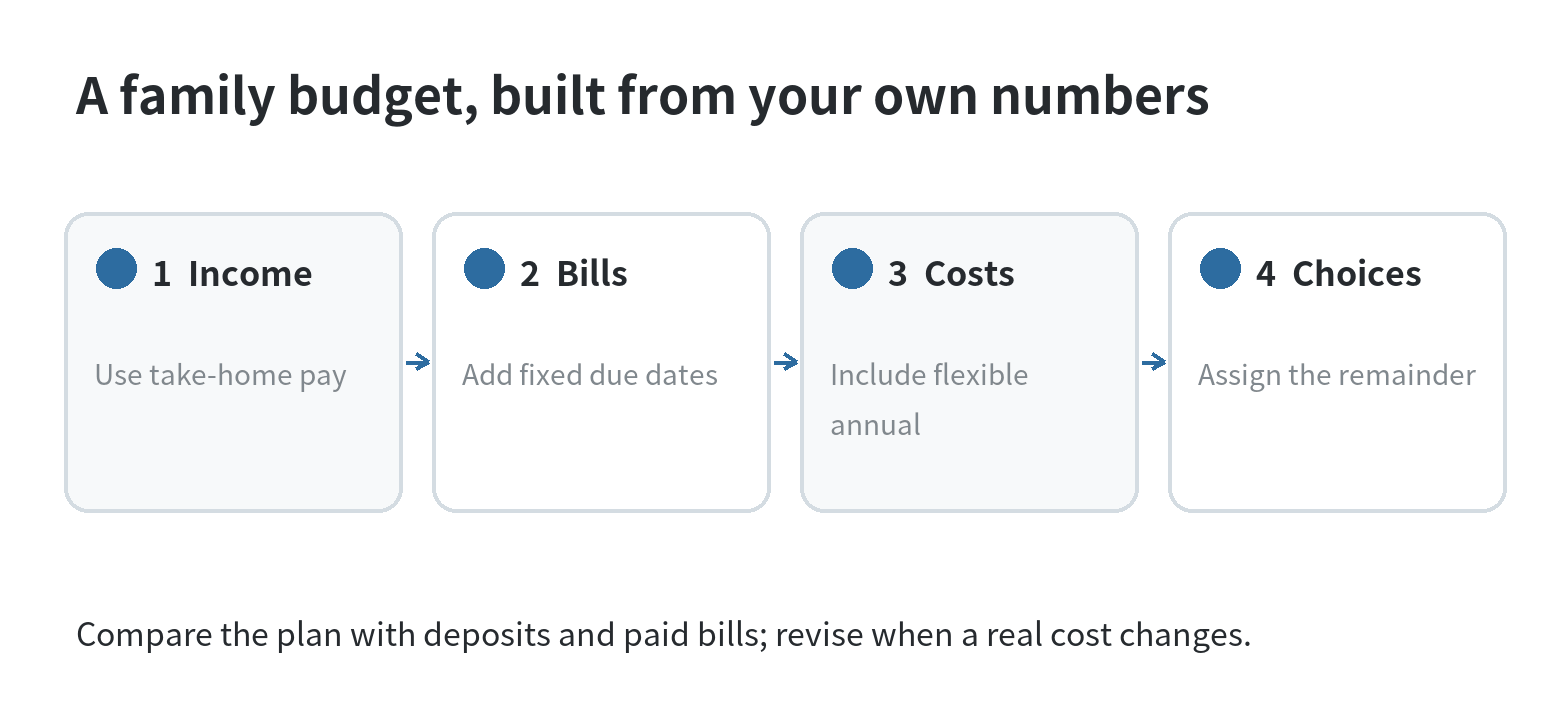
Build the month from bills, not percentages
Collect recent bank and card statements, pay stubs, bill notices, and childcare invoices. The CFPB’s spending assessment recommends reviewing checking and credit card history and looking across several months for less frequent costs such as insurance, school clothes, tuition, gifts, and vacations (checked September 30, 2026). Its financial planning worksheet suggests listing three months of each expense and averaging them. That gives you a starting estimate, not a rule that every month must match.
Here is an illustrative household with two adults and two children. The figures are invented to show the arithmetic; replace each one with your records. The household brings home $6,400 in a month and assigns $2,100 to housing, $550 to utilities and phones, $950 to groceries and household supplies, $700 to childcare and school costs, $600 to transportation, and $500 to debt payments. Those entries total $5,400, leaving $1,000 to divide among savings, irregular costs, and flexible spending.
Keep a simple category list alongside the bills:
- Fixed commitments: rent or mortgage, insurance, minimum debt payments, and scheduled childcare.
- Flexible essentials: groceries, household supplies, fuel, and utility bills that vary.
- Family-specific costs: school meals, uniforms, lessons, sports fees, birthdays, and childcare closures.
- Irregular costs: annual renewals, car maintenance, seasonal clothing, travel, and gifts.
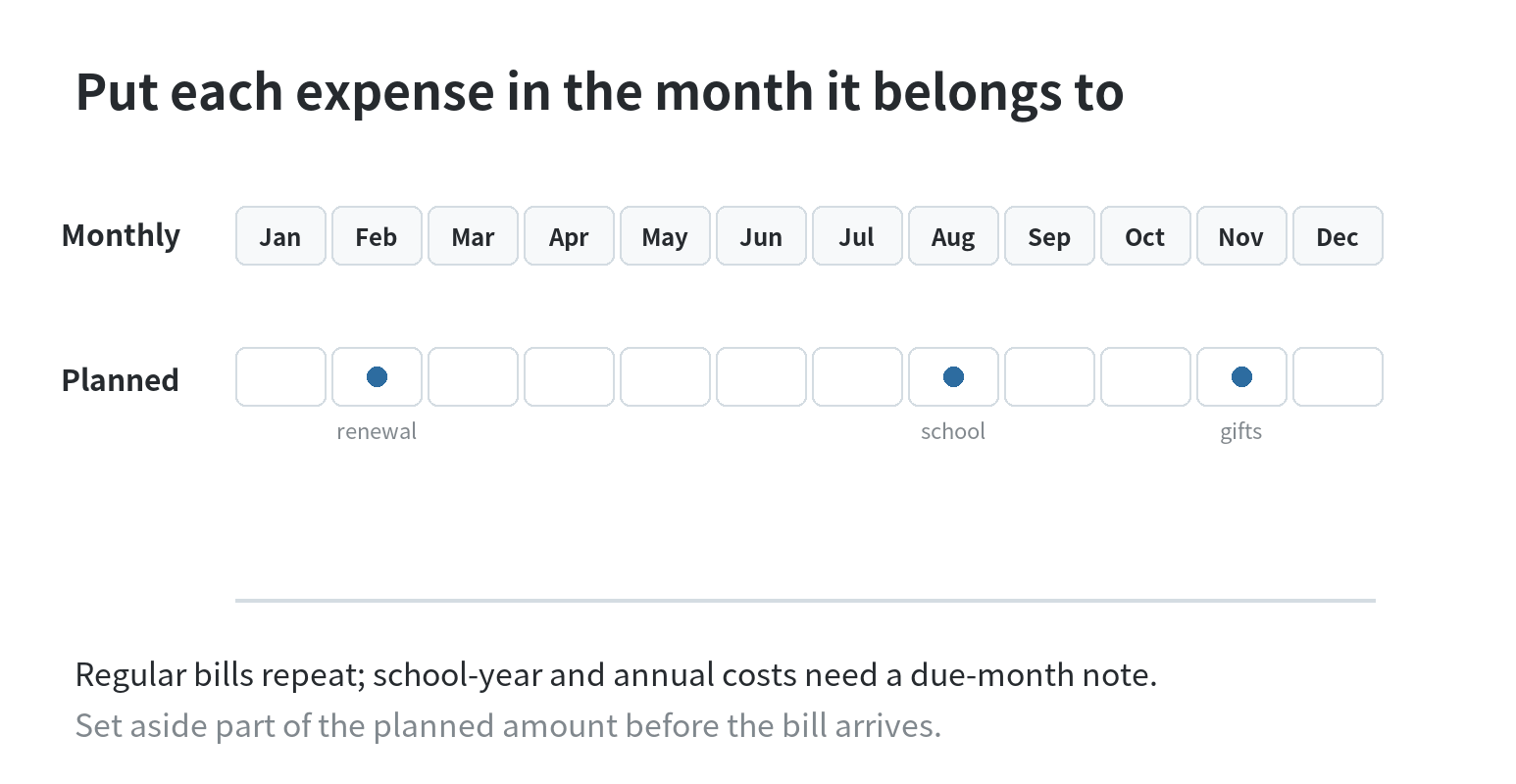
For a bill paid once or twice a year, divide the amount you expect to pay by the number of months until it is due. Put that amount in a separate savings line each month. If a $600 insurance bill is due in six months, setting aside $100 a month would cover it by then, assuming the bill and timing stay as expected. Update the line when the renewal notice arrives.
Give child-related costs their own lines
A single “kids” category hides which expense is squeezing the month. Separate childcare, school meals, supplies, clothing, activities, and care during school breaks if those costs apply. Use invoices, school calendars, and prior transactions rather than a generic family spending benchmark.
For expenses with a seasonal schedule, note the due month beside the amount. A sports registration fee in August or a school supply purchase in September should not appear as a surprise if you can identify it from the calendar. Divide the planned cost across the months before it is due, or reserve part of a month with extra income.
Ask which expenses are shared and which belong to one person’s choice. For example, each adult may agree that routine school costs come from the household account while optional activities need a quick conversation before enrollment. A clear rule makes the budget usable without turning every small purchase into a negotiation.
If childcare or school expenses change during the year, revise the line when the new schedule or invoice is known. Do not leave an old estimate in place just because it fits the spreadsheet. The budget is a working record of your current commitments.
Use the remainder to set priorities
After listing expected costs, compare the total with take-home income. If spending is higher, first check whether an expense was counted twice, whether an annual bill was treated as monthly, or whether an estimate came from a month with unusual costs. Then decide as a household which flexible category to adjust and what essentials remain protected.
If the example family has $1,000 left after listed bills, it might assign $300 to a planned car repair fund, $250 to savings, $250 to clothing and activities, and $200 to meals out or other personal spending. Those are choices for the example, not recommended targets. A family with a different rent, debt load, or childcare schedule will need a different split.
When the numbers are tight, rank bills by due date and consequence, then contact the provider or lender before a missed payment if you need to ask about options. Avoid filling a gap with credit card borrowing without including the payment in the next month’s plan. Mark the amount by which listed costs exceed take-home pay, then review flexible categories and upcoming expenses with both adults before deciding what to change.
Leave a small flexible line for costs that do not fit another category. If the line is used, record what happened and decide whether the expense belongs in next month’s plan. If it is not used, move the remainder toward a goal the household has already chosen.
Review the plan after real bills arrive
At month-end, compare the plan with cleared transactions and note only the categories that need a decision. A grocery line that ran high because guests visited calls for a different response than a recurring bill increase. Keep the reason with the revised amount so you can tell a one-time event from a new pattern.
Check the plan before upcoming bills are due so you can catch an activity fee or a category running low while there is still time to adjust. If one adult handles most transactions, share the current balances and upcoming expenses in a place both adults can access. Agree on who updates the budget and when, so the plan reflects the same set of numbers.
Rework the budget after a change in pay, childcare, housing, debt, or household membership. Bring the next known expense into the month it belongs to, then make the remaining choices with the updated total. A useful family budget is a shared map of obligations and decisions, not a scorecard.
FAQ
Should a family of four use one joint account for every expense?
No single account setup fits every household. Agree on which bills and child-related costs are shared, how each adult contributes, and how personal spending is handled; then make sure both adults can see the amounts due.
How should you budget when a paycheck arrives every other week?
Build monthly bills around the paychecks you can count on, and map each due date to a deposit date. Treat a month with an extra paycheck as income for a goal you have already named instead of assigning it to routine bills in advance.
What if childcare costs change during the school year?
Update the budget when you receive the new schedule or invoice. Record the amount and start date, then check which flexible category or savings assignment needs to change to make room for it.
Should you copy a national average for a family of four?
No. The Bureau of Labor Statistics reports spending by consumer units, a group that can include people living alone or households of different sizes. Use those reports as broad context only; your own statements and bills are a closer fit for your household.
Last updated: 2026-09