To budget your way through $10,000 in credit card debt, set a payment you can repeat after covering essentials, then route any extra cash to the card with the highest APR.
Start with the payment estimate on your statement and your actual take-home pay; the balance alone cannot tell you what a workable monthly amount is.
Start with the number on your statement
Pull the latest statement for each card. Write down its balance, minimum due, due date, APR for each balance type, and the issuer’s estimated monthly payment to clear the balance in 36 months.
The CFPB explains that the estimate uses the current balance and assumes no new charges; Regulation Z requires the disclosure for covered card accounts, with listed exceptions (CFPB explanation; Regulation Z § 1026.7, checked October 1, 2026).
Treat that figure as a reference point. It assumes you stop adding charges and keep making the stated payment. If your budget cannot support it, begin with the minimums and build a reliable extra amount.
If it can, use the estimate as a starting target while leaving room for rent, food, utilities, transportation, and a cash cushion.
Find a monthly payment that fits your cash flow
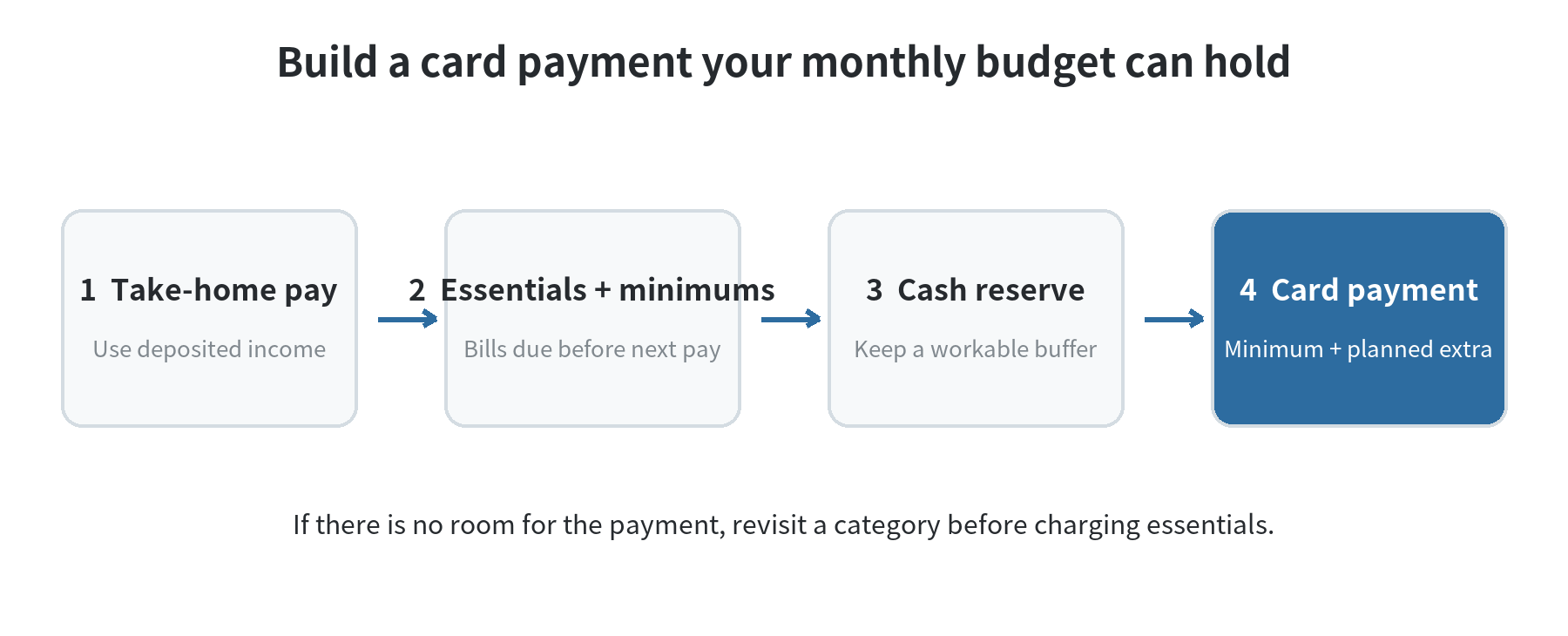
Use take-home income, not gross pay. List housing, utilities, food, transport, insurance, minimum debt payments, and expenses with non-monthly due dates, such as car registration or annual premiums. Turn those irregular costs into monthly set-asides by dividing each expected bill by the number of months until it is due.
Here is an example you can replace with your numbers: take-home income is $4,000. Essentials and household bills total $2,650; other debt minimums are $250; and planned irregular expenses get $300. That leaves $800 before the credit card payment and flexible spending.
Reserve $250 for ordinary surprises and personal spending, then budget $550 for this card, including its minimum. The categories total $4,000, so the plan does not depend on borrowing for groceries at month-end. For your version, use your own income and expenses as in the CFPB’s budgeting steps.
If $550 is too tight once you review recent transactions, lower the target and adjust one category at a time. If your income varies, make the required payment from your lower, dependable monthly amount; assign extra income only after it reaches your account and near-term bills are covered.
CFPB suggests adding income and expenses first, then deciding what you can afford if you cannot make the minimum (checked October 1, 2026; CFPB steps for managing card bills).
Understand what the APR does to the balance
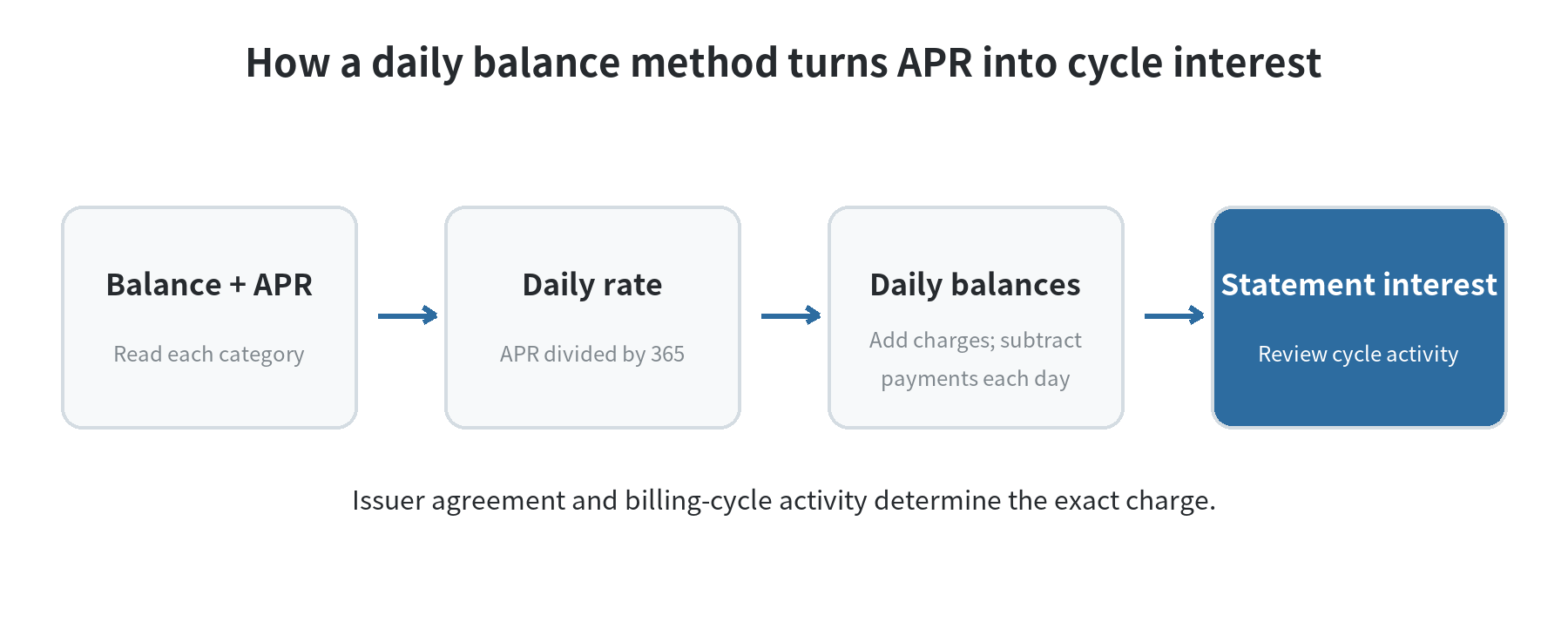
APR is an annual rate, but the CFPB says many card issuers calculate interest day by day using an average daily balance (CFPB interest explanation, checked October 1, 2026).
In a CFPB example of the average-daily-balance method, the daily periodic rate is APR divided by 365; the issuer applies it to the average daily balance and the billing-cycle days. Your agreement determines the method and may separate purchases, transfers, and cash advances into different APR balances (CFPB contract definitions, checked October 1, 2026).
For a simple scale check, at a hypothetical 24% APR, $10,000 multiplied by 24% and divided by 365 is about $6.58 of interest for one day if the balance stayed at $10,000; this uses the daily-rate formula described by the CFPB (checked October 1, 2026).
Chase also describes dividing APR by 365 for a daily rate and notes that some issuers use 360 instead, which is why your agreement matters (Chase’s calculation guide, checked October 1, 2026).
The $6.58 is not a monthly bill estimate: payments, new charges, fees, the billing-cycle length, and the issuer’s calculation method change the result. Check the statement’s interest charge and the APR attached to each balance rather than treating APR divided by 12 as your exact charge.
Choose where the extra payment goes
Pay at least the minimum due on every card by its due date. Direct the remaining debt-payment money to the balance with the highest APR.
When you pay above the minimum, CFPB says the issuer generally must apply that excess to the highest-rate balance first, then to other balances in descending APR order; the minimum-payment portion can be allocated under the issuer’s rules (CFPB payment-allocation explanation, checked October 1, 2026).
If all $10,000 is on one card, the choice is simple: keep the minimum current and send the budgeted extra to that card. With multiple cards, list them by APR, but do not skip a minimum on a lower-rate card to do it.
If two APRs are close, paying the smaller balance first can simplify your bill list, but that is a preference rather than a lower-interest calculation.
For a mixed-rate account, check the statement’s balance categories before estimating progress. A purchase balance, cash advance, and promotional balance can have different rates or terms. A payment may not reduce each category in the way a quick spreadsheet assumes.
| Monthly budget line | Example | How to replace it |
|---|---|---|
| Take-home income | $4,000 | Use deposited pay, after deductions |
| Essentials and household bills | $2,650 | Use recent bills and bank transactions |
| Other debt minimums | $250 | Add each statement minimum |
| Irregular-bill set-aside | $300 | Divide upcoming costs across pay periods |
| Reserve and flexible spending | $250 | Set a limit you can maintain |
| Target card payment | $550 | Include the card’s minimum |
Make the budget hold through the month
Put the due date on your calendar and schedule the minimum around the paycheck that arrives before it. If you are paid twice a month, split the target across both checks only if the money will be in your account before the payment date.
An extra payment earlier in the cycle may reduce the balance used in a daily calculation, since CFPB explains that interest accrues daily; keep enough cash for bills due before your next payday (CFPB interest explanation, checked October 1, 2026).
Stop new spending from quietly replacing the amount you just paid down. If you use the card for a recurring bill, move that bill to a payment method you can cover from checking, or include it in the card budget and pay it as part of the monthly plan.
CFPB says the statement’s 36-month estimate is based on the displayed balance and assumes no new charges; ongoing charges can change the timeline (CFPB statement estimate explanation, checked October 1, 2026).
At month-end, compare the planned payment with what posted and record the new balance and interest. Update the budget when rent, insurance, income, or minimum payments change.
If you receive a refund, bonus, or extra shift pay, first cover bills due before the next paycheck; then decide what portion you can send to the card without using the card again for essentials.
When the minimum no longer fits
If the minimum is unaffordable, contact the card issuer promptly and explain what you can pay and when your income may change.
CFPB advises asking about payment options and, if you seek credit counseling, asking about any fee and the services included (checked October 1, 2026; CFPB guidance). Avoid a company that guarantees it can erase the debt or tells you to stop communicating with the issuer or stop minimum payments; CFPB identifies those as warning signs.
If you are still meeting minimums but the balance barely moves, compare the statement interest with your payment and pause new charges if you can. Your next useful number is the monthly amount that remains after essentials and other minimums—not an online payoff date built on a different APR or payment schedule.
Use that number to revise the plan and review it again when the next statement arrives.
For a broader monthly spending setup, see how budgeting apps can organize your categories. If your pay changes from month to month, a variable-income tracking approach can help you base fixed commitments on money already received.
FAQ
Should I use savings to pay off a $10,000 card balance?
Keep enough cash for bills and likely near-term costs before deciding what to send. Compare the amount you can safely use with your card’s APR and minimum, and do not leave yourself needing to charge routine expenses again.
What if I have more than one card with a balance?
Make each required minimum, then direct the extra amount to the highest-APR balance. The CFPB says payments above the minimum generally go to the highest-rate balance first, subject to the account’s balance categories and payment rules (CFPB payment-allocation explanation, checked October 1, 2026).
Why did my balance fall by less than my payment?
Interest, fees, and new transactions can offset part of a payment. Compare the statement’s opening balance, new activity, interest, fees, and payments to see how the closing balance was calculated.
Can I budget a different payment every month?
Yes. Make the minimum on time, then add an amount your current cash flow supports. A steady base payment with occasional extra payments can fit uneven income better than a target that forces new card spending.
Last updated: October 2026
Last updated: 2026-10