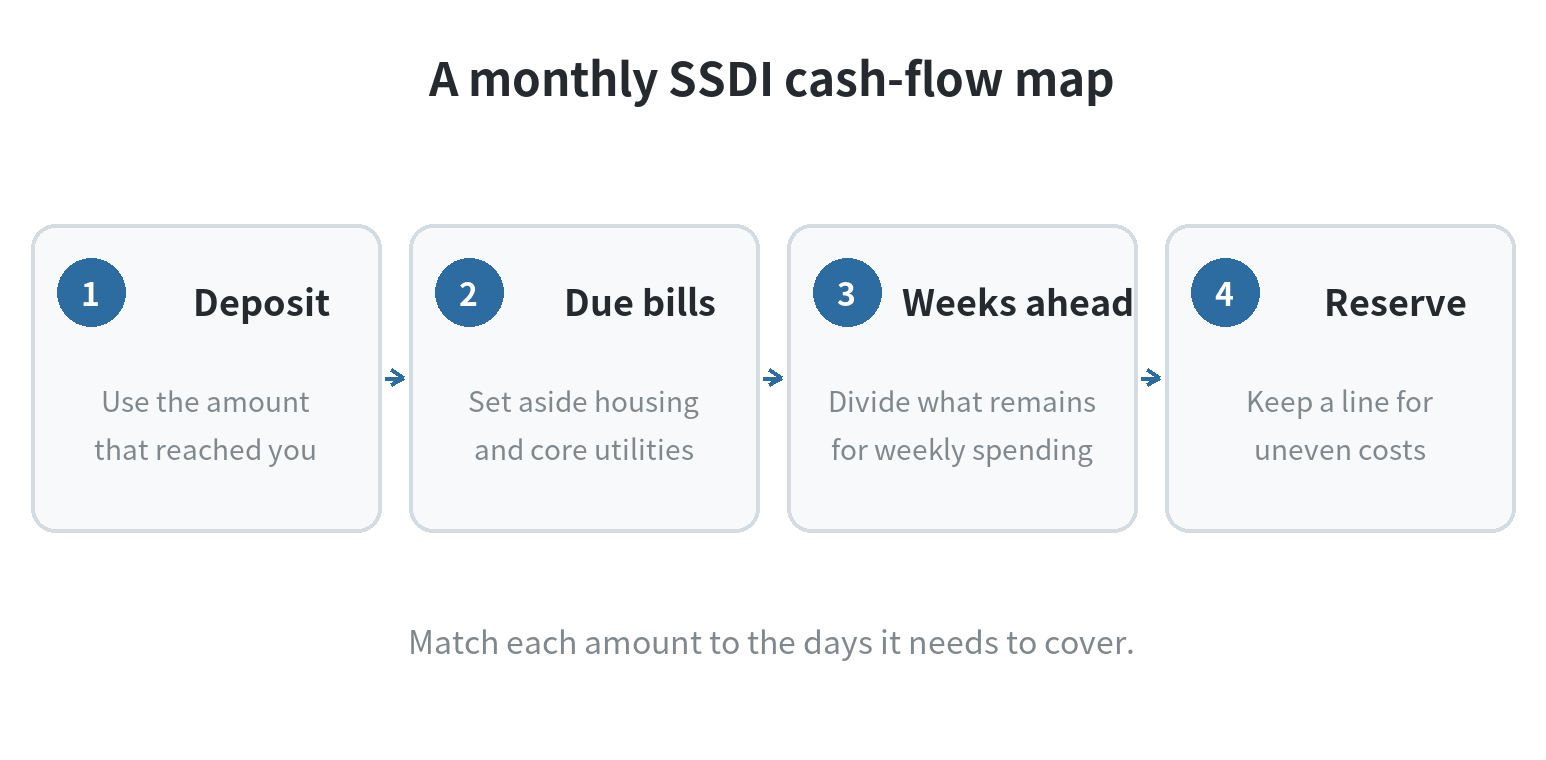
Budgeting on SSDI works best when you start with the amount that actually reaches your account, then assign it to bills in the order they come due. Build the plan around your deposit date, protect housing and basic utilities first, and give irregular costs their own small monthly amounts instead of hoping they fit later.
Start with the deposit, not an estimated benefit
Use the net deposit shown in your bank history or current Social Security notice. Do not build the month around a national average or an old award letter: your budget needs to match the money available to you after any deductions. If you receive another regular household income, list it separately so you can see what each source covers.
Social Security says payment timing depends on the benefit type and the birthday on the worker’s record. Check the 2026 Social Security payment schedule against your own deposit history; the calendar can help you place bills on the right side of payday. (Checked October 1, 2026.)
Write down three figures before you make categories: the amount deposited, the date it arrives, and the total of bills due before the next deposit. This separates a low monthly total from a timing problem. A bill may be affordable across the month but still come due before the benefit arrives.
Put due dates on a one-page calendar
Make one line for the deposit date and one for each bill’s due date. Include rent or mortgage, electricity, heat, water, phone, internet, insurance, debt minimums, and any recurring household payment. Beside each bill, record its amount from the latest statement and whether it is fixed or changes from month to month.
Mark the days between deposits as well. If rent is due early but your benefit arrives later, the problem is the calendar, not necessarily the monthly total. Ask the biller or landlord whether a different due date or payment arrangement is available. Do not assume a change is approved until you have it confirmed.
For weekly spending, divide the money left after due bills into the number of weeks you need it to cover. Keep that amount in a separate note, envelope, or account if that makes it easier to see what remains. The method matters less than being able to check the balance before spending.
Give the essentials first claim on the money
When the deposit lands, set aside the housing payment and core utilities before flexible purchases. Then reserve money for food, transportation needed for daily tasks, communication, insurance or medical bills, and required debt payments. The exact order within those groups depends on what keeps your household housed, connected, and able to meet necessary commitments.
Here is a made-up example, not a recommended SSDI amount: with $1,800 deposited for the month, a household might assign $800 to rent, $160 to utilities, $280 to groceries, $50 to phone service, $90 to transportation, $100 to household and personal items, $80 to out-of-pocket bills, $70 to debt minimums, $100 to a reserve, and $70 to flexible spending. Replace every line with your own statements and obligations.
| Purpose | Example | What to check |
|---|---|---|
| Housing | $800 | Rent or mortgage due date |
| Utilities | $160 | Recent bills and seasonal changes |
| Groceries | $280 | Receipts for a normal month |
| Phone and transportation | $140 | Plans, fares, fuel, or rides actually used |
| Household, out-of-pocket, and debt minimums | $250 | Statements and required payment dates |
| Reserve and flexible spending | $170 | Keep the reserve separate from weekly spending |
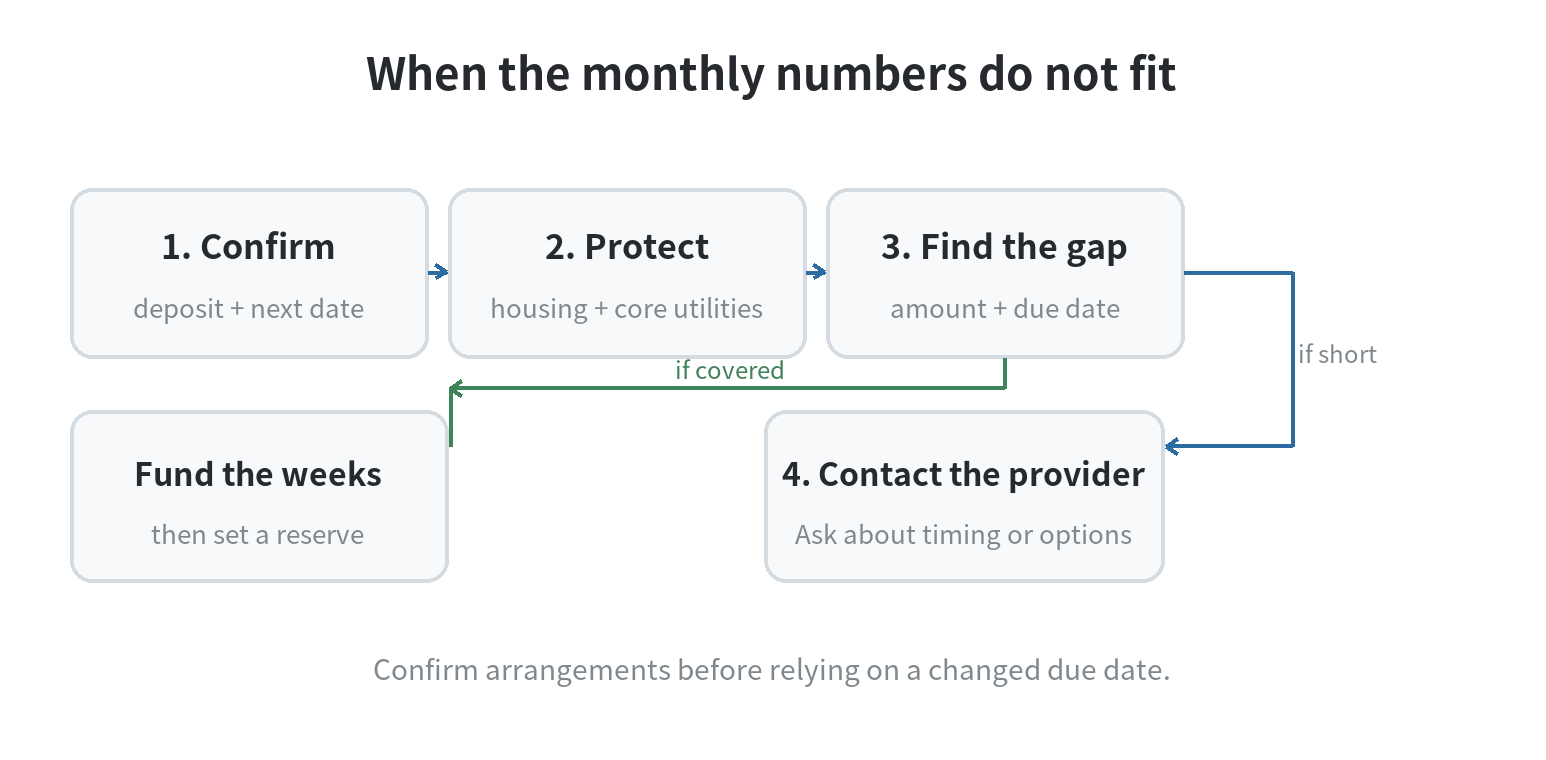
The example is useful as a worksheet, not as a target. If your essential lines already exceed your deposit, changing small optional purchases may not close the gap. Write the shortfall down clearly, then contact the provider tied to the largest upcoming bill to ask what payment options exist.
Turn uneven bills into monthly lines
Heating, car repairs, prescription copays, annual fees, and replacement household items do not arrive in equal monthly amounts. Look through past statements and receipts, list the irregular bills you can identify, and divide each expected bill by the number of months until it is due. Put that amount in a separate “upcoming costs” line each month.
For example, if an annual $240 fee is due in six months, setting aside $40 per month would cover that specific bill by its due date. That calculation is only a planning example; use the amount and timing from your own notice. If there is no room for the full amount, save what is realistic and contact the provider before the deadline to ask about options.
Use a simple list with four columns: bill, next due date, expected amount, and amount already set aside. Update it when a bill arrives. This gives you a short list of upcoming pressure points without needing to predict every expense or treat an uncertain estimate as guaranteed.
When the plan comes up short
Compare the next deposit with bills due before the following deposit. If the gap appears before payday, identify which payment is both urgent and negotiable. Call that provider before the due date and ask specific questions: Is there a due-date option? Can the balance be split? Is there a hardship or reduced-payment process? Write down the name of the person you spoke with and the terms offered.
Pause optional purchases that have not been committed, but avoid making a payment promise that the remaining budget cannot support. If you use automatic payments, check the account balance and scheduled drafts so that several bills do not pull money needed for food or transportation at once. A calendar reminder can help you review those drafts a few days before they occur.
If the shortfall repeats, bring the budget and recent bills to a nonprofit credit counselor or a local benefits counselor and ask for help reviewing the full picture. They can help you organize questions and options; only the agency or provider can confirm a benefit decision, eligibility rule, or account-specific arrangement.
Keep work income and benefit notices in separate records
If you work while receiving disability benefits, record gross pay, pay dates, hours, and work-related expenses separately from the amount that reaches your bank account. Keep pay stubs and copies of anything you send. Social Security says people receiving Disability benefits must report work activity; its work and disability page explains the reporting step and work incentives. (Checked October 1, 2026.)
Do not use a budget worksheet to decide whether a job, a number of hours, or a particular level of earnings will affect your benefits. Rules can depend on the benefit and work situation. Before changing expected income, check the current Social Security instructions and ask the agency how to report your own work activity.
Keep benefit notices with your budget records. If the deposit changes, compare the notice with the new bank deposit, update the income line, and then revisit bills due before the next payment. Avoid spending money that has not arrived just because an earlier notice showed a different amount.
FAQ
What should I do if an SSDI deposit arrives later than I planned?
Check the current Social Security payment calendar and your bank’s posted transaction history first. If the scheduled date has passed, follow Social Security’s instructions for a missing payment and contact the billers whose due dates fall before the deposit.
Should I budget from the benefit amount on an old letter?
No. Use the amount currently deposited or a current Social Security notice, because an old letter may not reflect what reaches your account now. Keep the notice with your budget so you can compare it with the next deposit.
How can I make room for a surprise bill?
Use any reserve you have set aside, then ask the provider about payment timing or a hardship process before the due date. If the reserve is empty, update the next month’s plan with the amount and due date instead of assuming the cost will disappear.
Last updated: October 2026.
Last updated: 2026-10