A sinking fund turns a bill you can name into smaller deposits made before its due date. List the cost, the date it is due, and the amount already saved; divide the remaining amount by the deposits left. The CFPB’s savings action plan uses this same target-and-time calculation, while Consumer.gov recommends listing recurring and less frequent bills in a monthly budget. CFPB savings action plan and Consumer.gov budget guidance (checked September 30, 2026).
It works for planned costs such as an annual insurance bill, school expenses, or a trip. The point is not to predict every surprise; it is to stop a known expense from arriving as if it were new. Keep an emergency reserve for costs without a known date, and use sinking funds for costs you can put on a calendar.
Start with bills that arrive out of rhythm
Scan your bank and card statements, bills, and calendar. Mark expenses that are irregular or larger than a normal week of spending: annual premiums, registration renewals, school fees, holiday travel, or a replacement appliance you already expect to need. The CFPB cash-flow calendar describes saving for annual expenses and periodic lump-sum bills (checked September 30, 2026).
Use the amount on the latest bill or a written estimate you can explain. If the amount changes by season, compare the same month in prior statements instead of treating one month as the annual cost. Leave an estimate labeled as an estimate, then replace it when the bill arrives.
Give each goal a clear name and due date. “Car insurance, due in August” is easier to budget than a generic “savings” line because you can see which upcoming obligation the balance belongs to. Add only expenses that matter enough to reserve for; a long list of tiny categories can make routine budget maintenance harder.
Calculate the deposit from the date backward
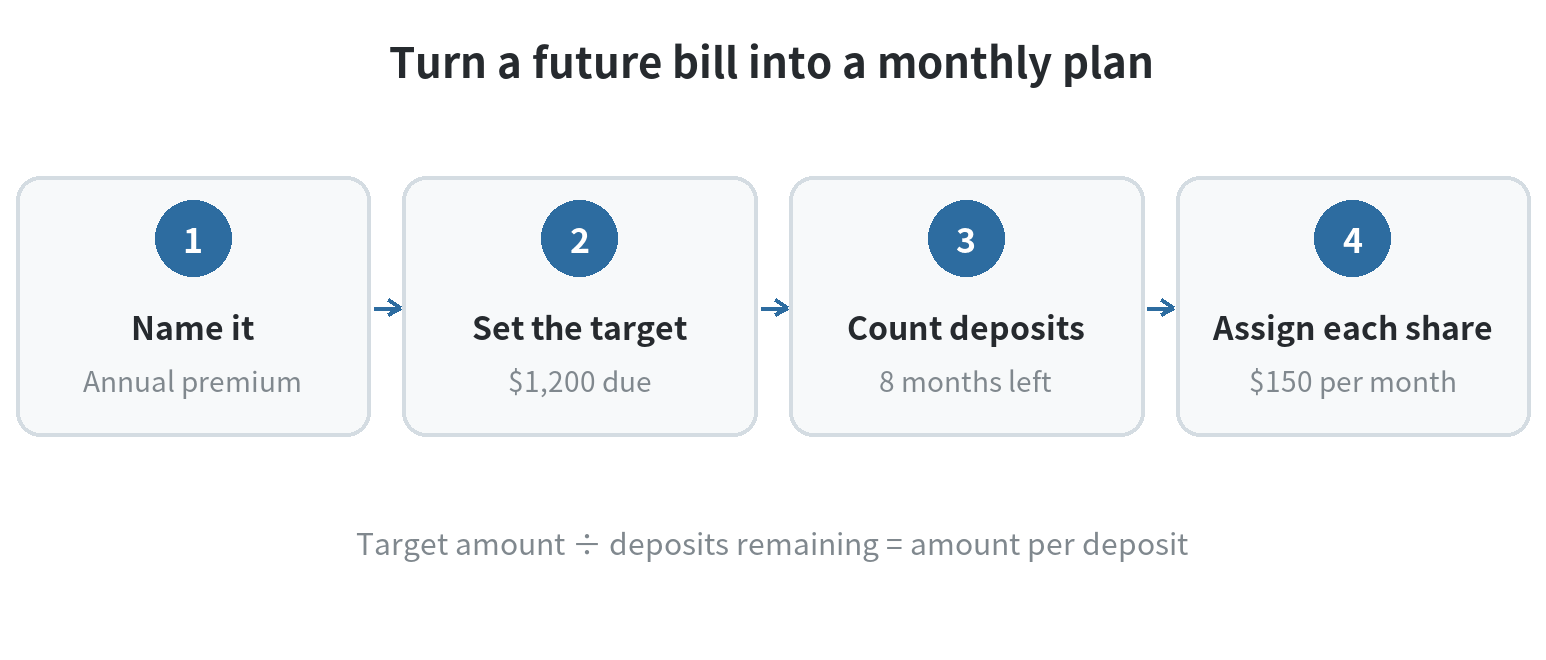
Use this calculation: (target cost − amount already saved) ÷ deposits remaining = deposit per pay period. Count only deposits you can make before the bill is due. The CFPB savings action plan lays out a total amount, time to reach the goal, and amount to save per week; it also says to choose a contribution rhythm that fits, such as weekly, monthly, or per paycheck. The CFPB action plan and FDIC savings-goal guidance both connect a target amount with a deadline and a saving plan (checked September 30, 2026).
For a replaceable example, suppose an annual premium is $1,200 and it is due in eight months, with no money set aside yet. Divide $1,200 by eight deposits: the plan calls for $150 a month. If $300 is already saved, the remaining $900 divided by eight deposits is $112.50 per month. Those are example calculations, not estimates of anyone’s actual bill; the target-and-time method follows the CFPB savings action plan.
Match the deposit to your pay schedule and cash flow. If you are paid twice a month, you could split a $150 monthly target into two $75 transfers. If income arrives unevenly, set the deposit after the paycheck that can cover it, then check that the bill will still be funded by the due date. The CFPB’s cash-flow calendar places income and expenses on their expected dates and uses that view to plan for periodic payments. CFPB cash-flow calendar (checked September 30, 2026).
Give each goal its own line
You do not need a separate bank account for every purpose. A notes app, spreadsheet, or budget category can track each goal’s current balance, next deposit, and due date. If the money is held in one savings account, keep a simple ledger so the combined account balance does not make you think the same dollars are available for two bills.
| Planned expense | Example target | Time left | Monthly set-aside |
|---|---|---|---|
| Annual insurance bill | $1,200 | 8 months | $150 |
| School costs | $360 | 6 months | $60 |
| Holiday travel | $900 | 9 months | $100 |
| Combined example deposit | $310 | ||
Every amount in the table is an illustrative target, not a national average or price quote. The arithmetic assumes no starting balance, equal monthly deposits, and no interest. For an actual bill, replace each target with your own statement or estimate and recalculate using the deposits still available. Consumer.gov’s budget guidance also recommends using your own bills and income when you make the monthly plan.
Write down when a goal is funded and what happens next. After paying the insurance bill, for example, its category can begin building toward the next renewal. If a goal disappears, move its remaining balance deliberately to another named goal or to general savings; do not let an old category quietly obscure what the money is for.
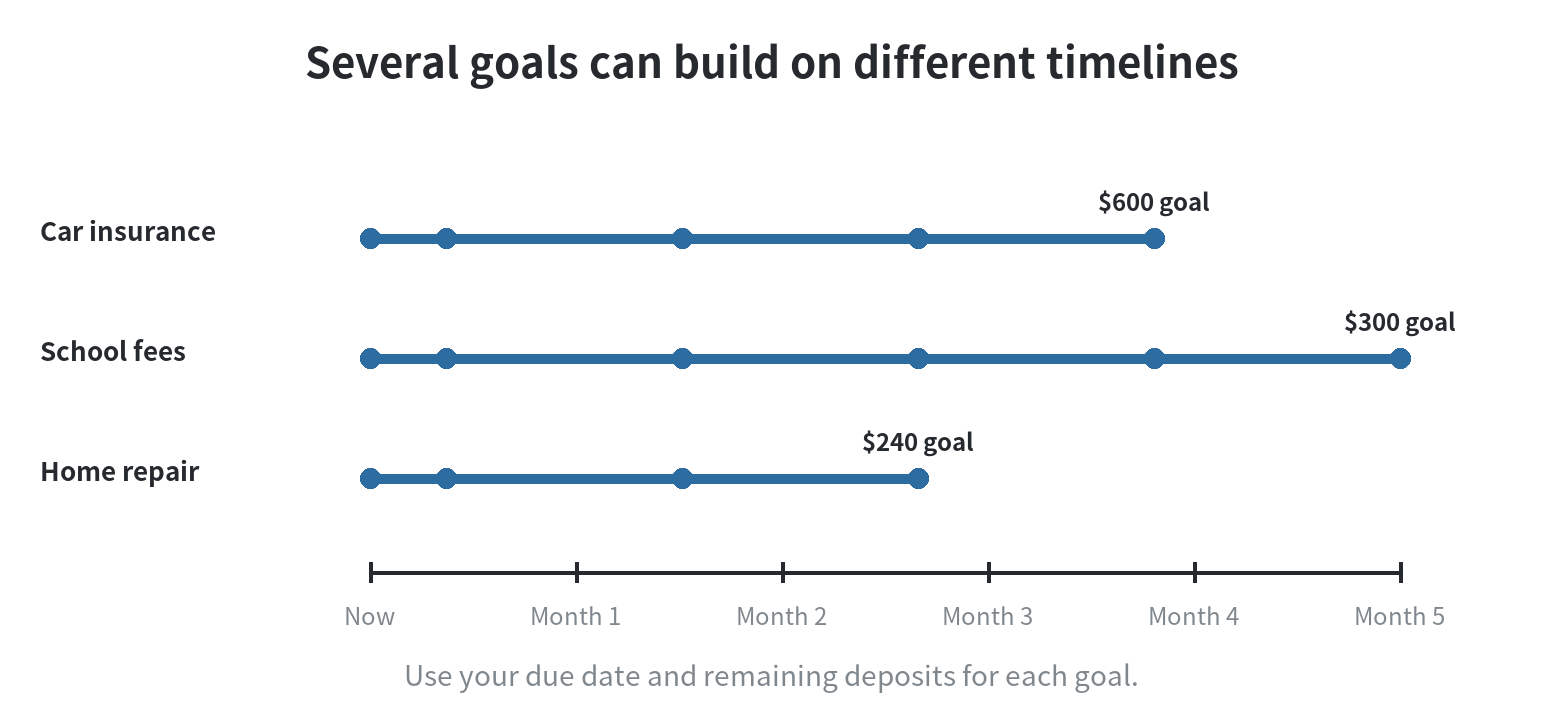
When two bills are due close together, compare their due dates with your paydays instead of looking only at the month-end total. A calendar can show whether a deposit lands before the bill is drafted and whether rent or utilities leave enough in checking first. The CFPB cash-flow calendar recommends placing income and expenses on the dates they are expected, which makes this timing check visible.
When the monthly total does not fit
Add the planned deposits to your regular bills and essential spending before assigning the rest of your paycheck. Consumer.gov says a budget compares monthly income with bills and other expenses, and advises reviewing the plan when expenses exceed income. Consumer.gov’s monthly budget steps (checked September 30, 2026).
If the total is too high, use the due dates to find the pinch point. First confirm each target and date from a statement, renewal notice, or calendar. Then decide whether the expense can be reduced, delayed, split, or handled with a smaller contribution. For a flexible goal such as travel, lowering the target changes the monthly amount directly. For a bill with a fixed due date, calculate how much can be set aside from each remaining paycheck and identify the gap early.
Do not quietly borrow from one goal to make another look complete. If you move money, record the transfer and update both balances. A short note such as “$40 moved from travel to insurance; travel target reset” keeps the plan honest and makes the next month’s budget easier to read.
Keep the routine small enough to repeat
At the start of the month, compare each balance with its target and due date. After the bill is paid, reduce the category by the amount spent. At month-end, compare the planned deposits with the deposits that actually happened and update the next month’s plan. Consumer.gov recommends making a monthly spending plan, recording spending, and using the month’s results to plan again (checked September 30, 2026).
For a quick review, ask three questions: Is the amount still realistic? Is the due date unchanged? Does the next deposit fit after bills already due before the following paycheck? The CFPB cash-flow calendar uses income and expense dates for this kind of timing check. If any answer changes, revise the line instead of treating the old number as a promise.
If the bill’s renewal notice changes the amount, update the target before setting the next deposit. If you have already saved more than the revised target, the extra is still your money; decide whether to leave it for another bill or assign it to a different named goal. A dated ledger entry preserves the reason for the change when you revisit the plan.
A simple spreadsheet can show the target, amount saved, remaining amount, due date, and next deposit. If you already track spending on your phone, the site’s budget tracker walkthrough can help you keep planned deposits beside everyday transactions. Readers comparing digital tools can also use the site’s overview of budgeting apps; the fund amounts still come from your own bills and calendar.
FAQ
Can I use one savings account for several sinking funds?
Yes. Track each goal as a separate balance in a spreadsheet or budget category, and reconcile the combined ledger with the account balance so you do not assign the same dollars twice.
What if I start saving after the first planned month?
Subtract what is already saved from the target, then divide the remainder by the deposits left before the due date. If the resulting deposit does not fit, revisit the target, timing, or payment plan now.
Should an emergency fund be one of my sinking funds?
Keep unexpected costs separate from named, dated expenses. An emergency reserve covers costs without a known due date; a sinking fund is tied to a planned expense and a calendar date.
What should I do with leftover money after the bill is paid?
Choose its next purpose and record it. You can start saving for the next cycle of that bill, assign it to another planned cost, or return it to general savings.
Last updated: 2026-09