Choose a turkey fryer by the setup your yard and power source can actually support, then follow the exact model manual.
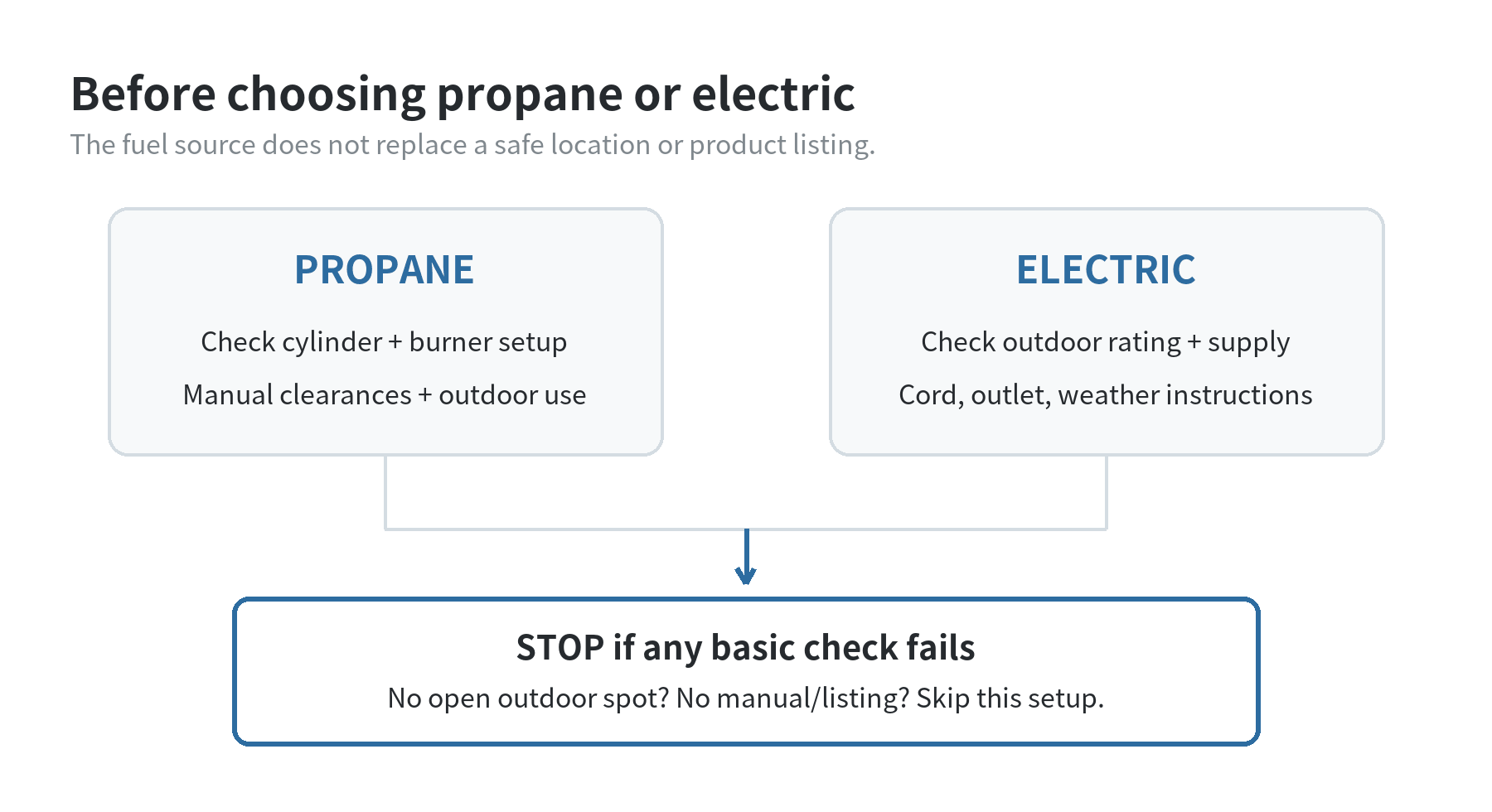
Propane and electric describe how a unit is heated; neither label makes a hot-oil fryer safe to use near a house, under a porch, or without supervision.
NFPA says home oil turkey fryers pose a risk of hot oil release and recommends considering listed alternatives, including electric models.
If you are still comparing outdoor equipment, the site’s guides to outdoor heater placement and carbon monoxide alarms cover related setup questions.
A fryer needs its own instructions; do not transfer clearances from another appliance.
Start with the cooking method, not the fuel label
A propane turkey fryer generally means a burner heats a pot of oil.
An electric turkey fryer uses an electrical heating element, but a product description alone does not establish whether that specific model is approved for outdoor operation.
Check the label and manual for the exact model before deciding where it can be used.
NFPA’s home fire safety guidance advises choosing a turkey fryer listed by a nationally recognized testing laboratory and staying with it while it is in use.
The same guidance warns that traditional home oil fryers can release hot oil, while the burner can ignite spilled oil.
That is a meaningful difference from comparing convenience features such as fuel supply or storage.
If your priority is reducing open-flame equipment, an electric unit may remove the separate propane burner and cylinder from the setup.
It still involves hot oil and electricity outdoors, so verify the outdoor rating, cord and outlet instructions, and required clearances.
If those details are missing or the intended location cannot meet them, do not improvise a setup.
Map the outdoor location before setup
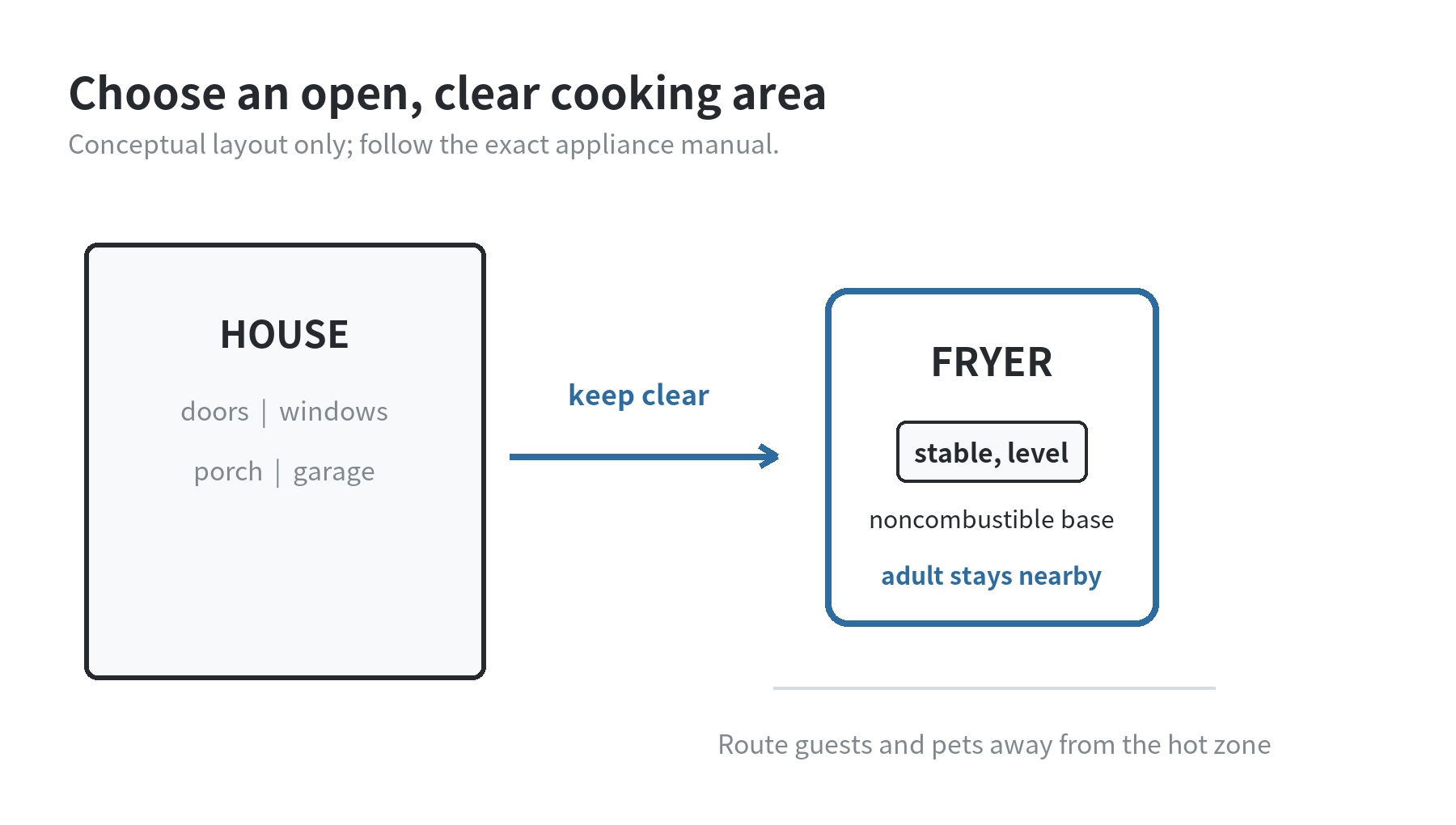
CPSC guidance says to use a turkey fryer outdoors and away from the home, never in a garage or on a porch.
Its fryer safety guidance also calls for an open area away from walls, fences, and other structures.
An open garage door or a roof over a patio does not turn an enclosed or covered location into an open cooking area.
Read the appliance manual for its own distance requirements from buildings and combustible materials.
Do not substitute a general number from another fryer or a neighbor’s setup.
If your yard cannot provide the specified space, choose another cooking method or location.
Set the fryer on a stable, level surface that can handle the appliance and hot cooking vessel.
Keep the route between the fryer and the kitchen clear, but keep guests, children, and pets away from the hot zone.
Put the control or shutoff within the operator’s reach without requiring anyone to lean over the pot.
Check wind direction before lighting a propane burner.
CPSC’s guidance says to position the tank and fryer so wind carries heat away from the propane tank.
Keep the fryer in full view while the burner is on; do not leave it unattended to answer the door or tend another dish.
What to check on a propane setup
Match the burner, pot, regulator, hose, and cylinder to the manufacturer’s instructions.
Do not combine components because their fittings seem to match.
Check that the hose is not cracked, kinked, or routed where it can touch hot parts or become a trip hazard.
NFPA’s gas grill guidance recommends checking a propane hose for leaks before the first use each year and after reconnecting the cylinder.
It describes applying a soap-and-water solution to the hose and connection and looking for bubbles.
Because a fryer may have different parts and instructions, use its manual for the approved leak-check procedure.
Keep the propane cylinder upright and in the position specified by the manufacturer.
If you smell gas or suspect a leak, shut off the supply if you can do so safely, keep ignition sources away, and follow the manual’s emergency steps.
Do not light the burner to test a connection.
What to check on an electric setup
Confirm that the exact fryer is approved for outdoor use.
Check the power rating against the outlet and the manufacturer’s cord directions.
NFPA’s general outdoor electrical guidance says outdoor extension cords should be rated for outdoor use and used within their ratings.
Outdoor electrical equipment should have ground-fault protection.
Keep plugs and connections out of standing water and follow the manual’s directions for wet weather.
Route the cord away from walkways, hot surfaces, and places where a chair or door could pinch it.
If the correct outlet or cord arrangement is uncertain, ask the manufacturer or a qualified electrician rather than adding an extension or adapter by guesswork.
Electric does not mean indoor.
If the label limits the fryer to outdoor use, keep it outside even when it is plugged into a household outlet.
Place it only where the manual’s ventilation, clearance, and weather limits can be met.
Plan the turkey and oil before heating
For an oil fryer, determine the oil fill level before heating.
Follow the model’s method; CPSC’s fryer guidance describes a water displacement test when a manual does not provide an oil amount.
Empty and dry the pot completely before adding oil.
Water left in the pot can splatter when it meets hot oil.
USDA food safety guidance says to thaw a turkey in the refrigerator, cold water, or microwave.
It gives refrigerator thawing as about 24 hours for every 5 pounds; cold-water or microwave thawing requires cooking immediately after thawing.
Never put a frozen or partly frozen bird into hot oil.
Lower and raise food slowly, keep exposed skin covered, and use the equipment specified by the manual.
If oil begins to smoke, follow the manufacturer’s shutoff steps.
Never pour water on an oil fire.
CPSC says to call emergency services if a fire occurs rather than attempting to extinguish it with water.
Use a food thermometer to check doneness.
USDA says a whole turkey should reach at least 165°F throughout, checked in the innermost thigh and wing and the thickest part of the breast.
Cooking time is not a substitute for measuring temperature.
Before comparing listings, note the model number and search the manufacturer’s documentation for that exact unit.
Check that the safety listing applies to the fryer, not only to an accessory or a similar product in the same product line.
Record the stated fuel or electrical requirements, outdoor-use wording, clearances, and oil capacity on one page.
If a listing and manual disagree, pause and ask the maker to identify the correct instructions for that model.
A quick go or no-go check
- The exact fryer is listed by a recognized testing laboratory, and its manual is available.
- You have an open outdoor location that meets the manual’s clearance and surface requirements.
- The propane or electrical supply matches the model’s instructions.
- The turkey is fully thawed, the oil fill plan is set, and an adult can remain with the fryer.
- Children, pets, and guests have a clear route that stays outside the hot area.
If one of these checks fails, postpone frying or use a different cooking method.
The appliance’s fuel source does not make a poor location workable.
FAQ
Can I use a turkey fryer on a covered patio?
Only if the exact model’s instructions allow that location and all clearances can be met.
CPSC says turkey fryers should be used outdoors and away from the home, not on a porch or in a garage.
Is an electric turkey fryer safe to use indoors?
Check the exact model label and manual.
NFPA recommends considering listed electric turkey fryers, but that does not establish indoor approval for every model.
Can I use an extension cord with an outdoor electric fryer?
Use one only if the fryer’s manual permits it and the cord is rated for outdoor use and the fryer’s load.
NFPA says outdoor cords must be used within their ratings.
How can I tell whether the turkey is done?
Use a food thermometer.
USDA says the whole turkey must reach 165°F in the innermost thigh and wing and thickest part of the breast.