A pole saw makes sense when the branch is above your normal hand-saw reach but still low, light, and clear of hazards.
Choose battery or gas around your work pattern, then check the tool’s stated length, weight, cutting limits, and manual before deciding.
Extra pole length does not make an unsafe branch a suitable DIY cut.
Start with the branch, not the power source
Write down the cuts you actually need: approximate branch height, diameter, and direction of fall.
A powered pole saw places its saw head at the end of a long shaft, letting you reach some elevated limbs while standing on the ground.
It does not give you a safe way to remove every high limb.
Look up before comparing tools.
If a branch touches, hangs over, or could fall onto a power line, stop and contact the utility or a qualified tree-care professional.
The STIHL Pole Pruner Safety Manual gives a 50-foot clearance for the tool and branches it contacts from energized lines.
A Husqvarna pole-mounted-pruner manual says never to use its tool near power lines.
These are serious hazards; do not treat one model’s clearance as a universal safe-distance rule.
Also check where the branch could land.
A limb over a roof, sidewalk, road, fence, or neighboring yard could land on property or a place where people pass.
If you cannot identify a clear landing area and a way to step aside, leave that cut to a professional.
Compare battery and gas by the work session
Battery power fits a session where easy starting, movement around the yard, and avoiding fuel handling matter.
Check whether a battery and charger are included.
Confirm which battery platform the saw accepts.
Make sure compatible packs have enough charge for the planned work.
Wisconsin Extension’s chain-saw guide describes battery runtime as a limit and gas refueling as a way to continue away from an outlet.
Gas power can suit repeated work away from an outlet when you are prepared for engine starting, fuel requirements, and maintenance.
The University of Wisconsin Extension notes that gas saws require more maintenance and effort to start than electric saws.
For a pole saw, verify the exact fuel mix and servicing steps in its manual instead of borrowing instructions from another machine.
| Question | Battery | Gas |
|---|---|---|
| What do you prepare? | Compatible charged battery and charger | Correct fuel and engine upkeep |
| What limits a session? | Available charge and spare packs | Fuel, starting, and maintenance routine |
| What should you compare? | Tool weight with the installed battery | Tool weight and the manufacturer’s fuel instructions |
Do not choose from a headline about power alone.
A heavier tool held at an angle can be harder to guide than its shelf weight suggests.
Compare the listed operating weight with the battery or cutting attachment installed.
Consider whether you can keep both hands on the handles and your feet planted while directing the head.
Read the reach number as a limit, not a promise
Product pages may describe maximum pole length or working reach.
Those figures do not mean the saw will feel controllable at full extension, nor that every branch at that height can be cut safely.
Look for the extension range, total operating length, and whether any extra extension is approved for that model.
Before choosing the longest option, picture the actual cut from the ground.
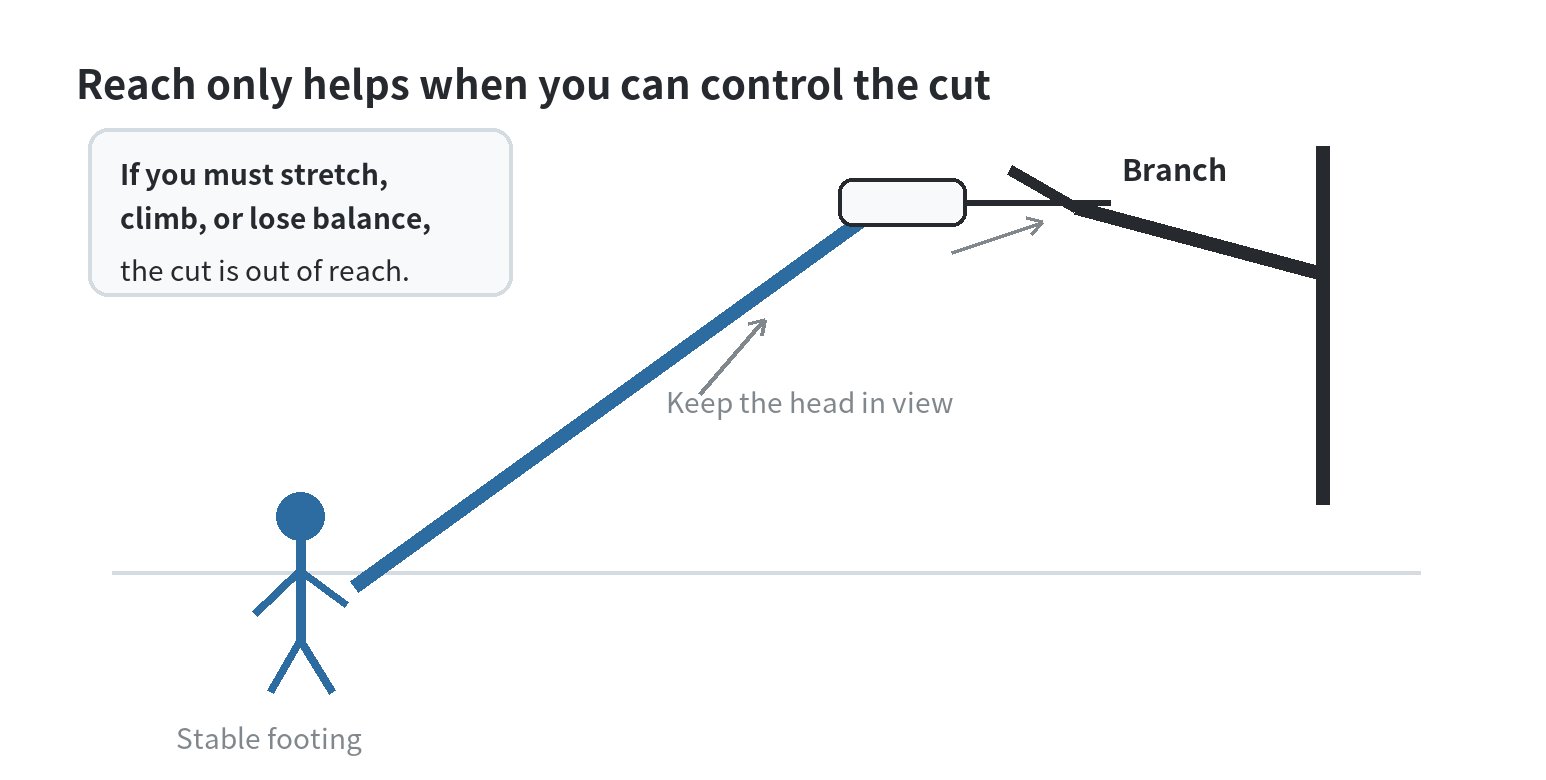
The saw head should approach the branch without you climbing, leaning far sideways, or standing directly beneath the limb.
The Husqvarna manual directs operators to keep both hands on the tool, maintain footing, work from the ground, and avoid overreaching.
If the cut requires a ladder or unstable support, it is outside that boundary.
Reach includes the space needed to position the bar and move the pole as the cut progresses.
Crowded branches, a fence, a roof edge, or a narrow side yard can block that movement.
A shorter, lighter setup with a clear approach can be more useful than maximum advertised reach.
Set a pruning limit before switching on
Keep the job to branches you can identify, control, and remove without putting yourself or anyone else in the fall path.
Check the specific manual for cutting capacity and operating instructions.
If the limb is large, heavy, dead, split, under tension, or trapped in other limbs, stop and get qualified help.
Pruning also has a tree-care side.
University of Minnesota Extension describes the branch collar as tissue around a branch base.
It advises making the final cut just beyond the collar without leaving a stub.
For a large limb, its guidance uses multiple cuts to reduce bark tearing.
Those cuts can be difficult to control with an extended power saw.
Do not use a pole saw as a reason to attempt major crown reduction or remove a large limb overhead.
For light maintenance, mark the branch you intend to remove before starting and leave neighboring limbs untouched.
The University of Georgia Cooperative Extension describes pole pruners as tools for branches beyond ground reach.
It warns against using aluminum-handled tools near power lines.
When the tree’s structure or the correct pruning point is unclear, pause and ask an arborist rather than making a shaping cut from below.
A saw that reaches the canopy does not make topping a good pruning plan.
University of Minnesota Extension distinguishes crown reduction from topping.
Proper reduction removes branches just above lateral branches.
The extension calls crown reduction the least desirable pruning type and says to use it only when necessary.
If your goal is to lower a mature tree or reshape its crown, hire a qualified arborist rather than making a series of overhead cuts with a pole saw.
For a single branch, identify the branch collar before cutting.
The final cut belongs just outside that collar, without leaving a stub or cutting into the trunk tissue.
The extension’s multi-cut method for a heavy limb is meant to limit bark tearing.
Positioning those cuts from below can put a homeowner under falling wood.
Treat a heavy limb as a professional job even when its outer end appears within reach.
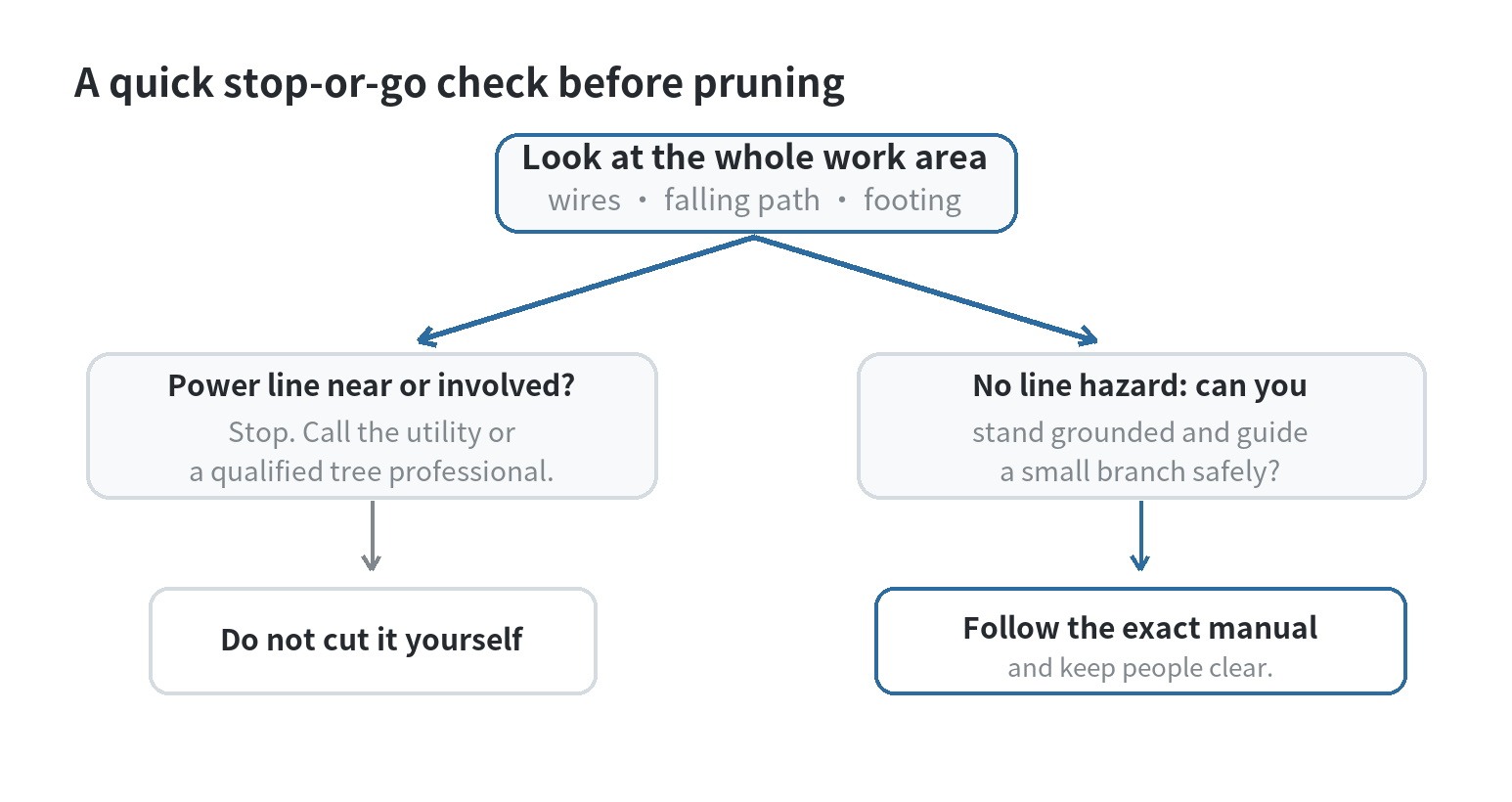
Run a short stop-or-go check
- Lines: If a line is nearby or a branch could contact one, stop and call the utility or a tree professional.
- Ground: Work only from firm footing. Do not use a ladder or climb while operating the pole saw.
- People and property: Clear the drop zone and keep people away. If a limb could reach a structure, path, road, or neighboring property, get help.
- Tool setup: Use the exact manual for the model, including its required protective equipment, permitted attachments, battery or fuel setup, and chain maintenance.
- Control: If you cannot guide the head with both hands without stretching or standing under the cut, stop.
Husqvarna’s safety instructions warn that limbs under tension can spring back when cut.
The manual also recommends head, eye, and hearing protection for its pole-mounted pruner.
The manual for the tool in your hands controls its operating limits.
If the work looks more like removing a tree limb over a target than trimming a small branch, choose a qualified tree-care professional.
A pole saw answers a narrow problem: a manageable branch that is too high for a hand tool but still reachable and controllable from the ground.
If the job is cutting logs already on the ground, use the separate chainsaw guide for ground-level wood.
For a broader yard-work calendar, see the seasonal home-maintenance checklist.
FAQ
Can a pole saw replace a ladder for every high branch?
No.
Use it only for work you can control from stable ground.
If you must climb, lean, stand below the fall path, or direct the saw near wires, get qualified help.
Should I use a pole saw on a branch over my roof?
Get professional help if a branch could fall onto a roof or other property.
Check the landing area as carefully as the cut.
An extended saw does not control where a released limb goes.
Can I add an extension pole to gain more reach?
Only if the exact tool manual lists that attachment as compatible.
An unapproved extension may affect control.
Do not assume extensions from another model fit.
What should I do if a branch is touching a power line?
Do not touch or cut it.
Contact the electric utility and let qualified line-clearance workers handle the hazard.