If you want the simplest setup, a 120V plug-and-play hot tub may fit—but only if its manual matches your outlet, circuit, and site. A 240V model can support a different electrical configuration, but it needs a planned installation. Jacuzzi’s electrical guide describes 120V plug-and-play and 240V hardwired systems. Compare the exact model’s electrical diagram, heating limits, filled weight, and service clearances before choosing a spot or arranging delivery.
The voltage label alone does not tell you whether a spa will work at your home. The model manual and local electrical rules control the circuit and GFCI details. The Consumer Product Safety Commission advises using a qualified electrician for hot tub electrical work under applicable local codes and the National Electrical Code.
Choose by how the spa can run
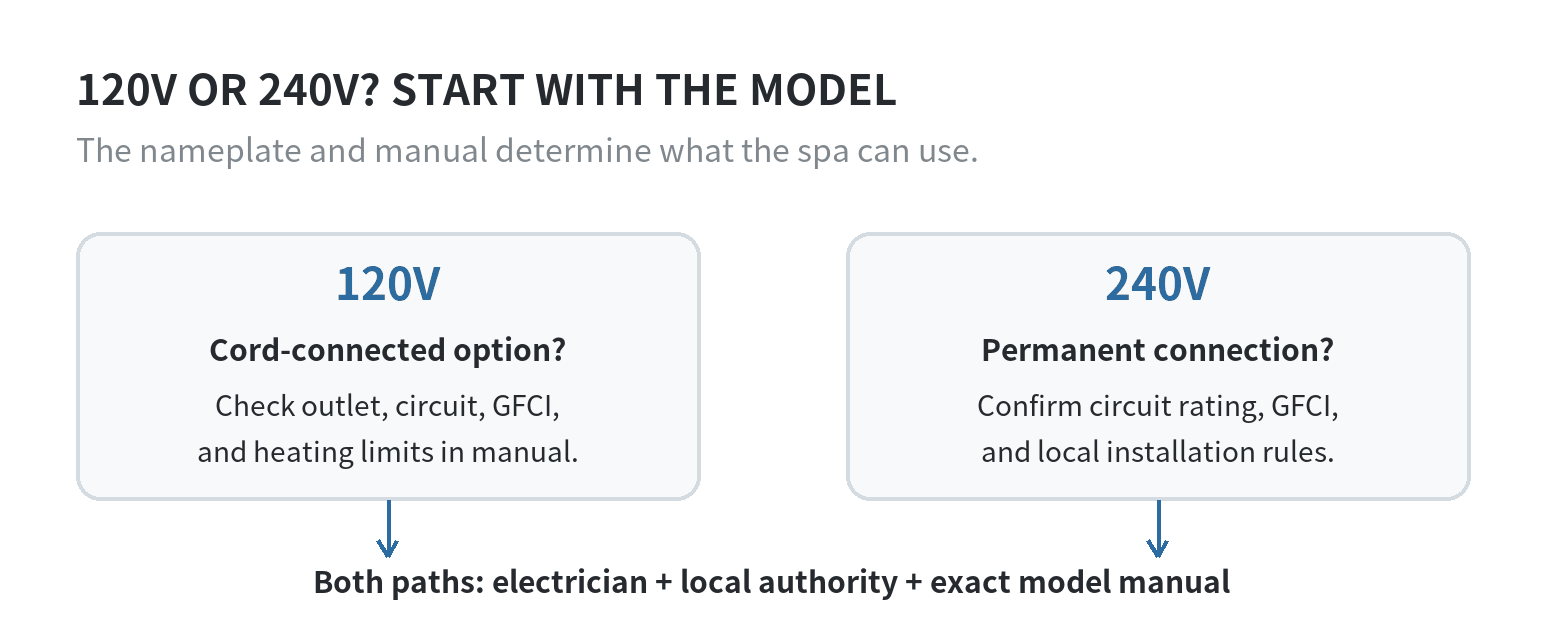
Jacuzzi describes its plug-and-play spas as 120V cord-connected models. That label does not mean you can use any nearby outlet or an extension cord.
Check the manual for the required receptacle, circuit rating, GFCI arrangement, and whether that circuit must serve the spa alone. Jacuzzi’s wiring guide says a hot tub needs a dedicated circuit. If the patio outlet also powers lights or a freezer, ask an electrician to confirm the circuit plan before delivery.
Jacuzzi contrasts 120V cord-connected models with 240V hardwired models. A higher-capacity heater or different pump combinations may be possible, but amperage, wiring, and simultaneous heating depend on the model.
Bullfrog’s electrical requirements list model-dependent 240V service and explain that a reduced-amp configuration can limit when heating operates. Jacuzzi likewise says its electrical diagrams vary by model and production year.
Check three operating limits: whether the heater runs with pumps, how filtration works, and what the manual says about cold-weather heating.
If you expect to use jets during cold evenings, ask whether that model can heat at the same time under its planned electrical configuration. A 120V label or a 240V label alone cannot answer that question.
Bullfrog’s Tadpole manual and Jacuzzi’s wiring guide show model-specific electrical configurations. Do not convert a 120V model or change a breaker based on another spa’s specifications. Ask the manufacturer or an electrician to confirm that exact configuration.
Confirm the circuit and GFCI before delivery
Send the model’s electrical page to a licensed electrician. Ask them to check panel capacity, the circuit route, disconnect location, permits, and inspection requirements.
Do not rely on a product label or a generic online amperage chart. Electrical requirements can change by model. Jacuzzi advises checking local city and county rules and any required permits.
For a clear handoff, share the spa’s model number and manual page. Include a photo of the panel label, taken without opening the panel, and the planned tub location. Ask who will verify permits and inspections so the electrical work and delivery schedule fit together.
GFCI protection is a core part of the plan. CPSC guidance names hot tub equipment, including 120V and 240V heaters. It recommends testing permanently installed GFCIs at least monthly. For infrequently used, portable, or cord-connected GFCIs, its guidance says to test before each day’s use. Follow the equipment’s instructions and have the electrician verify that the protection matches the spa and local rules.
Keep the GFCI and power shutoff locations easy to identify. CPSC recommends knowing how to turn off hot tub equipment in an emergency. If a GFCI trips, do not keep resetting it to force operation; leave diagnosis to a qualified electrician or service professional. For a broader explanation of receptacle and breaker protection, see our GFCI outlet guide.
Check the site as a loaded, serviceable space
Measure the complete route from the delivery point to the pad: gates, turns, steps, overhead branches, and the space needed to position the tub. Jacuzzi’s installation guidance asks owners to check widths, 90-degree turns, overhead clearance, and obstacles.
Give the delivery team the narrowest measurements and ask whether the chosen model needs special handling. A route that fits the tub’s footprint may still fail at a tight turn or low branch, so measure the whole path rather than only the final pad.
Next, verify the base and the filled weight. Hot Spring’s site-preparation instructions call for a structurally sound, level surface that can support the filled spa.
A deck needs a load-capacity check for that weight; a slab or spa pad also needs to match the model’s support requirements. Ask a qualified builder or structural professional about a deck or elevated installation.
Deck board material cannot establish the structure’s capacity. Our decking material overview covers the surface material choice; share the spa’s filled weight with the person assessing the deck.
Leave access to the equipment compartment and room to remove the cover. Plan where splash water and drained water will go, keeping water away from electrical equipment and building openings.
Check local rules for setbacks, barriers, drainage, and permits rather than borrowing a distance from another model’s guide. If the planned spot is near a property line or storm drain, confirm the local requirements before preparing the pad.
Build upkeep around the owner’s manual
Use the manual for the exact model as the schedule. Filter intervals differ by model. Bullfrog’s 2024 STIL guide says every three to six weeks. Jacuzzi’s owner FAQ says to rinse and clean filters monthly. These are manufacturer examples, not one schedule for every tub. Inspect the filter as directed, switch off power before removal when the manual requires it, and reinstall it correctly before operation.
Water testing, treatment, draining, and refilling also depend on the spa’s water-care system and use. Jacuzzi’s FAQ describes weekly water testing and water changes every three to four months. Bullfrog’s STIL guide gives a one-to-four-month interval based on use.
Follow the instructions for your water system and product labels. Before draining, check local disposal rules and choose a route that keeps water away from a storm drain or neighboring property.
A simple maintenance log can prevent guesswork: note the water-test date, any adjustment, filter rinse, cover cleaning, and refill date. Keep the product labels and model manual beside the log so each task follows the correct instructions.
Keep the cover secured when the spa is idle, clean it with materials allowed by the manual, and remove excessive snow if the manufacturer directs it.
Before cleaning, draining, or servicing, check the power-off procedure and winterization instructions. In freezing weather, residual water in plumbing can damage the equipment, so do not leave an outdoor tub empty without following its winter procedure.
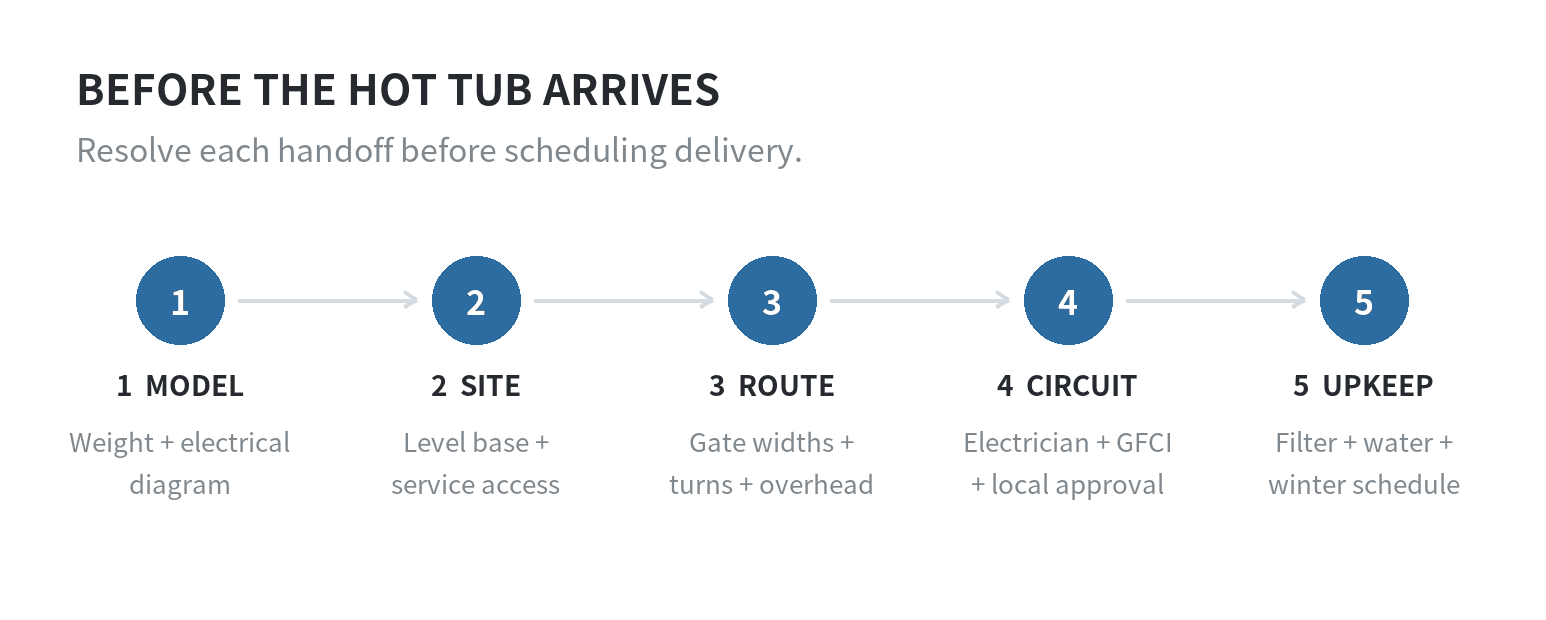
Use a short pre-delivery checklist
- Save the make, model, serial label, owner’s manual, and electrical diagram together.
- Get written confirmation of the circuit, GFCI, permit, and inspection plan from the electrician or local authority.
- Confirm the filled weight and base requirements, delivery route, service access, and water drainage plan.
- Write down the manufacturer’s filter, water-care, cover, and winterization schedule before the first fill.
Once those details match, compare the model’s operating limits with the electrical work your site can support. The plug style is only one part of the choice.
FAQ
Can I use an extension cord with a 120V plug-and-play hot tub?
Use an extension cord only if the exact spa manual explicitly permits it. The Tadpole owner’s manual prohibits extension cords for its 120V conversion. Confirm your model’s instructions and have an electrician check the outlet and GFCI arrangement.
Can a 120V hot tub be converted to 240V later?
Only when the manufacturer documents a conversion for that exact model. The Bullfrog Tadpole manual describes a conversion for specified system versions, while warning that its motors are not convertible. Ask the manufacturer and a licensed electrician to confirm compatibility.
Does a 240V hot tub always heat while the jets run?
No. Bullfrog’s electrical requirements explain that heating can be limited by the model’s electrical configuration. Check the owner’s manual or ask the manufacturer whether the heater can run with the pump setting you plan to use.
What should I ask before putting a hot tub on a deck?
Ask a qualified structural professional to compare the deck’s capacity with the filled weight at the planned location. The spa manufacturer’s site-preparation instructions provide the weight and support details to share.