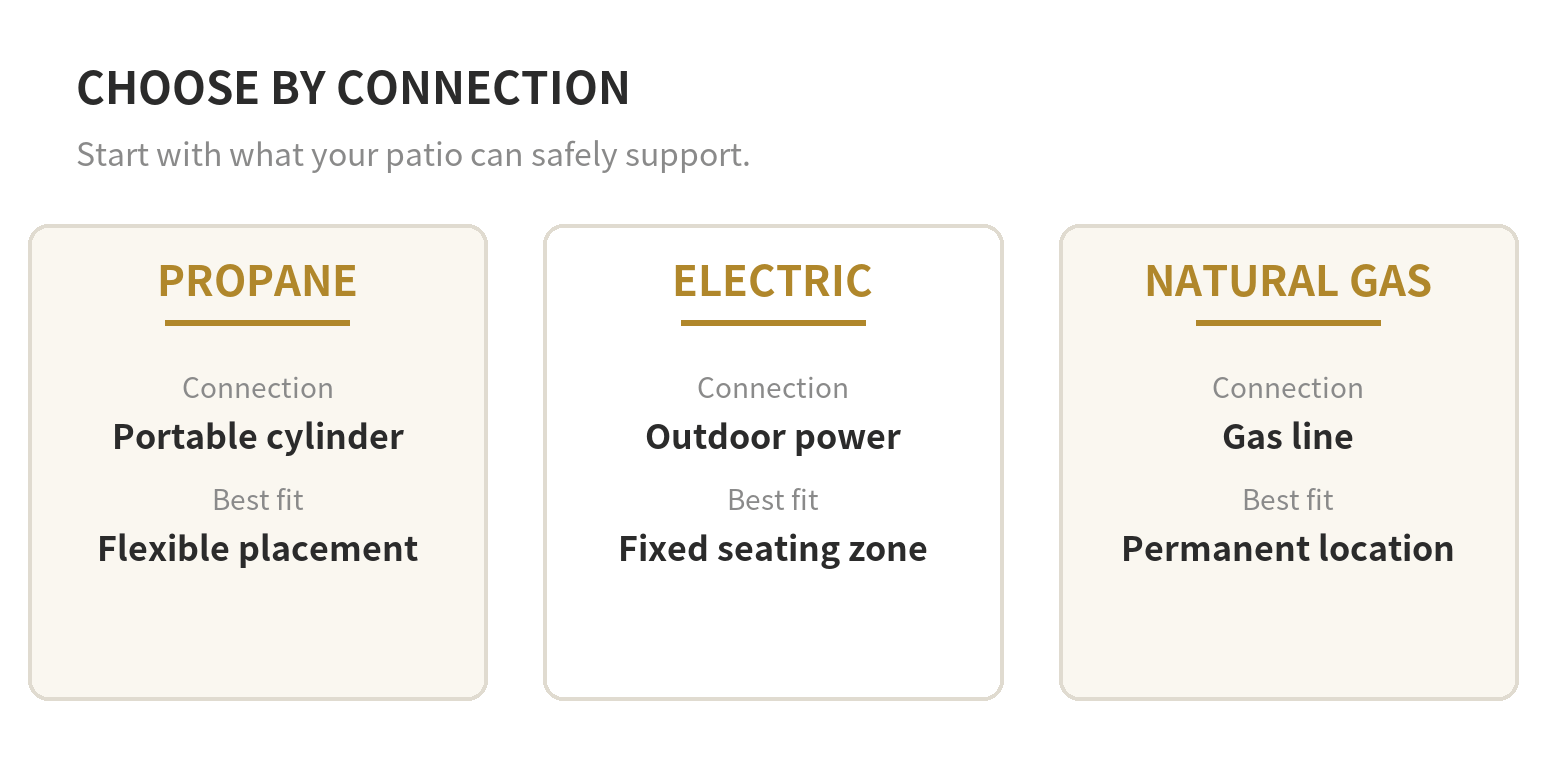
For a patio you use occasionally and cannot connect to a gas line, a portable propane heater is the flexible choice.
If you have a weather-protected outlet and want heat without a fuel cylinder, compare electric infrared models.
Natural gas makes sense when the patio has a suitable gas connection and the heater can be installed with the required clearances.
The right type depends first on your space and utility connections, then on how you want heat delivered.
All three types are designed for outdoor use, but they differ in setup, fuel handling, and where heat reaches.
A heater’s output rating alone does not tell you how comfortable a windy or open patio will feel.
Start with the patio, not the heater
Make a simple seating plan before comparing products.
Note the chairs people use most, the route to the door, and any spot where a heater would narrow that route.
A unit that fits an empty corner may interfere once chairs, a side table, and people are in place.
Think about how many seating positions need warmth at the same time.
Check the patio at the time you expect to use it.
Write down the available connections before shopping: a suitable outdoor outlet, a natural-gas supply, or room to use a compatible cylinder appliance.
If none fits the exact model’s instructions, remove that model from consideration rather than planning an improvised connection.
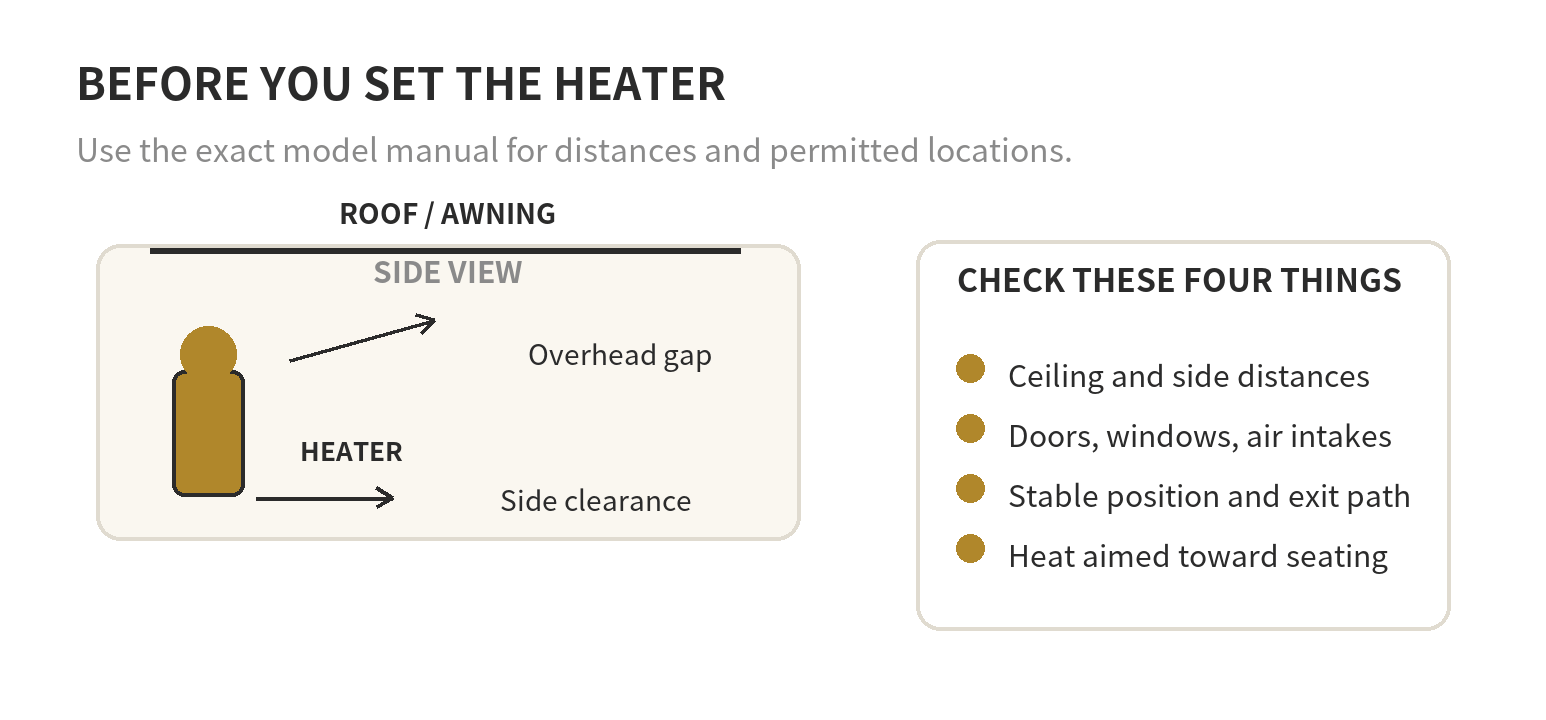
Measure the area where people sit, then look up at the ceiling, awning, branches, and nearby walls.
Mark doors, windows, air intakes, and combustible furniture. Compare those measurements with the exact model’s manual before narrowing the fuel type.
AZ Patio Heaters’ tabletop manual and Mr. Heater’s outdoor heater manual give different clearance dimensions.
Use the manual for the exact model.
Next, check what the site can support.
A portable cylinder may be easier to position than a fixed gas appliance, but it needs safe storage and handling.
An electric heater needs an outlet and a cord arrangement allowed by its manual.
A natural-gas unit may require a permanent connection and qualified installation.
If you rent, ask the property manager before planning a fixed connection or mounting.
Propane: portable heat with cylinder handling
Portability helps when the seating plan changes, but it does not mean the heater should be moved while operating.
Plan where it will sit during use and where the cylinder will be stored when the appliance is off.
Keep the manual available for connection, shutdown, and storage steps.
Before lighting, look at the cylinder connection and the surrounding area as the manual directs.
Stop if a part is damaged, missing, or does not match the appliance.
Use only the fuel type, cylinder arrangement, and replacement parts approved for that model.
Consider the recurring task as part of the choice.
Propane patio heaters use a cylinder as their fuel supply, so the heater does not depend on a permanent gas line.
That can suit a patio where you want to move the unit between seating areas or store it when not in use.
Check how the cylinder attaches, where it sits during operation, and how the manufacturer says to disconnect and store it.
The tradeoff is another fuel task.
You need to keep track of the cylinder, inspect its connection as directed, and follow the manual’s lighting and shutdown steps.
Do not improvise a larger tank, hose, adapter, or replacement part. A portable appliance also remains a combustion heater: the U.S.
Consumer Product Safety Commission explains that burning propane can produce carbon monoxide when combustion is incomplete.
Outdoor placement and the maker’s instructions matter.
Electric: no fuel cylinder, but a power connection
Map the cord path before choosing a freestanding electric unit.
The cord should not cross the main walking route or sit where a door, chair, or table can pinch it.
Follow the manual’s rules for cord placement and the connection; do not extend reach with an arrangement the maker does not allow.
For a wall- or ceiling-mounted model, decide which seats should fall within its directed heat before selecting a mounting point.
Electricity use is easier to compare when you keep the assumptions consistent.
Use the appliance’s stated input, estimate the hours you expect to run it, and apply the rate from your own bill.
Compare options over the same schedule, then adjust the estimate if your actual use changes.
Electric patio heaters avoid on-site fuel combustion and cylinder changes.
Some outdoor models use infrared elements, which transfer heat directly to people and objects in their path rather than heating all the
surrounding air first.
The U.S. Department of Energy describes infrared heating as energy transfer without first heating the air in its discussion of process heating.
For a patio, the practical point is to aim the heater toward the chairs.
This makes placement important: a beam aimed away from chairs contributes little to the seating zone.
Look for the intended mounting position, weather rating, cord or wiring requirements, and minimum clearances in the manual.
Do not assume an indoor extension cord or a household outlet is suitable outdoors.
If the installation calls for fixed wiring, use a qualified electrician and follow local electrical requirements.
Running cost depends on the unit’s electrical draw, hours of use, and your utility rate.
Compare those inputs instead of relying on a generic cost estimate.
Natural gas: a fixed connection for a defined spot
A fixed heater rewards careful planning because its position is tied to the gas connection.
Choose the seating area and mounting location together, then ask a qualified professional whether the supply and installation suit the selected model.
The appliance label and manual should identify the gas type.
A natural-gas heater can be a fit when the patio already has an appropriate gas supply or a permanent installation is practical.
It avoids handling a portable cylinder, but the appliance is less convenient to relocate.
Confirm that the model is made for natural gas; propane and natural-gas versions are not interchangeable just because their housings look alike.
Installation details matter.
A manufacturer’s manual can specify permitted mounting, gas pressure, ventilation, and distances from combustible surfaces.
Have a qualified gas professional check the connection and applicable local rules.
If the patio is covered or enclosed on several sides, do not treat an open door or fan as permission to use a heater outside its stated conditions.
Compare the setup you will live with
For a household that uses the patio only now and then, storage and setup may matter more than a permanent installation.
Separate purchase decisions into two steps. First eliminate models that do not match the available utility or allowed location.
Then compare the remaining models by placement, operating routine, and the people who will use them.
Use the same seating plan for each candidate.
Mark the heater position, the clearances the manual requires, the walking path, and the intended direction of heat.
| Type | What it needs | What to plan for |
|---|---|---|
| Propane | Compatible cylinder and outdoor placement | Cylinder handling, connection checks, storage, and manual clearances |
| Electric | Suitable outdoor power connection | Outlet or wiring capacity, weather exposure, cord routing, and beam direction |
| Natural gas | Compatible fixed gas supply | Professional installation, allowed location, gas specifications, and limited mobility |
Use the table to eliminate options that do not fit the patio. Then compare the manuals for the remaining models.
If two heaters appear similar, check their fuel type, intended indoor or outdoor use, installation method, and clearance diagram rather than
relying on a product photo.
Keep combustion heaters in their intended setting
The CPSC says outdoor heaters should never be used indoors.
The agency warns that outdoor heaters, grills, and generators can cause deadly carbon monoxide buildup indoors.
The Centers for Disease Control and Prevention also advises keeping propane-burning devices out of homes, garages, and carports.
A porch, tent, sunroom, or garage does not become safe for an outdoor-only heater because a door is open.
Before each use, follow the model’s setup and inspection instructions.
Keep the heater stable, maintain the manual’s required distances from combustible materials, and do not leave it running unattended.
Shut it down as directed before moving it, refueling it, or storing it.
If the placement cannot meet the manual’s requirements, choose another location or heating approach.
Leave a clear route between the seating area and the house.
Seasonal decorations, cushions, and storage bins can change where people walk, so reassess the heater location when you rearrange the patio.
Keep fabric, paper, and other combustible items outside the clearances shown in the manual.
Frequently Asked Questions
Can I use a patio heater under a covered deck?
Only if the specific heater is allowed in that setting and the required overhead and side clearances can be met.
Read the manual for the exact model and check local fire and building requirements before placing it under a roof or awning.
Can a propane patio heater be used in a garage with the door open?
No. The CPSC warns against using outdoor heaters indoors, and the CDC says propane-burning devices should not be used inside a garage or carport.
Keep an outdoor-only appliance outside.
Is an electric patio heater safe in rain?
That depends on the model’s outdoor rating and installation instructions.
Check whether the unit is approved for the location’s exposure and how its outlet, wiring, and controls must be protected; do not infer rain
suitability from the word “outdoor” alone.
How do I compare operating cost without guessing?
Use the heater’s input rating, your expected hours of use, and the utility rate on your bill.
For gas, include the applicable fuel rate and billing units.
Compare the same hours and season for each option, and leave out assumptions about heat output that the product information does not support.