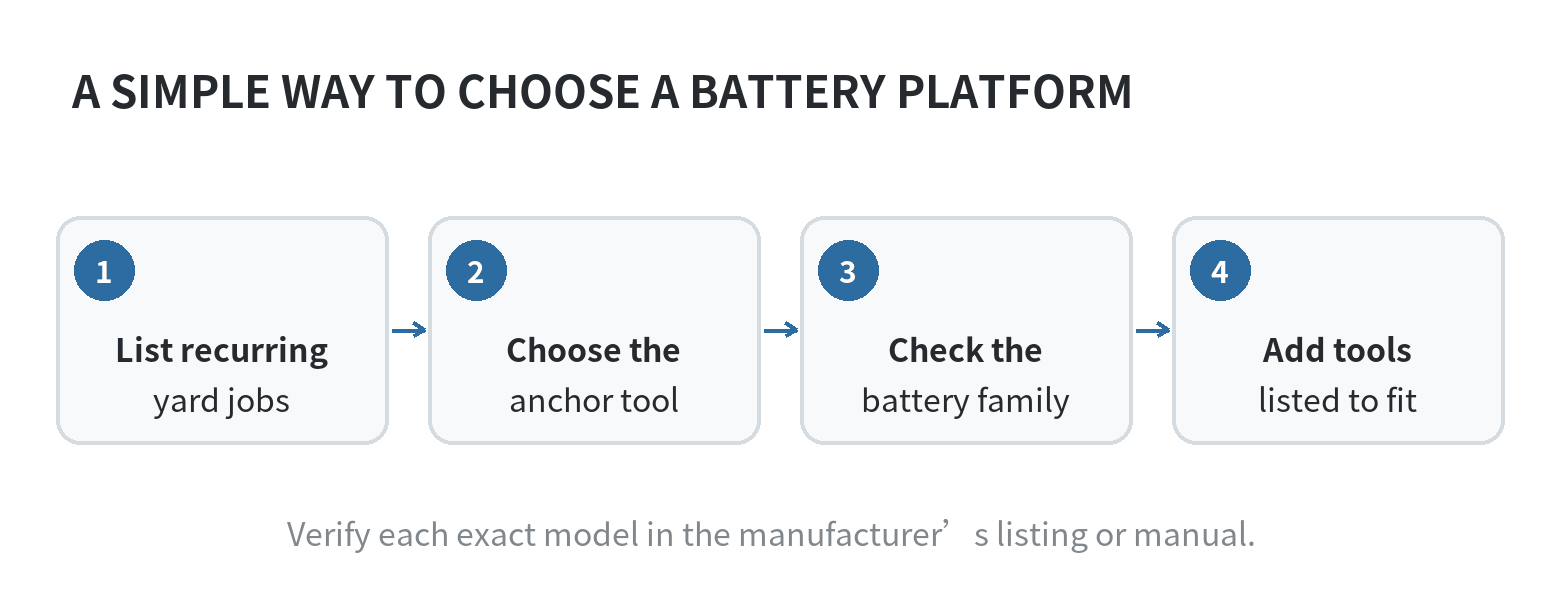
Choose a cordless outdoor tool battery platform by listing the yard jobs you repeat. Check which tools and batteries share the manufacturer’s exact system label.
A single platform can simplify charging and battery rotation, but voltage printed on a pack is not enough to establish compatibility.
Build around the tool you will use most, then see whether the rest of your seasonal list fits that system.
Start with the jobs that return every season
Write down the outdoor tasks you actually do: mowing, trimming edges, clearing leaves, pruning branches, or cleaning a patio.
Mark each one as weekly, occasional, or a one-time project. This separates the core system from tools that would sit unused after a single job.
Give peak cleanup its own line. The first leaf-heavy cleanup, a storm branch job, or the last mowing before winter can be more demanding than a regular pass.
If those jobs matter to you, include them when comparing tool requirements. A system that covers routine work may not answer the whole-season question.
Next, describe the size and conditions of the work in your own terms. For mowing, note the area and whether the ground is flat or sloped.
For trimming, note how much edge and fence line needs attention. For blowing, note whether you move light leaves across a short path or clear heavier debris over a larger area.
These details help you compare the right tool class and battery configuration without relying on a generic yard-size claim.
Pick the most demanding recurring task as your anchor. If mowing is the job you cannot split across several days, begin with the mower’s listed battery requirements.
If you already own a mower that meets the need, use its battery family as the starting point for a trimmer or blower.
Make a short list before comparing systems
Use a three-column list: job, tool type, and what the maker says the tool needs.
Check the product page or manual before adding the battery family, required packs, and charger compatibility.
A product described as tool-only may not include a battery or charger. Confirm the box contents instead of assuming a kit and a bare tool are the same setup.
| Recurring job | Tool to check | Question for the product page |
|---|---|---|
| Cut the lawn | Mower | Does this model require one pack or a paired set? |
| Trim borders | String trimmer or edger | Which battery family and pack size does the maker list? |
| Clear leaves | Blower | Is it in the same platform, and what packs are included? |
The table is a worksheet, not a product ranking. Fill it with the models you are considering, then remove tools that do not solve regular tasks.
A shorter list helps you see whether one battery platform covers the work or a separate system serves a distinct, heavier-duty job.
Read the family name, not just the voltage
Battery makers define compatibility within named product systems.
Milwaukee’s M18 battery page says M18 batteries fit M18 tools, and its outdoor equipment page describes compatibility across tools in each system.
EGO says its 56-volt ARC Lithium batteries work across its outdoor equipment. Those are system-specific statements; they do not mean packs from different makers can be swapped.
Voltage labels can also be presented differently. DEWALT explains that 20V MAX is the maximum initial voltage measured without a workload, while nominal voltage is 18 volts.
So a label that looks higher is not, on its own, a cross-platform compatibility test.
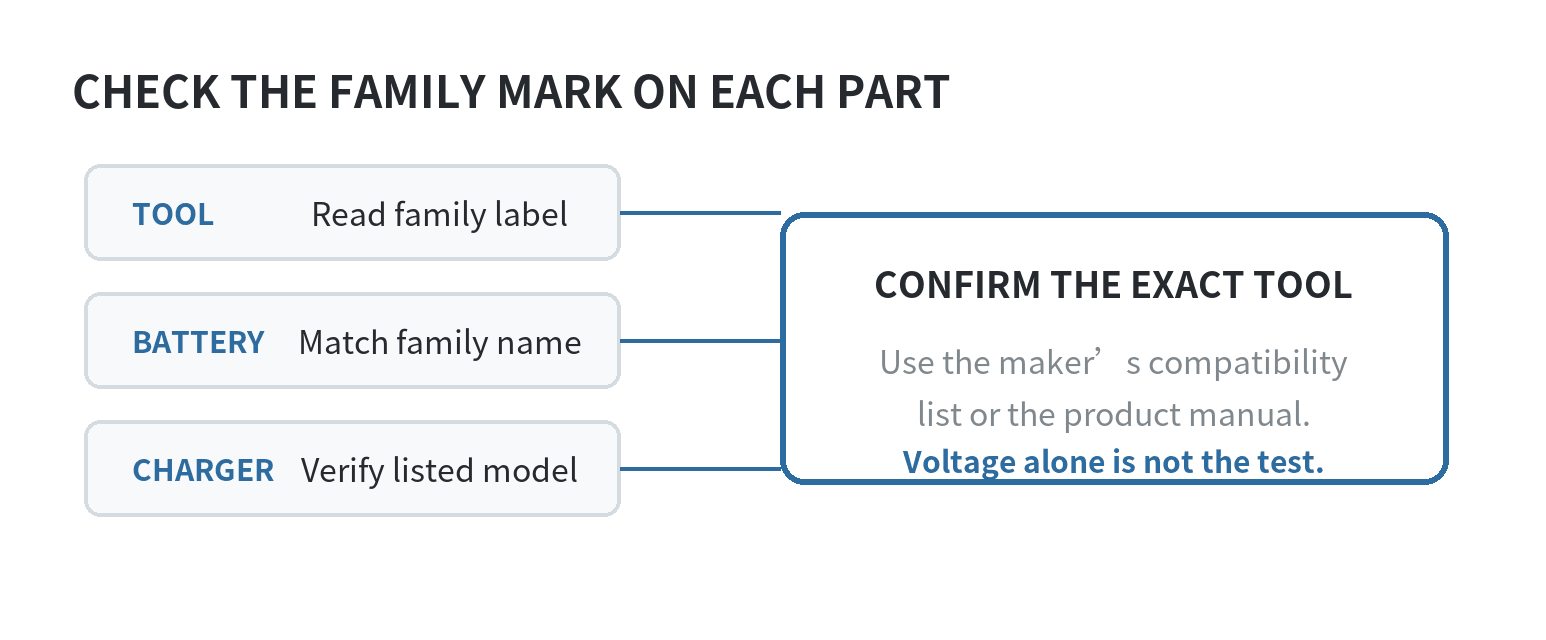
Match the full family name shown on the tool, battery, and charger, then confirm the exact model in the manufacturer’s compatibility list or manual.
For an existing battery, check the label on both the pack and the tool. Do not rely on color, a similar slide-in shape, or a voltage number.
A tool may share a battery family with some outdoor equipment but belong to a different line from the same manufacturer.
The family mark and model documentation settle that question.
Let your current tools change the decision
If you already own cordless tools, inventory their batteries before choosing another system. A familiar platform can reduce chargers and pack types in your rotation.
That works only if the outdoor tools you need are listed in that family. RYOBI’s system page shows outdoor equipment within its 18V ONE+ line.
It also separates that label from its other voltage families. Check the family name on each product. Do not assume every product from one maker uses one battery.
If you are starting from scratch, compare complete work setups rather than a battery by itself.
Look at the mower, trimmer, and blower you would use, whether the required packs come with each tool, and whether the charger serves those packs.
An attractive bare-tool listing can lead to extra battery or charger needs if you have no compatible equipment yet.
For broader context on how cordless tool families are organized, see this site’s battery-system overview and first-platform explainer.
Keep this decision narrower: the outdoor jobs on your list and the battery family each candidate tool specifies.
Set a clear point for considering a second system
Consider a second platform when your anchor tool is not listed for the battery family you own. The same applies when another outdoor job has requirements your system does not meet.
Keep the reason specific: “the mower I need is outside my existing family” is more useful than “a higher voltage must be better.”
Then compare complete setups for that missing job. Check the exact tool, required battery arrangement, included packs, and charger.
If the second system only adds a tool you would use once, leave it off the core list and revisit it when the task returns.
This keeps the decision attached to yard work you can name, rather than to a platform’s total catalog size.
Plan for a work session, not a headline runtime
Battery capacity alone does not tell you exactly how long a yard tool will run.
Milwaukee’s outdoor equipment guidance says needs vary with the tool, application, region, season, and number of operators. It recommends checking needs at the product level.
Use runtime or coverage information for the exact model and conditions, not a claim copied from another tool in the same platform.
Make a simple session plan. Your example list might be a mower, trimmer, and blower. Note their order and whether the maker specifies one pack or multiple packs for each.
Then decide whether to charge between jobs, rotate packs, or divide the work into sessions.
This is more useful than assuming one battery size will carry every tool through every task.
Keep a note of the pack label, tool model, charger model, and the work each pack completes. After several sessions, use that record to decide whether your setup covers the routine.
It can also show whether a second compatible pack would solve a real interruption.
A final compatibility check before settling on a system
Before settling on a platform, verify each tool’s system name, required battery configuration, package contents, and charger.
If a listing is unclear, check the maker’s model page and manual. Do not infer fit from voltage or appearance.
A good one-system plan is the one whose documented battery family covers your recurring outdoor work with a charging routine you can manage.
Start with the anchor tool, confirm its pack requirements, and add only the other tools whose exact models are listed as compatible.
That leaves you with a clear answer based on your yard and the manufacturer’s compatibility information.
FAQ
Can I use a battery from a different brand if the voltage matches?
No. Voltage alone does not establish fit; check the battery family and the tool maker’s compatibility information for the exact model.
Can one battery family cover both outdoor and workshop tools?
It can when the manufacturer lists both tool types in the same system. Check each tool’s exact family label and manual before counting it as compatible.
Does a larger amp-hour number guarantee a full yard on one charge?
No. Runtime depends on the tool and work conditions, so use model-specific runtime or coverage information and your own session notes.
Should I keep a second battery platform for one demanding tool?
That depends on whether the tool’s listed requirements fit your existing system and whether separating that job makes your charging routine easier.
Compare the exact tool and battery specifications before deciding.