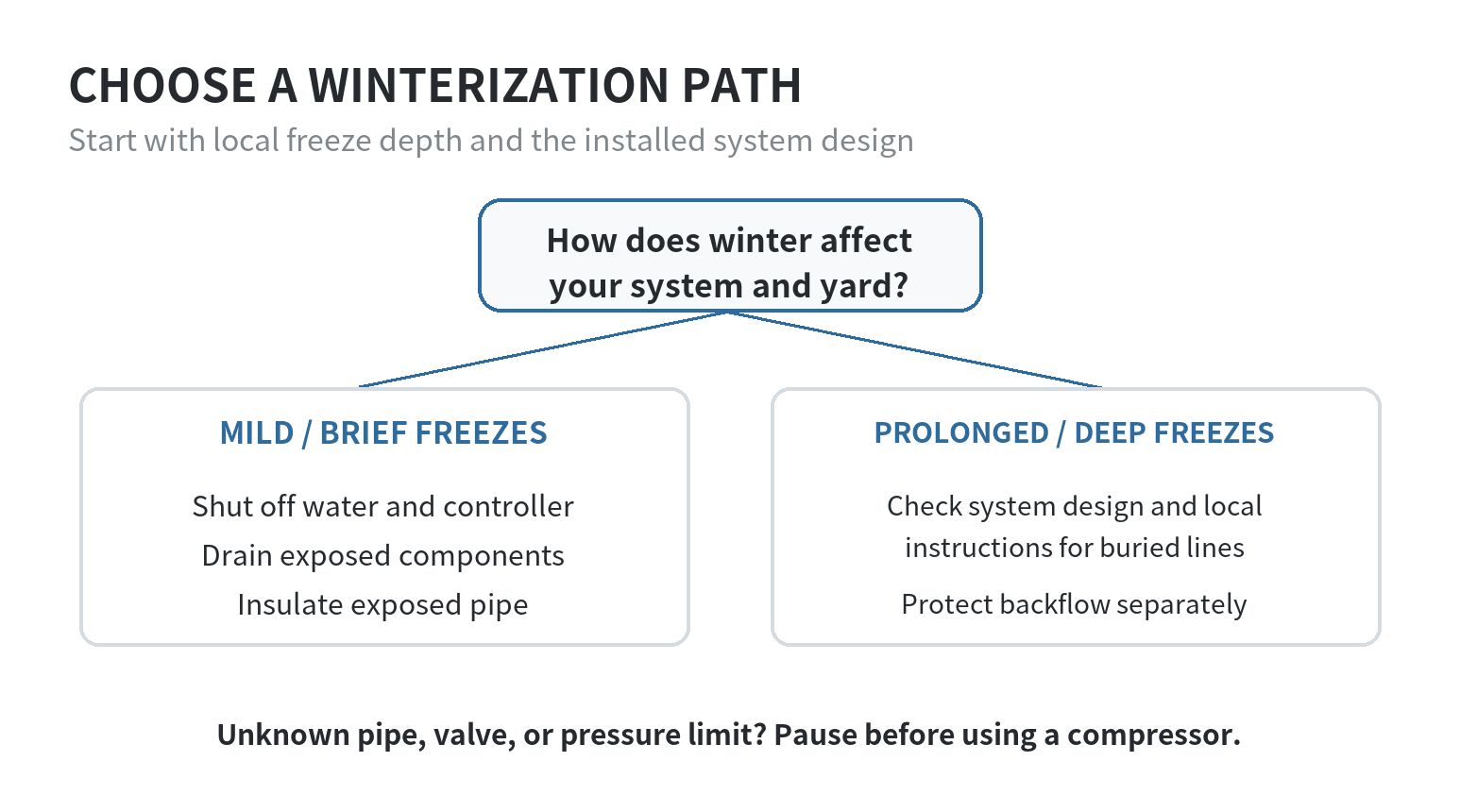
Choose the winterization method by how deeply and how long the ground freezes, then follow the instructions for your exact irrigation system. A warm-winter yard may need the water shut off and exposed equipment drained, while a system in a region with prolonged hard freezes may need its buried lines cleared. A compressor fitting is only a connection point; it does not tell you the safe air pressure for the system.
Start with the freeze pattern, not the calendar
Winterization is about water left where freezing can expand it and stress pipes, valves, fittings, and sprinkler bodies, as Colorado State University Extension explains. The right response depends on what is exposed, how the system was installed, and whether the soil freezes down to the buried pipe. Use your local climate guidance and the irrigation plan as the starting point.
Texas A&M AgriLife separates light or mild freezes in much of Texas from prolonged freezes in northern areas: its guidance for most of Texas emphasizes shutting off the water, turning off the controller, insulating exposed pipe, and draining above-ground components; it notes that many Texas systems are not designed for a blowout. Colorado State University Extension addresses a colder setting and discusses compressed-air blowout for the irrigation system. These regional approaches show why a single nationwide winterizing recipe can misfit a yard.
Before work starts, identify the main irrigation shutoff, drain valves, controller, backflow preventer, pump if present, and any exposed piping. Find the irrigation plan or zone list. Note whether the lines are rigid PVC, flexible polyethylene, or a mix, and whether valves are automatic or manual. If the plan is missing, the shutoff is buried or stuck, or the backflow assembly is unfamiliar, a qualified irrigation contractor can identify the system before compressed air enters it.
What the blowout fitting does—and what it does not do
A blowout fitting is a planned point for connecting an air hose to the irrigation mainline, commonly downstream of the backflow assembly. Its presence does not mean every component is safe to clear with air. Colorado State University Extension says that a backflow device needs a downstream blowout fitting for this method; it also warns that pressure vacuum breaker and reduced-pressure backflow devices must not be blown out with compressed air because heat can damage their internal seals.
Keep the backflow assembly’s winter procedure separate from the buried-zone procedure. The exact steps depend on the device type and installation. CSU Extension describes draining and positioning certain valves and test cocks for winter, while Texas A&M’s milder-climate guidance calls for draining above-ground backflow equipment and insulating exposed pipe. Use the device manufacturer’s instructions for the model installed at your property, and ask a professional when the device type is unclear.
Do not improvise a connection by removing a sprinkler head or attaching air to a random valve. The fitting should be intended for the system, and the instructions for the compressor and irrigation components should both be available. A fitting cannot compensate for an unknown pipe material, a closed zone valve, or an unsuitable air supply.
Set pressure from the equipment instructions
There is no universal pressure number that fits every sprinkler system. Colorado State University Extension gives different limits for rigid PVC and polyethylene pipe and says nozzle ratings matter. Rain Bird’s homeowner blowout article also gives a pressure ceiling, but the same page describes a compressor regulator setting above that ceiling. That internal conflict is a reason not to copy a number from a general web page and apply it to an unknown installation.
Check the irrigation-system manual, the pipe and sprinkler component ratings, and the compressor manual. Use the lowest applicable limit and a regulator that can hold it. Air volume and pressure are different: a compressor’s tank pressure does not tell you how much air it can deliver through a zone. CSU Extension recommends sizing around the flow needed by each zone, and explains that inadequate air volume can move some water while leaving water in low spots.
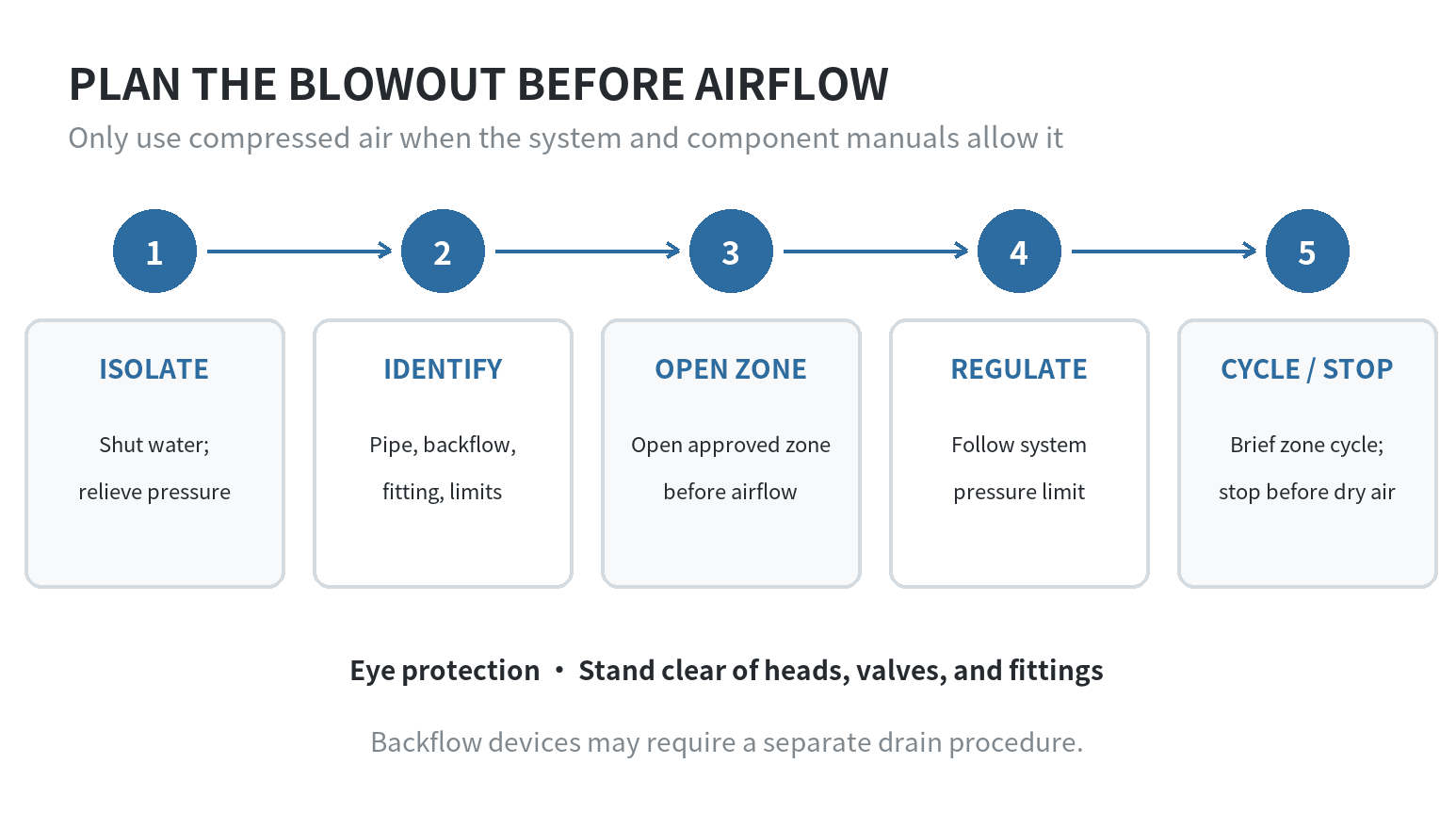
Compressed air can also heat components as it moves through a line. Rain Bird’s winterization guide says not to run a zone for more than two minutes at a time; it recommends short cycles rather than extended dry airflow. Treat the manufacturer’s specific limit as belonging to that procedure and system, not as a guarantee that every zone is safe for the same duration.
Use a controlled sequence for a system designed for blowout
If your system is designed for compressed-air winterization and its manuals support the procedure, prepare one zone at a time. Turn off the irrigation water supply, relieve water pressure as the system instructions specify, and make sure a zone valve is open before starting the compressor. Rain Bird’s guide warns against running the compressor with every zone valve closed and advises eye protection and keeping clear of irrigation components during blowout.
Regulate the air at the system’s approved connection point. Start with a modest flow and observe the zone from a safe position; do not stand over heads, valves, or pipe fittings. Stop if a component behaves unexpectedly, a fitting leaks, or the pressure regulator cannot maintain the required limit. Do not use a high-pressure tank surge to force water through a closed system.
Move through the zones according to the controller and system instructions. If the manufacturer specifies repeated short cycles, follow those limits and stop once the prescribed endpoint is reached. Do not keep sending dry air through a zone to chase every drop: heat and friction can damage pipe or sprinkler mechanisms. Shut down the compressor in the order specified by its and the irrigation system’s instructions before disconnecting the hose.
Drain and protect the parts above ground
After the water supply is isolated, handle the backflow preventer, exposed pipes, valve boxes, filters, and pump according to their own manuals. Texas A&M AgriLife recommends insulating exposed PVC and draining above-ground irrigation components for the mild-freeze conditions it covers. Colorado State University Extension describes draining a pump and storing it indoors when possible. These actions address equipment that can be exposed even where buried lines do not need a full system blowout.
Do not wrap a backflow device and assume that insulation replaces drainage. Insulation slows heat loss; it does not remove water trapped inside the assembly. Drain openings, valve positions, and any removable parts depend on the specific model. Keep removed caps or plugs together and label them so the system can be restored correctly in spring.
Keep a spring restart note
Record which shutoff was closed, which drains were opened, how the backflow device was prepared, and whether a contractor handled the compressed-air work. In spring, close drains and test cocks as directed before restoring water. Colorado State University Extension cautions that valves should be opened slowly when repressurizing a PVB assembly to reduce water-hammer stress. Check the system for leaks as it comes back online, one zone at a time.
If you cannot confirm the pipe material, backflow type, approved fitting, or pressure limit, pause before connecting a compressor. The system can still be prepared by locating its shutoff and gathering its manuals; an irrigation professional can identify the remaining components and perform the method suited to that installation.
FAQ
Can I use a small garage air compressor for a sprinkler blowout?
Only if its delivered air volume and regulated pressure meet the irrigation system’s requirements. Colorado State University Extension says compressor sizing depends on zone flow, and the tank’s maximum pressure alone does not establish suitability.
Should a backflow preventer be included in the blowout?
Not automatically. Colorado State University Extension says PVB and reduced-pressure devices should not be blown out with compressed air; use the specific device instructions for draining and winter positioning.
Do automatic drain valves mean I can skip every other winter step?
No. Rain Bird’s guide says automatic drain valves remove water when the system shuts off, but it also advises checking for excessive puddling that may indicate a drain is stuck open. Exposed equipment may still need separate preparation.
When should I winterize a system in a mild-winter area?
Follow local freeze guidance and the system design. Texas A&M AgriLife describes shutoff, controller-off, exposed-pipe insulation, and draining above-ground equipment for much of Texas; local conditions and equipment can call for a different procedure.
Last updated: 2026-10