Spring lawn care starts with two decisions: identify the grass already growing in your yard, then decide whether you want to prevent weeds or sow grass seed. Those plans can conflict. A calendar from a colder state is not a national schedule, so use your local university extension’s timing and the product label before setting dates.
Start with the grass and your local calendar
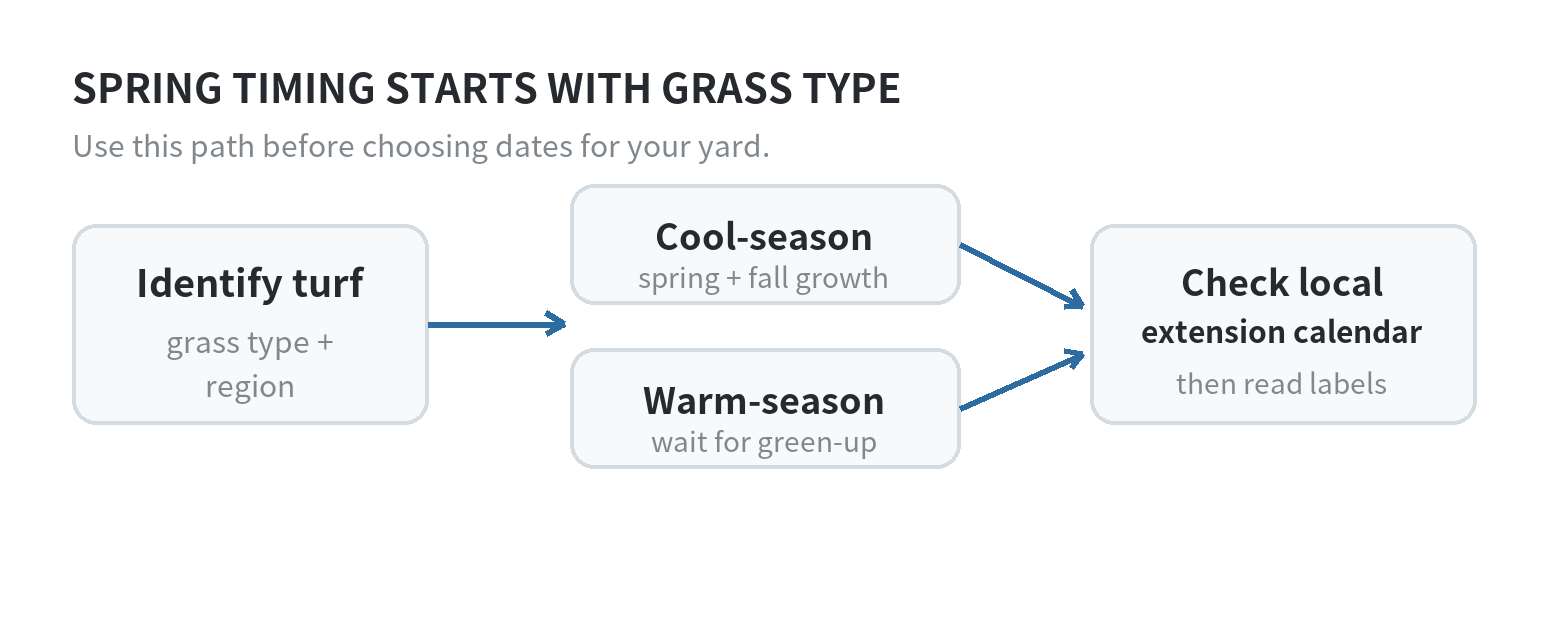
Look at a lawn-care record, a seed label from the last renovation, or a county extension guide to identify your turf. Cool-season grasses such as tall fescue and Kentucky bluegrass have a different growth cycle from warm-season grasses such as bermudagrass and zoysiagrass. The University of Minnesota Extension describes cool-season turf as growing actively in spring and fall, while its calendar notes that the dates for seeding, feeding, and crabgrass prevention reflect Minnesota conditions (checked October 22, 2026).
That local context matters more than the word “spring.” In Minnesota, the University of Minnesota Extension lists mid-April to mid-May for crabgrass pre-emergent timing and May through early June as an acceptable seeding period. The same calendar places fertilizer from May through late June, with the best period later in the year. Those entries describe Minnesota; they are not dates to copy into a warmer or colder region.
For a warm-season lawn in Georgia, University of Georgia Extension says to wait until the grass is out of dormancy before fertilizing; its county guidance places active growth later in spring than the first warm days. Your county extension can narrow the calendar to your grass and local weather. Use the closest land-grant university extension office when regional advice conflicts with a generic national chart.
Choose between weed prevention and spring seeding
Before spreading a pre-emergent, decide whether you plan to seed or overseed. A pre-emergent works by preventing seed germination, so it can also interfere with desirable grass seed. The University of Maryland Extension explains that some crabgrass preventers can conflict with spring seeding of cool-season turf when the ingredient affects all grass seed (checked October 22, 2026). The University of Minnesota Extension likewise says not to apply a pre-emergent to newly seeded lawns because it prevents seeds from germinating (checked October 22, 2026).
This is the decision point for a thin lawn. If filling bare areas is the priority, check whether the product label allows seeding and states a waiting period. If crabgrass prevention is the priority, postpone seeding until the label’s interval has passed. Do not guess from a brand name or assume every formula has the same interval: the University of Maryland Extension says label directions cover reseeding delays and other use conditions (checked October 22, 2026).
Think in lawn zones when the projects differ. For example, your front lawn may be established turf while a shaded side strip needs seed. Mark those areas on a quick sketch, then keep the pre-emergent decision with the established zone and the seed decision with the patch. The label still controls where and when an application can go; mapping the areas helps you avoid treating the whole property as one uniform project.
Write the intended order beside each zone: “seed patch,” “check label interval,” or “pre-emergent.” Add the product name and application date to the note after any treatment. Before the next task, compare its label with that record. This small planning step is useful when the yard has a mix of established turf, repairs, and areas you are leaving alone.
For an established lawn with no planned seed, use your local timing cue. The University of Maryland Extension ties crabgrass germination to soil temperatures above 55°F for several days. The University of Minnesota Extension’s Minnesota guide instead gives a regional calendar window. These are local cues, not a single date that applies nationwide.
Feed according to active growth, not the first warm afternoon
Set fertilizer timing after you know the grass type and whether you have a recent soil-test recommendation. The University of Minnesota Extension warns against adding fertilizer too early in spring when cool-season grass is slow or dormant, and its Minnesota calendar lists May through late June as an acceptable spring period (checked October 22, 2026). It also describes early August through mid-October as the best Minnesota feeding window for cool-season turf.
Warm-season lawns follow another schedule. University of Georgia Extension’s spring guidance says to wait until warm-season grass is fully out of dormancy before fertilizing; dates in its Georgia advice should not be applied to lawns in other states (checked October 22, 2026). A green tree canopy or a run of mild days does not identify the turf or establish that its roots are actively growing.
Read the fertilizer analysis and application directions before calculating a rate. Follow the amount shown for the lawn area and grass type, and avoid adding a second source of the same nutrient without checking the combined instructions. If the soil test, local extension calendar, and package direction appear to disagree, pause and ask the county extension office which recommendation applies to your lawn.
Save seed for the patch that fits its season
Spring seeding can make sense for a small repair, but it is not interchangeable with a fall renovation. The University of Maryland Extension says weed competition is greater on turf sown in early spring than in autumn, and identifies that competition as a common reason spring seeding attempts fail (checked October 22, 2026). Its guidance also says the right seeding season depends on grass type and region.
For a bare spot, first check whether the existing grass is still dormant or has died, then identify the likely cause before adding seed. A thin area caused by shade, compacted soil, or repeated foot traffic may need a different fix from a patch left by winter damage. Do not sow into a patch that will receive a pre-emergent unless the label specifically allows that sequence and gives a safe interval.
Choose seed labeled for your region and the light conditions of the patch. Read the label for species, sun or shade suitability, and coverage instructions. Keep the project limited to the area you can prepare and water according to the seed directions; a bag’s coverage estimate is based on its label, not on a universal lawn rate.
A simple order for the spring work
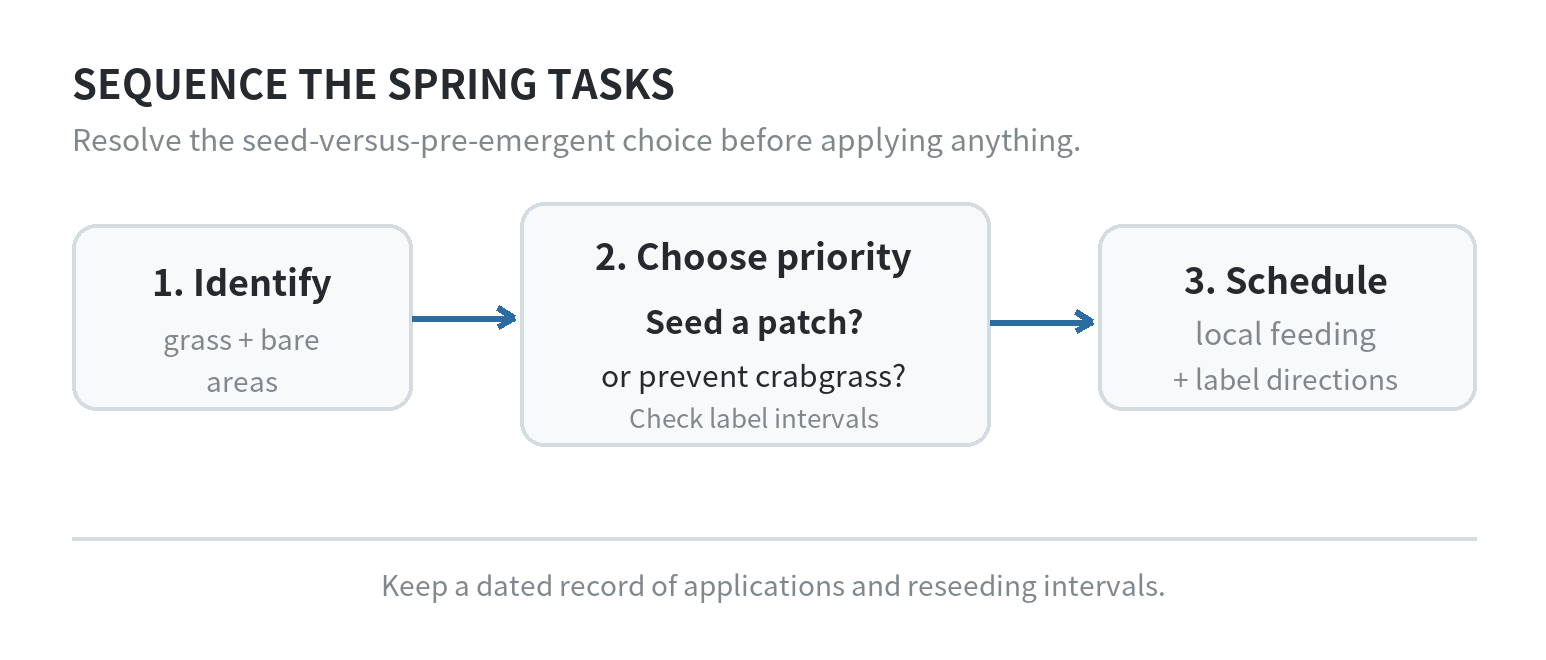
- Identify: write down the grass type, region, and any bare areas you intend to seed.
- Choose: decide whether preventing crabgrass or establishing grass seed is the priority for each area.
- Check: compare the local extension calendar with the product label, including any reseeding interval.
- Feed: use the grass-specific local schedule and soil-test guidance instead of applying fertilizer just because the weather feels mild.
- Record: note what you applied and the date, so a later seeding or feeding decision accounts for the label interval.
If you are comparing options for the yard, the existing beginner’s lawn and garden overview covers broader starter planning, while the weed-control overview discusses weed-control product categories.
For a broader seasonal supply list, see the site’s spring shopping list. Use the extension calendar for your area to make a schedule, and keep the product labels with your lawn notes so you can check intervals before combining seeding, weed prevention, and fertilizer.
FAQ
Can I apply crabgrass preventer and grass seed on the same weekend?
Only if the product label allows both steps and specifies a compatible interval. The University of Maryland Extension says some pre-emergent ingredients can affect turfgrass seed and directs readers to the label for reseeding delays (checked October 22, 2026).
Does a warm week mean it is time to fertilize?
No. Match fertilizer timing to your grass type and local extension schedule. University of Georgia Extension advises waiting until warm-season grass is out of dormancy, while the University of Minnesota Extension warns against feeding cool-season turf too early (checked October 22, 2026).
Is spring a good time to repair a bare patch?
It can be an option, but check the grass type, regional seeding window, and any pre-emergent label interval first. The University of Maryland Extension reports greater weed competition for early-spring seeding than autumn seeding (checked October 22, 2026).
Where can I find dates for my state?
Use your state land-grant university’s turfgrass or county extension guidance. A calendar written for Minnesota or Georgia describes those regions, so it does not set a national schedule.
Last updated: October 2026.
Last updated: 2026-10