For a roof replacement, compare the shingle’s construction and its tested wind classification separately. Three-tab shingles have a flat, repeating cutout pattern; architectural shingles are laminated to create a thicker, dimensional look. Neither label alone tells you whether a product suits a particular roof: the package rating, local code, roof exposure, and installation instructions all matter. The International Residential Code (IRC) calls for asphalt shingle packages to identify the applicable wind test and classification (checked October 22, 2026).
What the two shingle shapes tell you
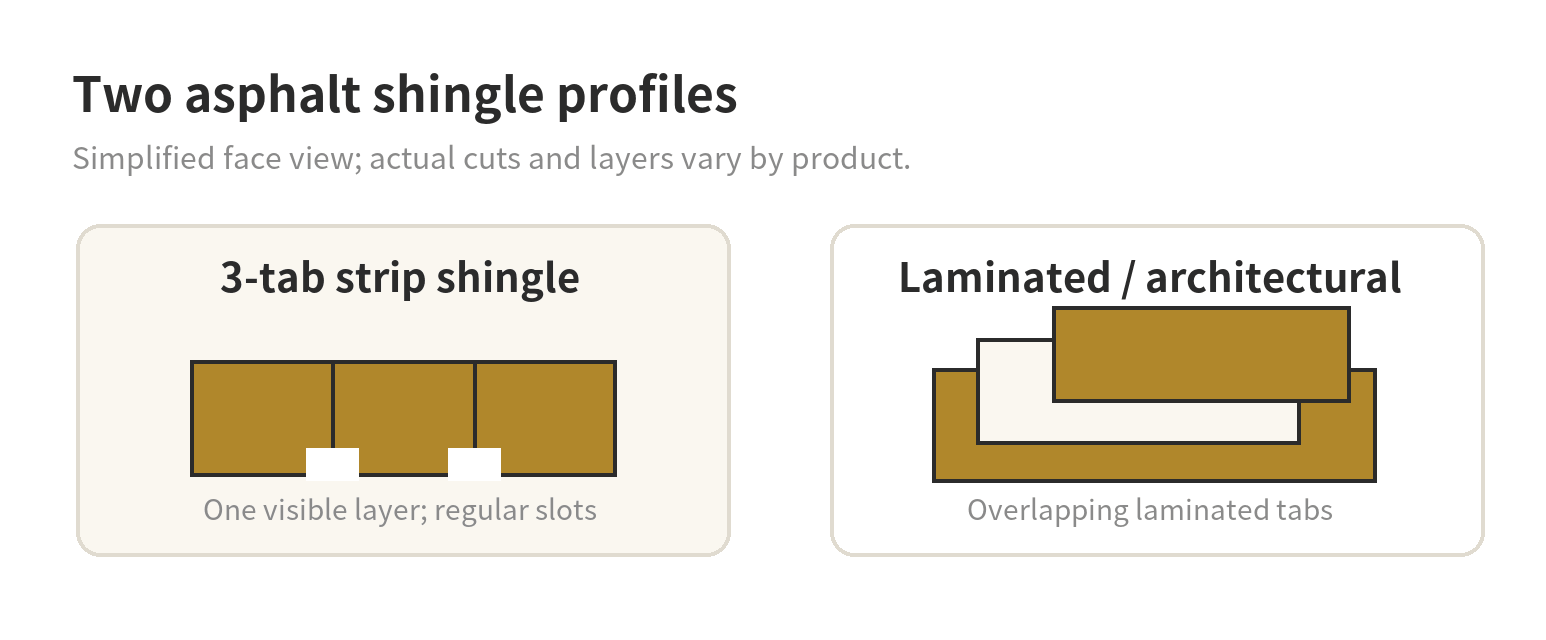
A three-tab shingle is a strip with regularly spaced cutouts that create the appearance of separate tabs. Its surface reads as a consistent pattern across the roof. A laminated shingle, also called architectural or dimensional, bonds multiple layers together to create varied edges and shadow lines. The Asphalt Roofing Manufacturers Association (ARMA) describes these as two distinct asphalt shingle types (checked October 22, 2026).
That difference is useful for narrowing appearance and product format, but it does not establish a wind rating, installation method, or fit for your roof. Specifications can vary among products in the same style category. Compare the exact product’s data sheet and packaging rather than assuming every laminated shingle shares one performance level—or that every three-tab product shares another.
Check the actual sample from several feet away and in the light where it will be seen. Color blends and shadow patterns can look different on a small sample than across a full roof. Ask for the product name and current technical sheet in writing so you can compare the exact version, not only a display sample or a broad style label.
Read the wind test and class, not a headline number
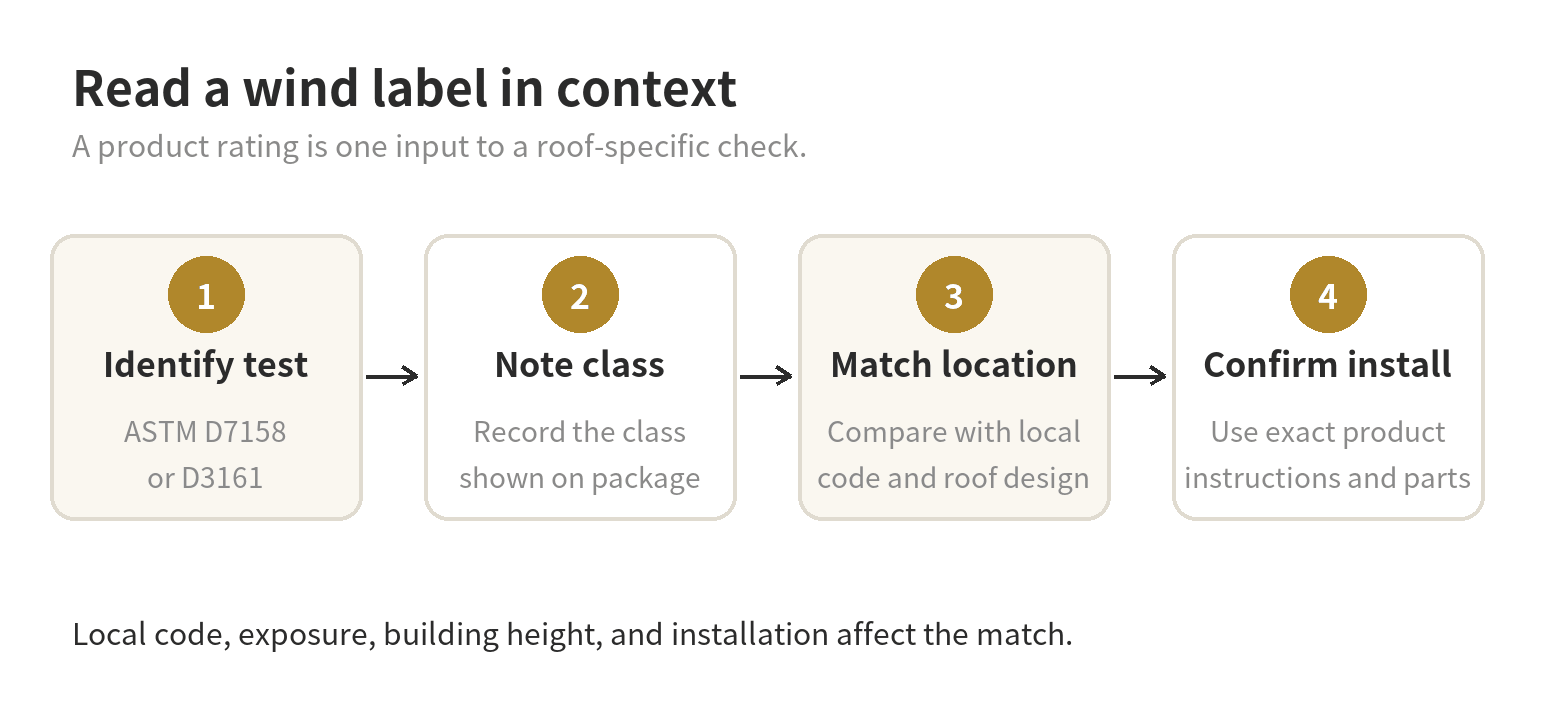
“Wind rating” may refer to a test classification, a wind speed associated with a test, or a limited warranty statement. Those terms do not mean the same thing. ARMA explains that ASTM D7158 evaluates uplift resistance and assigns classes, while ASTM D3161 uses a fan-induced test and its own classes (checked October 22, 2026). A class under one test should not be read as if it were a class under the other.
Start with the full marking on the package or product sheet: identify whether it lists ASTM D7158 or ASTM D3161, then note the corresponding class. The 2024 IRC requires the package to identify compliance with the applicable test and required classification. It also ties the required classification to the building’s design wind speed; a product with a prominent miles-per-hour warranty claim does not by itself establish code compliance (IRC R905.2.4.1, checked October 22, 2026).
The IRC’s standard calculations for ASTM D7158 assume Exposure Category B or C and a building height of 60 feet or less. The code says additional calculations are required outside those assumptions. Roof height, terrain around the home, local wind design, and roof geometry can therefore change the check. Use the local building department’s requirements and have a qualified roofing professional match the product to the specific property.
Do not treat a package’s wind-speed language as a forecast of the strongest gust a roof will face. The IRC uses design wind speed and a shingle classification together, and its D7158 assumptions cover specified building conditions. A warranty statement answers a different question: it describes the manufacturer’s coverage under its stated terms. Read the test label, code requirements, and warranty document as separate records, then ask the installer to explain any condition attached to a stated wind speed.
Local adoption also matters. The IRC is a model code; a city or county may adopt a particular edition and local amendments. Ask the building department which residential code and wind design information apply to the address. This prevents a comparison based on a table or product sheet from a different jurisdiction from standing in for the local requirement.
Use a short comparison sheet
When you compare two packages, write down the same fields for each one. That makes unlike claims easier to spot and gives a roofer a clear starting point.
| Field | What to record | Why it matters |
|---|---|---|
| Construction | Three-tab strip or laminated/architectural | Describes visible shape and layer format |
| Wind test | ASTM D7158 or ASTM D3161 | Classes belong to a named test method |
| Classification | Exact letter/class from package | Can be checked against applicable code |
| Installation | Fastener location/count, starter and ridge components | Instructions can be product-specific |
| Warranty terms | Limits, required components, exclusions | Headline wind language may have conditions |
Do not fill gaps by borrowing details from a similar-looking package. If a listing shows a broad wind claim but not the test method or class, request the manufacturer’s current technical sheet. Keep a photo of the package label with your project papers; the label connects the installed material to the product documentation.
Installation is part of the rating decision
A shingle’s test result does not describe every roof assembly or installation. The IRC directs installers to follow the roof-covering section and the manufacturer’s installation instructions. Its attachment section calls for at least the manufacturer-approved fastener count, subject to the code minimum, and requires the approved instructions for steep slopes. Local amendments may also apply.
Request the installation plan before work begins, not just a material description. The written scope can identify the deck preparation, underlayment, fasteners, starter course, ridge pieces, and any special details required by that product. The IRC has separate provisions for underlayment, attachment, and flashing, so a shingle’s front-facing label cannot show whether those parts of the roof assembly are addressed. Ask who will confirm that the selected accessories and installation details match the manufacturer’s instructions.
Ask the roofer to identify the exact shingle, test classification, fastening pattern, and any required starter or ridge products in the written scope. Have the contractor explain how the rating matches the home’s location and roof conditions. The Federal Trade Commission advises homeowners to confirm a contractor’s license with state or county government and ask for proof of insurance (checked October 22, 2026). Licensing rules vary by jurisdiction, so check the local authority rather than treating a product label as a contractor credential.
For a roof project, use a licensed roofing professional where your jurisdiction requires one. The IRC makes installation instructions and local design conditions part of the roofing requirements; choosing a package from a shelf alone cannot resolve those site-specific details.
Questions to settle before choosing
Ask for three items before approving the shingle selection: the exact product data sheet, the package’s wind-test label, and the installation scope. Compare style after those documents identify what is being proposed. If the contractor cannot match the test class to local requirements, ask the building department or a qualified designer what documentation is needed.
Keep the answer practical: choose the appearance you want from the available products, then confirm that the precise product and installation plan satisfy local requirements. A dimensional profile is a style and construction description; the wind classification and roof design check are separate pieces of the decision.
FAQ
Are architectural shingles automatically rated for higher wind?
No. The architectural label describes a laminated style, not a universal wind class. Check the exact product’s ASTM test method, classification, and installation requirements.
Can I compare an ASTM D7158 class directly with an ASTM D3161 class?
No. The standards use different test methods and classification systems. Compare each marking with the requirements that apply to the building and ask the roofing professional to explain the match.
Does a miles-per-hour warranty claim prove a shingle meets my local code?
No. Warranty language may have conditions, and code requirements depend on the building’s design wind speed and other conditions. Review the package classification and local building requirements together.
What should I ask a roofer to include in the estimate?
Ask for the exact shingle product, its test classification, the fastening and accessory requirements, and confirmation that the plan follows local code and manufacturer instructions. Also check local licensing rules and request proof of insurance.
Last updated: October 2026.
Last updated: 2026-10