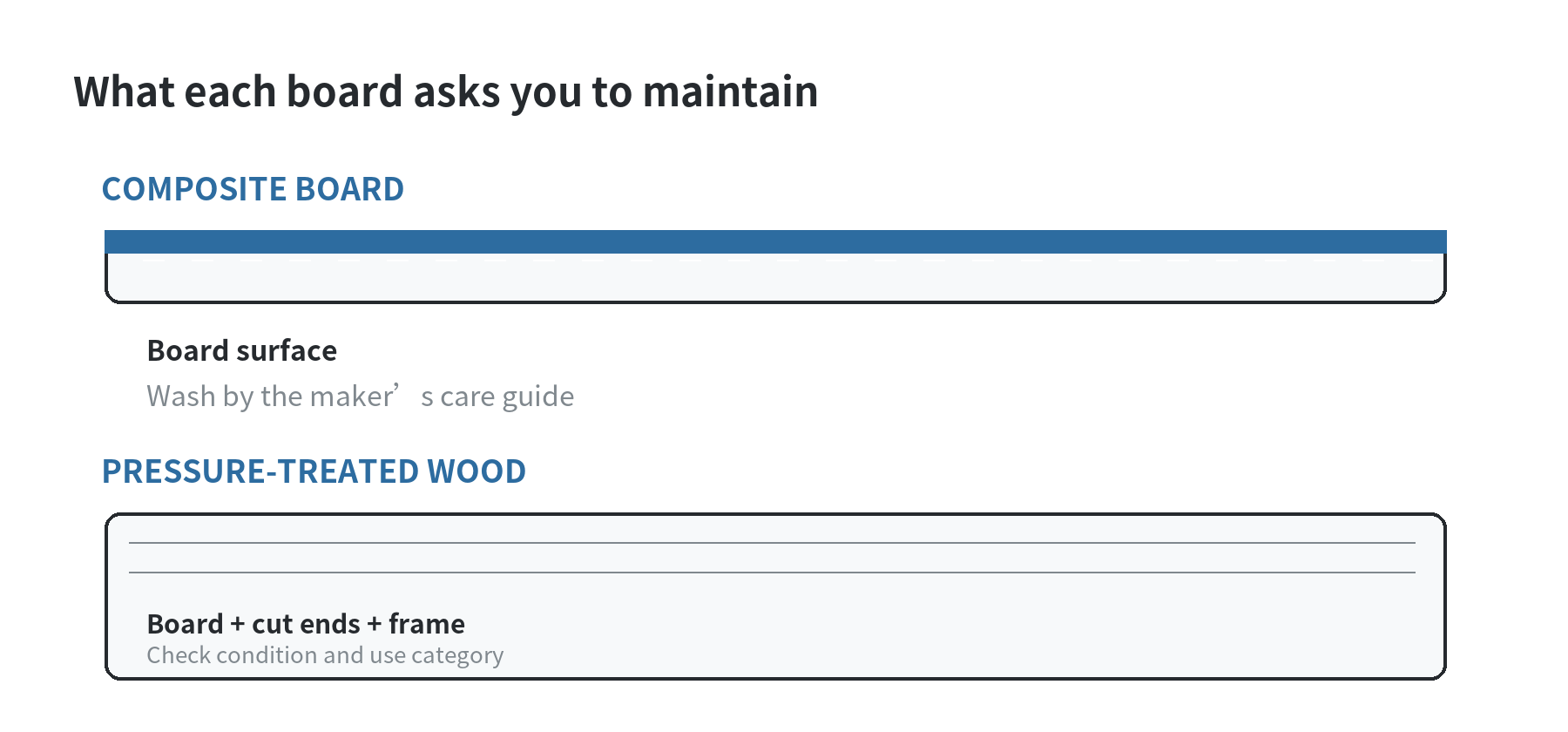
Choose between composite and pressure-treated decking by deciding which upkeep you would rather own. Composite boards reduce routine surface work, but they still need cleaning and their warranty depends on the exact product. Pressure-treated lumber asks you to watch the wood itself, including cut ends and the supporting frame, while its treatment category must fit the exposure. Neither material comes with a universal service-life number.
Start with the work you want to repeat
Composite decking can combine wood fibers and plastic; Trex describes those materials in its decking overview (checked October 22, 2026). Product lines still differ in construction and care instructions. The useful maintenance question is not whether composite is “maintenance-free”; manufacturers say it is not. Trex’s FAQ says its newer high-performance product lines can be cleaned with soap and water, while the manufacturer also maintains separate guidance for earlier-generation boards (checked October 22, 2026). That difference is a reason to identify the line before choosing a cleaner or tool.
Pressure-treated decking is wood treated with preservative. The American Wood Protection Association (AWPA) explains that treatment categories correspond to intended exposure (checked October 22, 2026). It remains wood: boards can weather, split, splinter, hold moisture, or show movement at fasteners. The treatment is intended for a stated exposure category, not as a promise that every board in every location will perform identically. You still need to plan for cleaning, inspection, and repairs.
If you would rather spend less time on recurring surface care, composite may fit better. If you prefer working with wood and can inspect its condition, pressure-treated lumber may be a better match. That comparison says more about upkeep than a simple “longer-lasting” label can.
Read the treatment mark before you plan around wood
For pressure-treated lumber, the label matters as much as the board’s appearance. The American Wood Protection Association (AWPA) organizes treated wood by Use Category, which relates the treatment to expected exposure (checked October 22, 2026). Its guidance identifies UC3B for above-ground exterior use with uncoated wood or poor water runoff, and UC4A for general ground-contact use. The AWPA deck-board guide lists UC3B or higher for above-ground deck boards (checked October 22, 2026).
“Above ground” does not settle every case. AWPA notes that a component physically above soil can face ground-contact-type hazards because of its design, climate, or site conditions (checked October 22, 2026). Persistent moisture, poor drainage, soil contact, or a hard-to-replace structural member can change what category is appropriate. Check the board end tag or treatment stamp and ask the project designer or lumber supplier to match it to the actual use.
Also inspect the framing plan. AWPA’s guide lists different categories for above-ground joists and beams versus ground-contact joists and beams (checked October 22, 2026). The deck surface and the structure below it may therefore call for different treatment categories. A board label alone does not tell you whether the whole assembly suits the site.
AWPA’s code guidance says drilled holes and cut ends need preservative treatment (checked October 22, 2026). Follow the lumber maker’s directions for the product and application; do not assume a cut edge is protected merely because the original board was pressure-treated.
Compare upkeep by task, not by slogan
| Task | Composite | Pressure-treated wood |
|---|---|---|
| Routine cleaning | Use the specific line’s care guide; instructions can differ by generation. | Use a method suitable for the wood and its finish; avoid damaging the surface. |
| Surface checks | Look for dirt buildup, stains, movement, or board damage. | Look for weathering, splinters, cracks, soft areas, and loose fasteners. |
| Edges and structure | Check fasteners, gaps, and the supporting frame. | Check cut ends, connections, drainage, and the supporting frame. |
| Finish work | Do not add coatings unless the maker permits them. | Any stain or sealer schedule depends on the wood and chosen finish instructions. |
The table is a maintenance map, not a fixed calendar. Site shade, rain, leaf litter, drainage, traffic, and the manufacturer’s instructions all affect what you need to do. A deck beneath trees may collect more debris than one in an open yard; a shaded, damp corner may stay wet longer than a sunny section. Those are site conditions to inspect, not a reason to promise a particular outcome.
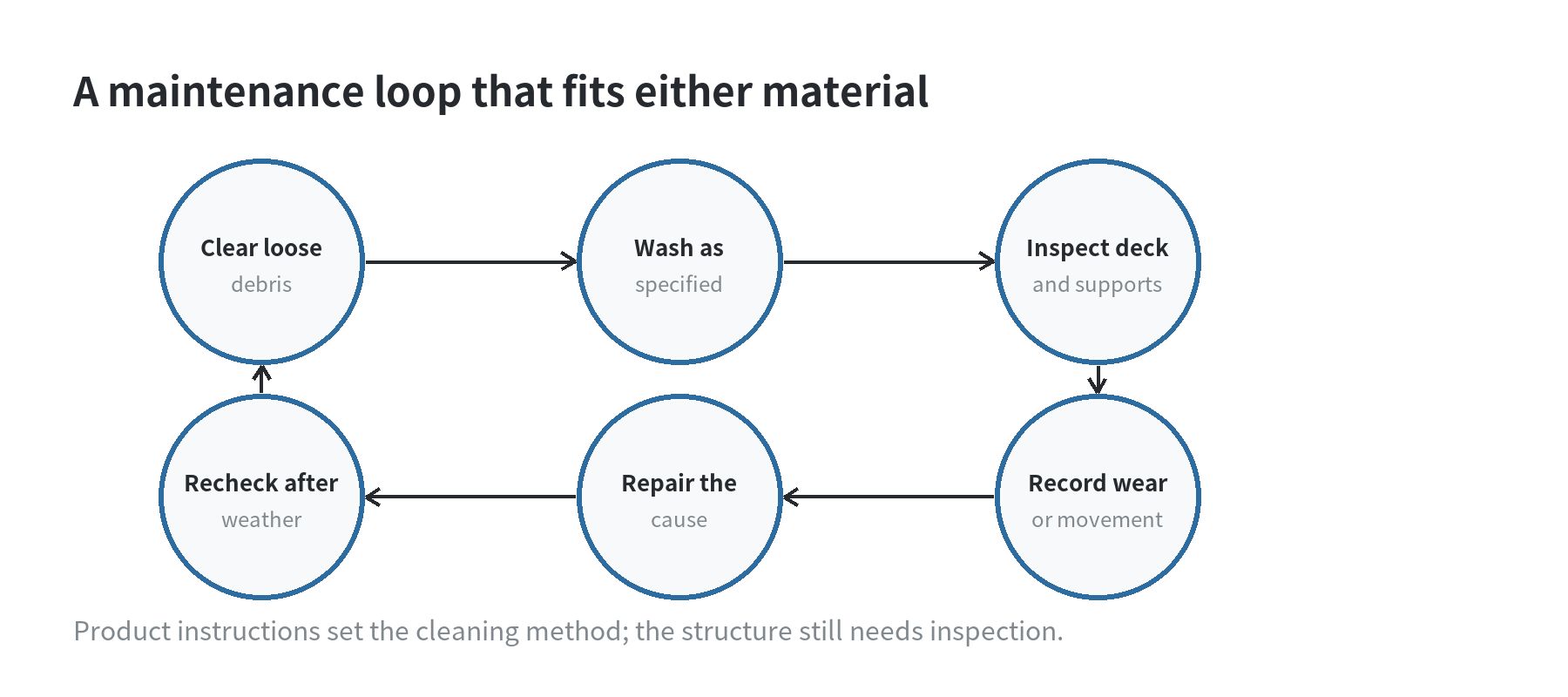
In a leafy yard, clear debris from board gaps and check whether it is collecting against the house-side connection. At exposed edges, look for raised fasteners or boards that shift underfoot. Keep a short log with the location, date, and repair; if the same damp spot or loose connection returns, you have a clear issue to show the installer.
Make cleaning gentle and product-specific
Start by removing loose leaves and dirt, then use the cleaner and method allowed by the product guide. Trex’s FAQ says its current high-performance lines can be cleaned with soap and water, and its download library publishes separate care guides (checked October 22, 2026). That is useful as an example, not a rule for every composite board. Confirm the brand and product line, and check whether the guidance limits pressure-washer settings, brush types, or cleaners.
With pressure-treated wood, use a deck-cleaning method that will not gouge the grain or drive water into joints. Let surfaces dry before deciding whether they need a finish. If you choose stain or sealer, follow that product’s label and the lumber maker’s instructions. A finish is a separate maintenance choice; it does not change the lumber’s Use Category.
For either material, avoid experimenting with harsh chemicals or abrasive tools in a visible spot. Read the care instructions first, test a permitted method in a small inconspicuous area, and rinse as directed. Keep gutters, gaps, and the spaces between boards clear enough for water and debris to move through rather than collect against the structure.
Use the warranty as a boundary, not a lifespan forecast
A warranty tells you what a manufacturer agrees to cover under stated terms. It is not a forecast of the year a deck will need replacement. Coverage can depend on product line, use, installation, care, and exclusions. Read the actual warranty for the board you are considering, including what it covers, what it excludes, whether remedies are prorated, and whether labor or removal costs are included.
The difference between a warranty period and an expected service life is visible in manufacturers’ own documents. For example, Trex lists limited residential warranty periods of 25, 35, or 50 years across product lines, while TimberTech’s published composite warranty lists 25- or 30-year residential periods for the covered collections (checked October 22, 2026). Those are examples of product-specific coverage, not a head-to-head lifespan ranking and not a guarantee that the deck will last for that duration.
Pressure-treated wood does not have one lifespan that applies to every deck either. The category, species, installation, moisture exposure, drainage, construction, and upkeep affect how the assembly performs. The AWPA Use Category system helps match preservative treatment to exposure; it does not assign a universal expiration date to a finished deck.
For either material, save the product label, receipt, installation records, and warranty document. Keep the maker’s care instructions with them. If a problem appears, document the board and location, check the warranty’s claim process, and address any drainage or fastening issue that could affect nearby parts.
Choose with a short site check
- Look at drainage and moisture: does water clear the deck, or does one area stay damp?
- Identify the framing exposure as well as the surface-board exposure.
- Decide whether you prefer periodic wood inspection and finish decisions or product-specific composite cleaning.
- Compare the exact warranty and care guide for each product line you are considering.
- Confirm the treatment stamp and installation details before specifying treated lumber.
If the project includes a ledger, stairs, posts, or framing close to soil, ask a qualified deck professional to review those components against the site and applicable building requirements. For a straightforward surface-board choice, focus on the work you are willing to repeat and on the product documents you can keep.
FAQ
Can composite decking be left without any cleaning?
No. Composite still needs cleaning, and the instructions depend on the product line and generation. Check the maker’s care guide before choosing a cleaner or tool.
Does pressure-treated lumber need a finish?
Not as a universal rule. A stain or sealer is a separate finish choice; check the lumber maker’s instructions and the finish label for surface preparation and upkeep.
Can I use above-ground treated lumber where a deck part touches soil?
Do not infer suitability from the board’s appearance. Match the Use Category on its tag to the actual exposure; AWPA lists different categories for above-ground and ground-contact uses.
Does a longer residential warranty mean a deck lasts longer?
No. A warranty describes limited coverage under its terms. It does not establish a universal service life or predict when a deck needs replacement.
Last updated: 2026-10