Choose a mower by the grass you actually cut, not the size of the whole lot. Measure the lawn, subtract the house, driveway, beds, and other non-grass areas, then weigh that number against slope, obstacles, and storage. A small, open lawn points toward a push mower; a larger area or a need to reduce walking can point toward self-propelled or riding equipment.
Published size guides do not use one shared cutoff. Husqvarna’s U.S. buying guide places push mowers at up to one-third acre, self-propelled walk mowers at up to one-half acre, and riding mowers at two acres or more; Briggs & Stratton says walk-behind mowers can suit yards around three-quarters of an acre or less. Both guides were checked October 21, 2026. Treat those ranges as starting points, then let the layout decide.
Measure the grass, not the property line
A property’s lot size includes space the mower never touches. Mark the lawn sections and measure each one, or use a map-based area tool and verify its outline against the property. University of Minnesota Extension recommends dividing a lawn into rectangular sections and measuring them with a tape measure; for each rectangle, multiply its length by its width. Subtract the house, paving, garden beds, and other areas without turf. The extension guide was checked October 21, 2026.
Write down two things: the total grass area and the shape of that area. A broad, open rectangle is easier to cover with a wider deck than a similar area split into narrow strips behind trees, fences, and beds. The second yard may take more turns and trimming even though its measured area is the same.
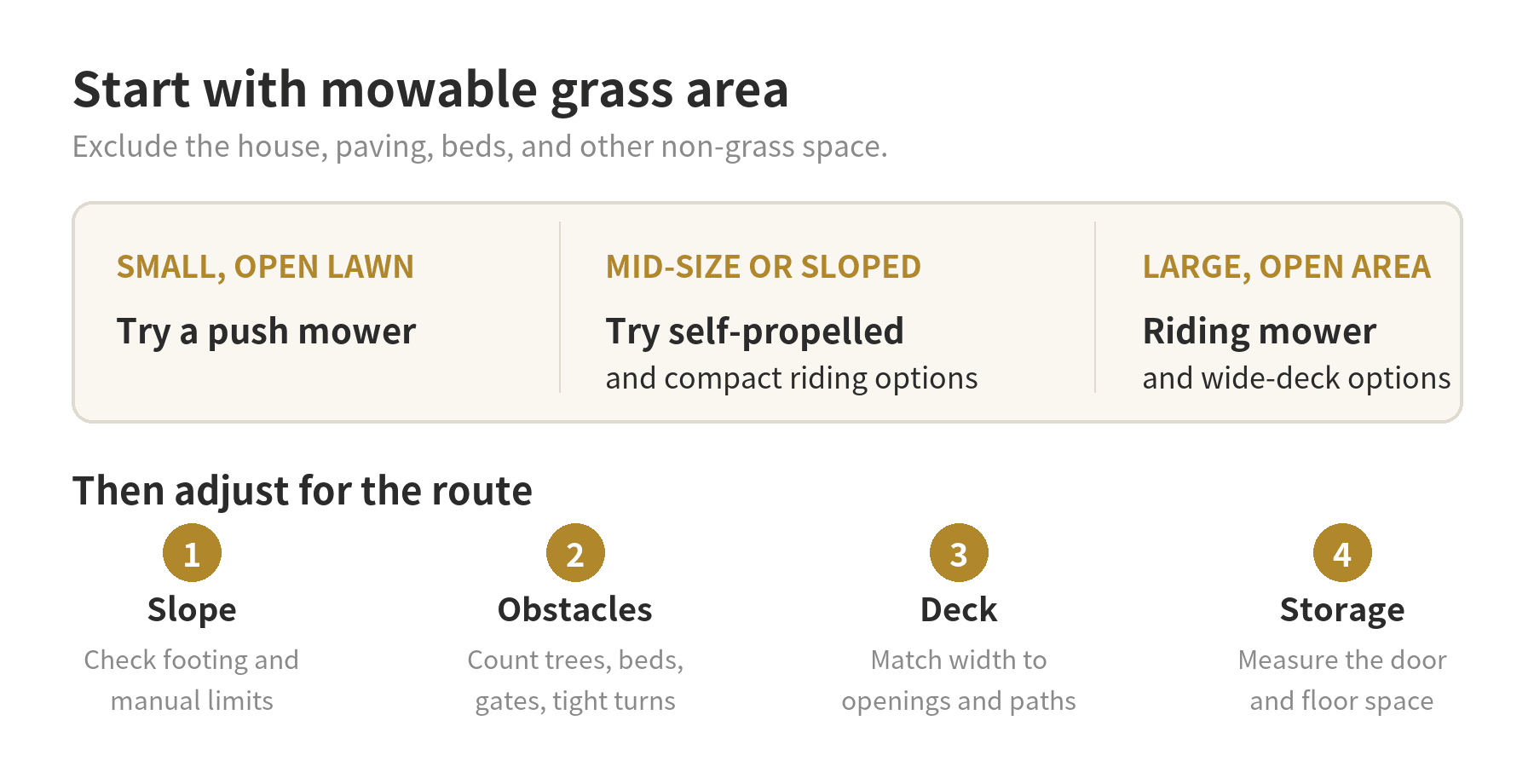
Use acreage as a first filter
| Grass area | Options to compare | What can change the choice |
|---|---|---|
| Small, open lawn | Push mower | Slopes, long walks, or difficulty pushing may favor self-propelled drive. |
| About one-third to three-quarters of an acre | Self-propelled walk-behind; compare a compact rider if walking or pushing is a barrier. | Hills, repeated turns, and mowing time. |
| Above roughly three-quarters of an acre | Compare riding options with a wide walk-behind mower. | Tight gates, trees, storage, and the amount of open ground. |
| One acre or more | Riding mower becomes a stronger candidate; match the deck to open versus divided lawn. | Terrain, obstacles, transport, and maintenance space. |
The table intentionally leaves overlap between categories. Husqvarna’s and Briggs & Stratton’s guides give different walk-behind thresholds, and Briggs & Stratton says a rider can suit a half-acre yard when walking behind a mower is difficult. A wide walk-behind mower can also bridge the gap: Toro’s homeowner guide describes wide-format walk-behind models for lawns that fall between walk and riding equipment. The three manufacturer guides were checked October 21, 2026.
Match the drive to slopes and turns
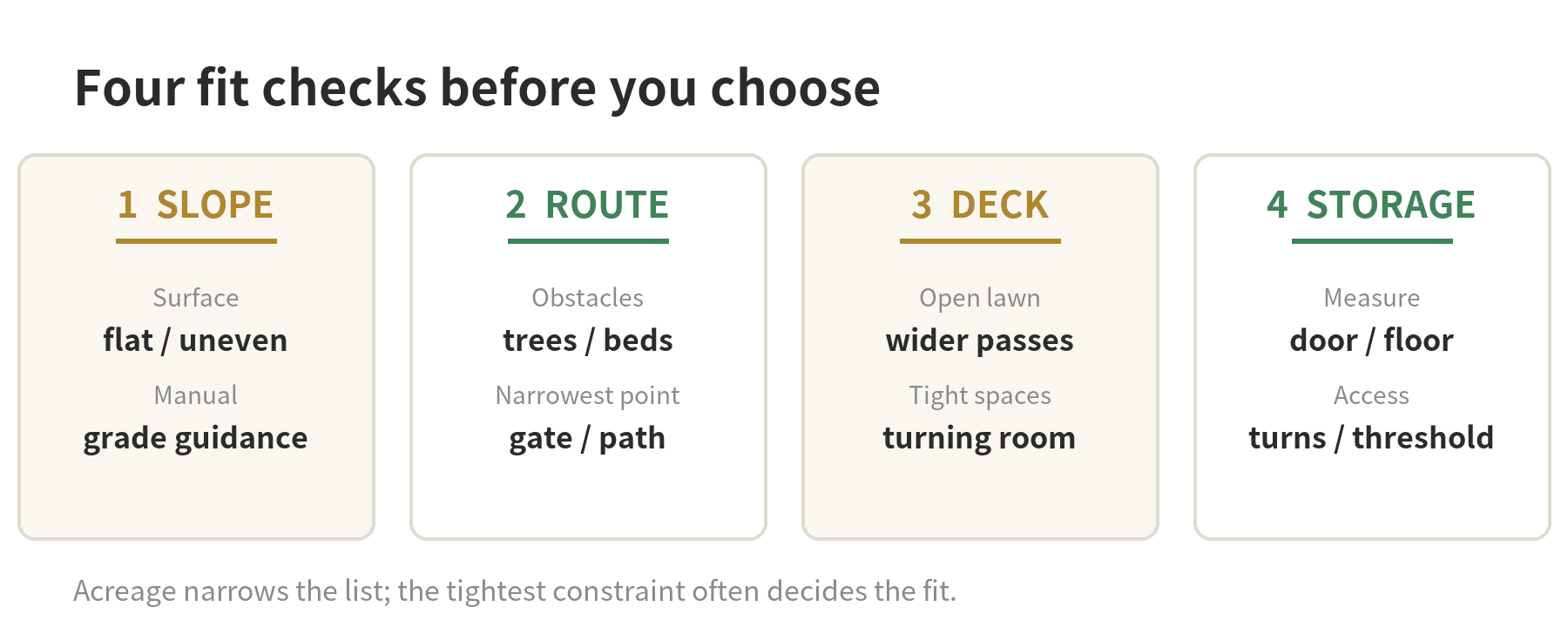
A push mower asks you to provide the forward force. A self-propelled walk-behind mower uses power from its engine to drive the wheels while you steer and control the pace, as described in Toro’s homeowner guide, checked October 21, 2026. It can make sense on a modest lawn with a grade or when pushing is the part of mowing you want to reduce. Drive layout and traction differ by model, so check the manual’s terrain guidance before choosing equipment for a slope.
A riding mower reduces the amount of walking on a broad lawn, but its footprint can be a problem in a narrow passage or crowded garden. Penn State Extension’s riding-mower safety guidance says to check the operator’s manual for slope practices; it gives a general direction rule based on whether a slope is greater than 15 degrees. This is a safety threshold, not a mower-capacity rating. If the lawn has steep sections, ditches, or uneven ground, use the manual’s model-specific instructions to decide whether that machine belongs there.
Count gates, tree trunks, bed edges, and tight turns. A broad deck covers more ground per pass, but needs more turning room and leaves a wider strip that may not fit between obstacles. A smaller walk-behind deck can enter confined spaces that a riding mower cannot. Toro describes zero-turn riders as maneuverable around obstacles and lawn tractors as suited to open, flat lawns; checked October 21, 2026. Check the whole route, not just the lawn’s total area.
Choose a deck that fits both lawn and garage
The cutting deck is the width of grass cut in one pass. Wider decks can reduce the number of passes on open ground; smaller decks are easier to thread through narrow sections. Compare the machine’s full width—not only its published cutting width—with the tightest gate, shed opening, and storage path. Include room to turn the mower around without lifting or forcing it.
Before choosing a larger mower for a large lot, check how much of the property is actually mowable in one continuous route. If the lawn is broken into small pockets, a wider deck may save less time than the acreage suggests. If it is mostly open, a rider or a wide walk-behind model may make more sense. Toro’s buying guide notes that deck width affects the amount cut in one pass and that smaller decks maneuver more easily in tight spaces; checked October 21, 2026.
Check power, clipping handling, and storage
Power source is a separate choice from mower type. Toro’s homeowner guides describe cordless walk-behind and electric riding mowers; checked October 21, 2026. For a battery mower, compare the maker’s stated runtime and charge time with the amount of grass you expect to cut in one session. Do not use a generic acreage estimate as a promise of runtime. Verify battery compatibility in the specific model’s manual.
Decide what should happen to clippings. Briggs & Stratton describes mowers with rear-bagging, side-bagging, or mulching, depending on the mower and attachments; checked October 21, 2026. Check which parts are included and what the manual requires for each setup. Bagging means emptying a catcher; mulching avoids collecting clippings but requires compatible equipment and suitable operating conditions. The operator’s manual is the source for the machine’s permitted configurations.
Finally, measure the storage space and the route into it. Toro’s homeowner guide notes that a riding mower takes more shed or garage space than a walk-behind mower; checked October 21, 2026. The garage door or shed opening may be narrower than the interior. Note the machine’s overall width and length, any foldable-handle dimensions, and whether the storage route includes a threshold or sharp turn. A mower that fits the lawn but cannot be stored or moved safely is a poor fit.
A short decision checklist
- Calculate mowable grass area, excluding buildings, pavement, and beds.
- Sketch slopes, ditches, trees, gates, narrow passages, and separate lawn sections.
- Use the acreage bands to shortlist push, self-propelled, and riding types; keep overlaps open.
- Compare deck width with both the open lawn and the tightest route.
- Check the operator’s manual for slope limits, clipping modes, power details, and storage dimensions.
If the yard is small and mostly open, a push mower keeps the machine simple and compact. If walking or pushing is the limiting factor, compare self-propelled models even below the usual acreage bands. If the grass area is large and open, compare riding models; for a divided yard, prioritize turning room and passage width. The right choice is the one that can cover the mowable area and navigate the actual route.
Frequently asked questions
What size lawn needs a riding mower?
There is no universal cutoff. Manufacturer guides place walk-behind suitability at different acreage limits, and terrain, shape, and the operator’s needs can shift the choice. Measure the lawn and use the published ranges as a first screen.
Is a self-propelled mower worth considering for a small lawn?
Yes, if pushing is difficult or the lawn has slopes. It drives the wheels while you guide it, so area alone does not determine whether that feature is useful.
Does a wider mower always finish faster?
No. A wider deck can cover more grass per pass on open ground, but tight turns, narrow gates, and small lawn sections can limit its usefulness.
Should I choose battery or gas power based on acreage?
Use the exact model’s runtime, charge or refueling needs, and manual as the comparison. Acreage alone cannot establish a reliable runtime for different grass and layouts.
Last updated: 2026-10