Choose by the surface you clear and the snow you actually get: a single-stage machine is the simpler fit for a paved walk or compact driveway, while a two-stage model is built for broader areas, gravel, and heavier accumulations. Before comparing width or advertised clearing depth, check the manufacturer’s guidance for the exact model; those figures are not interchangeable across machines.
What the stages do
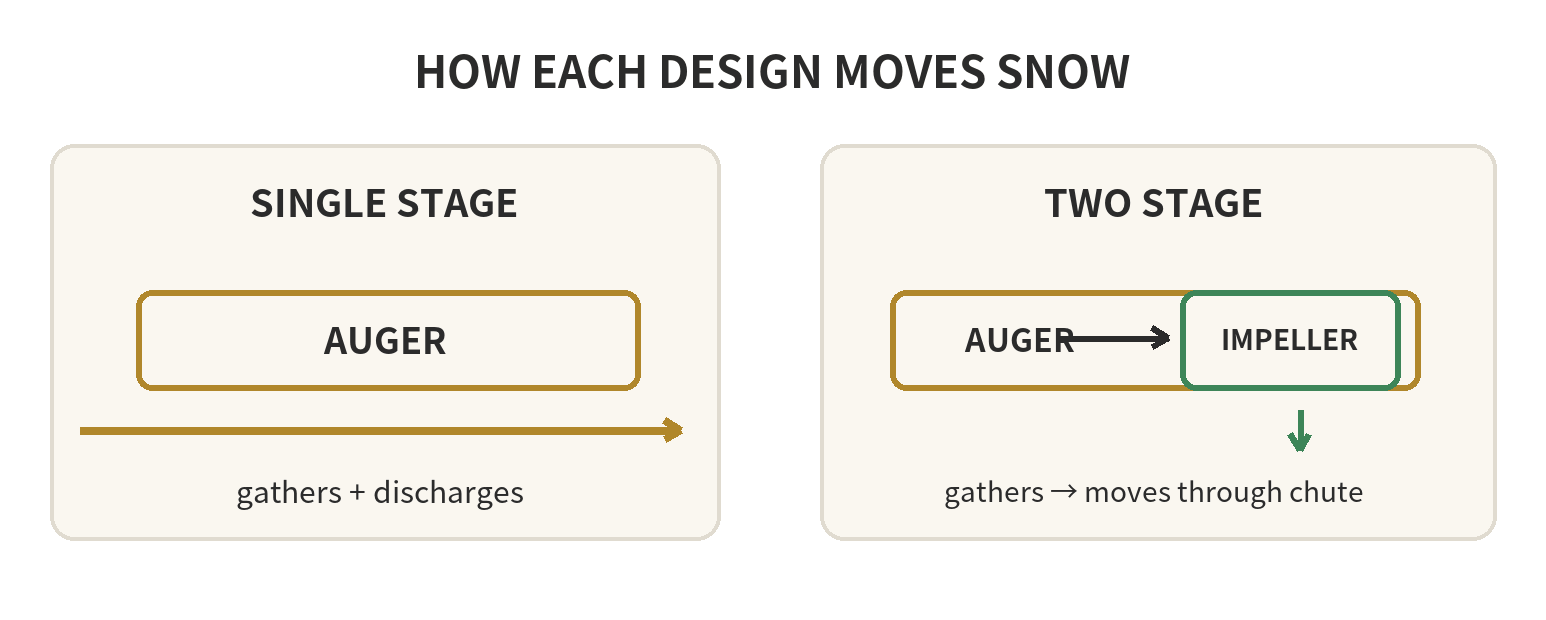
A single-stage blower uses its auger to gather snow and move it through the discharge chute. The auger does the collecting and throwing in one operation. The design is generally compact, and many models are intended to clear paved surfaces, where the auger can work close to the ground.
A two-stage blower separates those jobs. Its auger gathers snow, then an impeller moves it through the chute. That extra mechanism is useful when the snow is deeper or heavier and when the route includes gravel. The machine is generally larger and has more controls and parts to understand, so compare its footprint, weight, and maintenance requirements along with its clearing capacity.
These labels describe the snow-moving mechanism, not a universal performance rating. A wide single-stage unit and a narrow two-stage unit can differ in ways that matter more than the stage count alone. Check the operator’s manual and the manufacturer’s product page for the model you are considering.
Match the machine to the route
Walk the route before shopping. Note the surface, its slope, the narrowest passage, where snow can be thrown, and how much area must be cleared after a storm. Include the apron at the street and the space around parked cars; these can require extra maneuvering even when the main driveway is short.
- Paved walk, patio, or short paved drive: Start by comparing single-stage models. Their smaller form can be easier to steer and store, and the auger can clear close to pavement. Verify the manufacturer’s surface and snow-depth recommendations for the specific model.
- Gravel or mixed surfaces: Consider a two-stage machine with adjustable skid shoes. The shoes help set how close the housing runs to the ground. The manual explains the correct setup; throwing loose gravel can damage property or create a hazard.
- Long or wide route: Compare clearing width, propulsion, turning space, and the route’s bottlenecks. A wider intake can reduce the number of passes, but it can be awkward around gates, steps, and stored items.
- Deep banks or heavy end-of-driveway piles: Look closely at the manufacturer’s depth guidance and design. The plow ridge at the street may be denser than fresh snow, so one advertised depth does not tell you how every snow condition will move.
Make a route sketch that shows where each surface changes. A paved walk leading to a gravel drive creates two different ground-clearance needs, even if the whole route is short. Mark the transition and the place where you can safely turn or pause. That sketch helps you compare the machine’s recommended surface with the actual job instead of choosing from the driveway’s largest section alone.
Read width and depth as model-specific limits
Clearing width is the span taken in one pass. It affects how many passes a route may require, but it does not tell you whether the machine can handle your snow depth, wetness, slope, or surface. Measure the tightest path you need to clear, then compare that dimension with the machine’s overall width, not just its intake opening.
Depth claims need the same care. A manufacturer may describe a maximum snow depth for a particular model or recommended conditions. Treat it as a product-specific reference, not a promise for every snow type or operating pace. Fresh, light snow and packed, wet snow place different demands on the machine. Leave room in your decision for the conditions you see most often and consult the exact manual.
For example, Toro’s current single-stage snow blower page lists widths from 18 to 21 inches and identifies pavement as the recommended surface for the featured line. It lists maximum clearing depths of 12 inches for the battery option and 12.5 inches for the gas option. Those are manufacturer figures for that line, not a general limit for all single-stage machines. The single-stage operator manual identifies its unit as a single-stage model and includes model-specific specifications and safety directions. The manual provides model-specific specifications and safety directions (source checked October 21, 2026). Compare those primary documents against the precise model label.
Think through a full clearing session, not just the first pass. Snow may need to move in more than one direction as the route approaches a garage, path, or parked vehicle. Check whether the chute controls are reachable while you guide the machine, and identify a discharge area that keeps snow away from doors, windows, people, and vehicles. A machine that fits the route still needs a workable place to send what it collects.
Consider who will move the equipment between storage and the work area. Look at the listed machine dimensions and weight, then picture the turns through the garage or shed opening. Leave room to reach the controls and to handle the manual, charging equipment, or fuel safely. If storage is tight, confirm the complete stored footprint before settling on an intake width.
Compare the daily handling details
| Check | Why it matters | What to confirm |
|---|---|---|
| Surface and scraper setup | Ground contact affects how closely the machine clears and whether loose material is picked up. | Recommended surface; skid-shoe adjustment for two-stage models. |
| Clearing width | Sets the pass width but also affects access through narrow spaces. | Intake width and total machine width. |
| Drive and turning | A powered drive can reduce pushing effort; tight turns still need room. | Drive speeds, wheel or track design, and turning controls. |
| Chute controls | You need to direct discharge away from people, windows, and vehicles. | How the chute rotates and how its deflector adjusts. |
| Storage and upkeep | Seasonal equipment needs accessible storage and routine care. | Stored dimensions, fuel or battery instructions, service schedule, and parts availability. |
Power source is a separate decision from stage type. Battery and gas versions may be available in different designs, but the choice changes charging or refueling, storage, noise, and maintenance routines. Review the manufacturer’s instructions for battery care or fuel handling, and check whether the listed runtime or capacity applies to the included battery configuration. Avoid treating a power-source label as a substitute for the clearing-capacity specifications.
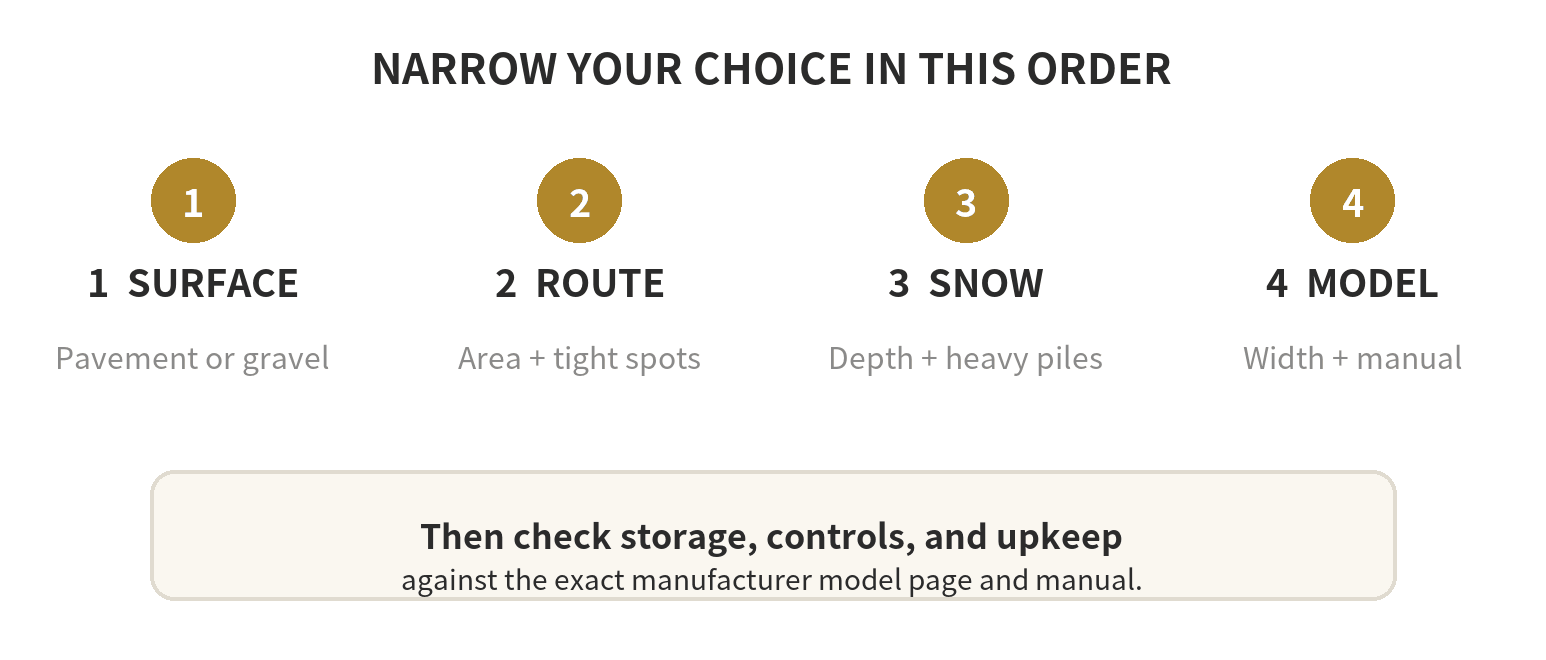
Compare two candidate models in the same order: surface guidance first, then the tightest route clearance, then the snow conditions each manual describes. This keeps a large advertised intake from dominating the decision before you know whether the machine suits the ground. If one model lacks a clear answer for a surface or condition you face, set it aside until you can check its manual or ask the manufacturer.
A short pre-purchase check
- Sketch the route and mark pavement, gravel, incline, gates, steps, and the street-end pile.
- Measure the narrowest clearance and the available storage area, including space to move the unit in and out.
- Write down the snow conditions that drive the job: ordinary snowfall, drifting, or compacted piles. Use local weather records or your own notes rather than a generic “average” snow depth.
- Use the manufacturer’s page to shortlist a stage type, then read the operator’s manual for the exact model before deciding.
- Compare the full width, depth guidance, drive system, chute control, maintenance tasks, and warranty terms in one place.
Before the season, make a small maintenance note from the manual: inspection tasks, cleaning directions, storage preparation, and any service intervals. Keep that note with the machine’s documentation so the person operating it can find the correct instructions. Battery and fuel models have different handling directions, so use the section written for the exact power configuration rather than relying on a general checklist.
Check the safety section before operating. The single-stage operator manual says to use only the clean-out tool for blockages, never hands, and to wait until moving parts stop before clearing or servicing. It also directs operators to keep discharge away from people and property. The manual was checked on October 21, 2026. Keep the manual with the machine and follow the specific instructions and warnings on its labels.
The best match is the smallest machine that fits the route and the snow conditions documented by its manufacturer. If you have gravel, a broad area, or recurring heavy piles, make sure a compact single-stage model’s stated use covers those conditions; if storage and maneuverability dominate on a paved route, a two-stage machine may add bulk you do not need.
FAQ
Can a single-stage snow blower clear a gravel driveway?
Check the exact model’s surface recommendation before using it on gravel. Manufacturers identify surface types for specific designs; the operator’s manual also explains ground-clearance setup and safe use.
Does a wider clearing width always mean faster clearing?
No. A wider intake can reduce passes on an open route, but machine width, snow conditions, drive speed, and turns affect the work. Measure tight spaces before choosing.
What should I check for snow piled by a street plow?
Look for model-specific guidance on snow depth and operating conditions, then consider how compacted the pile is and whether you have room to make multiple passes. Do not infer capacity from width alone.
Where can I find the correct maintenance schedule?
Use the operator’s manual for the exact model and engine or battery configuration. The manual lists its inspection, cleaning, storage, and service directions.
Last updated: 2026-10