Build your SSI budget from the amount that actually reaches your account, then assign that money to bills by due date. The federal maximum is only a reference point: other income, living arrangements, and a state supplement can change your payment. A written plan helps you see which bills need attention before the next deposit.
Start with your deposit, not the maximum
For 2026, the Social Security Administration lists a federal payment standard of up to $994 a month for an individual and $1,491 for an eligible couple with no countable income who meet the listed living arrangement conditions. Those are maximum federal amounts, not a promise of what any one person will receive. Your state may add a supplement, and countable income or living arrangements can affect the amount. SSA explains those conditions in its 2026 SSI payment and living arrangement chart and lists the same standards in its 2026 COLA fact sheet.
Use your current award notice or payment record for the number in your budget. If the amount changes, update the plan before assigning money to optional expenses. SSA describes SSI as a needs-based monthly payment program for people who are aged, blind, or have a qualifying disability and limited income and resources; its eligibility page lists additional conditions.
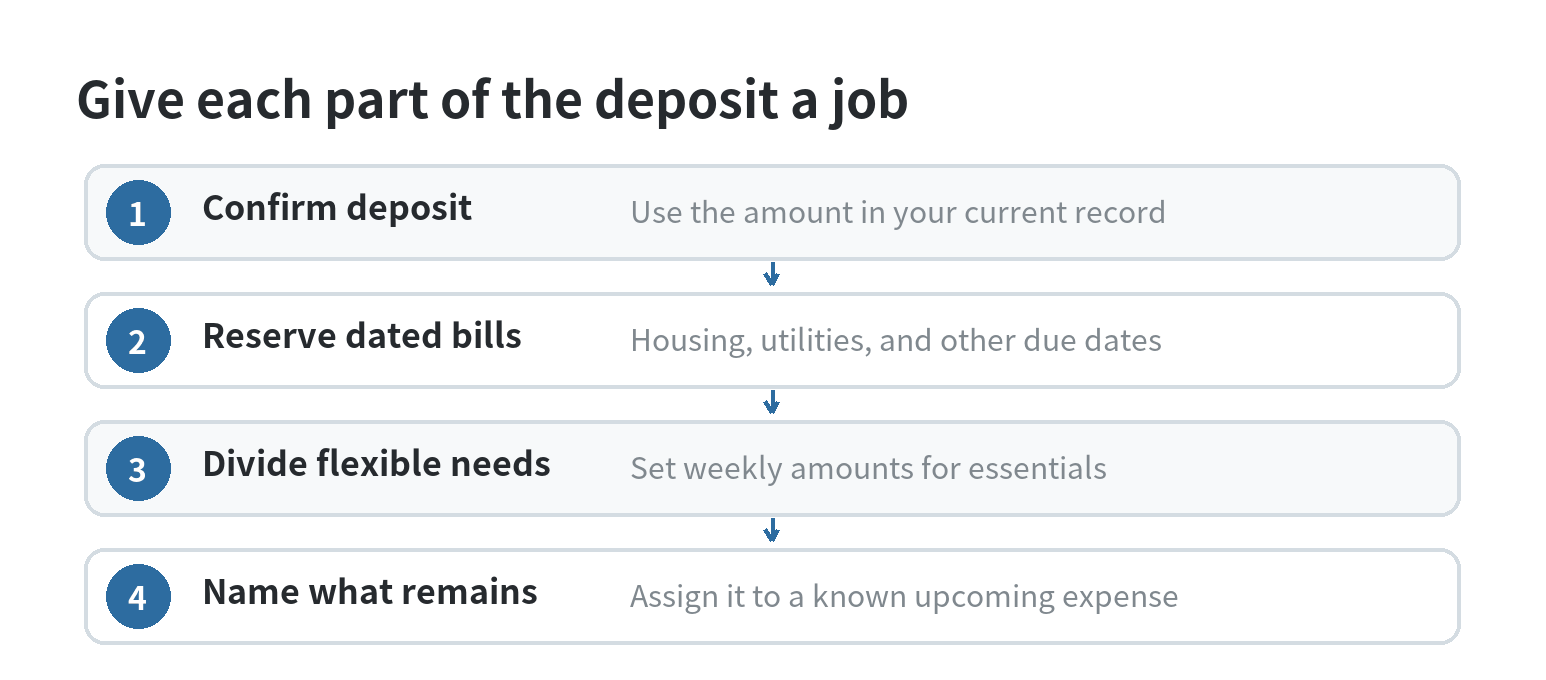
One practical rule: budget each dollar once. Write down the deposit, subtract essential bills, and give the remaining amount a job. If bills exceed income, the worksheet is still useful: it shows the exact shortfall and which due dates arrive first, so you can call a provider before a payment is late.
Put bills in the order they can disrupt your month
List each expense, its due date, and the amount due. Start with housing, utilities, food, prescriptions or other necessary care costs, and transportation needed for appointments or work. Then add phone service, debt payments, and household needs. Use the amounts on your own bills and receipts rather than an online “average.” If a bill changes from month to month, use the amount on the latest statement and leave room to update it.
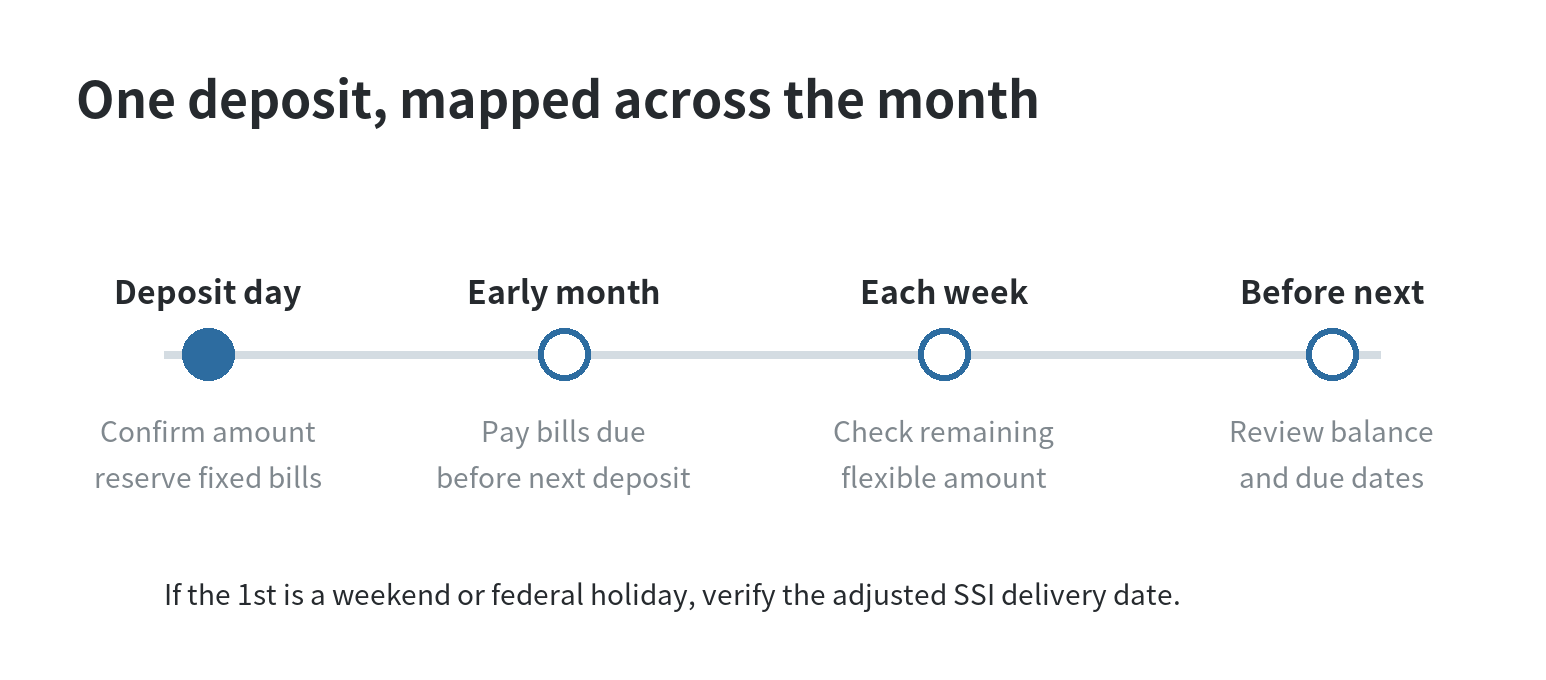
Separate expenses into two groups: bills with a fixed due date and flexible spending that you control week by week. A calendar makes the timing visible. Mark the SSI deposit date, then place rent and other due dates on the same page. SSA says SSI is generally delivered on the first day of the month; if that day is a weekend or federal holiday, payment is delivered on the preceding business day, according to its payment-date explanation.
Keep a small checking buffer only if it fits your situation and does not create a resource eligibility concern. SSI’s resource rules are separate from a household budget: SSA lists a $2,000 limit for an individual and $3,000 for a couple in 2026, while also noting that some property is excluded. Its resource guidance gives the limits and explains that certain resources do not count.
Use a one-deposit plan for a whole month
Here is a made-up example, not a typical SSI budget: suppose the deposit available to plan is $800. Rent and utilities take $430, food takes $150, phone service takes $35, transportation takes $60, and household or personal essentials take $55. That assigns $730, leaving $70 for a bill that runs high, a needed replacement, or a reserve that is allowed under your circumstances. Replace every amount with your own statement totals.
| Example category | Planned amount | When to set it aside |
|---|---|---|
| Rent and utilities | $430 | As soon as the deposit arrives |
| Food | $150 | Divide into weekly amounts |
| Phone | $35 | Before its due date |
| Transportation | $60 | Keep available for planned trips |
| Household and personal essentials | $55 | Use a short shopping list |
| Remaining example amount | $70 | Hold for a specific upcoming need |
The point is the order, not the sample amounts. Set aside rent and utilities first, then divide the grocery amount by the number of shopping weeks in your calendar. Keep the remaining money assigned to a named expense. “Miscellaneous” is hard to track; “bus fare for the clinic” or “laundry” tells you what the dollars are meant to cover.
Make a month-long payment last across the calendar
Because SSI is paid monthly, the first-week balance can look larger than the money available after later bills clear. After setting aside fixed bills, divide flexible categories into weekly envelopes, cash, or notes in a spending app. If a phone-based tracker helps you keep that ledger, see our overview of budgeting apps on your phone. If you use a checking account, a simple ledger with the planned amount and each purchase can show the balance without relying on memory.
For example, if your own food plan is $160 for the month, you could mark four weekly limits of $40. If a week needs more because of a household staple, subtract that difference from the next week before shopping again. Keep your own dietary and medical needs in mind, and use food benefits for eligible purchases when available.
For bills due before the next deposit, move the full amount into a separate account or mark it as unavailable in your ledger. A bill that is “paid later” still belongs to this month’s deposit if its due date falls before the next one. If your landlord or utility provider accepts partial payments, ask about the terms directly and write the agreed dates and amounts in the calendar.
When the plan is short, work the dates before cutting blindly
If the bill list is larger than the deposit, sort it by consequence and deadline. Call the landlord, utility, insurer, or creditor before the due date and ask about a payment arrangement, a different due date, or hardship options. Write down the representative’s name, date, amount, and next step. Do not promise an amount that would leave you unable to pay for another essential.
Look at recurring charges and compare each one with what you used during the last month. Cancel or change only after checking whether there is a fee, a loss of a needed service, or a contract condition. For groceries and household supplies, plan meals around what is already at home, bring a list, and compare unit prices where that helps. Our page on using a phone to keep track of everyday spending covers a related tracking use. These actions can free up room in a particular budget, but no spending method can make an income cover bills that are higher than the available money.
Ask a local benefits counselor or social services office about food assistance, utility help, rent support, and transportation programs. The programs and eligibility rules can vary by state and location. Before applying, check whether a payment or resource needs to be reported to SSA; a change in income, resources, or living arrangements can affect SSI eligibility or payment.
Keep payment changes from catching you off guard
Recheck the budget when your deposit changes, someone moves into or out of your home, your marital status changes, or you start receiving other income. SSA’s 2026 reporting guidance says changes in income, resources, living arrangements, and marital status can affect eligibility or the payment amount, and it asks recipients to report changes as soon as possible and no later than 10 days after the month in which they happened.
Keep a folder with the current award notice, rent statement, utility bills, receipts for essential purchases, and notes from calls about payment plans. A short review on deposit day is enough: confirm the amount, reserve money for due bills, update weekly spending limits, and mark any call or form you still need to handle. If you are unsure whether a change must be reported or whether an asset counts, ask SSA or a qualified benefits counselor about your own situation.
Checked against SSA information on September 30, 2026. Recheck official SSI guidance when annual amounts or your circumstances change.
FAQ
Does the maximum SSI payment mean that is what I will receive?
No. SSA’s listed federal standard is a maximum under stated conditions; countable income and living arrangements can affect an individual payment, and a state supplement may change the total.
What if the first of the month is a weekend or federal holiday?
SSA says the SSI payment is delivered on the preceding business day when the first falls on a weekend or federal holiday. Check the official payment calendar when planning a specific month.
Can I save part of an SSI payment?
Possibly, but check the resource rules that apply to you before setting money aside. SSA’s 2026 guidance lists resource limits and explains that not every asset counts; the treatment of a particular account or item depends on the rules.
Should I report a gift or help with household bills?
Ask SSA how the specific help should be reported. SSA’s reporting responsibilities include changes in help with living expenses from friends or relatives, as well as changes to income, resources, and living arrangements.
Last updated: 2026-09