Budget public transportation from your actual trips, not a national average.
Check the fare rules for every service you use, count the rides your calendar requires, then set aside that amount from each paycheck.
Keep a separate line for occasional trips and fare changes so a week with appointments does not quietly consume grocery money.
Start with the routes you actually use
Write down each regular trip: work, school, medical appointments, errands, and recurring family visits.
For each one, note the start and end points, the days you travel, and which services you board.
Include the return trip.
A one-way commute is not a full commute budget.
Then open the fare page or trip planner for the transit agency that operates each leg.
Check whether fares depend on distance, zones, time of day, transfers, or the service type.
The Federal Transit Administration describes passes, stored-value cards, and tickets as agency fare media in its fare collection guidance (checked September 30, 2026).
WMATA and TriMet publish different fare and pass structures on their monthly pass FAQ and fare pages (checked September 30, 2026).
Use the operator serving your route for your own estimate.
Do not assume a single payment covers a bus, rail line, ferry, or regional partner together.
Check transfer rules and the fare charged on each leg.
If one journey crosses two systems, price each part separately and add them.
Look for reduced-fare eligibility before setting the baseline.
TriMet lists reduced fare programs for older adults, youth, people with disabilities, qualifying income groups, veterans, and active-duty military.
Check your operator’s eligibility page and proof rules before estimating a reduced fare. (Checked September 30, 2026: TriMet fare categories.)
Turn the calendar into a monthly number
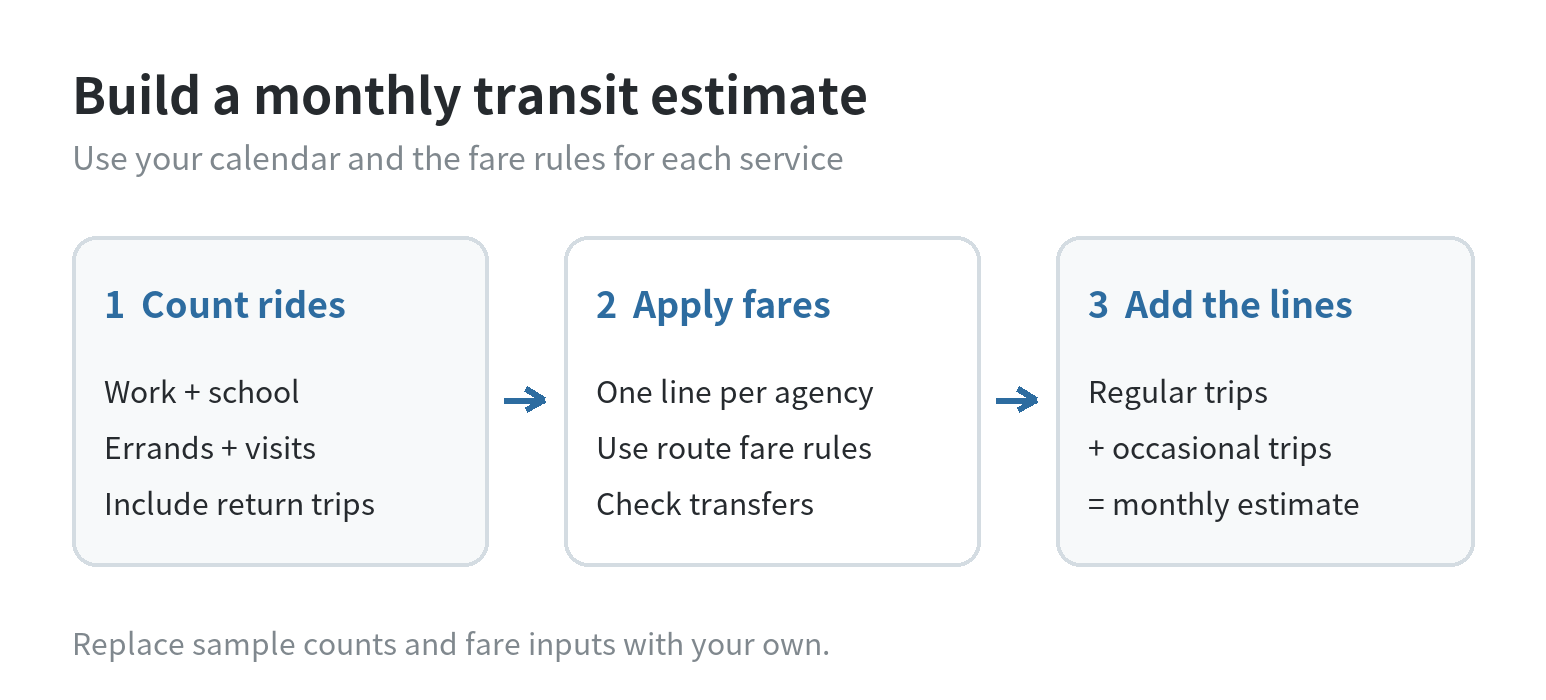
Use a normal month from your calendar, not a perfect month with no days off or extra errands.
Count expected boarding events by fare type, then multiply each count by that agency’s fare.
Add the results.
This makes a flexible estimate you can update if your work schedule changes.
For example, suppose your sample calendar has 18 office days with two paid boardings each, plus four weekend round trips that each require two boardings.
That is 44 boardings for the month.
If the applicable fare for each boarding is R, the base estimate is 44 × R.
Replace R with the fare shown by your agency; the example is arithmetic, not a quoted fare.
Count transfers according to the agency’s fare rules instead of treating every vehicle change as a new full fare.
If the trip planner gives a complete fare for a particular origin and destination, use that result for the whole trip.
Save the route and fare notes beside your estimate so next month’s update takes only minutes.
Compare a pass with pay-as-you-go
A pass is a budgeting option, not automatically the cheapest choice.
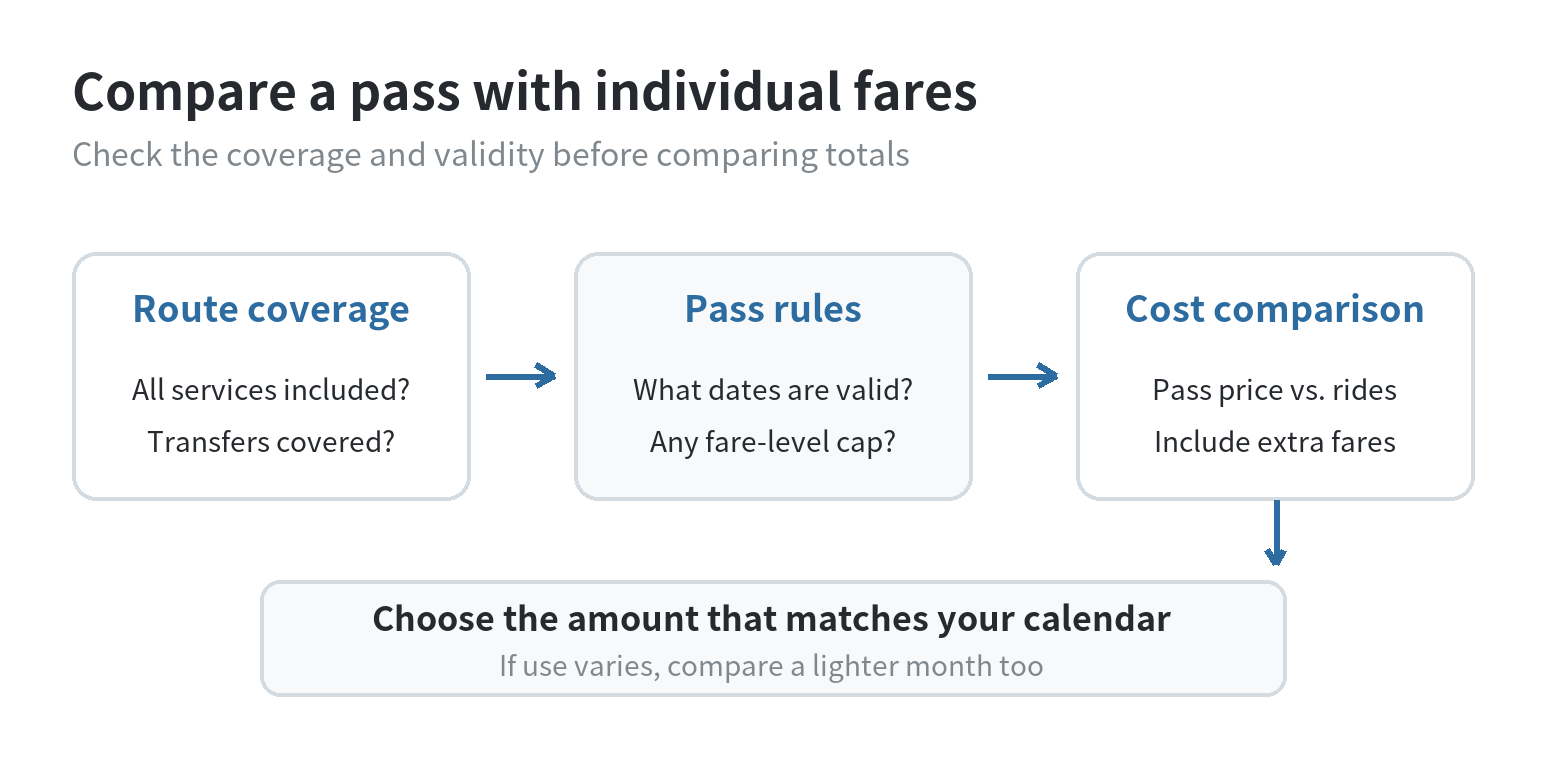
First total the fares you expect to pay under your current schedule.
Then compare that estimate with the pass price and coverage period on the agency’s fare page.
Check whether it covers every route and operator in your commute, whether it is unlimited or capped at a fare level, and when its validity begins.
Pass rules can change the calculation.
WMATA says its Monthly Unlimited Pass uses a selected fare level for one calendar month; trips above it may require an additional fare (checked September 30, 2026).
TriMet describes day and calendar-month fare caps for repeated rides (checked September 30, 2026).
These are local examples, not rules to assume for another city.
Test the pass against your real calendar.
A vacation, remote-work week, school break, or seasonal schedule may leave unused pass days.
If your trips vary, compare a typical month and a lighter month before you commit the same amount every month.
Give irregular rides their own allowance
Separate predictable commuting from trips that come and go: a late shift, an extra campus visit, an appointment, or a weekend outing.
Look back at your own transit account history, receipts, or fare-card reloads.
Add those extra rides and their applicable fares to a second monthly line.
If you have no history, start with the trips already on your calendar and adjust after recording actual use for a month.
When several agencies are involved, keep a line for each one.
A regional pass may cover a partner service only under stated conditions; a local bus pass may not cover rail.
The FTA describes passes, stored-value cards, and tickets as fare media in its fare collection guidance (checked September 30, 2026).
Verify coverage on each operator’s current page instead of extending one agency’s rules to another.
Fit the amount to your pay schedule
Once you have a monthly estimate, divide it across the paychecks that fund that month.
If you are paid twice monthly, assign half to each check.
With weekly or biweekly pay, use the number of checks that actually arrive before the bills and rides are due; do not count an extra paycheck as guaranteed monthly transit money.
For a lighter-use month, lower the trip count instead of carrying forward last month’s total.
A calendar with a planned vacation, school break, or temporary remote-work schedule gives you a different estimate; restore the regular amount when that routine returns.
Keep the transit amount in a separate budget category even when you load one fare card for several weeks.
A reload is cash leaving your account, while the rides it pays for may happen later.
Track the reload and the remaining card balance so you do not budget the same dollars twice.
If payday and the pass purchase date do not line up, reserve part of the cost from an earlier check.
A pass that starts mid-month may not match a monthly budget period, and a card balance can carry across months.
Write down both dates: when money leaves your checking account and when the covered rides occur.
That simple timing note makes the account balance easier to reconcile.
If the estimate competes with rent, food, or utilities, revisit the inputs before cutting the line blindly.
Confirm the cheapest valid fare method, employer transit benefits, and any reduced-fare eligibility on the official operator or employer page.
Record only benefits you qualify for and can use on your routes.
A general monthly budget can help place the transit category alongside bills; see how to build a simple budget tracker or how monthly budget categories fit together.
Review the line when your routine changes
At month-end, compare the planned number with actual fares, not just the money loaded onto a card.
Note the reason for a gap: a changed office schedule, extra transfers, a missed trip, or an occasional journey that became routine.
Update the next month’s boarding count and fare details when one of those inputs changes.
Check agency fare pages again before a pass renews or when a route, employer benefit, or service provider changes.
Fare prices and pass terms differ by agency, as WMATA and TriMet show (checked September 30, 2026).
Use your operator’s fare page and trip planner for your worksheet; if they do not show a needed fare, ask the transit agency for a quote rather than filling the gap with an average.
Last updated: 2026-09
FAQ
How much should I budget if I ride transit only a few days each week?
Count the trips on your calendar and price those trips under the local fare rules.
Compare the result with any pass whose coverage matches those dates; do not multiply a full-time commute estimate by guesswork.
Should I budget for a transit pass before I know my work schedule?
Use the schedule you can confirm, then compare a pass with individual fares for a lighter-use month.
Check the pass validity dates and coverage before treating its full price as a monthly expense.
How do I budget when one commute uses two transit agencies?
Calculate each agency’s fare separately, then add the legs using the transfer rules each operator publishes.
Verify that a pass or regional product covers both systems before including it in the estimate.
Where can I find the fare for a route I do not ride every week?
Use the transit agency’s trip planner or current fare page for the specific origin, destination, time, and service.
If it does not provide a fare for that trip, contact the operator for the amount instead of relying on a citywide average.