Budget for Prime from the amount and billing date shown on your own membership account, then set aside money between charges. The U.S. public page lists a monthly plan at $14.99 and an annual plan at $139, checked September 30, 2026; a Federal Trade Commission court filing lists the same rates. Your plan and renewal date are the useful numbers for your household budget.
The monthly plan belongs in the recurring-bills section. An annual plan belongs in a sinking fund: divide the amount due by the months remaining before renewal, then keep that money available for the renewal month. This keeps one subscription from turning into a surprise charge or a guess about what its benefits are worth.
Start with the charge you actually have
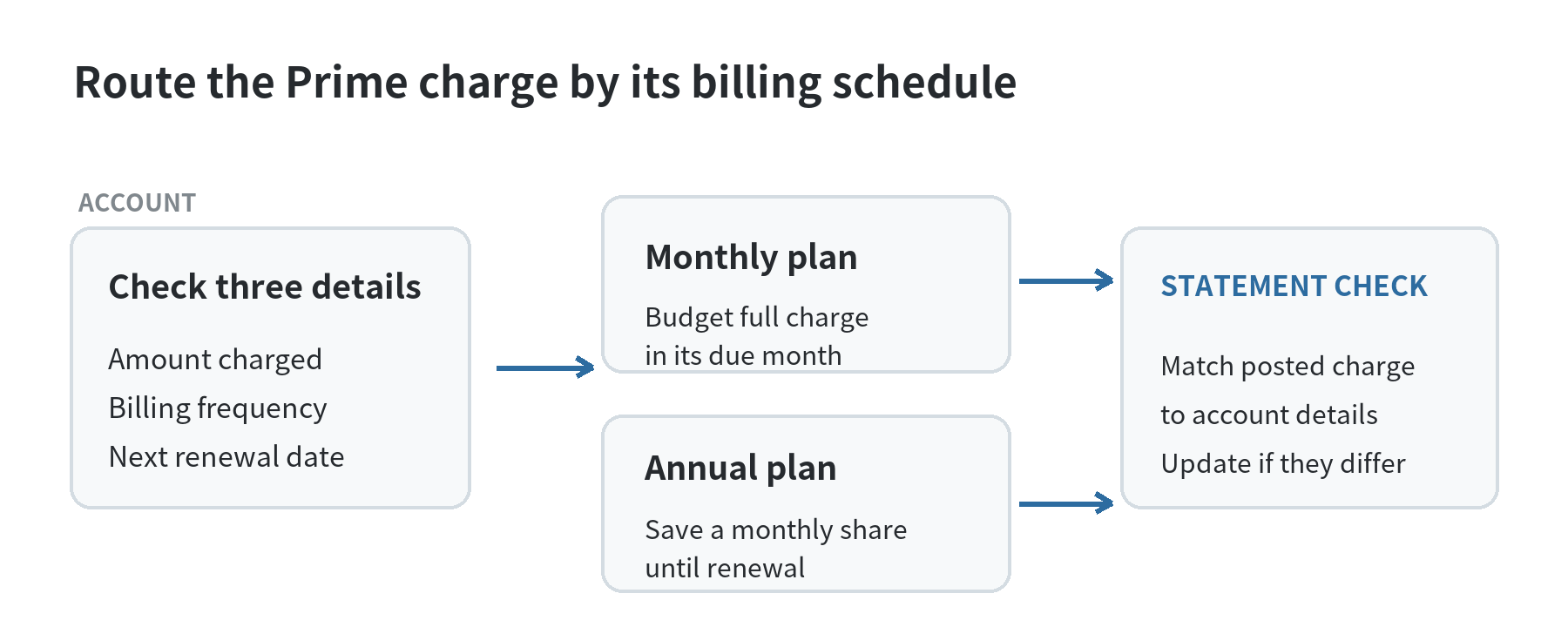
Open the membership account and note three things: the amount charged, the billing frequency, and the next billing date. Match those details against the card or bank statement. If the amount differs, budget the posted charge while you check which plan or membership the account shows.
Do not use a remembered price as your budget line. Membership prices and available plans can change, and a special plan may have different terms. The official U.S. Prime page is the source for public plan prices; the amount on your own account is the one to enter in your ledger.
If you need to find recurring charges beyond this membership, our subscription-tracking guide covers that separate task.
Give the charge its own label, such as “Prime membership.” Keep it separate from shopping, streaming add-ons, and delivery orders. A clear label lets you see the subscription by itself instead of blending it into a month with unusually high household purchases.
Convert the billing schedule into a monthly plan
If the account bills monthly, enter the exact recurring amount in the month it is due. If it bills annually, divide the renewal amount by twelve and transfer that share to a dedicated subscription fund each month. The annual charge still comes out as one large payment; the monthly amount is a saving target, not a change to the plan.
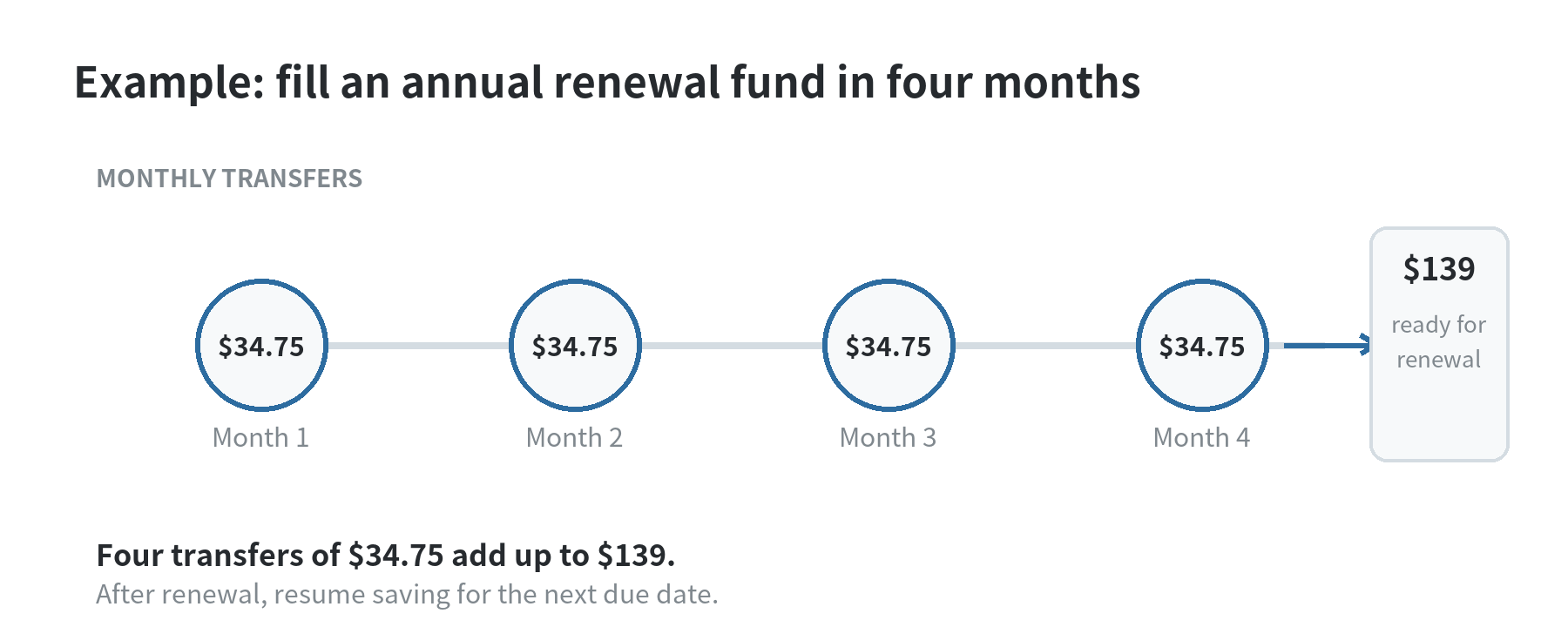
For a worked example, suppose a household has the listed $139 annual plan. Dividing $139 by 12 gives about $11.58 to set aside each month. If renewal is four months away and the fund is empty, the household needs to reserve $34.75 per month for those four months to reach $139. Once funded, it can return to the roughly $11.58 monthly pace for the next renewal.
Use the remaining months before your actual renewal, not a generic calendar year. If the charge is due next month, dividing by twelve would understate the short-term amount needed. If the date is several months away, add the transfer to payday or bill-day routine so the money does not get spent on another category.
If you budget by paycheck, split the monthly target across the deposits you expect before the charge. For an $11.58 reserve target and two planned deposits, that is $5.79 from each deposit. If a paycheck arrives after the renewal date, do not count it toward this charge; fund the earlier due date from money already available.
Keep the reserve contribution separate from the expense entry. The transfers build cash for a later bill; they are not extra membership fees. When the annual charge posts, record the $139 expense once and reduce the reserve by the same amount. This prevents a budget from counting both the monthly set-asides and the renewal as two separate costs.
| Billing pattern | Budget entry | Cash-flow check |
|---|---|---|
| Monthly | Full account charge in its due month | Leave that amount available before the charge date |
| Annual | Annual charge divided by months until renewal | Keep the full renewal amount ready for the due month |
| Plan or date unclear | Temporary line based on the latest posted charge | Confirm the account details before setting a longer-term target |
Separate membership cost from shopping habits
A subscription and the purchases made while using it are different budget decisions. Put the membership fee under subscriptions. Put each order under the category for what it contains, such as household supplies, groceries, or gifts. This makes it possible to review both the fixed charge and flexible spending without treating one as a discount against the other.
The Federal Trade Commission’s amended complaint describes Prime as a bundle that includes shipping and services such as video, music, and gaming; the company’s June 2026 U.S. press notice also lists delivery, video, music, and other benefits. Use those descriptions as a prompt to check which services are part of your current plan and which separate charges appear on your account. Add-ons and one-time orders should get their own ledger lines.
For a simple example, assume the membership charge is $15 per month and a household places $48 of household-supply orders in the same month. The subscription line is $15; the supplies line is $48. If both are recorded as one $63 “Prime” expense, next month’s review cannot show whether the fee or shopping changed.
This split also helps when another person in the household uses the same account or payment card. Agree on one category for the membership and use the household’s purchase categories for orders. If one person pays the card bill but another tracks the budget, share the renewal date and annual reserve balance along with the statement total.
If you keep the ledger in an app, our phone budgeting app guide covers a way to organize the broader monthly plan.
Check the renewal without rebuilding your budget
On statement day, compare the posted transaction with the amount and date in your plan. Mark it paid, then restore the monthly transfer to the annual fund if you have an annual plan. If the charge is different, pause the old target and confirm the plan shown on the account before changing your budget.
The FTC advises consumers to review bank or card statements for subscription charges and auto-renewals. That check can sit beside the monthly budget review: scan the transaction list, match the membership charge, and note the next renewal date. If you see a charge that does not match your account, keep the statement entry and seek help through the service’s official account support or your payment provider.
When money is tight, adjust the subscription line explicitly. Move the planned amount from a flexible category only if that category has room, or review the subscription account’s current options and renewal details. Avoid counting delivery savings, entertainment use, or a hypothetical future benefit as cash already available for rent, food, or another bill.
If you have several subscriptions, review their charge dates together but keep separate lines. A single “subscriptions” total may show whether the combined amount fits, while individual labels show which renewal is coming next. Do not erase a line just because its charge did not post this month; an annual item still needs a reserve between renewals.
When your plan or payment changes
A plan change resets the budget math. Replace the old amount with the charge now shown in the account, calculate the number of months remaining to renewal, and divide the amount still needed by those months. If a renewal posts before you have funded the full amount, record the shortfall as a budget adjustment instead of hiding it in shopping.
If the charge moves between monthly and annual billing, update both the due month and the monthly reserve. A calendar reminder a month before renewal gives you time to review the amount and decide how it fits. Keep the reminder beside other annual expenses, such as insurance or a yearly software bill, but retain a separate line for each service.
A useful Prime budget is simply a dated expense line backed by the actual account charge. Keep the membership fee apart from orders, fund an annual renewal in smaller monthly pieces, and compare the next statement with the plan you recorded.
FAQ
How do I budget for an annual Prime renewal when I just joined?
Use the months remaining before the renewal date to set the monthly amount. Divide the full renewal charge by that number of months, then move the money into a separate subscription fund.
Should I count Prime shipping as money saved in my budget?
No; record the membership fee as an expense and record each purchase in its own spending category. A shipping benefit is not cash deposited into the household budget.
What if a Prime charge appears but I cannot find it in my plan?
Compare the transaction date and amount with the account’s membership and payment records. If they do not match, save the statement details and contact the service or payment provider for help.
How should I budget if my Prime billing date changes?
Move the planned charge to the new due month and recalculate any annual reserve using the months left before that date. Keep the old target only if it still matches the amount and schedule shown in the account.
Last updated: September 2026.
Last updated: 2026-09