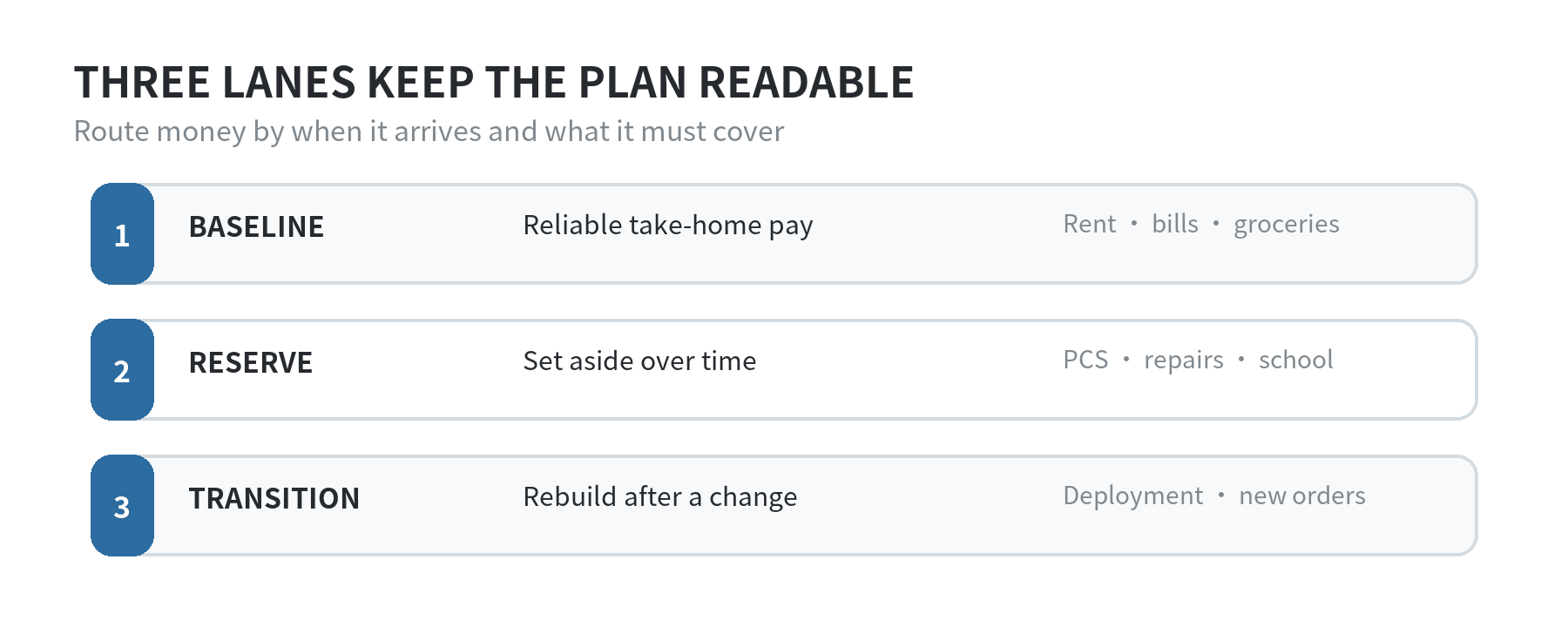
A workable military family budget starts with the money that reliably reaches your bank account, then gives changing pay and move-related costs their own lanes. Build the regular household plan from take-home pay shown on the Leave and Earnings Statement (LES); treat a new allowance, deployment pay or reimbursement as unconfirmed until it appears in the account. That keeps rent, food and scheduled bills from depending on money that may change.
Military OneSource’s spending-plan guidance (checked September 30, 2026) says to list basic pay, allowances and special pay, review prior spending, and leave room for future military-life events. DFAS describes the LES as a record of earnings, withholding and allotments; Military OneSource’s LES explainer lists the same pay details. Those sources point to a practical starting point: use the LES to establish income, and your own statements to measure spending.
Build the baseline from money already received
Open the latest LES and note the net deposit, allotments and deductions. Use the amount that actually lands in checking for the monthly plan, not the headline gross pay. Then list the service member’s stable pay and any spouse or partner income that is already arriving. If a paycheck, deduction or allotment changed, check the statement and account before updating the household totals.
BAH relates to housing, while BAS is a subsistence allowance. They are separate allowance lines, not interchangeable labels for spare cash. The amount and applicable rules depend on the service member’s circumstances; do not copy a number from another family’s budget. For a 2026 housing estimate, use the Defense Travel Management Office’s BAH rate lookup and compare the result with the current LES. Military OneSource also directs families to the official lookup. The pages were checked September 30, 2026.
Make two income columns: “arrived and recurring” and “possible or changed.” Put stable net pay in the first. Put a pending promotion adjustment, a new duty-related payment, reimbursement or a spouse’s not-yet-started job in the second. A budget can show the second column for planning, but don’t assign it to bills until it arrives. For a phone-based way to record expenses, see this simple budget tracker walkthrough.
Give each paycheck a job before the bills arrive
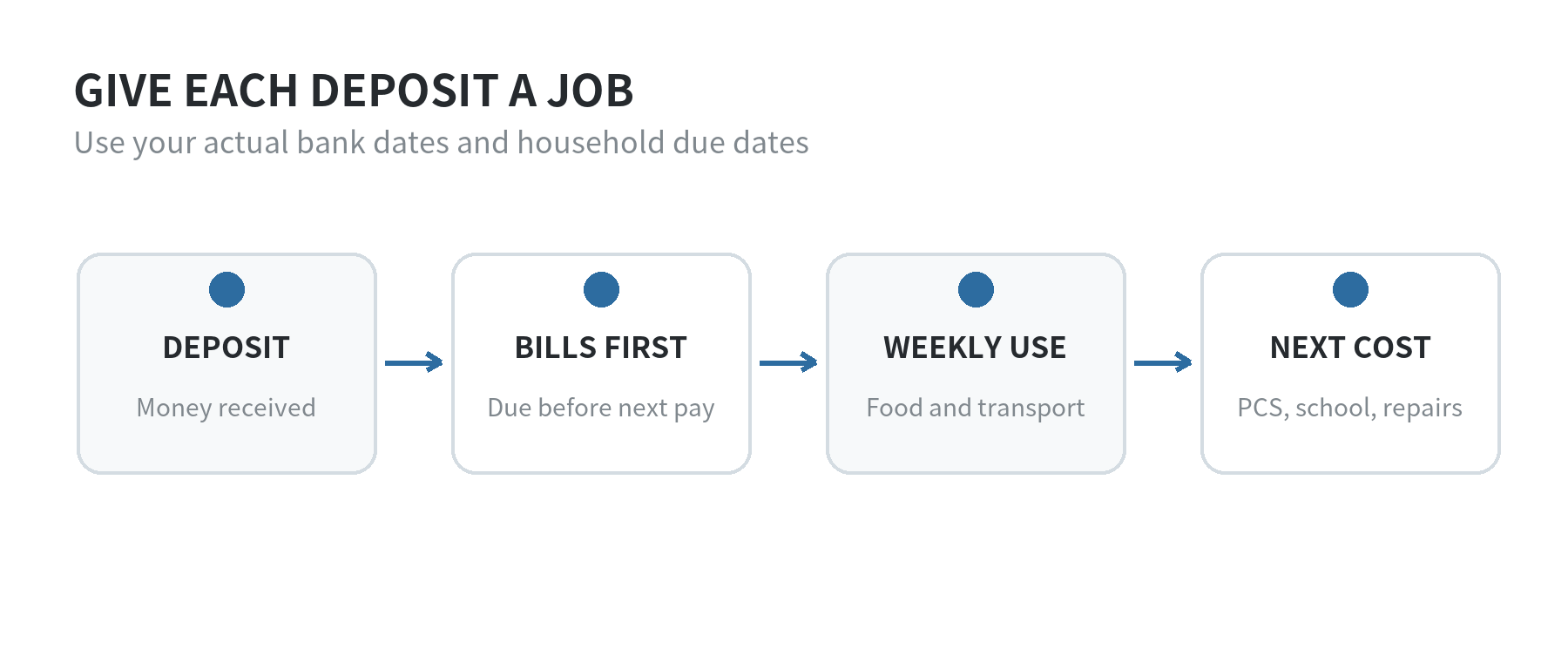
Use the dates your deposits actually reach your account, then write them beside rent, utilities, insurance, childcare and debt due dates. A budget based on the real deposit calendar shows whether a bill needs money reserved from the prior deposit. Plan from your account history rather than assuming an expected early deposit.
Write each expected deposit on a calendar beside rent, utilities, insurance, childcare and debt due dates. Assign each bill to the deposit that arrives before it. If rent and childcare are due before the later deposit, reserve those amounts from the earlier one. A weekly cash-flow view helps reveal a short week even when the monthly total looks balanced; the CFPB’s military-family worksheet maps income and expenses week by week.
For a made-up household example, suppose the take-home deposits are $2,400 each, arriving on the dates shown in the family’s account. If rent and childcare total $1,650 and are due before the later deposit, set that amount aside from the earlier deposit. The remaining $750 is not automatically spending money: cover food, transport and other bills due before the next deposit, then reserve any remainder for upcoming costs. Replace every sample amount and date with your LES, account history and actual due dates.
Keep changing military income outside the bill budget
Deployment, temporary duty and a permanent change of station (PCS) can change both pay and household costs. Military OneSource advises reviewing the LES and not adjusting the budget for added deployment pay until it starts. Before orders take effect, make a second version of the household plan with the bills that continue, costs that stop, and new costs such as childcare, household help, temporary lodging or travel.
Do not build a fixed bill around a special or incentive payment that could stop when duty changes. When an added payment appears on the LES, decide together whether it will cover a known deployment expense, replenish cash reserves, or fund a specific upcoming bill. Keep any reimbursement separate until it is received; an expense paid now and reimbursed later still needs cash in the meantime.
For a PCS, create a one-time moving list beside the regular household plan. Include deposits, travel, lodging, storage, meals on the road and expenses you expect to pay before reimbursement. Military OneSource’s PCS budgeting guidance identifies these as planning categories and points readers to the Defense Travel Management Office for current travel and reimbursement information. Save receipts and record each expected reimbursement separately from money already available.
Use a reserve for costs that arrive off-cycle
Uniform replacement, school expenses, car repairs, insurance and holiday travel can land far from payday. Pull those costs from prior statements, receipts or bills. For a predictable bill, divide the total by the number of pay periods before it is due and move that amount into a labeled savings bucket each payday. The Military OneSource guide calls this a sinking fund and lists school costs and uniforms among its examples. For an uncertain cost, choose a starting amount the current budget can support and revisit it after you have more records.
Keep the categories concrete: “PCS travel,” “car repair” and “school start” are easier to use than a single large “miscellaneous” line. Separate labels can be spreadsheet columns or savings subaccounts; the point is to know which upcoming cost already has money set aside. Military OneSource describes this set-aside approach as a sinking fund and identifies moves, school costs and uniforms as examples.
Review the plan when orders or pay change
Set a short check-in around a real trigger: new orders, a duty-station change, a promotion, deployment preparation, a spouse’s job change or a new recurring bill. Compare the newest LES with the prior month, update the deposit calendar, and check which bills now fall before each deposit. If a figure on the statement is unclear, DFAS directs members to their servicing finance office rather than guessing at an entitlement.
Military OneSource’s budgeting guide recommends reviewing and adjusting the plan monthly, quarterly or yearly as needs change; a new order or pay change is a practical reason to review sooner. For a couple, agree on which account pays each bill, who checks the deposit, and where the reserve for a PCS or repair is tracked. The plan can use one shared account, separate accounts, or both; the essential detail is that both people can see the bills due before the next deposit. If you want to track a shared plan digitally, compare the approaches in this overview of budget apps for different workflows. Keep a short note of what changed so the away partner can follow the same plan.
For a starting worksheet, use the latest LES, recent bank and card statements, the bill calendar, and one list of irregular costs. Build the baseline first, schedule each deposit against the bills that precede the next one, and keep uncertain pay out of fixed commitments. Check current pay and allowance details with DFAS and the relevant DoD tools on September 30, 2026, before changing the plan.
FAQ
Should a military family budget from gross pay or net pay?
Use net deposits for bills and spending because deductions have already been taken out. DFAS’s LES explanation lists earnings, withholding and allotments for reviewing pay.
Should deployment pay count toward recurring bills?
Wait until an added payment appears in the LES and bank account before assigning it to recurring bills. Military OneSource’s deployment budget guidance advises families not to count added deployment pay before it starts. Plan separately for added household costs.
How should a family budget for a PCS reimbursement?
List the expense when it must be paid and record the reimbursement as pending until it arrives. Check current travel rules with the Defense Travel Management Office and keep receipts for eligible expenses.
Where can a family check its current BAH figure?
Use the Defense Travel Management Office BAH rate lookup for the duty location and compare the result with the latest LES. Check the applicable year and location each time circumstances change.
Last updated: 2026-09