A concert budget works best as a small, planned part of your entertainment money, with the ticket and the night around it counted together. Set a monthly amount you can spare after bills and savings, then let that balance decide which shows fit. A ticket’s advertised number is not the whole outing: travel, food, parking, lodging, and optional extras can change the total.
Start with money left after the essentials
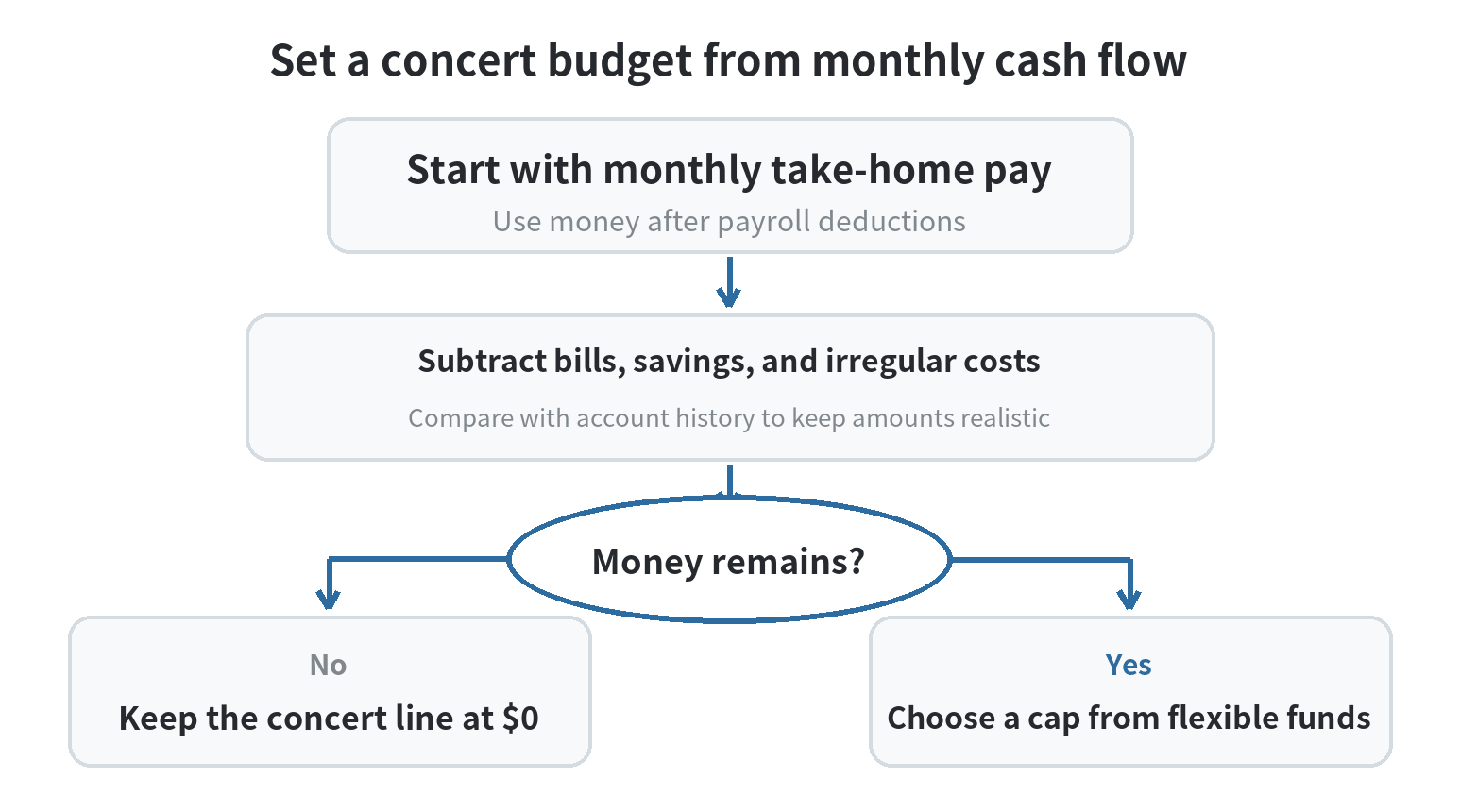
Use take-home pay, not your salary before taxes. List housing, utilities, groceries, minimum debt payments, insurance, and other bills that must be paid. Add regular savings contributions and expenses that do not arrive every month. The Consumer Financial Protection Bureau (CFPB) recommends reviewing several months of account history and including less-frequent costs such as recreation and gifts in a monthly budget (CFPB spending assessment).
Then find the amount available for flexible spending. Concerts share that space with restaurants, movies, hobbies, and other plans. If the remaining amount is tight, make the concert line smaller or leave it at zero for now; do not treat a credit limit or a future paycheck as money already available.
For a sample month, imagine take-home pay of $3,600, essential bills of $2,450, and planned savings of $300. That leaves $850 for flexible spending, not $850 for concerts. If you set aside $60 from that flexible amount each month for four months, the concert fund reaches $240 before interest or fees. Those are example figures to replace with your own.
Price the whole night before choosing a show
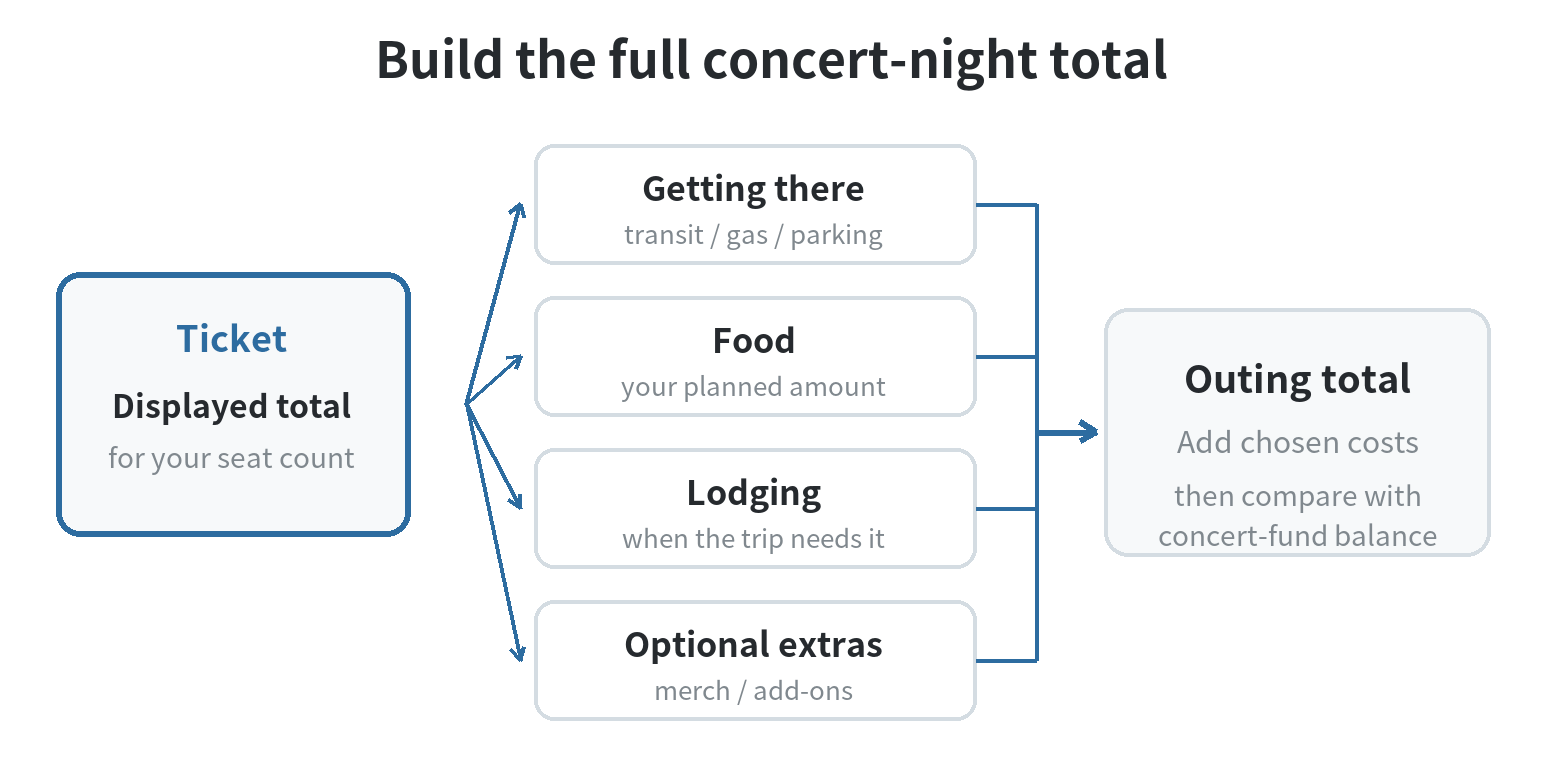
Write down each likely cost for the specific event: ticket total, travel, parking or transit, food, lodging if needed, and anything optional you may add. Use your own route, plans, and checkout screen instead of a national “average.” For an example, a pair of tickets at a $180 total, $36 of travel, $24 for food, and $15 parking adds up to $255. Saving $85 a month for three months would cover that sample total.
The FTC says businesses may use dynamic pricing based on demand or inventory when the pricing information is not misleading (FTC fee-rule FAQ). For a real number, open the event’s official ticketing page, compare the available seats, and use the displayed total for the number of tickets you need. Check the final payment amount before you commit, including taxes and any optional selection.
The FTC’s Rule on Unfair or Deceptive Fees took effect on May 12, 2025. When a business advertises a live-event ticket price, the rule requires the upfront total to include known mandatory fees; taxes, shipping, and optional add-ons may be shown later but must be disclosed before payment (FTC fee-rule FAQ). That disclosure rule does not give every event one standard fee, so use the specific event quote in your plan.
Turn the show date into a savings target
Once you have a realistic outing total, subtract money already set aside for concerts. Divide what remains by the number of pay periods or months before the event. If a $255 sample outing is three months away and the fund is empty, the monthly target is $85. With $45 already saved, the remaining $210 would mean $70 per month for those three months.
Choose a method that matches your pay schedule: move the planned amount after payday, or transfer a smaller amount each week. The CFPB describes cash-flow planning as a way to match the timing of income and expenses; its guidance also recommends including savings contributions in the budget (CFPB savings and cash-flow guide; CFPB spending assessment). Keep the concert amount in a clearly labeled savings bucket or note so it does not get mistaken for money available for bills.
If the monthly target does not fit, change a choice rather than stretching the budget: consider a closer date, a lower-cost seat, a local show, fewer add-ons, or waiting until the fund covers the total. These are planning options, not a promise that a particular ticket or price will be available.
Keep group costs separate from your own limit
When you go with friends, calculate your ticket and personal travel costs first. Then list shared expenses such as a rideshare, gas, or a hotel room as a separate amount per person. If one person books for the group, agree in advance on the split and payment date; do not count the full group’s reimbursement as money you can spend unless everyone has paid.
For example, a sample pair traveling together might plan $40 for the driver’s gas and parking plus $20 for shared snacks. If four people agree to split those costs evenly, each person’s share is $15. Add that personal share to the ticket amount and any expenses that are yours alone. This prevents a low ticket price from hiding the cost of getting there.
Give uncertain extras their own line
Some parts of the night are choices rather than fixed costs. Decide before you leave whether you plan to buy food at the venue, pay for merchandise, or add a post-show stop. Write a limit beside each choice, and keep it separate from the ticket and transportation amounts. If you do not know the price, check the venue’s current menu or event information when available, or leave that item out of the plan until you have a quote.
You can also create a small cushion by choosing an amount from your flexible budget, such as $20 in this example, and keeping it unassigned until the event. If you do not need it, leave it in the concert fund for the next show. Do not label the cushion as a required fee or assume it will match every event; it is simply a personal spending boundary.
Decide what to do when plans change
Prices, dates, and your own calendar can change between the first search and the event. Recheck the event total when you are ready to make a decision, then compare it with the balance already saved. If the total is higher than the amount available, revise the outing or move it to a later month. Avoid filling the gap with money assigned to rent, utilities, groceries, or debt payments.
If a show is canceled or you cannot attend, check the ticket seller’s event-specific terms for refund, transfer, or resale rules. Do not count a possible refund in next month’s budget until it has actually arrived. For future planning, record what the outing cost and update your next concert target; the CFPB’s spending review guidance likewise advises comparing a budget with account history and adjusting amounts that do not match actual spending (CFPB spending assessment).
FAQ
How should I split a concert bill with friends?
Agree on the per-person limit and who is paying each shared cost before anyone reserves or pays. Keep each person’s ticket separate when possible, and write down shared travel or lodging amounts so the total does not get confused with one person’s ticket budget.
Should I use a credit card for concert tickets?
Base the decision on whether you can pay the statement from money already set aside. A card changes the payment method, not the outing’s cost; include any charge in the same concert total and do not count available credit as savings.
What if tickets go on sale before I have saved enough?
Decide whether the event fits the money already available after bills and planned savings. If it does not, pass on that sale or adjust another flexible plan without borrowing from required expenses; a future listing or price is not guaranteed.
How much should I set aside each month for concerts?
There is no single amount that fits every household. Use your own take-home pay, bills, other priorities, and the specific outing total, then set a monthly amount that leaves required expenses covered.
Last updated: September 2026.
Last updated: 2026-09