To budget funeral costs, start with an itemized quote rather than a national average.
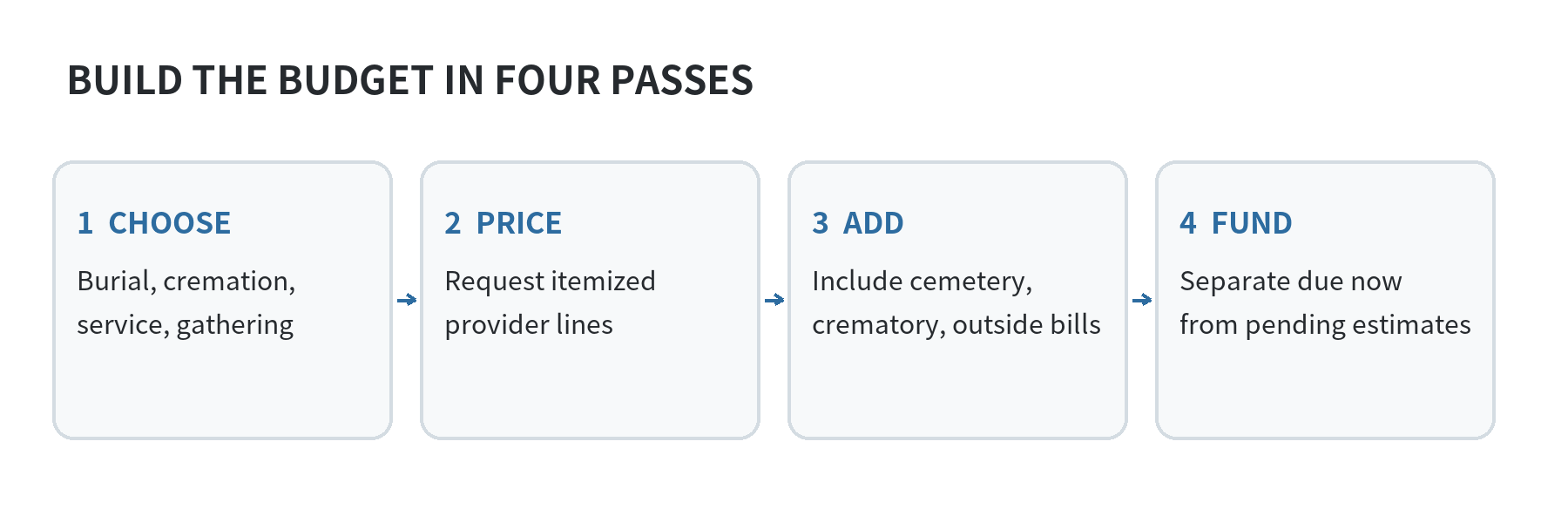
List what your family wants. Ask providers to price those choices. Add cemetery, crematory, and cash-advance charges, plus a reserve for bills not yet priced.
The Federal Trade Commission’s Funeral Rule gives you a way to request and compare prices; it does not set one total price for every funeral.
Build the plan around what your family expects to arrange: disposition, any gathering or service, transportation, and the final resting place.
Keep the budget in dollars and separate a confirmed quote from an amount you still need to verify.
That makes the total useful without pretending that one family’s bill predicts another’s.
Start with the arrangements, not a package name
Write down the decisions that shape the bill before you compare providers. Is the plan burial, cremation, or another disposition?
Will there be a viewing, a ceremony with the body present, or a memorial at a different time? Does the family already have a cemetery plot, urn, or other item?
These answers affect which quote lines belong in your working total.
The FTC’s Funeral Rule summary says the General Price List (GPL) lists a funeral provider’s goods and services with their prices.
Consumers may choose their goods and services, subject to the non-declinable basic services fee and legal requirements, under the Funeral Rule summary.
Ask for the GPL when you discuss arrangements. The FTC’s Funeral Rule guide says a provider must give you a copy during an in-person visit.
Funeral homes must also give price information by phone when asked, according to the FTC’s comparison-shopping guidance (checked September 30, 2026).
Mark each quote line as “chosen,” “ask whether required,” or “not planned.” Do not treat a package total as a complete budget until you know what it includes.
A package may cover a service the family wants, but the line-by-line list lets you compare it with a different combination.
Put every charge in the right bucket
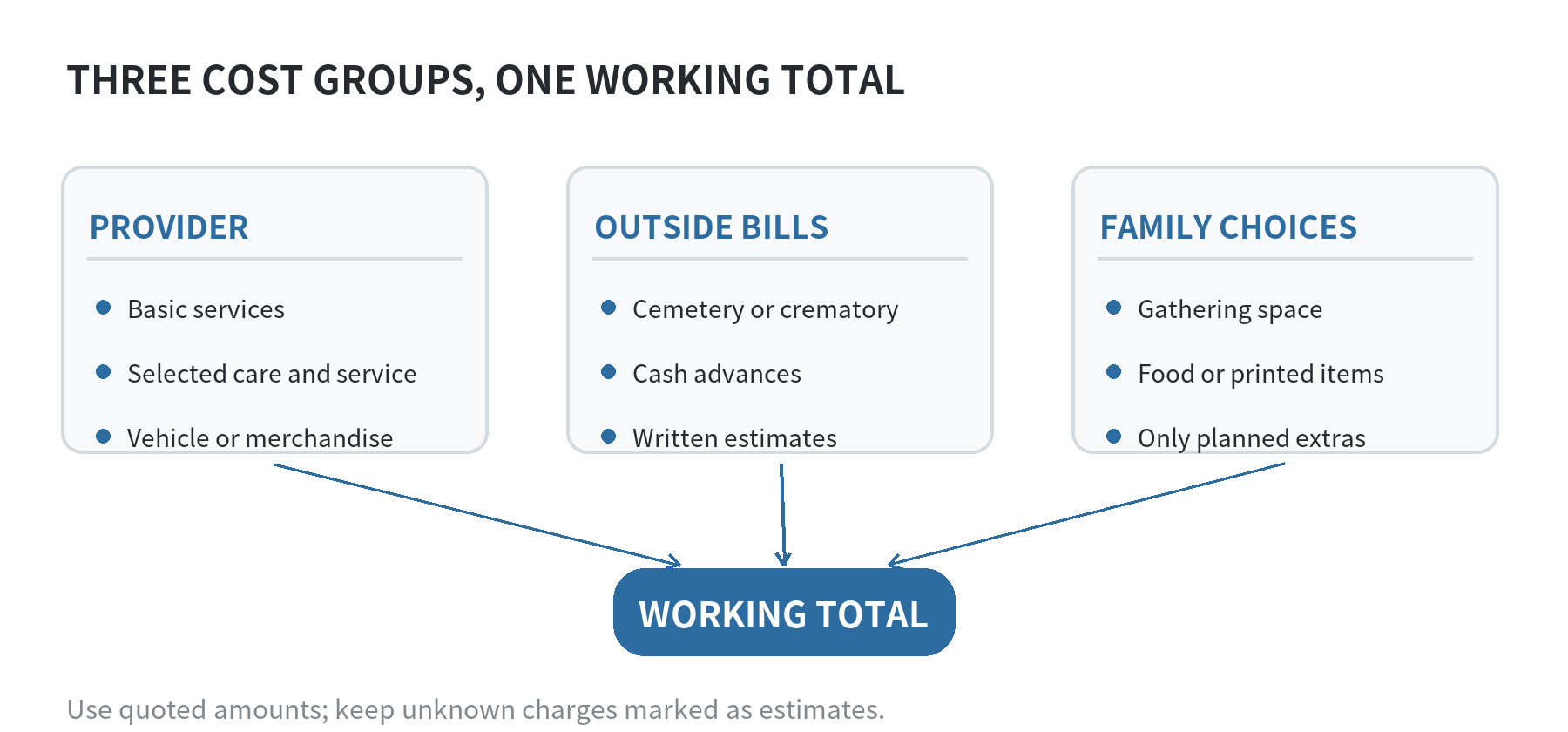
Use the GPL to list the basic fee, transfer, preparation, facilities, vehicles, merchandise, and service charges in your plan.
The FTC’s funeral cost checklist says the basic fee covers planning, permits, notices, sheltering, and coordination (checked September 30, 2026).
Read each line item to see which services the package includes.
Keep cemetery, crematory, and other outside-provider charges on separate lines.
The FTC explains that these can include cash advances the funeral home arranges for the family.
If a cash-advance amount is unknown, the provider must give a written good-faith estimate, according to the FTC’s funeral cost checklist.
The provider’s final statement lists selected goods, services, and their total, according to the FTC’s Funeral Rule guide.
Ask which estimates are still open and who will send each bill.
Give each outside cost a status: written quote, estimate, or not yet priced.
For a cemetery, ask about the plot or crypt if needed, opening and closing, a marker, and any required container.
For a gathering, list venue, food, printed materials, flowers, or clergy only if the family plans to include them.
Keep the rows that apply and delete the rest; the point is to avoid adding costs based on a generic checklist.
If the plan has cremation now and a memorial later, keep those as separate arrangements. Ask whether the provider’s quote covers both dates.
Put later venue, food, travel, or lodging costs in the family section of the budget. They may be handled outside the funeral provider’s statement.
Compare written totals on the same plan
Ask each provider to price the same arrangement in the same way.
If one quote includes a viewing and ceremony while another prices direct cremation, their totals do not answer the same question.
Write down the items included, the price of each, and any separate estimate.
The FTC says funeral providers must give a written statement listing the goods and services selected, each price, and the total before payment; see its Funeral Rule guide.
Invented worksheet only: provider items, $4,600; cemetery, $2,200; gathering, $500. The total is $7,300. Organize quote lines with the FTC’s price checklist.
These invented amounts show addition, not a market estimate. Replace them with written prices for your location and plan.
Before choosing, compare the services included, outside charges, and written local requirements. Request a revised statement if the plan changes.
The FTC says the provider’s statement must disclose legal cemetery or crematory requirements, according to its Funeral Rule guide.
Keep a short quote log beside the worksheet: provider, date received, arrangement priced, and any question waiting for an answer.
When you revise the plan, update the affected row and recalculate the total rather than adding an alternate service on top of the old choice.
That leaves one current working figure and a record of what changed.
Decide how much cash must be ready
A full budget total and the amount due now are different numbers.
Ask each provider when payment is due and who collects charges for outside services. Separate confirmed deposits from estimated bills.
Add confirmed bills due before the service to your near-term total. Keep later or pending charges in a separate column.
For each bill, write the vendor, expected due date, person handling payment, and whether the price is final. This makes it easier to see which amount is still unconfirmed.
If the funeral home collects an outside charge, keep one row for that bill and mark who receives the payment. Avoid adding the same estimate again under the outside vendor.
Set a reserve for unresolved charges, such as a cemetery bill, final cash advance, or gathering cost tied to attendance.
Avoid adding an arbitrary percentage without a quote behind it.
Write the open question beside each estimate and the person responsible for getting an answer.
If several relatives are contributing, record who has agreed to cover which line and when the payment is expected.
Keep the arrangement in writing so the family can see whether the funeral home, cemetery, or another vendor has been paid.
Check the final statement before paying
Compare the final statement with the choices your family approved.
Check that each selected item appears once, that an item you declined is not included, and that the totals match the latest quote and outside estimates.
The FTC says the provider must give you an itemized statement of selected goods and services, each price, and the total before payment; see its Funeral Rule guide .
Ask the provider to explain a changed line or a new requirement before paying. Keep the statement and receipts with the family’s records.
For embalming, the FTC says the provider may not perform the service without permission or falsely state it is required by law, as explained in the agency’s cost checklist.
The FTC says a viewing may make embalming a practical necessity; see its funeral cost checklist.
Direct cremation or immediate burial may not require embalming, according to the FTC’s cost checklist.
Ask what applies in your location, where state and local requirements can differ.
A clear funeral budget is a short list of choices, quoted provider charges, outside bills, due dates, and unresolved estimates.
Start with the GPL, keep each added cost tied to a real plan, and update the total when a written price or final bill arrives.
FAQ
Can I ask for funeral prices by phone without sharing my contact information?
Yes. The FTC says you do not have to give a funeral home your name, address, or phone number before asking for prices by phone. See the agency’s Funeral Rule guide.
Does a funeral home’s price list include a cemetery plot?
Not always. The FTC Funeral Rule does not apply to cemeteries without an on-site funeral home, so ask the cemetery for a separate written price. See the FTC’s Funeral Rule guide.
Does a funeral home have to accept a casket bought elsewhere?
Yes. The FTC says a provider may not refuse or charge a fee to handle a casket purchased elsewhere, as described in its Funeral Rule guide .
Confirm delivery arrangements and any separate services in the written quote.
Can I plan a funeral before someone dies?
Yes. The FTC says the Funeral Rule applies when someone asks about arrangements in advance as well as when a death has occurred, according to its Funeral Rule guide .
Keep notes about the selected plan and share them with the people who may need to carry it out.
Last updated: 2026-09