A grad student budget works best when you treat stipend or paycheck income, loan funds, and school bills as separate cash flows.
Build your monthly plan around money that has actually arrived.
Schedule term-based aid against the school’s billing calendar instead of treating a full-year award as monthly income.
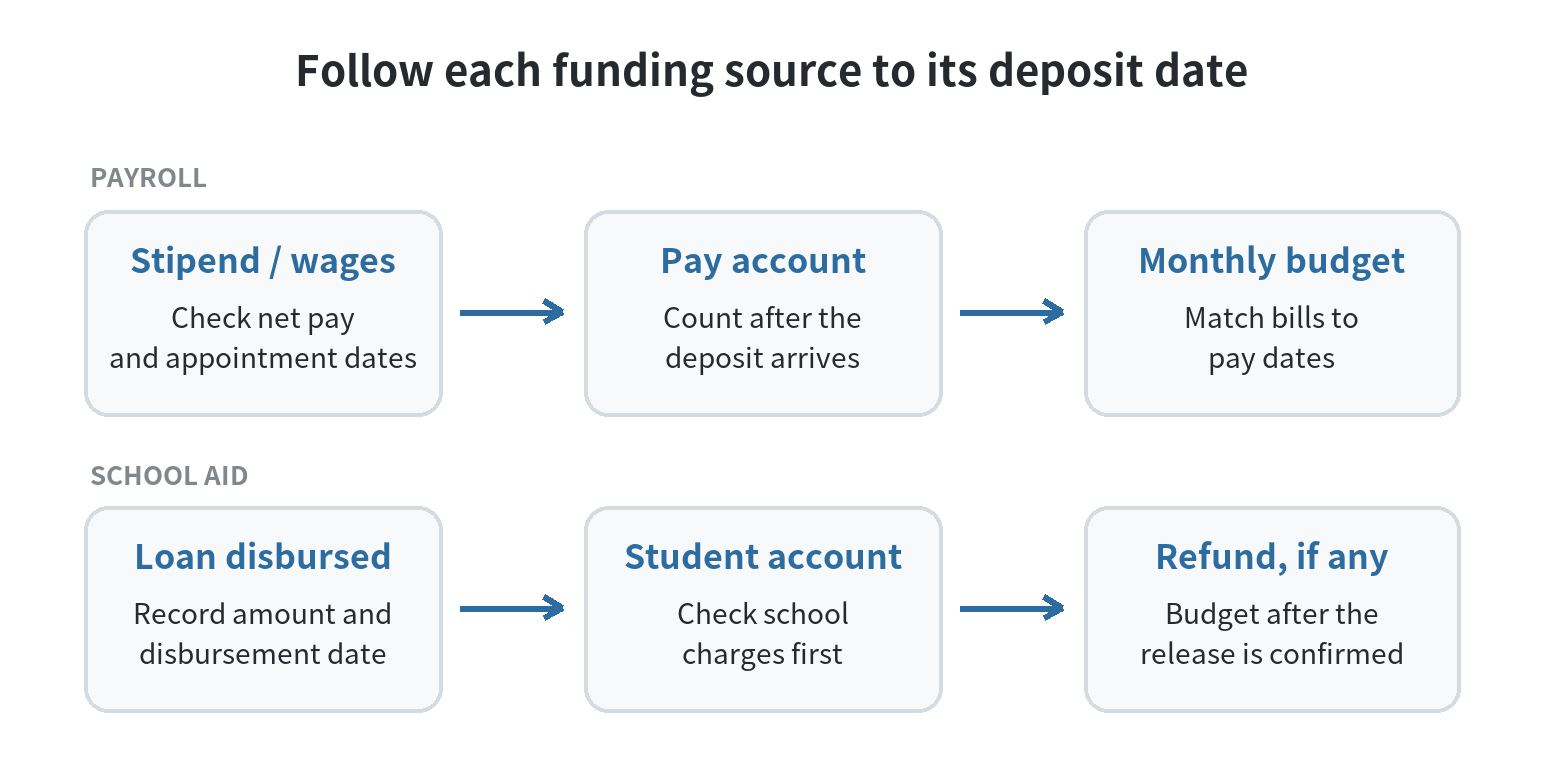
That distinction matters because a stipend may arrive on a payroll schedule while loan funds go through the school and first cover eligible school charges.
The CFPB says aid left after tuition and fees may become a student refund (checked September 30, 2026).
Ask financial aid and student accounts about your school’s dates and process (checked September 30, 2026).
Sort the offer letter into money you can spend and money you owe
Make a one-page funding list before assigning dollars to rent or groceries.
For each source, record its amount and type: wages, stipend, grant, scholarship, or loan.
Note when it is expected and whether the school or payroll office deducts anything before it reaches you.
Use the deposit amount for a paycheck-based budget, not a headline amount from an offer letter.
If your assistantship has separate summer terms, a break between appointments, or different pay during the academic year, put each period on its own line.
Ask the department or payroll office to confirm the dates and the amount you will receive.
Keep borrowing in its own column.
A loan can help bridge a school-year shortfall, but it is borrowed money that must be repaid under its terms.
The CFPB advises students to budget for each school year and their expected time in school.
Its student loan guide says to borrow only the amount needed for education costs (checked September 30, 2026).
For federal graduate loans, the current rules depend on when your program and borrowing began.
Outside the transition exception, Federal Student Aid caps Direct Unsubsidized loans for eligible graduate students who have never been professional students.
That limit is $20,500 each academic year (checked September 30, 2026).
That group’s graduate aggregate cap is $100,000 (checked September 30, 2026).
Federal Student Aid lists professional students in a separate loan-limit category (checked September 30, 2026).
New graduate Grad PLUS loans are unavailable from July 1, 2026, except for qualifying transition borrowers (checked September 30, 2026).
The Department of Education’s Federal Student Aid Partner Connect loan-limits FAQ lists the same caps, checked September 30, 2026.
Federal Student Aid says the limited exception generally covers students enrolled in the same program and school by June 30, 2026 (checked September 30, 2026).
The student must have received a Direct Loan for that program before July 1, 2026, and remain continuously enrolled (checked September 30, 2026).
The Department’s Federal Student Aid Partner Connect FAQ lists the program conditions.
Ask your school’s aid office which limit applies to your record.
A cap is an eligibility ceiling, not a suggested amount to borrow.
Put deposits and due dates on one calendar
List each expected deposit beside the bills that must be paid before the next one.
Include rent, utilities, phone, transit, food, required fees, and debt payments.
Add the due date, not just the monthly total: a budget can balance on paper and still come up short if several large bills fall before a deposit.
For aid, note the school’s tuition due date, expected loan disbursement, and any refund date the student accounts office gives you.
The CFPB says loan money may first cover tuition and fees; any remaining credit balance may be refunded to you (checked September 30, 2026).
Do not count a projected refund as cash in checking until the school confirms when and how it will be released.
Mark summer separately if your assistantship or classes change then.
Estimate summer income from confirmed work or funding, and list rent, food, transportation, and other bills that continue between terms.
If you expect a gap, decide in advance which bills can be moved, which expenses can be reduced, and how much of any earlier refund must stay reserved for the gap.
Build the calendar from your account statements, payroll records, the student account, and the academic calendar.
If a payment date is uncertain, label it “not confirmed” and leave it out of the available-cash total until the school or employer gives you a date.
Use a sample month to see what the stipend has to cover
Suppose, just for illustration, a student receives $2,100 in take-home assistantship pay each month.
The table below assigns example amounts to household expenses; they are not national averages.
Replace each number with your own bills and recent spending.
| Example monthly line | Amount | How to set your number |
|---|---|---|
| Rent and utilities | $1,050 | Use lease and current bills |
| Food | $330 | Review grocery and meal purchases |
| Transit | $100 | Use pass, fuel, parking, or fares |
| Phone | $65 | Use the current statement |
| Required monthly fees | $80 | Check your student account |
| Irregular-cost reserve | $150 | Set aside for known nonmonthly costs |
| Books and supplies fund | $80 | Use course lists and term estimates |
| Unassigned after these lines | $245 | Review before giving it another job |
The example leaves $245 before any additional personal spending, savings, or debt payments.
That remainder is a prompt to complete the budget, not proof that the student has $245 to spare.
Add anything missing, such as laundry, household items, a required trip, or a bill paid once per term.
For costs that do not arrive monthly, divide the amount you expect to pay by the months available to prepare.
If supplies are expected to cost $480 across a six-month period, setting aside $80 a month would cover that example target.
Use a course list, invoice, or your own receipts to replace the example.
The CFPB’s “My New Money Goal” worksheet suggests recording three months of income and calculating an average when it varies (checked September 30, 2026).
It also compares monthly income with expenses and existing savings commitments.
Check the worksheet, reviewed September 30, 2026, if your work hours, summer pay, or recurring bills vary.
Choose a lean-month budget before spending extra money
If your hours or stipend can change, make the baseline budget from the smallest confirmed monthly deposit in the relevant period.
Assign that amount to bills and essentials first.
Then decide how to handle extra pay when it arrives, such as replenishing a school-cost reserve or covering a bill that varies.
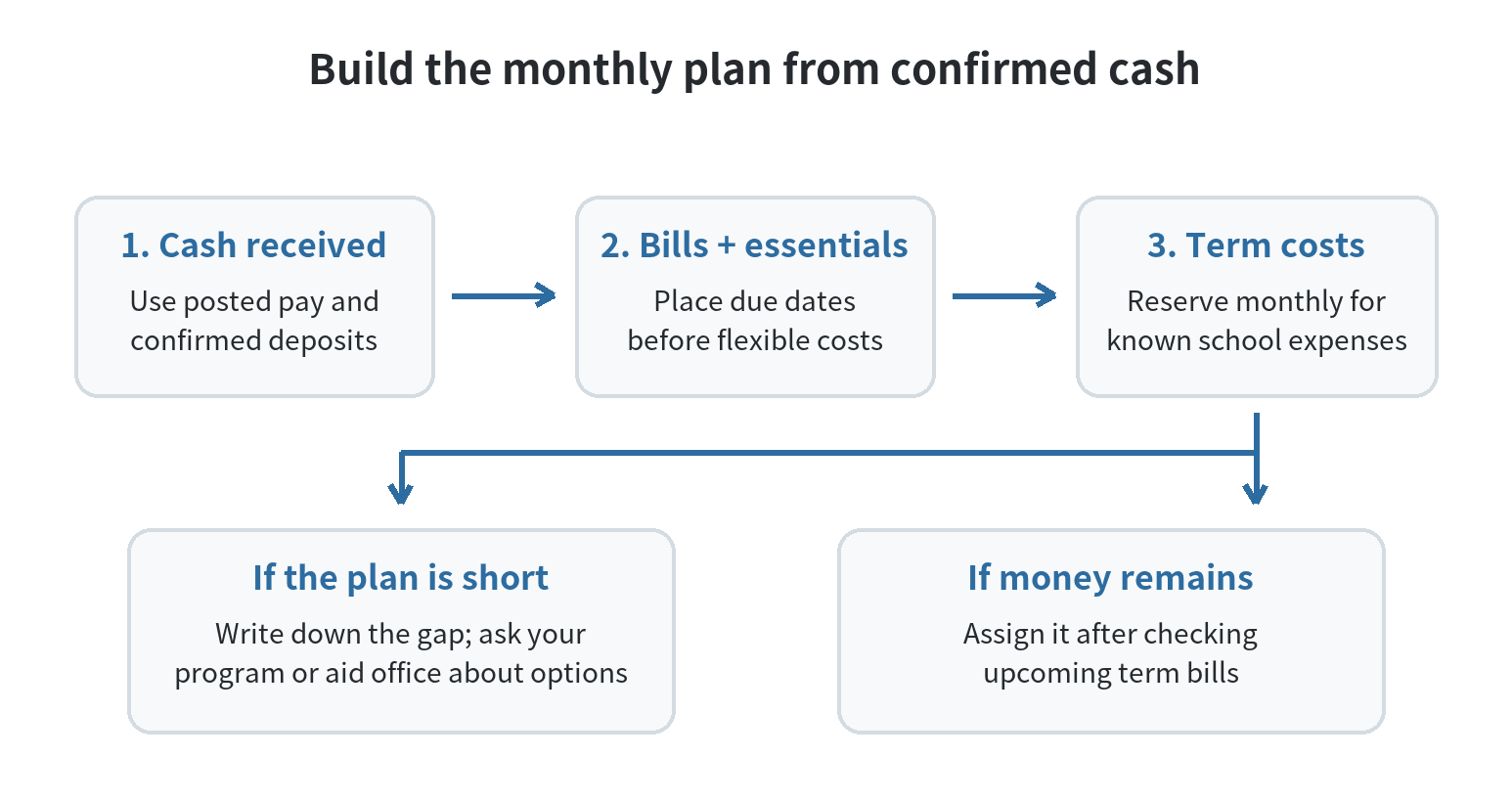
When the baseline does not cover essential expenses, write down the monthly gap and the date it begins.
Bring your funding list and calendar to the financial aid office or graduate program administrator.
Ask what school funding, appointment, payment-plan, or emergency-resource options exist.
A loan offer does not establish that the added debt fits your situation.
If your budget app or spreadsheet helps, set categories for “monthly bills,” “term costs,” and “funds not yet received.”
Our guides cover setting up a budgeting app and assigning income across budget categories.
You can also use a paper calendar and account statements; the categories matter more than the tool.
Review the plan when a term or funding source changes
Recheck the budget when an appointment ends, summer funding is confirmed, rent changes, or a new term bill appears.
Update the expected deposit and due-date columns first, then recalculate what remains for flexible spending.
Keep the old version long enough to see which estimate changed.
At the end of each month, compare planned amounts with posted transactions.
If groceries exceeded the estimate because you were on campus longer, adjust the category using the actual pattern.
If a one-time fee made the month unusual, record it as a term cost instead of inflating every future monthly estimate.
CFPB’s “My New Money Goal” worksheet includes income, expenses, and existing savings in a new goal plan (checked September 30, 2026).
A graduate budget can use the same structure while keeping loan money, payroll income, school charges, and refund timing visible as separate lines.
For example, if a refund arrives in August and your next stipend date is September 15, list the bills that fall before that deposit.
Leave enough of the refund assigned to those bills and the rest of the term’s planned costs before treating any remainder as flexible spending.
FAQ
How should I budget if my stipend stops during summer?
Build a separate summer plan from confirmed income and bills due during the gap.
Ask your department when the appointment ends and whether another funded appointment is confirmed before including it.
Does a graduate fellowship count as monthly take-home pay?
Use the amount and payment schedule the school or fellowship administrator confirms.
Record whether it is paid through payroll, applied to your student account, or paid on another schedule; ask the administrator about reporting and tax questions.
What should I do with a student aid refund?
First match the refund against costs it needs to cover through the next deposit.
The CFPB says a credit balance may remain after school charges are paid (checked September 30, 2026).
Your school’s student accounts office can explain the release date and delivery methods.
Can I include the full federal loan limit as income?
No.
A loan limit is a maximum eligibility rule, not income or a budgeting target.
Check your aid offer, school charges, current StudentAid.gov information, and the amount you actually need before planning around borrowed funds.
Last updated: September 2026.
Last updated: 2026-09