A realistic entertainment budget starts with what is left after your take-home income covers bills, planned savings, and expenses that do not arrive every month. Track what you actually spend, choose a monthly ceiling you can live with, then divide it among subscriptions, planned outings, and flexible fun. The right number comes from your own household, not a national average.
Decide what counts as entertainment
Choose the category boundary before you total anything. The Consumer Financial Protection Bureau (CFPB) includes movies, concerts, sporting events, books, and subscriptions in its entertainment category; consumer.gov also lists entertainment as an expense. Both sources were checked September 30, 2026. You might put streaming services, games, hobbies, and tickets here too, as long as you use the same labels each month.
Keep categories that answer different questions separate. A restaurant meal might belong under dining out, while a concert ticket belongs under entertainment. A family activity fee may fit education or childcare if that is how you track it. Use the same labels each month so the same purchase does not move between categories and hide the pattern.
Review bank and card statements, receipts, cash notes, and recurring charges. Include annual memberships and seasonal activities: divide a known annual charge into monthly set-asides, or plan for the full renewal in its billing month.
Set the ceiling after bills and priorities
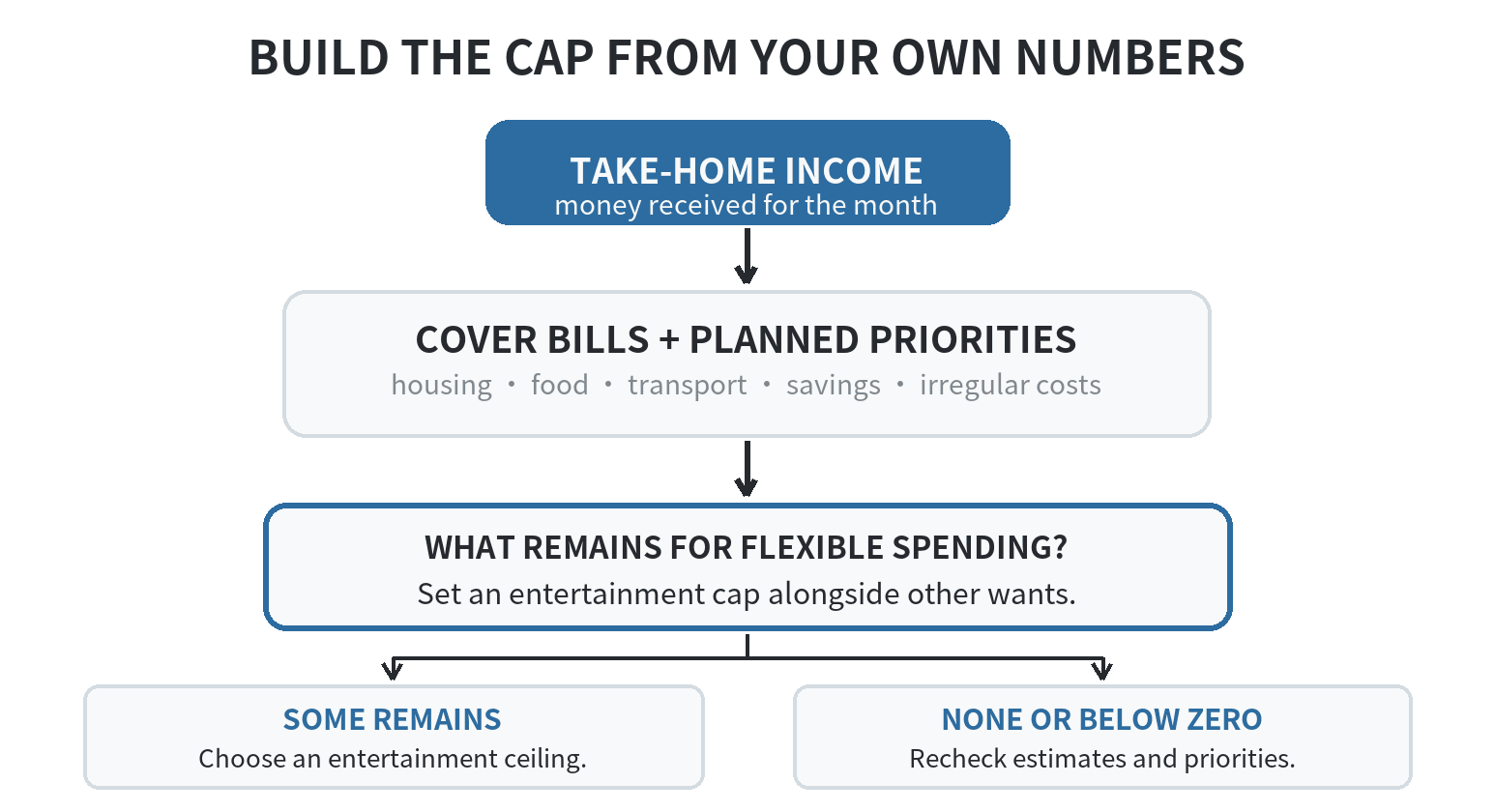
Start with monthly take-home pay: the money that reaches your household after payroll deductions. Subtract bills and necessary spending, minimum debt payments, and any savings or upcoming expense amount you have already decided to protect. The remainder is available for flexible categories; entertainment is only one of them. Do not assign every remaining dollar to fun if you also need room for clothes, meals out, or unplanned costs.
Here is a made-up example to replace with your figures. Say take-home pay is $3,800. Rent, utilities, groceries, transportation, insurance, and minimum debt payments total $2,650. You also set aside $300 for savings and $250 for car maintenance and other irregular costs. That leaves $600 for all flexible spending, not $600 for entertainment alone.
If you want to keep $300 of that flexible money available for other categories or breathing room, the remaining $300 is the most you could assign across dining out, personal spending, and entertainment. Suppose your own priority list gives entertainment $180. The arithmetic does not make $180 a recommended amount; it shows how to derive a limit from your commitments. If the leftover is zero or negative, check bill estimates and planned contributions before adding entertainment spending.
Turn one monthly cap into a usable plan
Give the cap a few jobs. The example’s $180 could reserve $45 for subscriptions, $60 for an event, and $75 for casual activities. Split that final amount across the weeks in your calendar; the example uses $20, $20, $15, and $20.
Write down each recurring subscription and its renewal date. If the total is higher than your planned subscription amount, decide whether every service still belongs in the plan before the month begins. When several people share the budget, agree on whether each person gets a personal allowance or whether all entertainment purchases come from one shared amount. A shared cap works only if everyone can see what has already been spent.
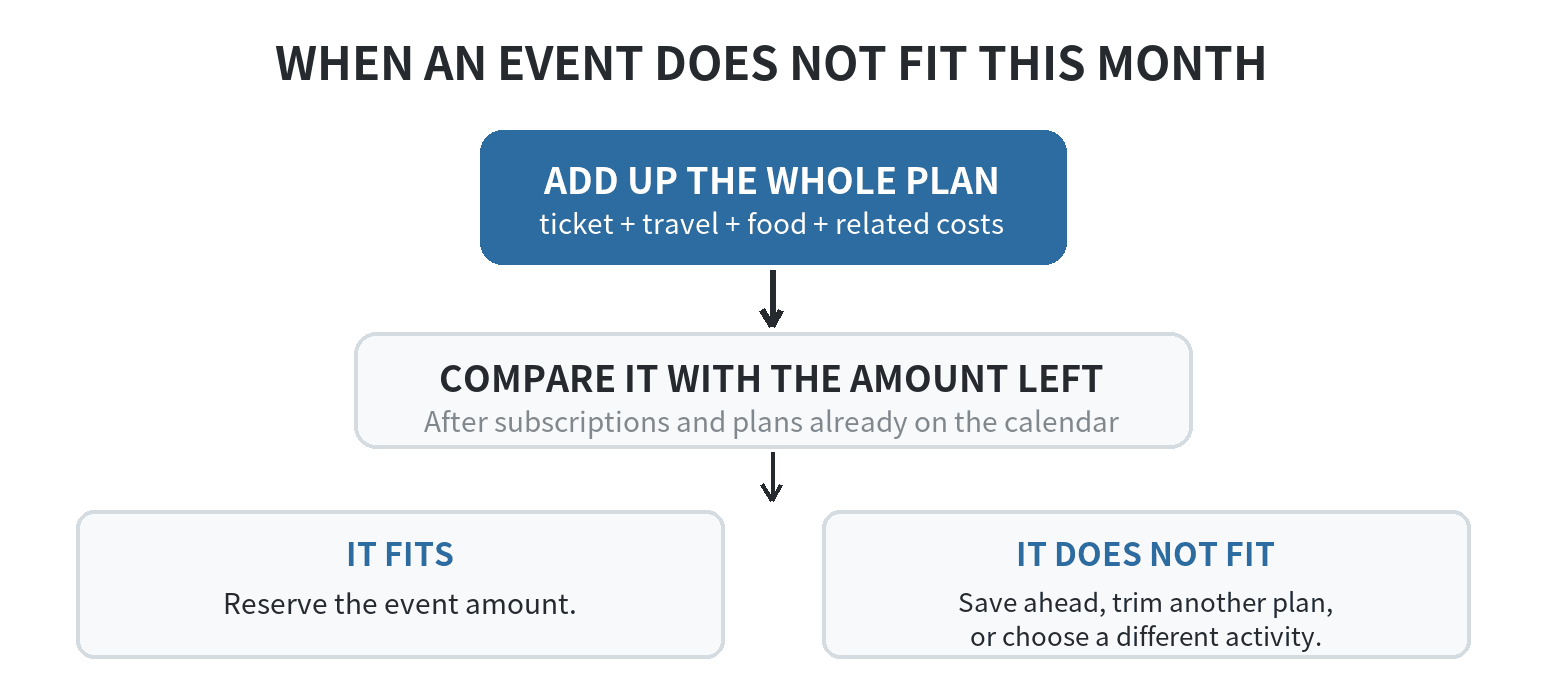
For an event that costs more than a week’s allowance, reserve money in advance rather than quietly borrowing from later weeks. If tickets, travel, and food total $90, make room for the full amount. Save part of the entertainment budget in advance, choose a less expensive plan, or skip another outing before committing.
Make the plan fit a lumpy calendar
Birthdays, school breaks, and festivals can crowd the same month. Put known events on the calendar before assigning weekly amounts. Decide which plans move or wait; in a quieter month, you can reserve unused money for a future event.
Separate predictable annual costs from surprise costs. If a membership renews each December, a monthly set-aside makes that charge visible before December arrives. If you cannot set money aside yet, put the renewal date on your calendar and include it when you plan that month.
When income changes from month to month, begin with the lower amount you can count on for regular commitments. Treat extra income as unassigned until bills and priority expenses for that month are covered. Then decide whether part of the extra can expand the entertainment cap. This keeps a strong month from creating a recurring entertainment commitment that a lean month cannot support.
Check the number against real spending
Use receipts or account history to log purchases as they happen, including cash, tickets bought in advance, and renewals. The CFPB’s Spending Tracker recommends recording spending for at least two weeks or a month to see patterns; its budgeting guidance also says to review bills, income, and spending together. Both pages were checked September 30, 2026. consumer.gov describes making a plan at the start of the month, recording daily spending, and comparing the plan with actual spending at month’s end, checked the same date.
At the end of the month, compare the planned amount with what cleared your accounts. If the total is higher, identify the cause: did you miss an annual renewal, count dining out in the wrong category, or make more plans than the weekly split allowed? Change the category or next month’s cap based on that information. If you spent less, decide whether to carry the remainder toward a planned event or leave it in the household’s general cushion.
Check the remaining amount against upcoming plans. If $18 remains and a $30 event is planned, reduce another activity or move the event. Record the change so the same dollars are not promised twice.
When the first number does not work
If the cap feels too small every month, check the whole budget instead of blaming one category. Confirm that take-home income is current, irregular bills are represented, and recurring charges have not been counted twice. Then decide what you value most: one bigger outing, several low-cost plans, or a subscription you use at home. You may need to revise another flexible category or choose a lower entertainment cap for now.
If a household member regularly exceeds a shared limit, make the plan more specific. Set aside separate personal amounts, agree on which purchases need a quick conversation, or divide the shared cap by week. A clear rule such as “tickets come from the event portion” is easier to use than a general request to spend less.
Keep the worksheet simple enough to update. A notes app, paper list, or spreadsheet can all work: record the planned cap, recurring charges, purchases, and amount remaining. For a phone-based tracking setup, see how to build a simple budget tracker on your smartphone. If your next goal is setting aside money for a less frequent expense, the site’s phone-based emergency-fund planning article covers that separate task.
FAQ
Should subscriptions come out of an entertainment budget?
Yes, if those services are part of how you define entertainment. Put the renewal amounts in the same monthly cap so a recurring charge does not compete invisibly with tickets or outings.
How can I budget for an expensive event several months away?
Estimate the full amount you plan to spend, including related costs, then reserve part of your entertainment money in earlier months. If that leaves too little for current plans, lower the event target or choose another activity.
What if my entertainment spending changes each month?
Keep predictable subscriptions and planned events visible, then make the flexible portion smaller or larger to match the calendar. Review the actual total at month-end before setting the next cap.
Should leftover entertainment money roll into the next month?
It can if a future event is a higher priority than another flexible expense. Label the amount for that event so you do not count it as available for both plans.
Last updated: 2026-09