Set your eating out budget from what you actually spend and what remains after bills and savings priorities. Review a recent month of restaurant, takeout, and delivery charges, choose what counts in the category, then give the remaining dollars a job across the month. The result is a limit you can explain and adjust, rather than a national average that may not fit your household.
Start with a month of your own transactions
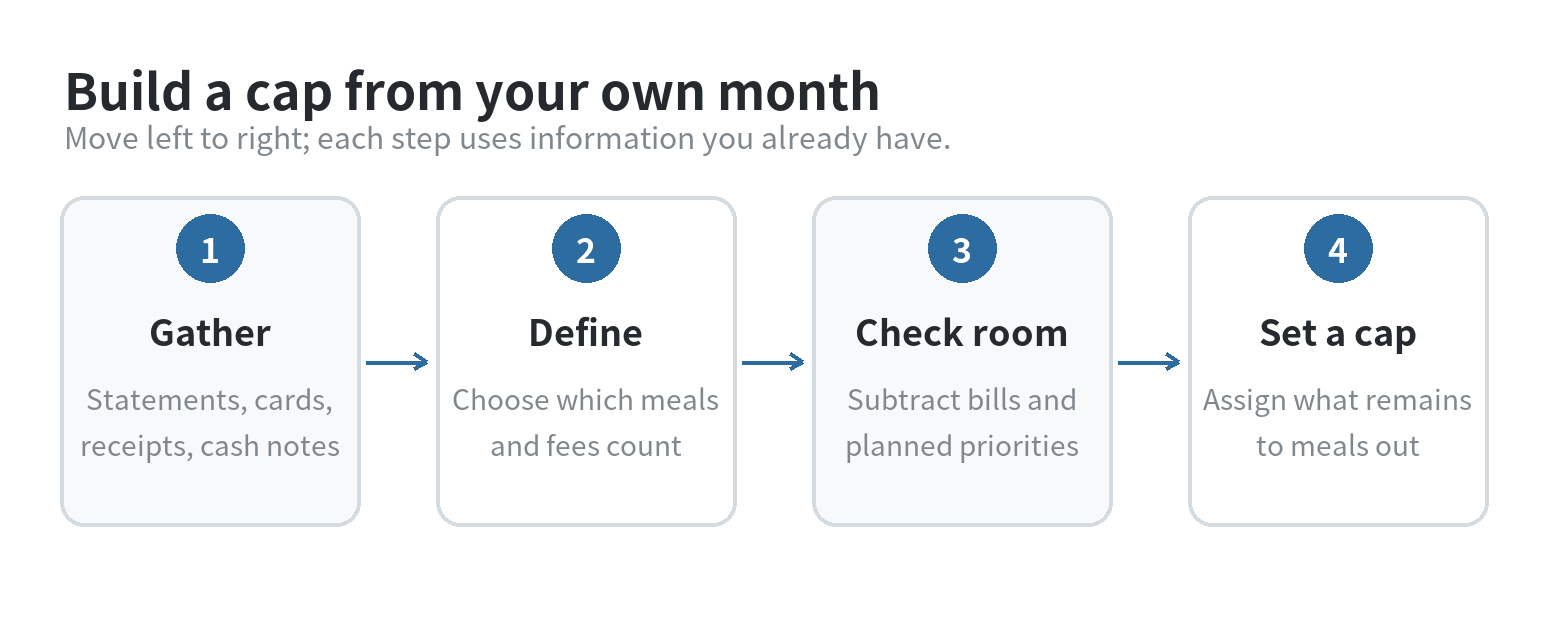
Pull transactions from checking accounts, credit cards, payment apps, and receipts. The CFPB spending tracker recommends recording expenses for at least two weeks or a month; a Department of Defense financial readiness workbook also uses a two-week expense record. The FTC’s consumer.gov budget guide says to record daily spending and compare it with the plan at month’s end. Checked September 30, 2026.
Search for restaurant, cafe, takeout, and delivery charges. Add cash purchases from notes or receipts. Decide whether work lunches, coffee, delivery fees, and tips belong here or on separate lines; use the same rule each month. Split mixed grocery and prepared-food receipts only when you can do so reliably.
Count what left your pocket, including tax and tip. For delivery, decide whether service fees share the meal category or have their own line. A birthday dinner can stay in eating out or go in a special-occasion fund; do not count its dollars twice.
Choose a cap after bills and priorities
List take-home income, bills, debt payments, chosen savings, and necessary expenses. The FTC budget guide says to subtract expenses from income. The CFPB advises comparing the plan with take-home pay and checking statements if the remainder does not match. Both pages were checked September 30, 2026 (FTC guide; CFPB spending assessment).
What remains is not automatically restaurant money. Keep room for irregular bills and a buffer you need. From the dollars that remain, choose an eating-out cap that leaves the rest for your other flexible spending. If the calculation is negative, pause before adding an eating-out target; first decide which parts of the full budget need attention.
Here is a made-up example, not an average: take-home pay is $3,800, and the household assigns $3,430 to bills, debt payments, savings, groceries, and other planned expenses. The $370 remainder still has to cover every unplanned or flexible purchase. If the household sets aside $120 for a car-related surprise and $80 for other personal spending, $170 remains as its possible restaurant and takeout cap. Change every figure to match your own month.
Keep the same priority order when income or bills change. A car repair or large utility bill may leave less room for restaurant meals. If eating out competes with rent, required payments, groceries, or a chosen savings goal, lower its cap before the month starts.
Turn one monthly number into choices
Connect the monthly cap to visible plans: split it into weekly amounts, set aside money for work lunches, or reserve part for an occasion. Pick one method so a meal is not counted twice.
For example, imagine a $170 monthly cap. You plan two lunches at $14 each, one takeout meal at $32, and a dinner expected to total $58 after tax and tip. Those plans use $118, leaving $52 for other restaurant choices that month. These are sample amounts, not recommended prices. If the dinner estimate changes, update the remainder before making another plan.
If office lunches are the pressure point, mark the days you expect to eat with coworkers and reserve those dollars first. Then decide how much of the remaining cap is for spontaneous stops or a weekend meal. You can make that choice before the invitation arrives, rather than trying to remember how much you spent after the statement closes.
If weekly amounts help, divide the monthly cap into four planning portions. That is a budgeting choice, not a prediction of how often you will eat out. You can let the balance move across weeks while keeping a later event’s share reserved.
Choose where to check the balance: a spreadsheet, a budgeting tool, or a note on your phone. If you want a phone-based way to organize transactions, see the site’s guide to a smartphone budget tracker. If missed bill timing is part of the squeeze, the site’s bill reminder guide covers that separate task.
Decide what counts before the next meal
Write one rule beside the category, such as “Restaurant, cafe, takeout, delivery, tax, tip, and delivery fees count; groceries do not.” If a meal is shared, record your household’s share, not the whole group bill.
For a shared household budget, either enter the full charge once or have each person record their share. Do not do both. Decide whether reimbursed work lunches count.
For an event you already know is coming, move its cost into a separate occasion line before setting the routine-meal cap. If you prefer one combined category, reserve the event amount inside the cap and treat it as already spent. The important thing is that the same dollars do not remain available for an everyday meal after you have promised them to a celebration.
What to do when the balance is running low
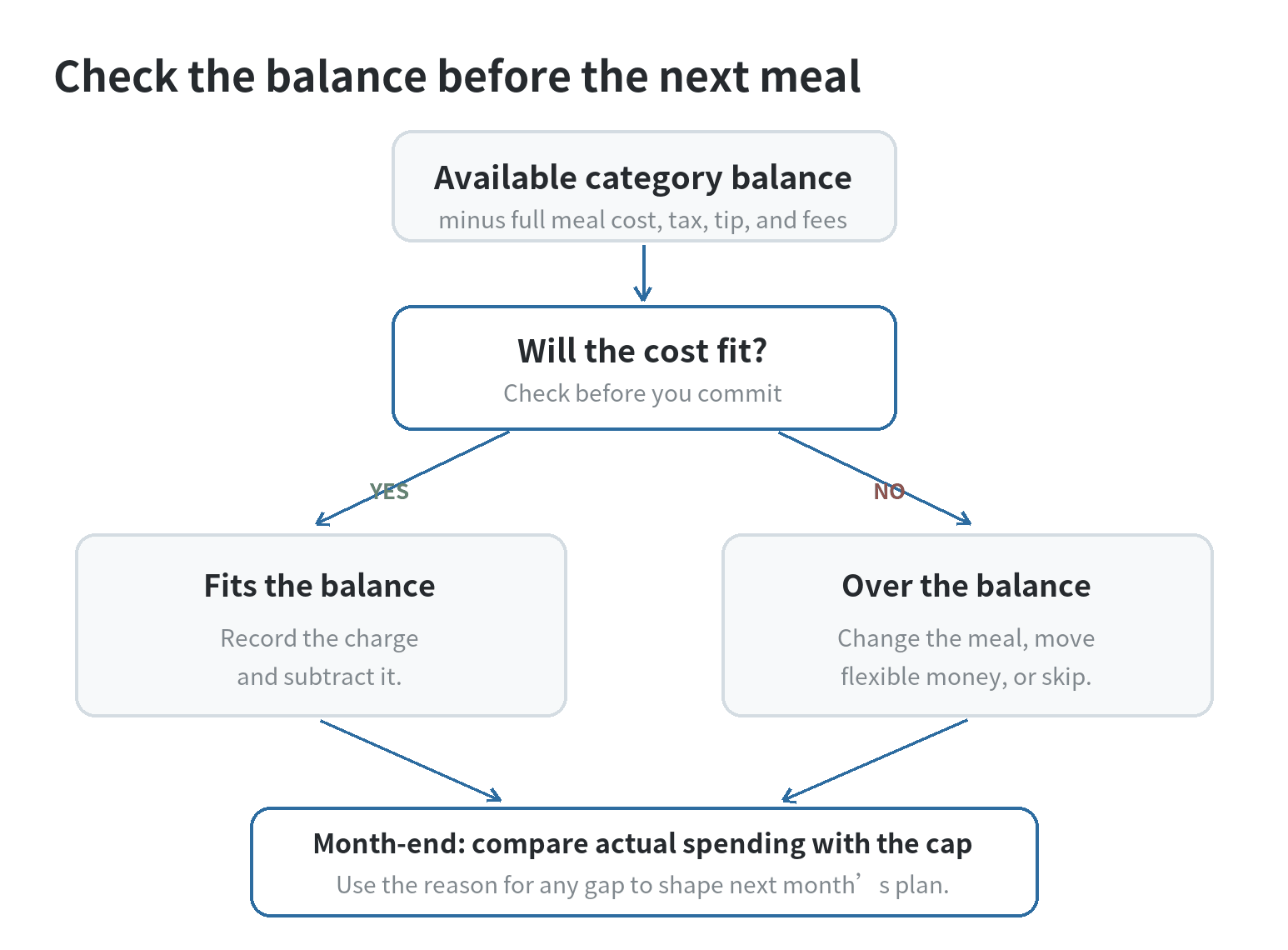
Check the remaining category balance before placing another order or agreeing to a meal out. Subtract the planned cost from the available amount, including tax, tip, and fees under your category rule. If the meal would take the category over its limit, choose a lower-cost plan, use money from another flexible category only if you deliberately reassign it, or decline that expense. Do not count a credit-card purchase as affordable just because its payment comes later.
Suppose the balance is $24 and the next planned meal is $31 under your estimate. The gap is $7. You can change the meal, move $7 from another flexible line, or skip that plan. If you move money, reduce the other line at the same time so your full budget remains honest.
If you crossed the limit, record the amount and identify why: more meals, larger checks, fees, or an unplanned occasion. Adjust next month’s cap or calendar to account for that cause.
Review the plan at month-end
Compare the planned amount with the charges you recorded, including missed cash expenses or purchases placed in the wrong category. The FTC budget guide recommends a month-end comparison, and the National Credit Union Administration recommends a monthly budget check-in; both pages were checked September 30, 2026 (FTC guide; NCUA Money Basics guide). A planned graduation meal or work travel week can make one month unlike the next, so keep the reason with the number.
If actual spending fits the plan and the remaining money went where you intended, keep the same cap for another month. If the limit repeatedly fails, adjust it using both your records and the amount available after priorities. The goal is a usable plan for your household’s choices, not a number borrowed from somebody else.
FAQ
Should I include coffee and snacks in an eating-out budget?
Yes, if you decide they belong in the category and count them consistently. Some households track coffee with meals; others keep a separate line for convenience purchases.
How should I budget for a dinner I only have once in a while?
Reserve part of the monthly cap for it or place it in a separate occasion category. Set that amount aside before treating the rest as available for routine meals.
What if my partner and I pay for shared meals in different ways?
Choose a shared record and enter the household’s total once. If each person tracks a share, make sure the shared total is not also entered as one full charge.
Last updated: 2026-09