Split shared housing costs with a rule everyone can explain before the first bill is due. Start with equal shares for costs everyone uses, then adjust only for a clear difference such as a private parking space, a room-size agreement, or a service one roommate does not use. Put the formula, due dates, payer, and backup plan in writing so a late transfer does not become a new argument every month.
A fair split does not have to mean that every line is divided the same way. Rent, electricity, internet, and a one-time household purchase have different reasons behind them. Separate those costs first, then choose a rule for each one.
Separate the bills before choosing a split
Make one list of shared housing costs and keep personal spending off it. Rent and required building charges belong in the housing list. Utilities and internet can go there if everyone agreed to share them. Groceries, streaming subscriptions, and personal supplies need their own agreement; do not quietly fold them into the rent calculation.
For each shared line, write down the amount, who receives the bill, whose account pays it, and the date roommates need to send their shares. The CFPB’s bill-calendar guidance recommends recording what each bill is for, its amount, and its due date, then checking the calendar regularly (checked September 30, 2026). That simple record gives the household one place to compare the bill with the agreed split.
| Cost | Possible rule | What to settle first |
|---|---|---|
| Rent | Equal shares or an agreed room adjustment | Room sizes, private features, lease names |
| Utilities | Equal shares, unless a clear use difference matters | Billing period, account holder, due date |
| Internet | Equal shares for household access | Who manages the account and equipment |
| Shared supplies | Split only among people who agreed to share them | What counts as shared and how receipts are recorded |
Use equal shares as the starting calculation
For a straightforward household, add the shared amount and divide it by the number of roommates who agreed to pay that line. For example, if three roommates agree to share a $1,800 rent payment equally, each share is $600. If a $150 utility bill is also shared equally, each person owes another $50. These are sample figures; replace them with the lease and actual bills.
Keep rent and variable bills as separate calculations. A fixed rent share can stay the same from month to month, while a utility share changes with the statement. If one person pays the provider, list that person’s payment as a credit against the total they owe the household. This avoids charging the payer once for the full bill and again for their share.
Check the statement for a charge that belongs to one person before splitting the total. If a roommate added a personal service or requested a one-time item, separate that line from the shared amount and show the receipt. If the bill does not identify who used the service, agree whether the household will share it or ask the provider how the charge is calculated before assigning a cost.
A move-in or move-out during a billing period needs its own rule. Use the dates shown on the bill, agree whether the departing roommate pays through a stated date, and record how any amount paid in advance will be credited. Do not silently change the base split after the bill arrives; tell everyone which period the calculation covers and keep the same rule for that period.
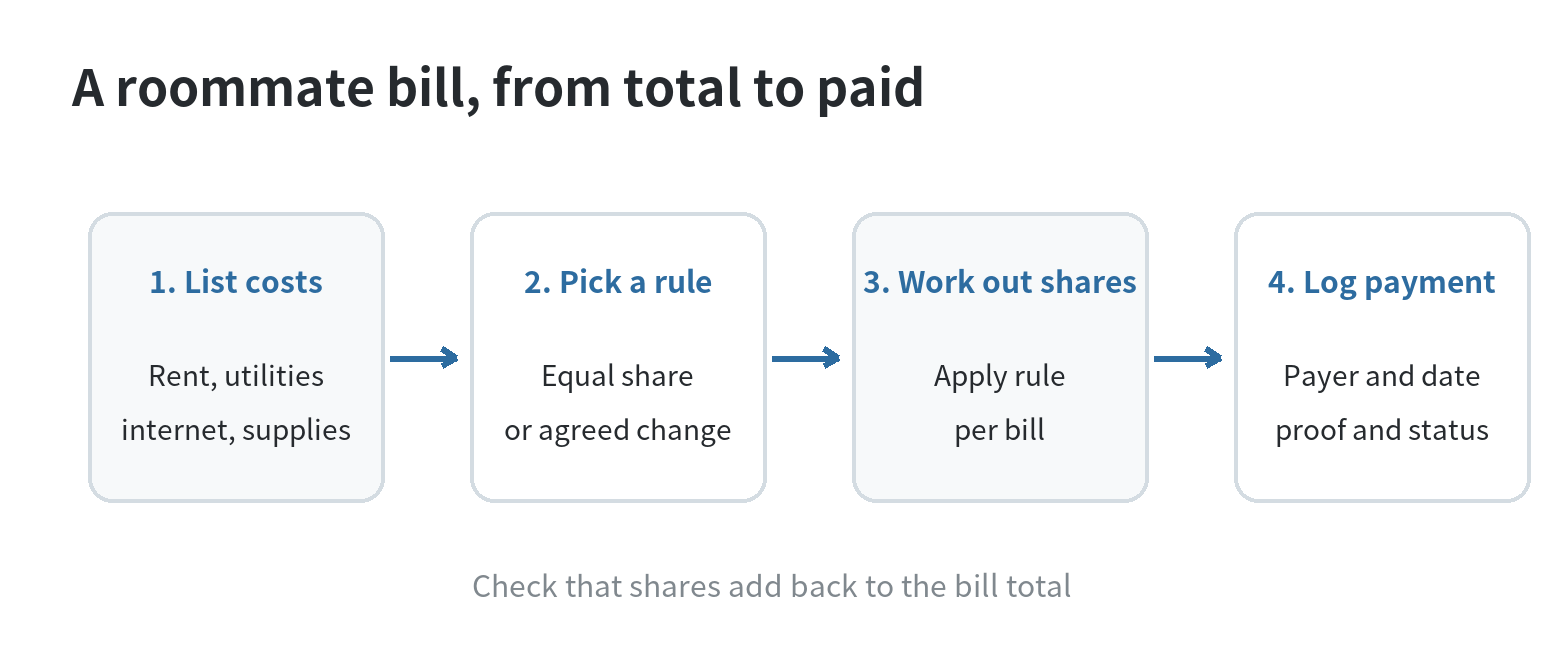
Before accepting the total, check that the shares add back to the bill. In the example, three $600 rent shares add to $1,800, and three $50 utility shares add to $150. If the numbers do not reconcile, the issue is arithmetic or a missing credit; resolve that before anyone sends money.
Adjust rent only for a difference you can describe
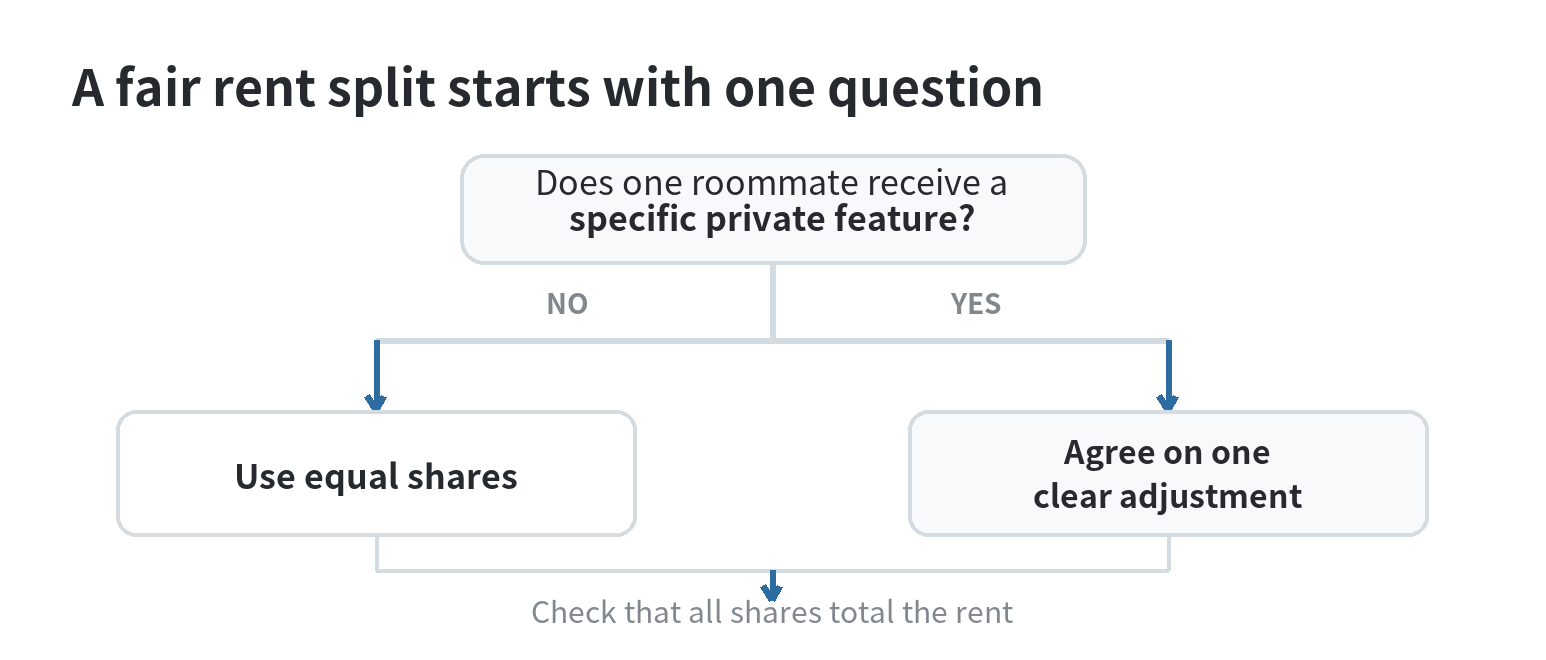
Equal rent shares are easy to calculate, but roommates may prefer another arrangement when rooms differ. Decide what counts as a meaningful difference before choosing amounts: floor area, a private bathroom, a dedicated parking space, or a storage area are examples the group can discuss. Do not use a vague judgment such as “the room feels nicer” after everyone has already moved in.
One workable method is to agree on a base share for the common housing cost, then assign a stated extra amount to a feature that only one roommate receives. For instance, the group could agree that a private parking space carries an additional $75 share, then divide the remaining rent among the roommates. The figure is illustrative, not a market rate. Write the adjustment beside the feature and show the arithmetic to everyone.
Another option is to compare room areas, but area alone does not capture every preference. If you use that method, agree on what space is measured and how common areas are treated. Do not add several adjustments that reward the same feature twice. The goal is a formula the group accepts before the lease starts, not a claim that there is one universally correct price for each room.
Make the payment routine visible
Choose one person to pay each provider only after the household agrees how that person will receive the money and what proof will be shared. A shared spreadsheet can show the bill total, each person’s share, payments received, and the date the provider was paid. Save the statement or receipt with the entry; a note that says “utilities” is hard to reconcile later.
Pick a roommate payment date that leaves time before the provider’s due date. The CFPB’s bill-calendar tool says to list bill amounts and payment dates and compare weekly bills with income; the FDIC’s consumer budgeting guidance also recommends tracking due dates on a calendar (both checked September 30, 2026). Use the actual statement’s date rather than assuming every provider bills on the same schedule. For a personal payment reminder workflow, see the site’s bill payment walkthrough.
Agree on what happens if the bill changes, a roommate pays late, or someone moves out. For a higher utility bill, share the statement and recalculate from the agreed rule. If a roommate is short, ask for a specific payment date and record any temporary amount still owed. For a move-out, write down the last day included in the split, how any final bill will be handled, and who will update account access.
Put the agreement in writing before move-in
A short written agreement can fit on one page. Include each shared category, the calculation rule, individual shares or the formula, who pays the provider, how roommates submit payment, what records are shared, and how a new charge is approved. Have everyone review the lease and provider account details together before relying on a roommate’s verbal summary, so the group can see whose names are listed and where each payment goes.
Use a shared note or spreadsheet for the household ledger, but keep account numbers and passwords out of it. The CFPB toolkit includes bill calendars and tools for tracking income and bills (checked September 30, 2026). A roommate ledger can use the same basic fields without turning into a full personal budget: bill, period, total, split rule, shares, payer, due date, and paid status. For help tracking your own spending, see the site’s budget tracker walkthrough.
At move-in, walk through one sample bill together and make sure everyone reaches the same per-person amount. If a line feels unfair, change the rule before the next billing cycle and record the new version. Tell the group when the change starts, which people it affects, and whether it applies to an open bill or only future periods. A clear calculation and a shared record make it easier to discuss a real exception without reopening every other bill.
Last updated: 2026-09
FAQ
Should roommates split rent by bedroom size or equally?
Either can work if everyone agrees to the rule before moving in. Equal shares are simpler; a room-size or amenity adjustment needs a measurement or a specific feature and a calculation everyone accepts.
How should roommates split a utility bill when someone travels?
Use the rule the household agreed to before the trip. If the group wants travel absences to change a share, define the length of absence and which bill categories qualify before the next billing period.
What should roommates do when one person pays the full bill?
Record the full bill, subtract the payer’s own share from the amount others reimburse, and mark each received payment. Keep the provider receipt with the ledger entry.
How do roommates handle a final bill after someone moves out?
Use the written move-out date and the household’s agreed rule for the final billing period. Share the closing statement and record who owes each remaining share.