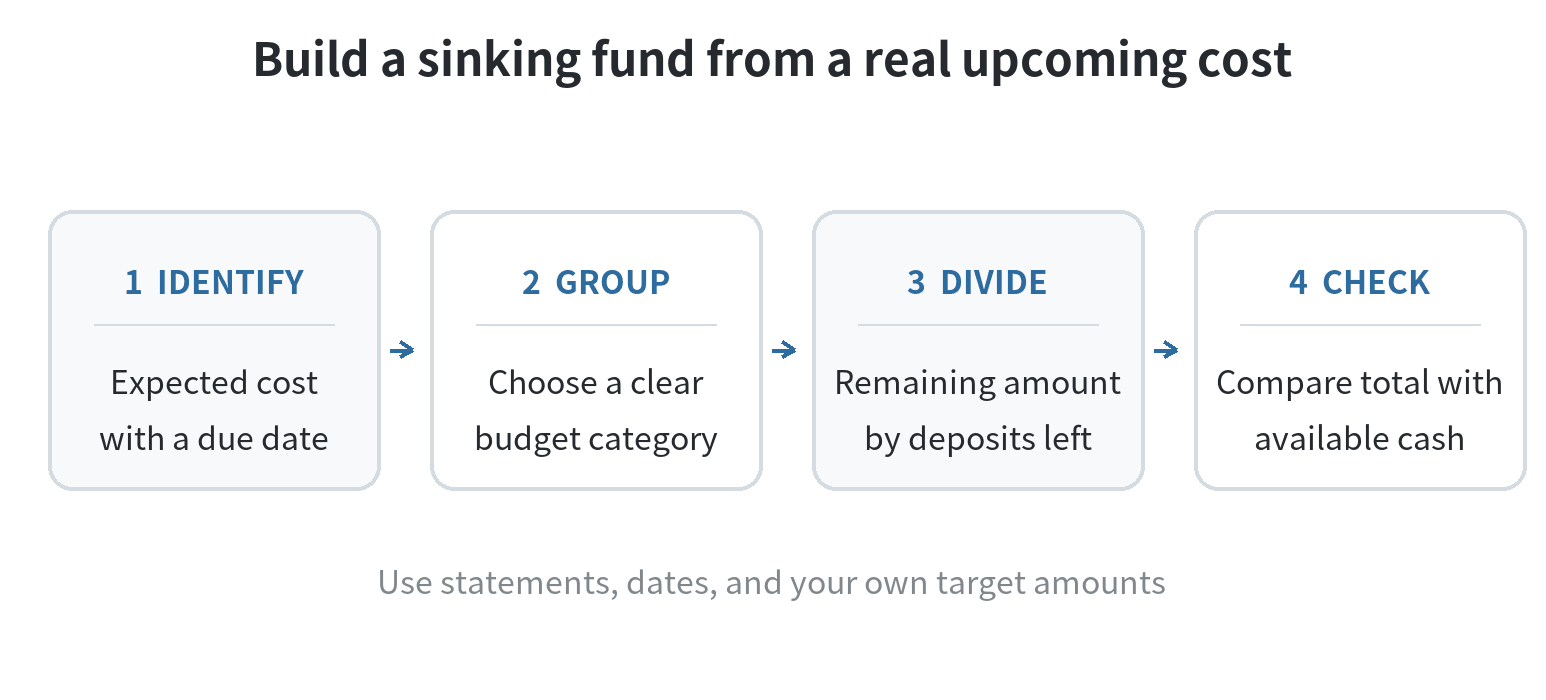
Sinking funds turn expenses you can name into smaller deposits made before the bill arrives. List each expected cost by category, estimate the amount and due month from your own records, then divide the amount still needed by the number of deposits left. If your car insurance renews in six months and you need $720, for example, setting aside $120 a month reaches that bill amount on schedule.
The point is timing: a yearly premium, school supplies, holiday travel, or a replacement appliance does not have to compete with rent in the month it is due. The CFPB’s spending guidance says to look across several months for less frequent costs, and its savings worksheet asks you to set a goal amount and deadline (checked September 30, 2026).
Choose categories from bills you can see coming
Start with statements, renewal notices, calendars, and receipts. Mark costs that are expected but do not arrive every month. The CFPB names insurance, tuition, seasonal expenses, gifts, and vacations as items that can disappear from a one-month view; its savings plan also separates goals, expenses, and unexpected events (checked September 30, 2026).
| Category | What to inspect | How to set the target |
|---|---|---|
| Car and home upkeep | Recent repair bills, inspection notes, or a planned replacement | Use a known quote or the amount you choose to prepare |
| Annual or seasonal bills | Renewal statement, school calendar, or last year’s receipt | Use the bill amount and due month |
| Gifts and events | Dates you expect to mark and the amount you can set aside | Set a household limit first, then fund it by event |
| Travel or planned purchases | Trip dates, deposits, and remaining payments | Add the costs you have decided to cover in cash |
Keep an emergency reserve separate from known bills. A sinking fund has a named use and an expected timing; emergency savings cover costs that are not planned in advance. The CFPB and FDIC both treat planned goals and unexpected expenses as distinct parts of a savings plan.
Calculate a deposit that fits the deadline
Write down four figures for each fund: target cost, amount already saved, months until payment, and planned deposit frequency. Subtract the saved balance from the target, then divide the remainder by the number of deposits before the bill. The CFPB’s goal worksheet uses the same basic relationship between an amount, a deadline, and a monthly contribution; the FDIC’s Money Smart worksheet applies it to saving for goals (both checked September 30, 2026).
For example, suppose you want $900 for school costs in five months and already have $150 set aside. The remaining amount is $750. Divide by five monthly deposits: $150 per month. If that amount strains the current budget, change the deadline or target, or use another funding source you have already planned for. Do not quietly leave out rent, food, or a bill due in the same period.
For an annual expense, converting the full amount to a monthly figure can make the cash-flow effect easier to see. A $480 bill due once a year works out to $40 for each of twelve monthly deposits. If you start with less time, divide the remaining balance by the actual number of deposits left instead. The FDIC’s budgeting material likewise converts annual expenses to monthly amounts by dividing by twelve (checked September 30, 2026).
| Target and timing | Already saved | Remaining amount | Monthly deposit |
|---|---|---|---|
| $720 car insurance in six months | $0 | $720 | $120 |
| $900 school costs in five months | $150 | $750 | $150 |
| $480 annual bill in twelve months | $0 | $480 | $40 |
Replace them with the actual total, current balance, and remaining paydays for your household. If deposits arrive weekly or every other week, divide the remaining amount by the number of pay deposits before the due date rather than forcing the schedule into a monthly number.
Use the amount you still need to pay, not a headline estimate that ignores money already credited. If a contractor deposit, reservation payment, or prior installment has reduced the balance, subtract that credit before calculating future contributions. For a bill that has not arrived yet, mark the number as an estimate and update it when the statement appears. This keeps the fund tied to the amount still due instead of funding the same cost twice.
If you are choosing a target from past spending, separate a recurring charge from a one-time exception. A year with a repair, late fee, or unusual trip may not match the next year’s plan. Keep the receipt and note why the amount changed; then decide whether that cost belongs in this category again or needs a separate line. Your target should describe the expense you are preparing for, not an unexplained average.
Fit several funds around the same paycheck
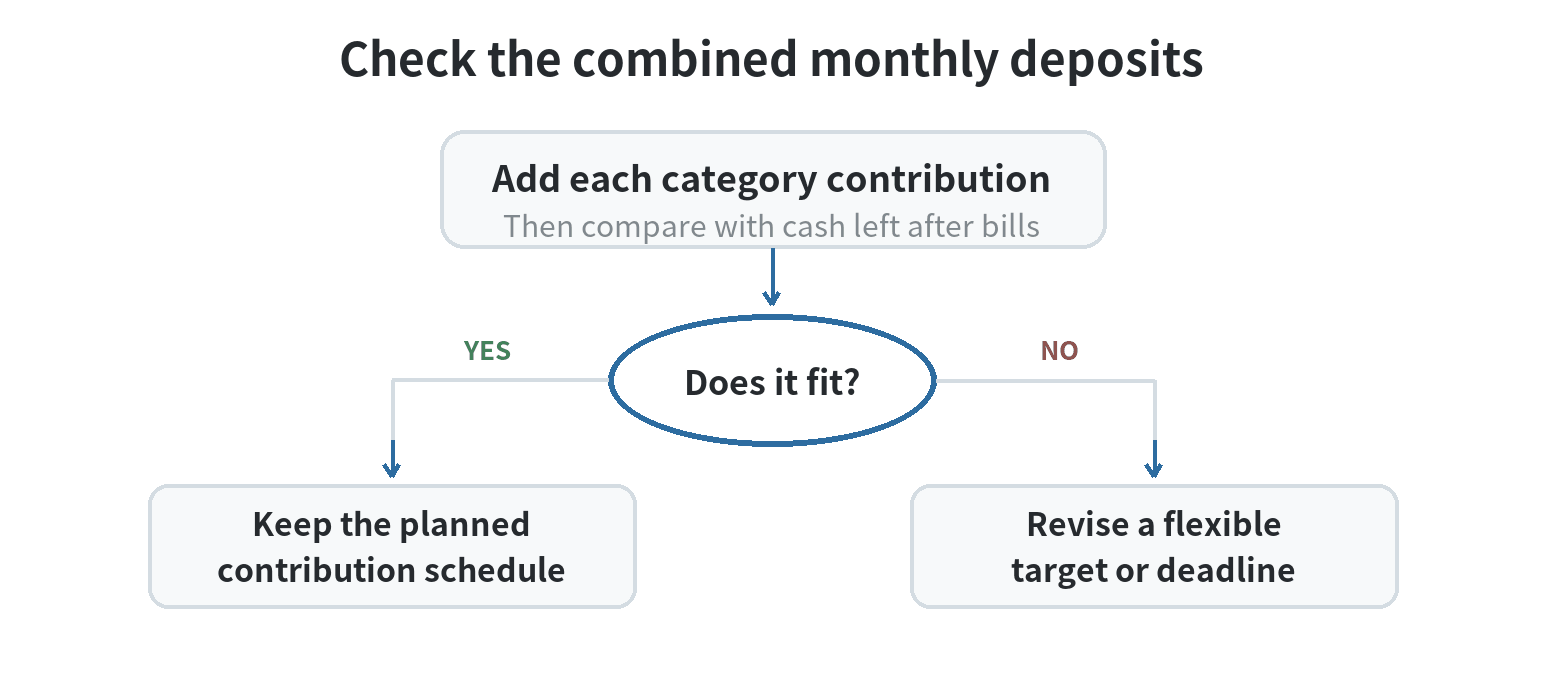
List every planned contribution beside your ordinary monthly bills, then total them. Say take-home pay is $4,200 and the monthly bills and flexible spending you have listed total $3,850. That leaves $350 for planned savings in this example. If four sinking funds call for $120, $150, $40, and $75, their combined $385 exceeds that room by $35.
Close the gap by changing a decision, not by pretending the total fits. You could extend the deadline for a flexible goal, lower a target you chose, pause a lower-priority fund, or reduce another budget category after checking the real bill. Keep required due dates and existing commitments visible while deciding which change is workable.
Prioritize the funds by consequence and timing. A bill with a fixed due date and a known amount needs a different place in the plan from an optional trip. A repair fund may have a target you select from past costs, but an unpredictable repair does not become a guaranteed bill date. Record what the estimate covers so you can see later whether the category still matches your plans.
Match each transfer to when money reaches your account. If you are paid twice a month, you might split a monthly target between those deposits. If pay dates vary, write the next deposit dates beside the bill date and count only the deposits that arrive in time. Do not assign a transfer to a payday that falls after the bill is due; use the available balance or revise the plan before that month begins.
For example, an $800 annual bill due in four months with $200 already saved leaves $600 to fund. If three paydays remain before the payment date, each planned deposit would need to be $200. If that amount collides with another deadline, show the conflict in the budget and decide which target can move. A date-based budget can help line up the contributions with bills; the site’s monthly budget example shows how planned categories fit into a full-month allocation.
Keep balances separate enough to track
You can track categories in a spreadsheet or in separate labeled savings buckets if your account offers them. The important part is knowing the total saved for each purpose and the cash available for the next bill. If all categories share one account, maintain a ledger so the same dollars are not assigned to car insurance and travel at once.
When a bill is paid, subtract it from its category and record the date and amount. If the final bill differs from the estimate, use the actual amount to update the next cycle. A higher bill can mean a larger future target; a lower one can leave a balance for the next renewal or another use you choose.
Check the list when a renewal changes, a planned purchase moves, or a goal is complete. CFPB budgeting guidance recommends comparing the budget with account statements and adjusting figures when the plan does not match what remains in the account (checked September 30, 2026). Keep the next due date visible so a category balance does not look available for ordinary spending when it is already assigned. A separate bill reminder can help keep the payment date visible; see the site’s bill calendar walkthrough for a phone-based reminder setup.
After a category reaches its target, decide whether to stop transfers, keep the amount as a cushion for the next bill, or redirect future deposits to another goal. Write that choice beside the category. A clear rule keeps a completed fund from continuing to claim money automatically after its purpose has changed.
FAQ
Should a sinking fund stay in checking or savings?
Use an arrangement that lets you identify the balance and access it before the bill is due. The CFPB savings plan asks you to name where the money will be held; check your account terms for access rules and any fees before choosing an account.
What if I start saving after the due date is close?
Divide the remaining amount by the deposits left before payment, then compare that contribution with the rest of your budget. If it does not fit, decide whether the goal amount or date can change, or whether another planned source can cover part of it.
Can one fund cover several related costs?
Yes, if the costs share a purpose and you can still see each expected payment. For example, a vehicle category can track registration and planned maintenance together, with separate lines and dates in its notes.
How often should I update the categories?
Update a category when you make a deposit or pay from it, then revisit the full list when a bill changes or a new date enters your calendar. Comparing your records with statements helps catch amounts that no longer match the actual spending pattern.
Last updated: September 2026
Last updated: 2026-09