Set the monthly contribution from cash left after bills, planned expenses, and a cash reserve—not from a market forecast.
Index funds seek to track a market index. Their value can fall, so use your budget to limit the cash exposed to that risk.
Investor.gov’s index fund overview explains how the funds work, while Investor.gov’s IRA page describes the account wrapper separately.
Give the investment line a job in your budget
Start with take-home income, then list costs that have a due date or a clear purpose.
The CFPB monthly budget worksheet follows this sequence: list income, list expenses, then subtract spending from income.
Separate fixed bills, flexible spending, irregular expenses, cash savings, debt payments, and investing.
Use pay stubs for net deposits, statements for due dates, and account history for flexible costs.
Those records help show which line changed when you revise the contribution.
They also keep estimates tied to your household instead of an online average.
This keeps rent, insurance, car repairs, and annual bills visible before you assign money to investing.
Use a fictional take-home amount to check the arithmetic.
Using the CFPB worksheet’s income-minus-expenses method, assume $3,800 in monthly take-home pay.
A sample plan assigns $1,650 to housing and utilities, $500 to food, and $350 to transportation.
It assigns $450 to insurance and debt payments, plus $300 to irregular expenses. Those lines total $3,250.
Those lines use $3,250. If you assign $250 to cash savings and $100 to flexible spending, $200 remains for investing.
The amounts are examples to replace with your own pay records and bills, not a recommended savings rate.
For phone-based expense tracking, see the site’s guide to tracking expenses on your phone.
| Monthly line | Example amount | What to enter |
|---|---|---|
| Take-home pay | $3,800 | Deposits after payroll deductions |
| Core bills and spending | $2,950 | Housing, food, transport, insurance, debt |
| Irregular costs | $300 | Known annual or seasonal bills |
| Cash savings | $250 | Your chosen cash reserve contribution |
| Flexible spending | $100 | Room for costs that vary |
| Potential investing amount | $200 | Available only if the other lines hold |
If the calculation leaves $0, take that as a useful result: the current plan does not fund an investment transfer.
Compare recurring charges, food, transportation, and annual costs with your statements. Correct missed or duplicated lines before changing the plan.
You can assign a future raise, lower bill, or completed debt payment to investing after that cash is actually available.
A planned deposit is not available money for a bill due today, so keep dates beside the amounts in your budget.
If the margin moves from month to month, leave the recurring transfer small enough for a lean month or make a fresh decision after each paycheck.
A zero transfer in a tight month is still a clear budget choice.
The table is a planning example, not a target.
If your checking balance repeatedly falls below the amount needed for upcoming bills, lower or pause the planned transfer and revise the budget.
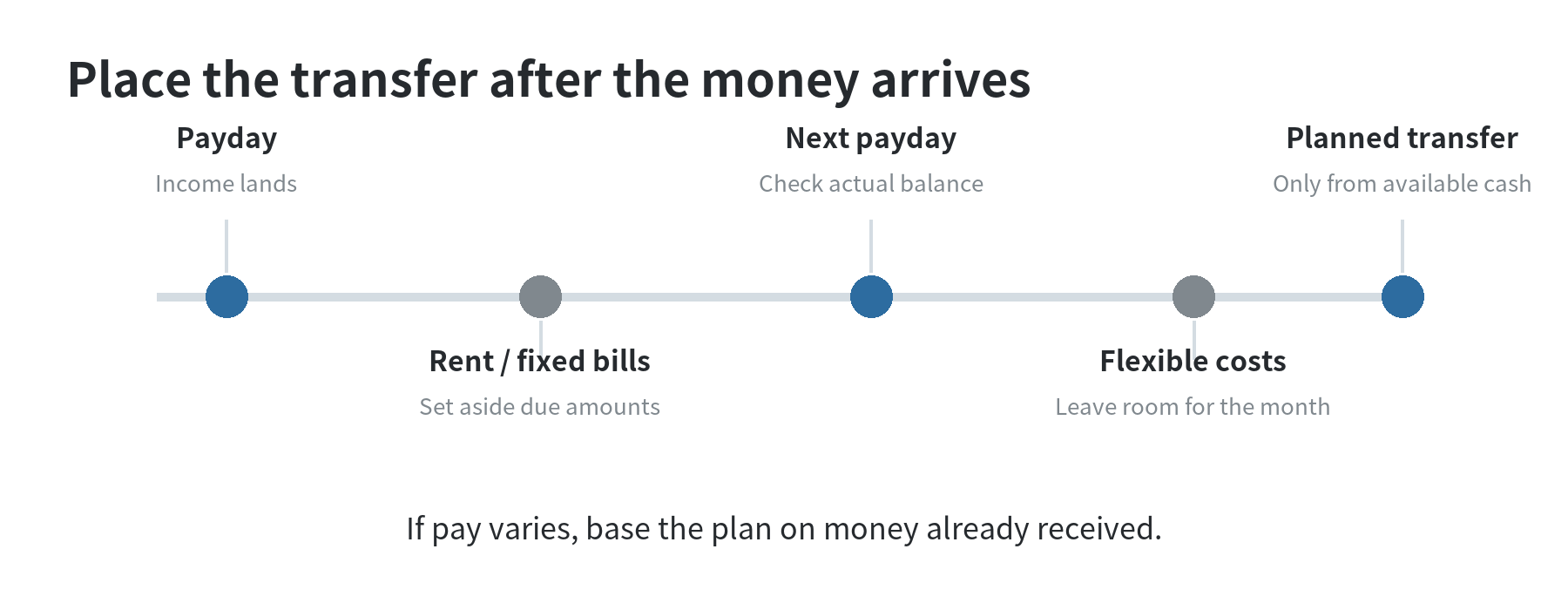
If your pay varies, begin with money already received and add another transfer only after the next deposit clears.
A contribution you can maintain in a lean month is easier to budget than one that depends on an unusually good month.
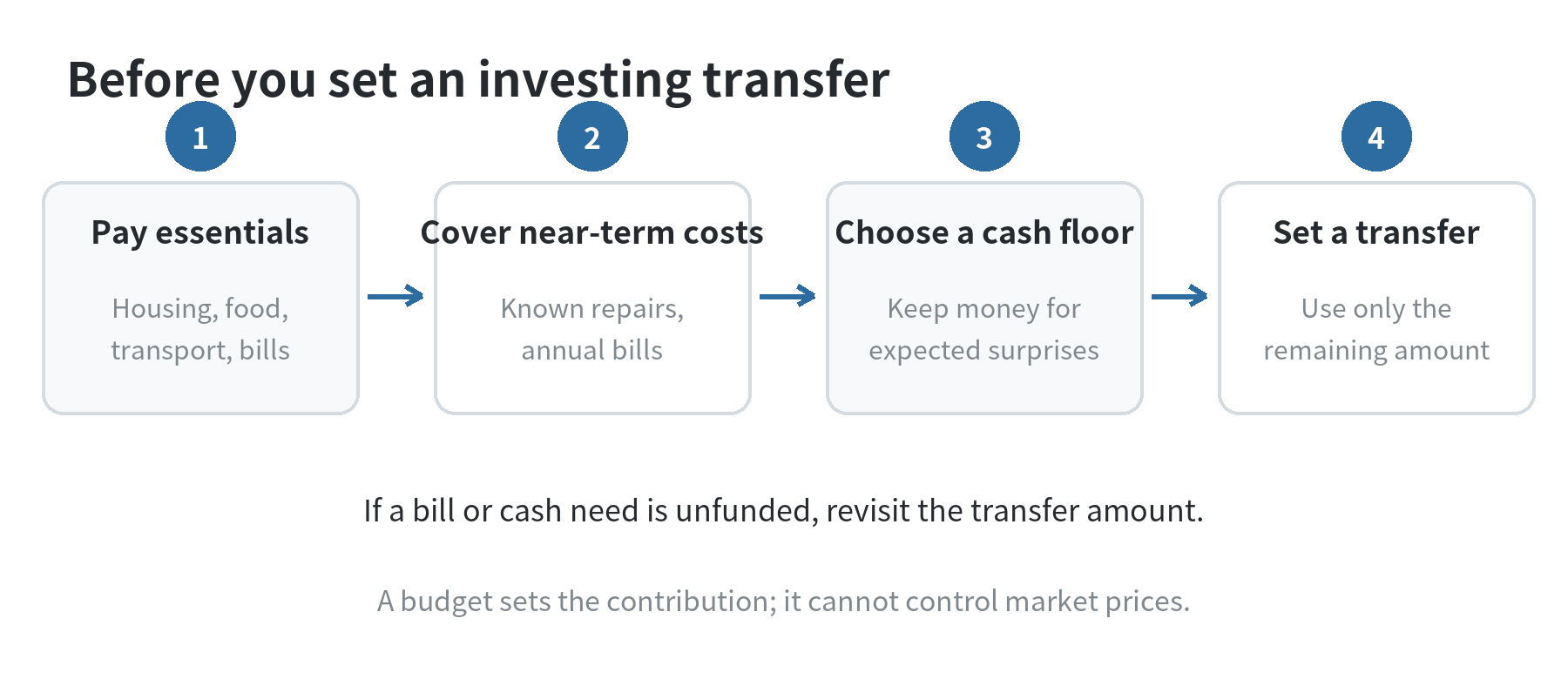
Make irregular expenses visible before investing
Car registration, insurance, school costs, travel, and home maintenance can arrive between paychecks. Include them in the monthly plan.
Look at statements and notices, write down the next due date and amount, then divide the expected bill across the pay periods before it is due.
If the amount is unknown, use the last bill or ask the provider for the current schedule instead of inserting a national average.
Keep this planned-expense bucket distinct from emergency savings.
A predictable annual bill is not an emergency; leaving it out makes an investment contribution look affordable until the bill arrives.
If a known cost is due soon and the cash is not set aside, budget for that obligation before increasing the investing line.
This is also where debt payments need to be visible. Put each required payment in the plan and note any extra amount you choose to pay.
If high-interest debt competes with an investment transfer, compare its borrowing cost with the risk of investment loss.
Choose a budget split without assuming a particular outcome.
That comparison is a budgeting decision, not a promise that either choice will produce a particular result.
Pick a transfer date that matches your pay
Choose a date after income arrives and after essential bills have been assigned.
On a predictable pay schedule, check the account after each deposit. Set aside bills due before the next payday, then move the planned remainder.
Someone paid on an irregular schedule can use a minimum transfer of zero in a low-income month and decide again when cash is available.
A calendar helps catch timing problems. Mark expected paydays, rent and loan dates, insurance withdrawals, and known large expenses.
Put the planned investment transfer after the deposit that funds it, rather than relying on a date that may arrive before the paycheck.
The timeline below shows the order; the dates and spacing should match your own account activity.
For a paycheck-based approach to household cash flow, the site also has a smartphone budgeting system walkthrough.
Whichever tool you use, compare the plan with cleared transactions.
Review automatic transfers after a pay cut or a bill change, then reset the amount to match available cash.
Separate the account limit from the fund amount
An index fund is an investment; an IRA or workplace plan is an account that can hold investments.
Investor.gov describes IRAs as tax-advantaged accounts with different types and rules, and directs readers to the IRS for tax information.
The IRS IRA contribution limits page lists limits by tax year; the amounts and eligibility rules depend on account type.
Before setting an annual target, check the IRS page for your account type and tax year.
The IRA contribution limits page and annual adjustment table show current rules.
Checked September 30, 2026.
Do not confuse an account’s contribution ceiling with a monthly amount you need to invest. A limit is a boundary, not a savings goal.
If payroll contributions go into a workplace plan, include that deduction in take-home-pay math.
Check the plan statement before budgeting another deposit.
Traditional and Roth IRAs have different rules. Eligibility, deductibility, and contribution limits depend on account rules, not the fund held.
Review fund costs and risk without making a forecast
When comparing fund documents, note the index tracked, the holdings approach, expenses, and any transaction or account charges.
Investor.gov says index funds may hold all securities or a sample. They may not track their index exactly.
Fees, trading costs, or tracking error can cause underperformance.
Its fee bulletin explains where prospectuses disclose operating expenses and shareholder fees.
Read the prospectus and the latest shareholder report before deciding whether a fund fits your plan.
A broad label such as “index” does not describe how concentrated the holdings are or how the fund behaves in a decline.
Investor.gov notes that a narrowly focused fund may not provide the diversification a person expects.
FINRA’s mutual fund overview says a stock index fund attempts to replicate a market index.
A fund’s prospectus describes its strategy, risk profile, and fees.
These details help you understand what the budget contribution would buy without relying on a return estimate.
Set a review reminder around a budget event, such as a pay change or a bill renewal.
Check the planned amount against actual expenses, cash reserves, and account contributions.
If one input changes, update the contribution line first; there is no need to increase it just because a market headline sounds optimistic.
FAQ
Can I start budgeting for index funds with a small monthly amount?
Yes.
Use the amount left after planned bills and expenses. Check account minimums and transaction costs before transferring it.
Index funds differ in costs and mechanics, so review their documents rather than assuming that every fund accepts the same amount.
Should I invest money I may need for a car repair next month?
Budget for the known repair before assigning that cash to investing.
The amount and date belong in your near-term expense plan; market investments can lose value while you are waiting to use the money.
Can a Roth IRA hold an index fund?
An IRA provider may offer mutual funds as investment options, and an index fund can be a mutual fund or ETF.
The specific investment choices depend on the account provider; check its account materials and the fund prospectus.
What should I do if I cannot make the planned transfer one month?
Update the budget using the income and bills you actually have, then reduce or skip that month’s transfer if needed.
Check upcoming obligations and any account rules before changing recurring instructions. Compare fund fees and expenses, which reduce returns, and check whether your mix of stocks, bonds, and cash still fits your time horizon and risk tolerance.
Last updated: September 2026.
Last updated: 2026-09