Pair each season’s maintenance with a matching product category: HVAC air filters, weather stripping, caulk and sealants, ladders, and outdoor power equipment.
Those categories appear in the linked home-care guide, checked October 4, 2026.
Use the seasons as reminders, then adjust the tasks for your home, climate, and equipment manual.
Start with your HVAC filter’s size and type; use the remaining rows for brief seasonal inspections.
Put the year on a seasonal loop
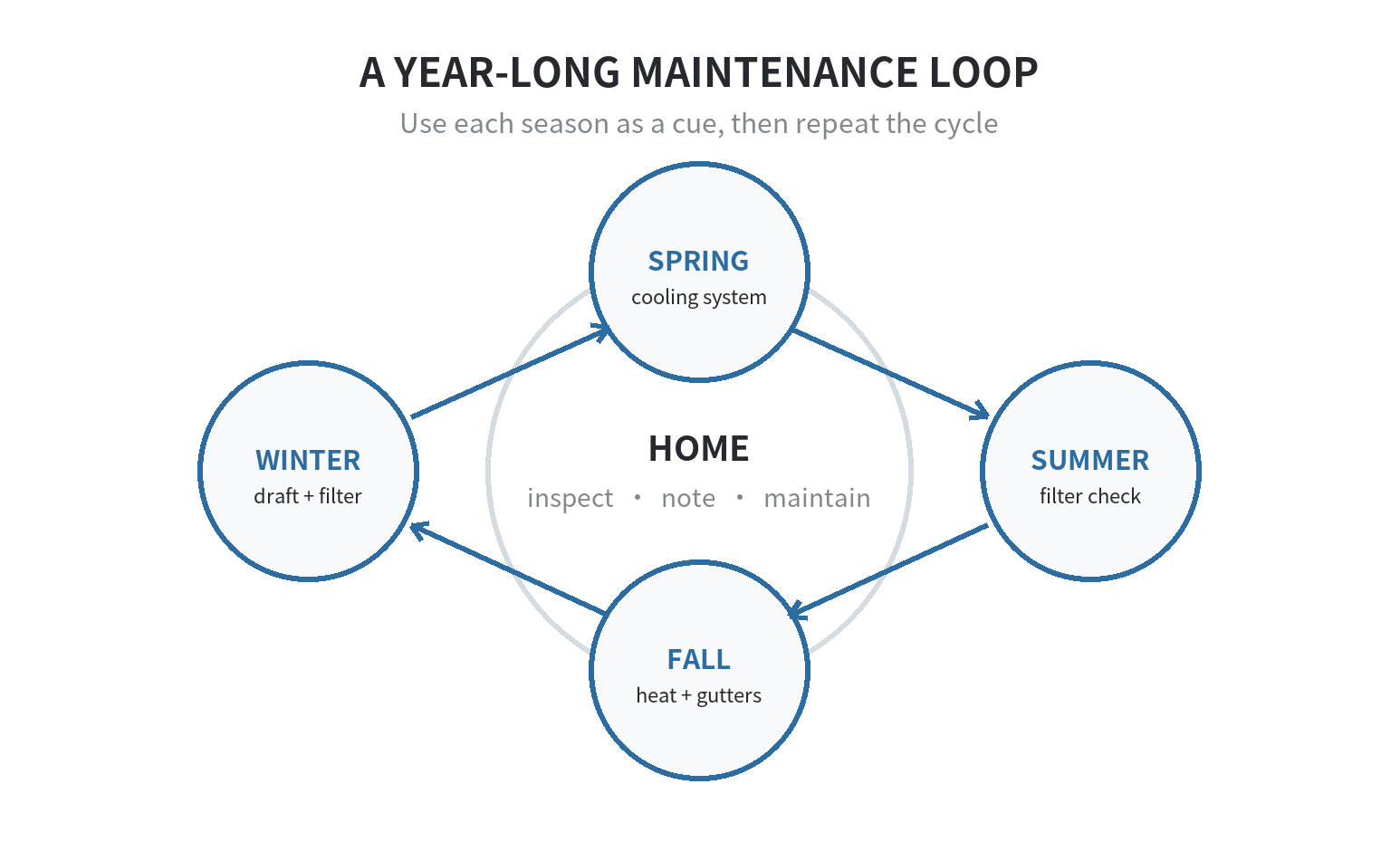
Think of the checklist as a loop rather than a one-day project.
ENERGY STAR suggests checking cooling equipment before summer and heating equipment before winter.
Its certified-home guide places gutter checks in spring and fall.
Those seasonal cues were checked October 4, 2026, against the ENERGY STAR maintenance checklist and certified-home maintenance guide.
| Season | Check or task | Product category to pair with it |
|---|---|---|
| Spring | Prepare cooling equipment before warm weather; check gutters and downspouts. | HVAC air filters; gutter and yard tools. |
| Summer | Check the HVAC filter during heavy-use months; clear vents and outdoor equipment space. | HVAC air filters; basic yard tools. |
| Fall | Prepare heating equipment; clear gutters and inspect door weather stripping. | HVAC air filters; gutter tools; weather stripping. |
| Winter | Look for worn seals around movable doors and windows; check the filter. | Weather stripping; caulk and sealants for suitable fixed joints. |
Seasonal timing was checked October 4, 2026, using the ENERGY STAR checklist and its certified-home guide.
Product categories were checked in the linked home-care guide.
Spring: get the cooling system ready
Before the first stretch of hot weather, put a cooling-system check on the calendar. ENERGY STAR recommends a spring pre-season check.
Carrier recommends annual HVAC maintenance, with spring service for cooling equipment. Both sources were checked October 4, 2026.
For your own part, remove dust or leaves from around the outdoor unit without opening its cabinet.
Keep supply registers and return grilles clear of boxes, rugs, and furniture.
If the unit makes a new noise, leaks, or fails to start, write down what you notice and arrange qualified service rather than opening electrical or refrigerant components.
When you walk the exterior, note damaged caulk at stationary joints and worn seals on moving doors or windows.
The Department of Energy distinguishes caulk for fixed gaps from weather stripping for movable joints; the guidance was checked October 4, 2026.
Use a product label and substrate instructions for the actual repair.
Summer: let the filter tell you what it needs
Check the filter before a seasonal reminder slips by. ENERGY STAR recommends a monthly check, especially during heavy-use months.
ENERGY STAR says to replace the filter at least every three months, sooner if it looks dirty.
The Department of Energy gives the same monthly check and three-month minimum in its winter home-energy guidance.
Both pages were checked October 4, 2026.
A clogged filter can restrict airflow and make the system work harder, according to ENERGY STAR and the Department of Energy.
Treat the calendar interval as a prompt to inspect, not permission to ignore a visibly dirty filter or the equipment maker’s instructions.
Because ENERGY STAR singles out heavy-use months, give the filter reminder extra attention while the equipment runs hard.
The product category to map to this task is a replacement HVAC air filter.
The home-care guide lists air filters as a maintenance category; its contents were checked October 4, 2026.
Use the equipment requirements to identify a compatible filter instead of choosing by package appearance.
Match the filter before you leave the equipment
Start with the filter already installed or the equipment manual.
Record the printed width, height, and thickness, and note whether the system calls for a disposable or washable filter.
Trane says filter location and type depend on the HVAC system; Carrier also advises following the system’s specific maintenance information.
Those manufacturer pages were checked October 4, 2026: Trane filter guidance and Carrier maintenance guidance.
If your home has separate HVAC systems for different zones, check each filter slot and record its dimensions separately.
Trane notes that separate systems can have multiple filters.
The Department of Energy says a filter may sit in each return grille when the air handler is not accessible; see its filter-installation guidance.
Trane notes that homes with multiple HVAC systems may have multiple filters; confirm each one instead of assuming all units share a size.
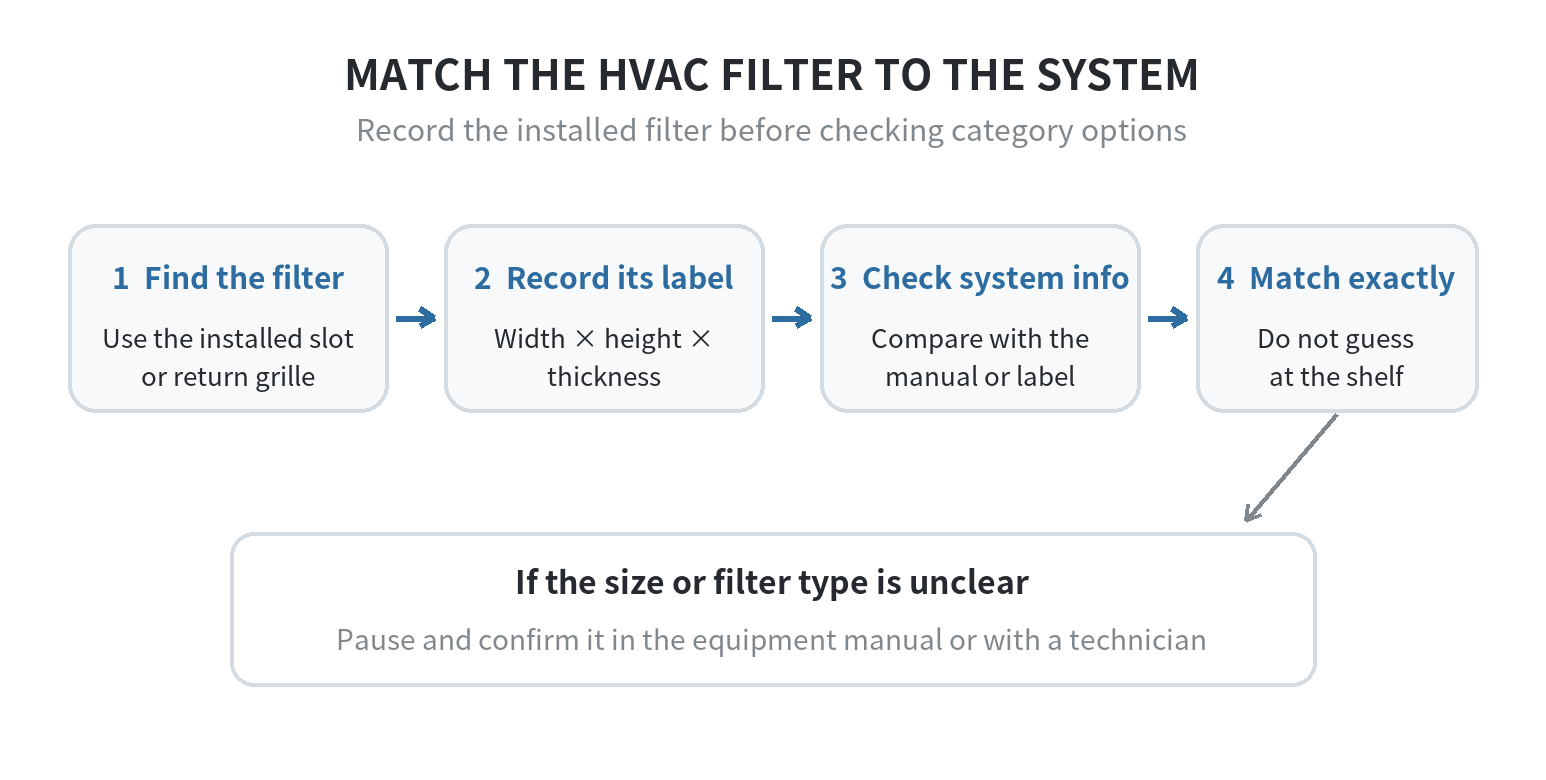
Do not choose a filter by thickness or rating alone; use the equipment manual to check which specifications fit your system, as Carrier’s maintenance guidance advises.
A higher number on a package is not a substitute for checking what your blower and filter slot are designed to use.
Slide it in without bending the frame, close the access panel, and write the date on a household calendar.
If the frame size is missing or the filter will not seat correctly, pause and confirm the specification with the manual or a service technician.
For a washable filter, follow the cleaning and drying directions supplied for that filter and system.
Do not put a damp filter back into the equipment.
If you cannot confirm whether your system uses a washable or disposable design, leave it in place until you check the manual instead of guessing.
Fall: clear water paths and prepare for heat
Before heating season, schedule the heating-system check. ENERGY STAR recommends a fall pre-season check.
Carrier recommends annual maintenance before heating season; both sources were checked October 4, 2026.
Keep this as a service task rather than a do-it-yourself inspection of burners, wiring, or a heat exchanger.
Clear leaves from gutters.
Check that downspouts carry water away from the house. ENERGY STAR’s certified-home guide lists spring and fall gutter cleaning and downspout checks.
The linked fall home-maintenance checklist also covers gutters and seasonal yard cleanup; both pages were checked October 4, 2026.
For this job, match gloves, a hand tool, and a hose with gutter clearing. The spring checklist mentions gloves, a garden trowel, and a hose.
Yard tools suit leaf cleanup around the house; the linked home-care guide lists outdoor power equipment and ladders.
Do not climb onto a roof or reach beyond a ladder to clear a gutter.
If access is unsafe or a downspout is blocked below ground, make it a service call rather than adding risk to a routine checklist.
Winter: seal small gaps and close the loop
Inspect the weather stripping on exterior doors and movable windows. ENERGY STAR’s certified-home guide recommends an annual check and replacement as needed.
Marvin’s window-and-door checklist also includes an annual weather-strip inspection; checked October 4, 2026.
The Department of Energy identifies weather stripping for movable joints and caulk for stationary gaps. Both sources were checked October 4, 2026.
Replace a strip that is torn, loose, or no longer makes contact when the door closes.
For a fixed gap, match sealant to the surfaces and location; the caulk guide distinguishes indoor and outdoor uses.
If a gap surrounds wiring, a vent, or a fuel-burning appliance, ask a qualified professional before sealing it, as DOE air-sealing guidance advises.
Keep the plan visible where you store home records.
The linked tool-safety article covers basic preparation before home projects, and the chore-and-repair list article has a simple way to group household tasks.
Use this year’s notes to mark the next seasonal cue, record the filter size, and list repairs that need a specialist.
The home-care guide groups air filters, weather stripping, caulk and sealants, ladders, and outdoor power equipment under home maintenance.
Use the checklist as a category map: inspect first, identify the task, then match only the material or tool the work calls for.
Check current labels and availability when you plan a repair.
Keep a short maintenance record with the equipment manual.
Note the filter size and type, the date you inspected or changed it, the last service visit, and any leak, noise, or drainage issue you observed.
A concise record gives you useful details to share with a service technician and helps you resume the checklist at the next seasonal cue.
FAQ
How do I find the right HVAC filter size if the label is worn off?
Check the equipment manual or ask a service technician to identify the required filter.
Filter location and specifications vary by system, as noted in Trane’s filter guidance; confirm the system requirement before using a replacement.
Should a heat pump get one annual visit or spring and fall checks?
Use the equipment schedule and ask the service technician to set the visit plan for your system.
ENERGY STAR recommends cooling checks in spring and heating checks in fall. Checked October 4, 2026.
Carrier recommends annual maintenance overall and seasonal service for some equipment. Checked October 4, 2026.
What if my house has more than one HVAC filter?
Check each filter slot and keep a separate size and replacement note for each system.
Trane notes that homes with multiple HVAC systems may have multiple filters; its guidance was checked October 4, 2026.
What if my home does not have gutters or central HVAC?
Skip tasks tied to equipment your home does not have and keep the remaining seasonal checks.
A maintenance calendar is a way to organize your home’s actual systems, not a requirement to add equipment or materials.
Last updated: October 2026.
Last updated: 2026-10