Choose a chainsaw by the work area first, then match the bar to the wood you expect to cut.
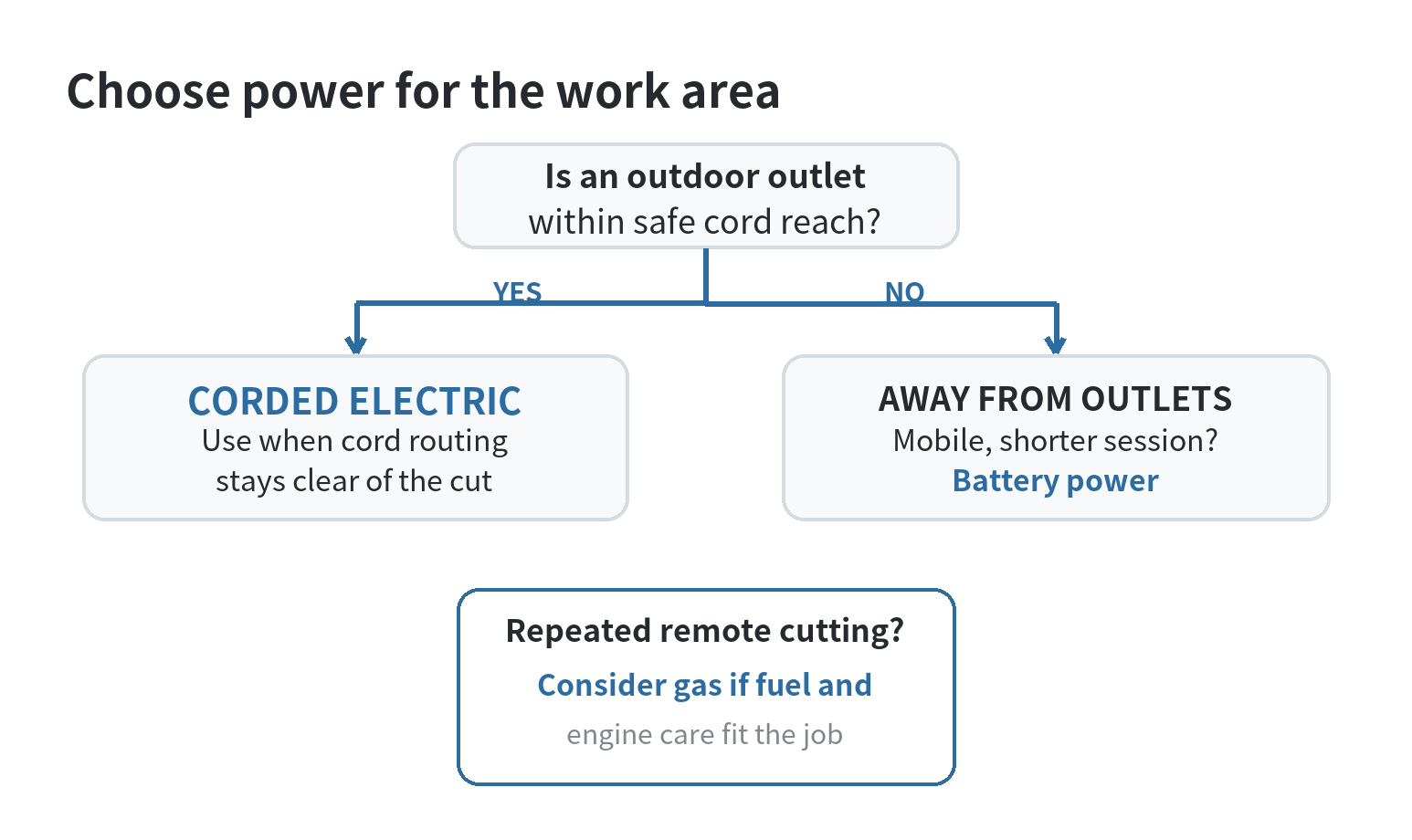
A corded saw makes sense near a dependable outdoor outlet; a battery saw trades runtime for freedom to move; a gas saw suits work that needs refueling away from an outlet.
For an occasional homeowner job, the shortest bar that fits the main task is easier to manage than extra reach you rarely use.
Start with where the cut will happen
Write down the job before comparing power sources: trimming a few reachable limbs, cutting already-fallen wood into sections, or working farther from the house.
Also note whether you can keep a cord clear of the cutting area and whether you want to store fuel or charge batteries between jobs.
A retailer buying guide checked October 2026 groups saws into gas, corded electric, and cordless battery models.
University of Wisconsin Extension describes the same tradeoffs:
a cord limits range, a battery gives more mobility but depends on charge, and gas offers longer work away from an outlet with more engine upkeep.
| Power source | What it asks of your setup | Fits this kind of job |
|---|---|---|
| Gas | Fuel, engine care, and a place to refuel safely | Cutting away from outlets or handling repeated work where refueling is practical |
| Corded electric | An outdoor outlet and a cord route kept behind and away from the saw | Work close to the house where cord reach is enough |
| Battery | A charged, compatible battery and a plan for recharging | Moving around a yard without dragging a power cord |
Trade a cord, a charge, or engine upkeep
A corded saw removes gasoline and battery charging from the routine, but the cord becomes part of the work zone.
The buying guide notes that an outdoor outlet or generator is needed.
Keep the cord behind the tool and out of the cutting path; if the route crosses brush, standing water, or the wood being cut, that setup is a poor fit.
A battery saw moves freely around a yard, but the pack sets the session’s limit.
Check whether the saw includes a battery and charger, whether the battery is compatible with equipment you already own, and how the manual says to charge and store it.
A spare pack is useful only if its cost, storage, and charging routine suit the task.
A gas saw can work away from outlets and can be refueled for continued work, but it adds engine care, fuel handling, noise, and starting steps.
University of Wisconsin Extension lists fuel mixing and engine maintenance among the extra chores.
Read the manual’s fuel requirements before treating fuel as a simple convenience.
Weight matters after the first cut, not just while lifting the saw from a shelf. A longer bar and a larger powerhead can make the tool harder to position and hold.
If your work is short limbs near ground level, a compact saw that you can control is a more relevant comparison than maximum power.
Match bar reach to the usual wood
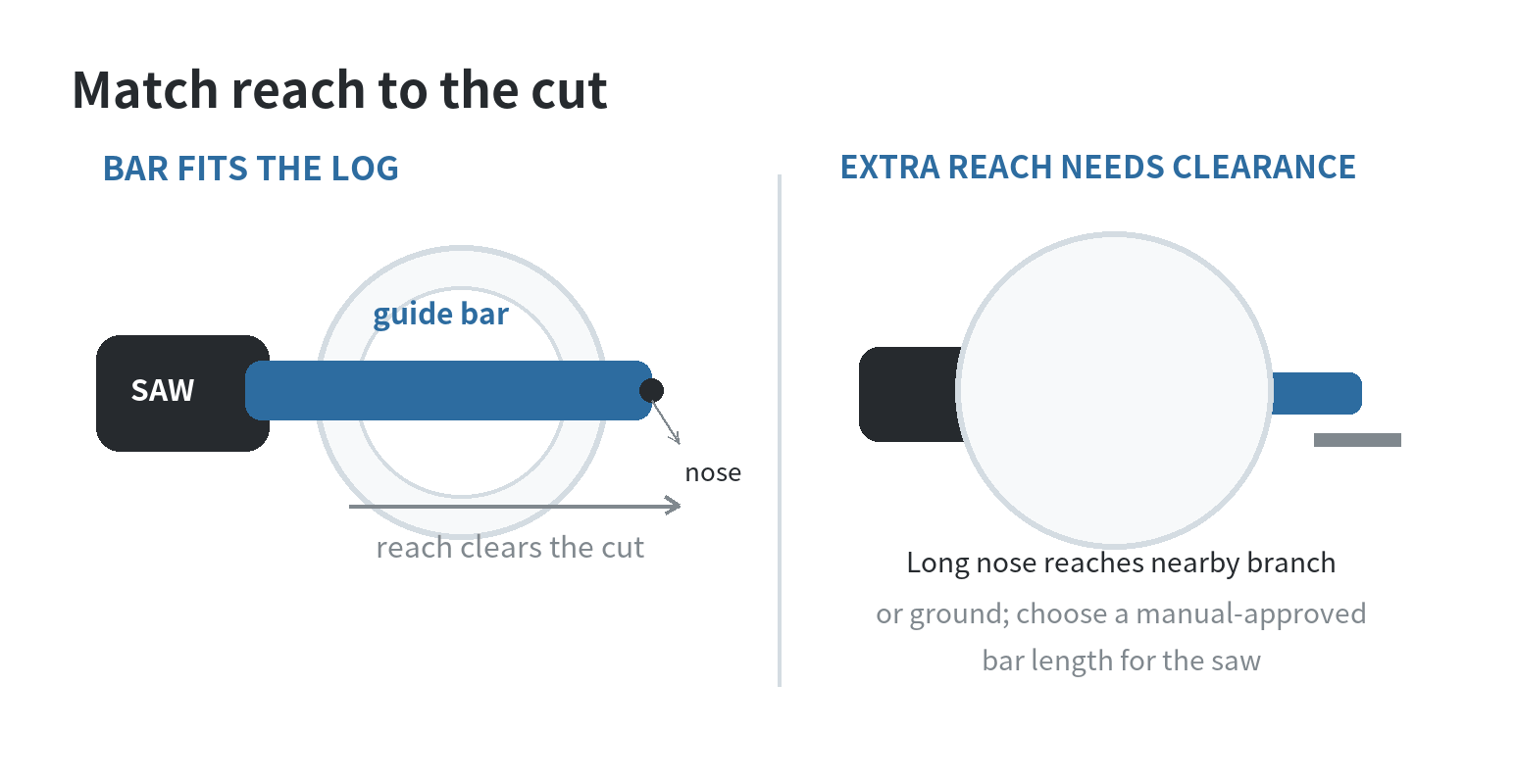
The guide bar is the rail around which the chain runs; its listed length is not a promise that every cut of that diameter will be easy or appropriate.
The retailer buying guide, checked October 2026, places 14- to 16-inch bars in occasional, lighter homeowner work and 18- to 20-inch bars in larger-diameter cutting.
The University of Missouri Extension likewise separates light, occasional work from more frequent log cutting.
Use the wood you expect to cut most as your reference.
Measure its diameter where the cut will pass, then compare that measurement with the bar guidance in the saw’s manual.
A guide bar slightly longer than the wood diameter can allow a straight cut from one side, but extra length adds leverage, weight, and exposed tip.
The Missouri Extension warns against choosing a bar so long that its tip can strike the ground or a nearby branch.
For a yard with small pruning cuts and occasional firewood sections, begin in the shorter homeowner range shown in the table below.
If you are comparing other outdoor equipment for leaf cleanup, our yard cleanup tools guide covers those tasks separately.
If the recurring work is thicker logs, compare a mid-size bar and the saw’s power and weight together.
Alabama Cooperative Extension also cautions that longer bars need more engine output and add weight, so a bar change must be approved for that saw in its manual.
| Typical work to plan around | Starting point in published guides | What to confirm |
|---|---|---|
| Light pruning or small logs | About 14 inches or less in Missouri Extension guidance | Reach, balance, and the exact bar sizes allowed by the manual |
| Occasional homeowner cutting | 14–16 inches in the retail buying guide | Wood diameter and whether the cut can be made from a stable position |
| Frequent thicker logs | 14–20 inches in Missouri Extension guidance | Powerhead weight, bar compatibility, and operator experience |
| Large-diameter work | 18–20 inches in the buying guide | Whether the job belongs with a trained tree-care professional |
These published ranges are starting points, not permission to mount any bar on any saw.
Before comparing a longer bar, confirm the allowed bar length, chain pitch, chain gauge, and replacement-chain fit in the exact model manual.
A mismatch can prevent correct installation or operation.
Compare control and upkeep before features
Before focusing on convenience features, pick up a powered-off display model if available and consider whether its balance and handle position feel manageable.
Compare the complete working weight listed by the manufacturer, including the bar, chain, battery or fuel where the listing separates them.
A bare powerhead weight can understate what you will hold.
Then check chain tensioning, chain lubrication, and access for routine cleaning.
The buying guide describes automatic oiling and tool-free adjustment as features offered on some models, not every model.
Read what the manual requires for oil, tension checks, sharpening, and storage; these tasks apply across power types.
For battery models, add battery and charger availability to the comparison.
For corded models, check the manufacturer’s outdoor cord requirements and plan the cord route before a job.
For gas models, confirm the fuel mix, cool-down, and storage instructions. These details can matter more to your routine than a feature name on the box.
Make safety features part of the shortlist
Kickback happens when the moving chain at the bar nose contacts an object or the chain gets pinched, sending the saw back toward the operator.
The CPSC described this mechanism in its chain-saw safety release; OSHA’s Chainsaw Safety Quick Card also warns users not to cut with the bar tip.
A low-kickback chain and a functioning chain brake reduce hazards but do not make a saw risk-free.
Check that guards, chain brake, chain catcher, throttle lockout, and stop controls are present and work as the manual describes.
The University of Missouri Extension explains how several of these parts help control a broken chain or stop chain motion.
Do not remove, disable, or substitute safety parts to make a cut easier.
OSHA says chainsaw operators need hand, foot, leg, eye, face, hearing, and head protection.
Set aside the cost and storage space for protective equipment before choosing between saw types.
Clear the cutting path, keep both hands on the handles, maintain secure footing, and stop if a branch is under tension or the saw begins to bind.
Tree felling, overhead cuts, and storm-damaged limbs can involve forces and drop paths that are hard to judge from the ground.
OSHA’s logging guidance treats chainsaw work as hazardous, and its quick card calls out branches under tension.
If a tree is leaning, hung up, near a structure or utility line, or beyond your training, arrange qualified tree-care help instead of sizing a saw for the job.
For broader preparation and work-area basics, see our first-project safety checklist.
Use a short checklist before choosing
- Identify the main material and the largest routine cut; use a guide-bar range as a starting point, then check the exact manual.
- Choose corded electric only when the outlet and cord route fit the cutting area; choose battery when mobility and charging fit; choose gas when remote runtime justifies fuel and engine care.
- Compare complete weight, bar compatibility, chain and oil upkeep, included battery or charger, and required protective equipment.
- Skip work involving unstable trees, suspended limbs, overhead cutting, or conditions outside your training.
When saws appear close on paper, compare the setup you will repeat:
where it will be used, what has to be carried or charged, which maintenance steps the manual requires, and whether the bar suits the wood.
That gives you a concrete shortlist without treating a longer bar or a higher power rating as an automatic advantage.
FAQ
Can I put a longer bar on a chainsaw later?
Only if the manufacturer lists that bar length for the exact saw.
Alabama Cooperative Extension warns that a longer bar can need more engine output and add weight;
check the manual for approved bar sizes and matching chain specifications.
Does a battery chainsaw include its battery and charger?
Not necessarily; listings may distinguish a complete kit from a tool-only configuration.
Check the included-items section and the manufacturer’s documentation for battery compatibility and charging requirements before comparing packages.
Is a low-kickback chain enough to make chainsaw use safe?
No. The University of Missouri Extension says low-kickback chains reduce the hazard but do not eliminate it.
Keep the saw’s safety features working, use the required protective equipment, and follow the operating manual.
What should I do with a storm-damaged tree near a house?
Keep people clear and contact a qualified tree-care professional when a limb is suspended, the trunk is under tension, or the tree is near a structure or utility line.
OSHA warns that branches under tension can spring when cut.
Last updated: 2026-10