When paychecks arrive on different dates, build your budget around the dates money actually reaches your account. List each expected deposit, place bills on their due dates, and assign the dollars from each paycheck to expenses that fall before the next deposit. A monthly total can look balanced while the calendar still leaves you short on rent week.
The Consumer Financial Protection Bureau (CFPB) recommends putting income and expenses on a calendar and tracking bill amounts and due dates; checked September 30, 2026. The FDIC’s Money Smart for Adults guide also uses pay stubs and bill records to build a spending plan; checked September 30, 2026. Use those records, then work through the dates below with your own take-home pay.
Start with take-home pay and the dates it lands
Use the amount deposited after payroll deductions, not gross salary. Open recent pay stubs or account activity and write down the net amount and date for every income source. If your checks vary, use the confirmed amount for the upcoming deposit rather than assuming it will match a larger past check.
Next, list fixed bills with their amounts and due dates: housing, utilities, insurance, loan payments, and subscriptions. Add flexible costs such as food, fuel, transit, and household supplies. Review recent statements to estimate each category from your own spending. Include expenses that arrive quarterly or annually by setting aside part of the bill each month; a car registration payment due later still belongs in the plan before its due date.
Finally, mark each paycheck and bill on a calendar. The CFPB’s cash-flow worksheet places deposits on the days they arrive and expenses on the days they are paid. That view makes the gap between a bill and the next paycheck visible. A monthly budget remains useful for totals, but the calendar decides whether money is available in time.
Give each paycheck a job before spending from it
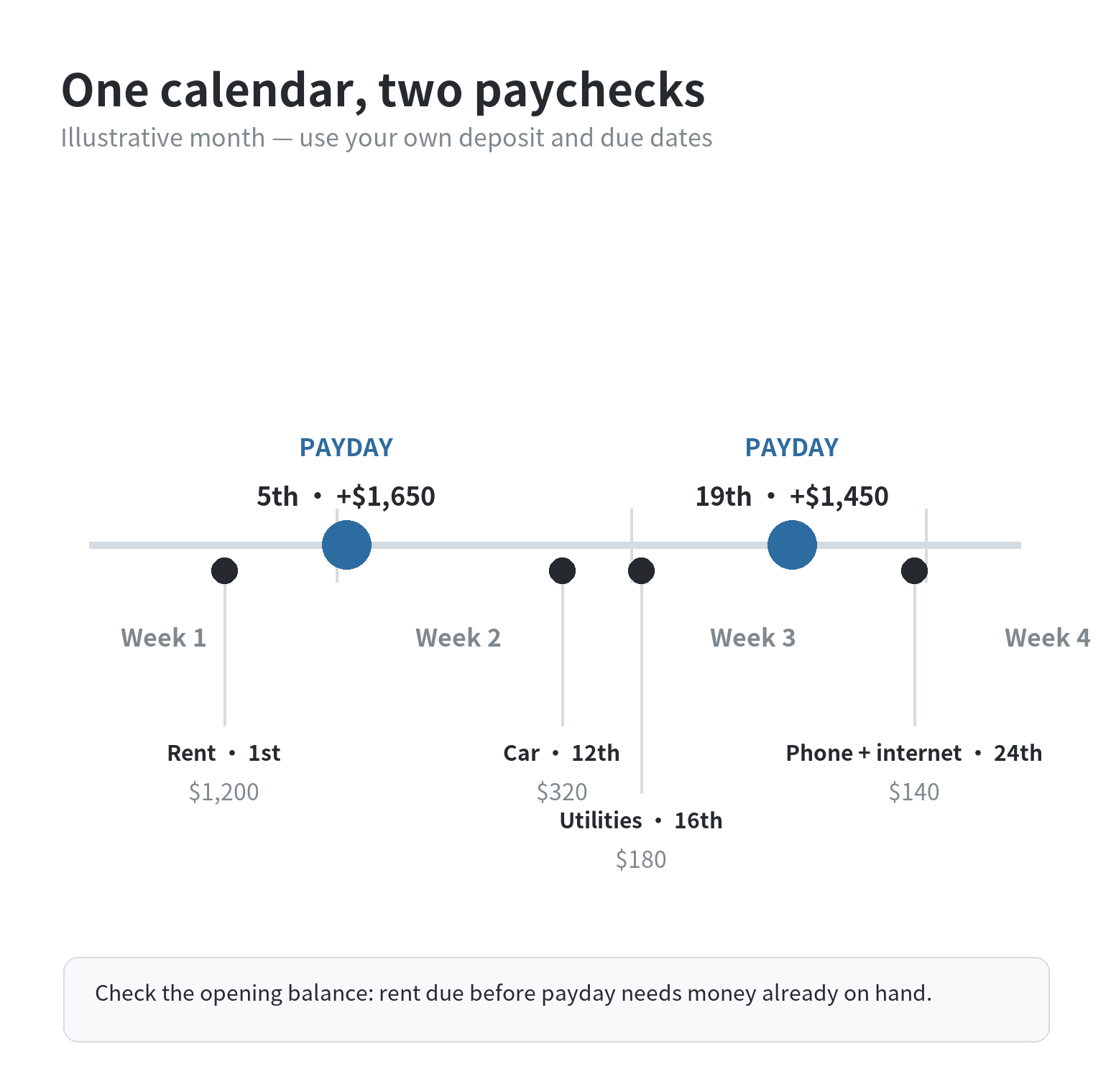
Suppose one household receives $1,650 on the 5th and $1,450 on the 19th. Its rent is $1,200 due on the 1st, a car payment is $320 due on the 12th, utilities are $180 due on the 16th, and phone and internet are $140 due on the 24th. The household also plans $400 for groceries and $160 for fuel during the month. These are made-up figures for the example, not typical costs.
The calendar exposes the first problem: rent is due before the first listed check arrives. If the household has no money already set aside, neither paycheck assignment can fix that timing gap in this month. It needs to identify the amount available at the start of the month, contact the landlord or biller if payment timing is a concern, and avoid treating the 5th’s deposit as if it arrived on the 1st.
For the next cycle, the 5th paycheck can reserve $320 for the car payment, $180 for utilities, and part of the food and fuel money needed until the 19th. The 19th paycheck can reserve $140 for phone and internet plus the remaining food and fuel money, then begin setting aside the next rent amount. Check the running balance after every planned payment; the dollars assigned to rent cannot also cover groceries.
the two checks total $3,100, and the listed expenses total $2,400 before any other costs or savings. That $700 difference is not automatically free spending. Add every omitted line, including debt minimums, childcare, medical bills, annual expenses, and savings goals, before deciding what remains.
Separate monthly planning from paycheck-by-paycheck timing
The monthly view checks whether spending fits total income. The paycheck view assigns expenses to a deposit that arrives before each due date. Keep both: start with monthly totals, then assign each line to one or more paydays.
For recurring bills, record the due date and the paycheck that funds them. If a provider lets you request a different due date, compare options that fall after a deposit and before the next cluster of bills. The CFPB suggests contacting creditors about changing due dates or splitting a large periodic bill into smaller payments. Confirm the new arrangement directly with the provider before changing the calendar.
For spending throughout a pay period, reserve an amount for each stretch between deposits. With a $400 monthly food plan and two pay periods, for example, assign $200 to each check. Adjust the split for the number of days in each stretch and when you shop.
Handle weekly, biweekly, and twice-monthly pay without guessing
Pay frequency changes how you translate income into a monthly plan. Consumer.gov says that if you do not get paid monthly, you can add your income from the prior year and divide by 12 for a monthly estimate; checked September 30, 2026. That estimate helps compare income with monthly expenses, but it does not tell you which day a specific bill can be paid.
For the calendar, enter the actual upcoming dates instead of spreading an estimated monthly average evenly across the month. A twice-monthly schedule may use fixed dates, but your employer’s posted pay calendar determines the expected deposit date. Check it against your recent deposit history before assigning a bill to a date.
If two people are paid on separate cycles, put both deposits on one calendar. Assign shared bills to the deposits available before they are due, then agree on who transfers what and when. The calendar should still show whether the household can cover the bills.
When the calendar shows a shortfall
First, check whether the problem is a one-time date mismatch or a monthly gap. If total planned expenses exceed dependable take-home income, moving due dates may help with timing but will not close the recurring gap. Review variable categories and optional spending, then update the plan with amounts from statements rather than estimates that no longer fit.
If the month has enough income but a bill arrives before the paycheck that funds it, consider whether the biller offers another due date or a split payment. Ask about any fee, terms, and effective date before agreeing. The CFPB cash-flow worksheet also suggests moving expenses where possible and taking action to make the change real. Mark the confirmed date in your calendar and keep a record of the agreement.
A checking cushion can make timing less fragile, but build it from an amount the rest of the budget can support. Choose a small initial target based on the gap you see between deposit dates and bill dates; increase it when the monthly plan leaves room. The cushion is money already assigned to future bills, so do not count it twice as both savings and spendable cash.
For a bill payment workflow on a phone, see how to pay bills on time using your phone. If you are setting aside a separate reserve, the site’s guide to building an emergency fund covers that neighboring goal.
A short review before every new pay period
Before each deposit, compare the calendar with the account balance and latest bill amounts. Mark cleared payments, update flexible spending from recent activity, and revise the plan if a check changes.
Confirm that bills due before the next deposit are funded, reserve daily spending, and include less frequent costs. If something does not fit, adjust a flexible expense or ask a biller about timing. Carry the change into the next payday plan.
At each payday, record the deposit, cover bills due before the next one, reserve day-to-day spending, and carry forward dollars already assigned to a later bill.
FAQ
How do I budget when my paycheck date shifts around a weekend?
Use the deposit date shown by your employer or account history, then revise the calendar when a holiday or weekend changes it. Keep bills on their actual due dates and do not assign money based on an assumed early deposit.
Should I budget monthly or by paycheck if I am paid every two weeks?
Use both views: the monthly plan checks whether income covers the month’s expenses, while the paycheck calendar assigns each bill to a deposit that arrives in time.
What if one paycheck is much smaller than the other?
Assign bills according to the actual net amount and timing of each check. List the smaller deposit first on the calendar, cover expenses due before the next deposit, and reduce the flexible spending reserved for that stretch if the numbers do not fit.
Can I use a credit card to bridge a gap between paydays?
A card changes when cash leaves your checking account, but the card payment still needs a place in a later paycheck plan. Add its due date and planned payment to the calendar, and review the card agreement for its payment terms before relying on it.
Last updated: September 2026
Last updated: 2026-09