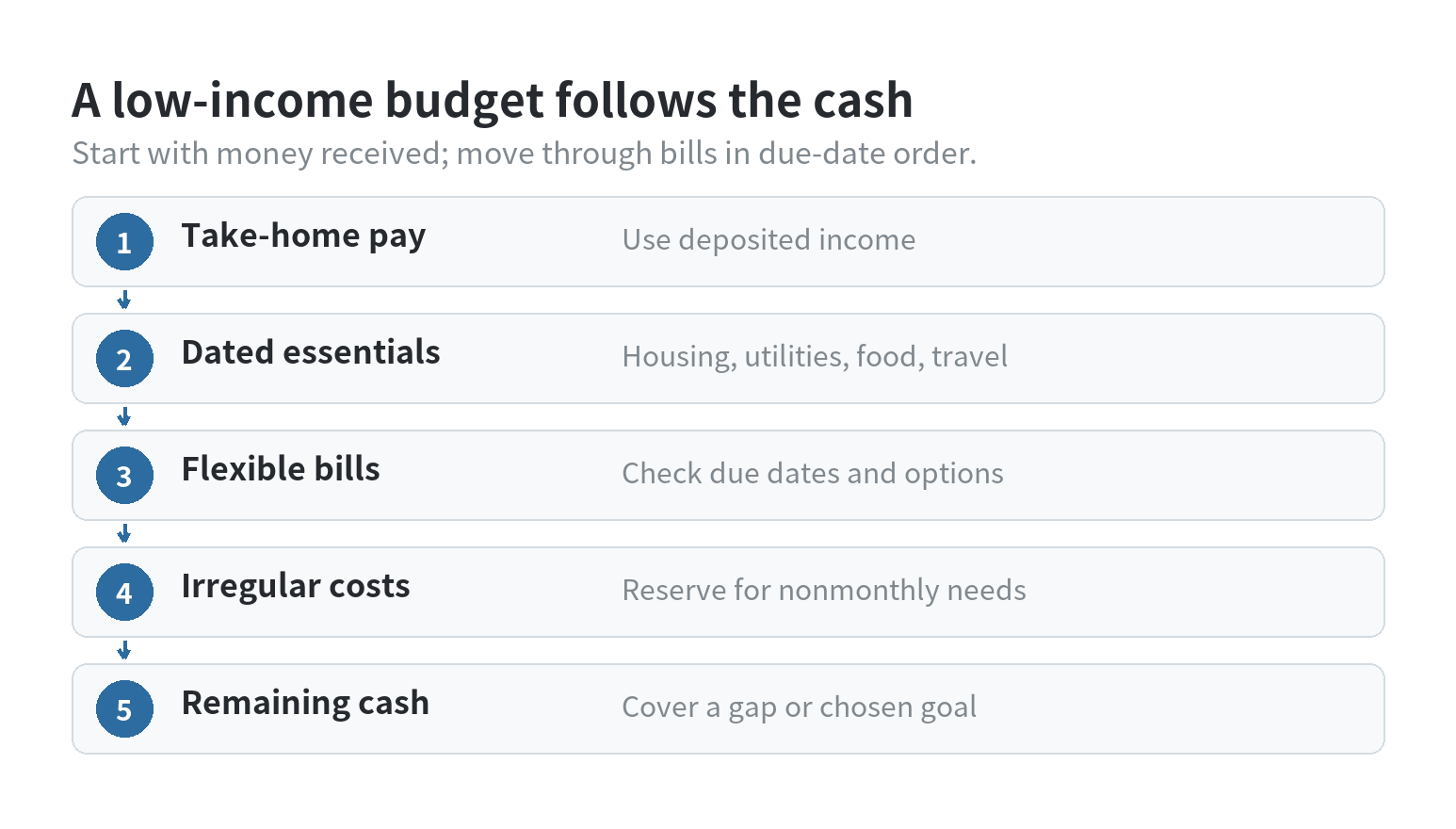
A low-income budget works best as a cash-flow plan: cover the bills that protect housing, utilities, food, and transportation first, then assign what remains.
Start with take-home money you can count on, and make the plan match the dates it arrives.
The sample below is fictional; replace every amount with your own statements and due dates.
The CFPB and the FTC’s consumer budget guide both recommend listing income and expenses, comparing the totals, and adjusting the next month’s plan (checked October 2026).
Build the plan from money that actually arrives
Use the amount deposited after taxes and payroll deductions, not gross pay.
Add other reliable household income separately, and write down when each payment lands.
If hours change, build the first draft around your lowest recent take-home month, then leave extra shifts or one-time money unassigned until received.
Consumer.gov recommends using pay stubs and bills to make the list.
The CFPB also says to compare the finished budget with bank statements.
This can catch a mismatch: a paper plan may look balanced while groceries, transit, or a bill date pull cash out earlier than expected.
Keep the first version simple.
A page or spreadsheet can have four columns: due date, bill or need, planned amount, and paid amount.
You can also use a budgeting app, but a tool cannot decide which bill needs attention when the available cash is short.
See our budgeting app overview for ways to compare app features, or the phone budget tracker walkthrough for a manual tracker.
Give each paycheck a job before it is spent
List expenses in the order they affect daily stability: housing, power and water, food, and work transportation.
Then add required insurance, medicine or care you already use, and minimum debt payments.
List flexible bills and goals after that. This is a sorting tool, not a judgment about what you deserve.
When the total is larger than the money available, mark each bill by its due date and the consequence of missing it.
Call a provider or creditor before the due date to ask whether a different date or payment arrangement is available; the CFPB identifies due-date changes as one cash-flow option.
Keep a small “not monthly” line for costs that still arrive: school supplies, annual renewals, clothing, or a car repair.
Consumer.gov’s worksheet includes irregular expenses, and the CFPB advises looking across several months so less frequent costs do not disappear from the plan.
A sample month shows where the pressure point is
Here is a made-up monthly plan for a household bringing home $1,800.
These amounts are examples, not cost averages or recommended limits.
| Line | Sample amount | What to replace it with |
|---|---|---|
| Rent | $750 | Your rent and due date |
| Utilities | $140 | Recent bills, including seasonal changes |
| Groceries and household basics | $300 | Receipts or account history |
| Transportation | $90 | Work trips, fuel, fares, parking |
| Phone | $45 | Current bill |
| Insurance | $125 | Premium due this month |
| Care and medicine | $60 | Expected out-of-pocket spending |
| Minimum debt payments | $75 | Statements and due dates |
| Irregular-cost reserve | $80 | Upcoming nonmonthly needs |
| Unassigned after these lines | $135 | Keep for gaps or a chosen goal |
The example leaves $135 after listed costs.
That remainder is not automatically “spending money”: check whether the plan missed laundry, school costs, work meals, or a bill due early next month.
If the real remainder is below zero, change one line at a time and recalculate.
When an essential bill alone uses most of the available cash, trimming small extras cannot solve the whole gap.
Keep the budget as a record of the shortfall while you check bill timing, household contributions, and assistance options.
Match the plan to the dates, not only the month
A monthly total can hide a cash shortage between paydays.
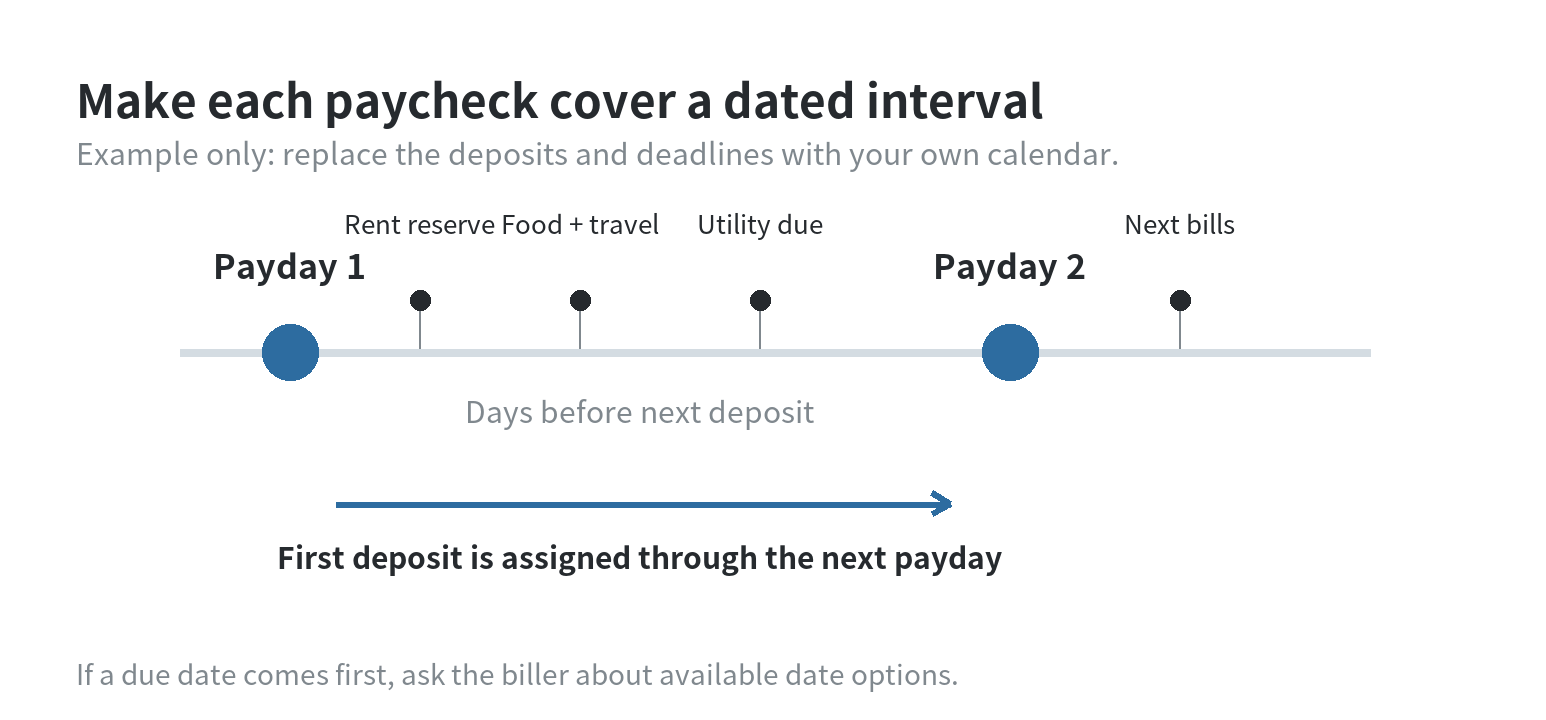
Draw a calendar with deposits and due dates, then reserve bill money from the paycheck that arrives before each deadline.
Divide a bill into weekly portions only if the money will stay available until its due date.
For a sample two-paycheck month with $900 deposited on each payday, suppose rent is due before the second check.
Set aside the rent portion from the first deposit first, then assign the remaining amount to food, utilities, and travel through payday two.
A calendar makes the timing visible; it does not increase the total money available.
If a due date falls before a paycheck, ask the company whether it can move the date.
CFPB guidance on managing cash flow describes contacting landlords, utility companies, or card issuers about due dates.
Get any arrangement and its fees or conditions directly from that provider.
When the numbers do not balance
First, check for missing income or expenses and confirm that the budget uses take-home amounts.
Then separate adjustable items from bills with fixed due dates.
Review renewals, add-on services, and purchases that can wait; do not remove a necessary expense from the plan just to make the total appear balanced.
If there is still a gap, contact the biller before missing a payment and ask what options exist.
Write down the person or department, date, amount offered, and any deadline.
For debt questions, the CFPB toolkit includes bill-prioritizing and cash-flow worksheets; the tool is for organizing choices, not a promise that a creditor will agree.
Check whether public help is relevant to the household. USAGov’s benefit finder lists food, housing, and utility categories (checked October 2026).
For food assistance, USAGov and USDA direct applicants to their state or local SNAP office.
HHS/ACF’s LIHEAP eligibility screener and USAGov’s energy-assistance page (checked October 2026) explain that rules vary by state or territory.
A screener is not official approval. Ask the administering office to confirm eligibility, amount, and timing before counting help as bill income.
Turn a monthly amount into a safe weekly amount
Once fixed bills are reserved, divide the money left for day-to-day needs across the weeks before the next deposit.
The result is a planning ceiling, not a quota you must spend.
If your calendar includes an extra week between checks, stretch the amount across that longer interval.
Keep food, transportation, and household supplies in separate notes if one category keeps taking money from another.
If that is too much tracking, write each purchase in one list and mark which need it covered.
The purpose is to find the line that runs short first.
For a variable paycheck, build the baseline from dependable income and match it against bills due in that period.
When more money arrives, first cover a bill already due, replenish a category that ran short, or set aside cash for a known irregular expense.
Decide its job after the deposit clears.
If there is no remainder, leave savings as a future line rather than borrowing an amount from rent or food on paper.
A zero remainder still tells you the current costs use the whole paycheck.
It gives you a clear starting point for asking a biller about timing or finding a support program.
Use a short reset when a bill changes
When a utility bill rises or work hours fall, update only the affected lines first.
Write the new amount, its due date, and which deposit must cover it.
Then recalculate the dollars available for the next stretch between paydays.
Move postponed purchases into a separate list with a date to reconsider them.
This prevents a delayed cost from vanishing and appearing as a surprise later.
If a necessary cost cannot fit, contact the company or local agency while you still have the bill and due date in front of you.
Keep copies of the latest bill, pay stub, and any written payment terms together.
A quick record makes the next budget revision easier: you can replace an estimate with the actual amount, update the date, and see what changed without rebuilding every category.
Review one useful number next month
At month-end, compare planned amounts with what left the account.
Consumer.gov recommends using this month’s spending to plan the next one, while the CFPB says to use statements to test whether the plan reflects real spending.
Carry forward the difference instead of treating it as a personal failure.
Pick one adjustment for the next pay cycle: move a bill date, change a grocery plan, set aside part of an irregular bill, or leave a shortfall visible while you contact an agency.
A workable budget is a record of choices and timing that you can revise when income or bills change.
Frequently Asked Questions
What should I do with an extra paycheck in a budget period?
Assign it to the next known bill or a cost that does not arrive monthly. Then cover a category that fell short before treating any remainder as available.
Keep enough for the next interval of bills and needs.
How can I tell whether a bill has a flexible due date?
Ask the provider if the due date can change. Ask when the new date starts and whether fees or service change.
Record the answer before updating your calendar.
What should I change if grocery money runs out before payday?
Check receipts and count the days until payday. Compare the planned food amount with actual spending.
Keep money reserved for housing, utilities, or travel separate while revising the next food plan.
What should I ask an assistance office before counting help in my budget?
Ask whether your application is complete and whether eligibility has been decided. Confirm the amount and payment date with the office.
Until then, leave possible help out of the income you rely on for bills.
Last updated: 2026-10