If subscriptions are crowding out other bills, build the budget from the charges on your own statements, then decide which services deserve a place next month. A subscription audit turns recurring charges into a monthly number you can plan around; it does not require an industry average or a special app.
Start with checking and card records, list each recurring service and its real billing schedule, then choose a monthly cap that fits after essentials. The CFPB recommends reviewing account and card history; its spending-tracker guidance, published June 11, 2019, suggests tracking for at least two weeks or a month. The FTC also advises checking statements for charges after a cancellation. Both agencies point to records you already have.
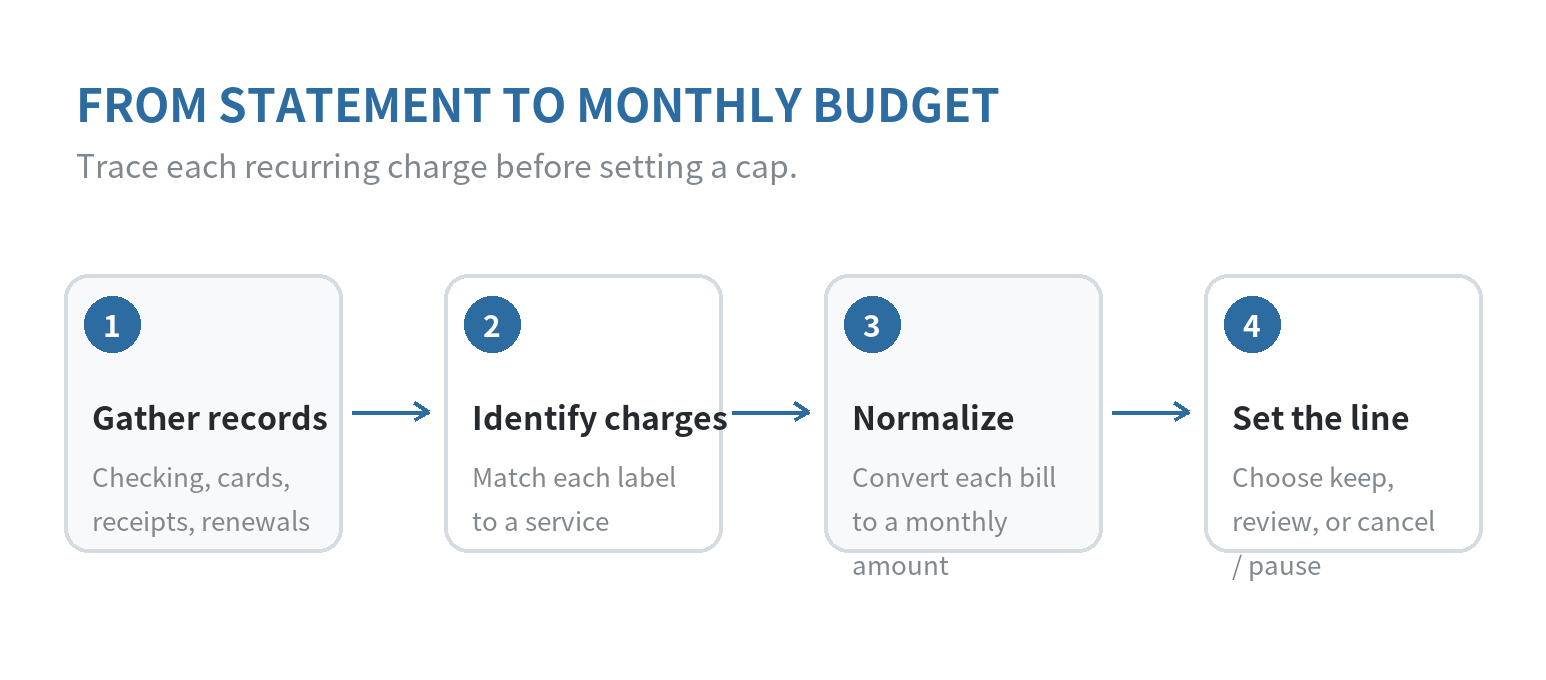
Gather the charges that can hide in different places
Review bank statements, credit card activity, and any payment account you use for online services. Search your email for receipts, renewal notices, and words such as “membership,” “renewal,” or “trial.” These are cross-checks: the statement shows money leaving, while a receipt can explain a merchant label that is hard to recognize.
Write down the service name, amount, payment date, billing interval, payment account, and next renewal date if it is shown. Add services billed through an app store or bundled with another account only when the statement or receipt identifies a recurring charge. If a transaction label is unfamiliar, check the account’s receipt or contact the listed provider before treating it as a subscription.
For a first pass, compare a recent month of transactions with an older statement period. Add a longer period if you suspect annual renewals: a charge absent from one month may still be a yearly expense. The CFPB’s spending assessment says to review account and card history over several months and look back for less frequent costs. That makes the calendar part of the audit as important as the total.
Convert each billing schedule into a monthly line
Do not compare an annual plan with a monthly plan by looking only at the amount charged today. Give every service a monthly equivalent so the total represents what the household is setting aside over time. Use the amount actually billed, including taxes or add-ons that appear on the transaction.
| Billing schedule | Monthly budget entry | Example using your own charge |
|---|---|---|
| Monthly | Use the monthly charge | $12 per month = $12 |
| Every three months | Divide by 3 | $30 every three months = $10 |
| Annual | Divide by 12 | $84 per year = $7 |
The amounts in the table are arithmetic examples, not market prices. Replace them with the transaction amounts on your own account. If the next annual renewal is close, reserve the full renewal amount before using the monthly equivalent for longer-term planning; otherwise, a small monthly line can conceal a large bill due soon.
Keep the actual payment date in a separate column. A monthly budget answers “how much does this use over time?” The payment calendar answers “will the money be in the account when it is charged?” The CFPB explains that automatic debits can draw from checking on a recurring basis and advises people to watch their balance and upcoming payments.
Sort services by what they do for your household
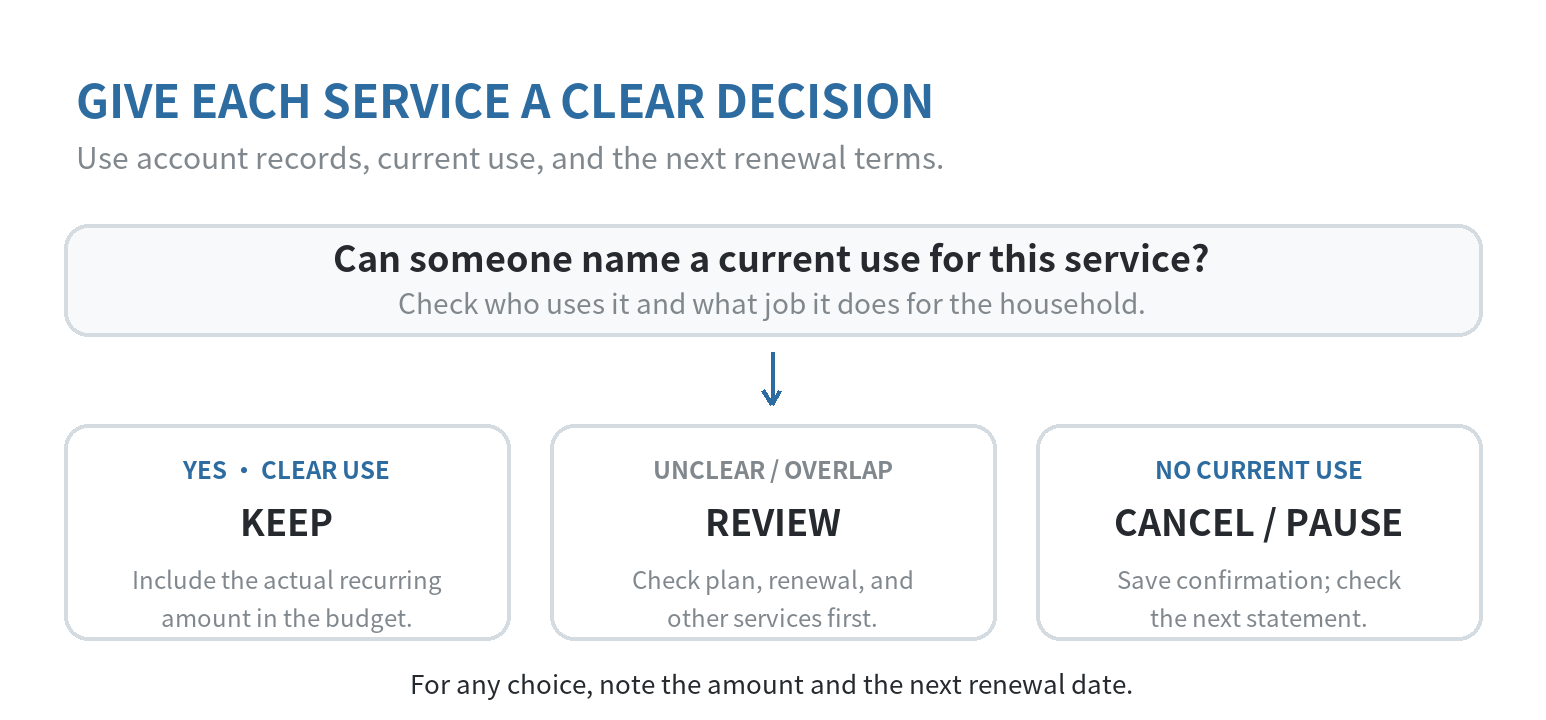
Make three groups: keep, review, and cancel or pause. “Keep” means you can name the person who uses it and the job it does. “Review” means it may still be useful, but the renewal, plan, or overlap needs a decision. “Cancel or pause” means no one can point to a current use that justifies the next charge.
Ask concrete questions rather than judging the service by its monthly price alone:
- Who uses it, and what would they use instead if it ended?
- Does another service already provide the same function?
- Is the current plan needed, or would a lower tier meet the same use?
- Is a free trial ending, a promotional period expiring, or a renewal coming up?
- Would pausing affect saved files, family access, or a commitment in the terms?
The FTC notes that an automatic renewal can charge a different amount than a prior promotional price and advises checking the renewal notice. Put the stated date and amount beside the service, then make the decision before that date rather than building the budget around an expired offer.
Set a cap from the budget that remains
First list take-home income and the expenses that already have a clear claim on it, such as housing, utilities, food, transportation, debt payments, and savings you have committed to. CFPB budgeting guidance says to compare spending categories with take-home pay and check statements against the budget. The amount remaining is the space subscriptions must share with other flexible spending; it is not automatically a subscription allowance.
Here is a made-up household example. Assume $3,200 in take-home income, $2,650 assigned to other planned categories, and $120 in monthly-equivalent subscriptions. The remaining $550 is still needed for any unlisted expenses and flexible spending. If the household chooses a $90 subscription cap, it needs to remove or change $30 in monthly-equivalent charges to meet that cap. The arithmetic shows how to use your own figures; it does not predict a typical household budget.
When the subscription total is already below the cap, keep the cap visible rather than using the gap as a reason to add services. When it is above the cap, rank the “review” lines by renewal date and household use. Change one decision at a time and recalculate the total, so the cap reflects actual services rather than a hopeful estimate.
Make cancellations show up in the next budget
Cancel through the service provider and save the confirmation, date, and any reference number. The FTC recommends keeping a copy of the cancellation request and notes from conversations. Then check the relevant bank or card statement after the cancellation for another charge. A removed line in a spreadsheet is not proof that billing has stopped.
Stopping an automatic withdrawal is different from ending the service agreement. The CFPB says to contact the company to cancel the contract or subscription and, when appropriate, separately tell the bank or credit union that payment authorization has been revoked. If an unwanted charge appears after cancellation, use the provider’s stated process and contact the card issuer or bank about the transaction.
Update the budget only when you know the renewal status. If a service remains active until the end of a paid period, keep its cost in the current month and mark the later month for removal. Add an annual renewal to the calendar even after dividing it into a monthly amount. This gives you both a usable monthly total and a date to prepare for.
For a broader way to track categories on a phone, see iPro+’s budget tracker walkthrough. If you want to compare a phone-based workflow with manual tracking, the site also has a guide to budgeting apps. Use either as a record-keeping format; the audit itself depends on matching entries to charges on your accounts.
FAQ
How do I budget for a subscription billed once a year?
Divide the actual annual charge by 12 for the monthly-equivalent line, then keep the renewal date and full amount on your payment calendar. If renewal is close, reserve the full charge before treating the monthly amount as a long-term plan.
What if I cannot identify a recurring charge?
Check the receipt, renewal email, and payment account associated with the transaction, then contact the provider shown on the account. Do not cancel a service you have not identified until you know what access or agreement is attached to it.
Should I remove a subscription from the budget as soon as I cancel?
Keep it in the budget until you have the cancellation confirmation and know when access or billing ends. Check the next relevant statement for another charge, as the FTC recommends monitoring statements after cancellation.
Can I stop the payment through my bank instead of canceling with the service?
Stopping an automatic payment does not itself end the service agreement. The CFPB advises contacting the company to cancel the subscription and separately contacting the bank or credit union about revoked payment authorization when needed.
Last updated: 2026-10