You can budget without an app by putting your take-home income, bills, and day-to-day spending on paper, then checking the totals against your bank balance. A notebook, a few envelopes, or a printed worksheet is enough. The useful part is the routine: make a plan before spending, record purchases, and use what happened to set the next month’s amounts.
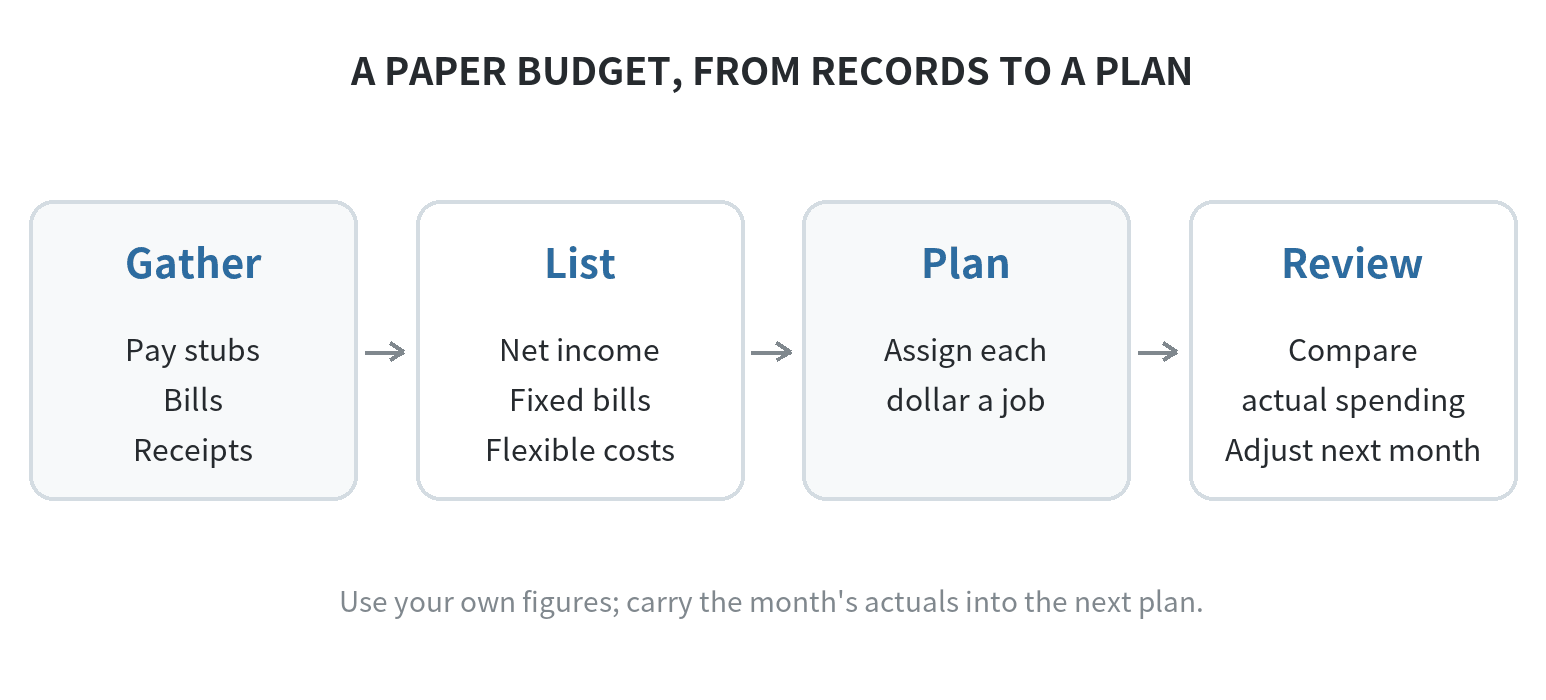
Consumer.gov describes a budget as a written plan for monthly income and spending; its worksheet subtracts expenses from income. The Consumer Financial Protection Bureau (CFPB) also offers paper tools for tracking income, spending, bill dates, and cash flow (checked September 30, 2026). You can use the same building blocks with your own figures.
Start with money that actually reaches you
Take a notebook page and write down your net pay: the amount deposited after taxes and payroll deductions. Add other dependable income you expect to use for household expenses. If your pay changes, list the amount you can count on first; write uncertain income separately so a good week does not become a promise to spend money you have not received.
Next, copy fixed bills from statements or billing notices: rent, insurance, a car payment, phone service, and minimum debt payments. Record the due date beside each amount. A bill calendar matters because a month can balance on paper yet feel short when several payments fall before payday. CFPB’s budgeting guidance recommends tracking both spending and when bills are due (checked September 30, 2026).
For a simple cash-flow check, draw a line down the page for each payday. In an example month, write “$1,600 deposited on the 1st” and “$1,600 deposited on the 15th,” then place each bill under the paycheck that needs to cover it. If rent is due on the 3rd, reserve it from the first deposit before assigning that money to groceries or optional spending. The dates and amounts here are placeholders; copy your real pay dates and bill deadlines. If one paycheck carries more bills than it can cover, mark the gap before the month begins and contact the biller about any options it offers.
Then list flexible spending such as groceries, fuel, meals, household supplies, and personal spending. Use recent bank statements and receipts as evidence, not memory. If you pay in cash, keep the receipts in an envelope until you record them. The goal is a list that reflects your actual life, including small purchases and expenses that do not arrive as monthly bills.
Give irregular expenses a place on the page
Costs with a schedule other than monthly include car registration, school supplies, annual memberships, or a holiday trip. If you ignore them, the month they arrive can look like a budget failure. Write each expected cost and due month in a separate “not monthly” section. If you know the amount and have time before it is due, divide the amount by the number of months remaining and reserve that portion each month.
For example, suppose an annual $240 fee is due in six months. Setting aside $40 per month would total $240 by then. That is arithmetic for this example, not an average fee or a recommended savings target. If the cost or due date is uncertain, write down what you know and revisit it when you receive the notice.
Make a plan using your own numbers
Here is an illustrative month with $3,200 in take-home income. Replace every amount with your own:
| Line | Planned amount |
|---|---|
| Rent and utilities | $1,350 |
| Food and household supplies | $500 |
| Transportation | $380 |
| Insurance and debt payments | $420 |
| Irregular-cost reserve | $150 |
| Personal and flexible spending | $250 |
| Unassigned remainder | $150 |
The planned lines total $3,200. If your own lines add up to more than take-home income, do not hide the gap in a miscellaneous category. Mark the shortfall and decide which flexible line can change, whether a bill date can be moved by contacting the provider, or whether the income estimate needs correction. If the remainder is positive, assign it to a purpose—such as a future bill or savings—rather than letting it disappear from the plan.
Keep the example in proportion: it does not describe a typical household or tell you what housing, food, or transportation should cost. Consumer.gov and CFPB both direct readers to build a budget from their own income and expenses. For a separate phone-based method, see the smartphone budget tracker guide; its digital approach can complement the paper method if you later decide to log transactions on a device.
Choose a paper system you will keep using
A notebook works if you want one place for the plan and daily entries. Give each month a page for planned amounts and a page for actual spending. Write the date, category, and amount when you buy something. At the end of the day, total the receipts you collected and check them against the page.
When your statement arrives, compare its posted transactions with the ledger. Circle purchases missing from the page and add them once; cross-check entries already recorded so pending card charges are not counted twice. This check also helps catch a forgotten subscription or an incorrectly categorized purchase before you set next month’s limits.
Envelopes can make category limits visible. Label an envelope for a flexible category, such as eating out, and put the amount you planned to spend there. When you pay with cash, take the money from that envelope and keep the receipt inside. For card purchases, write the amount on the envelope or ledger so the paper balance stays current; the envelope itself does not track card transactions.
A printed worksheet is useful if you prefer prompts over blank pages. Consumer.gov’s worksheet separates income and expense lines, while CFPB’s Your Money, Your Goals toolkit includes a spending tracker and bill calendar (checked September 30, 2026). Use a worksheet as a starting structure and add rows for expenses that matter in your household. Do not force every purchase into a category that obscures what it was.
Review without turning every difference into a failure
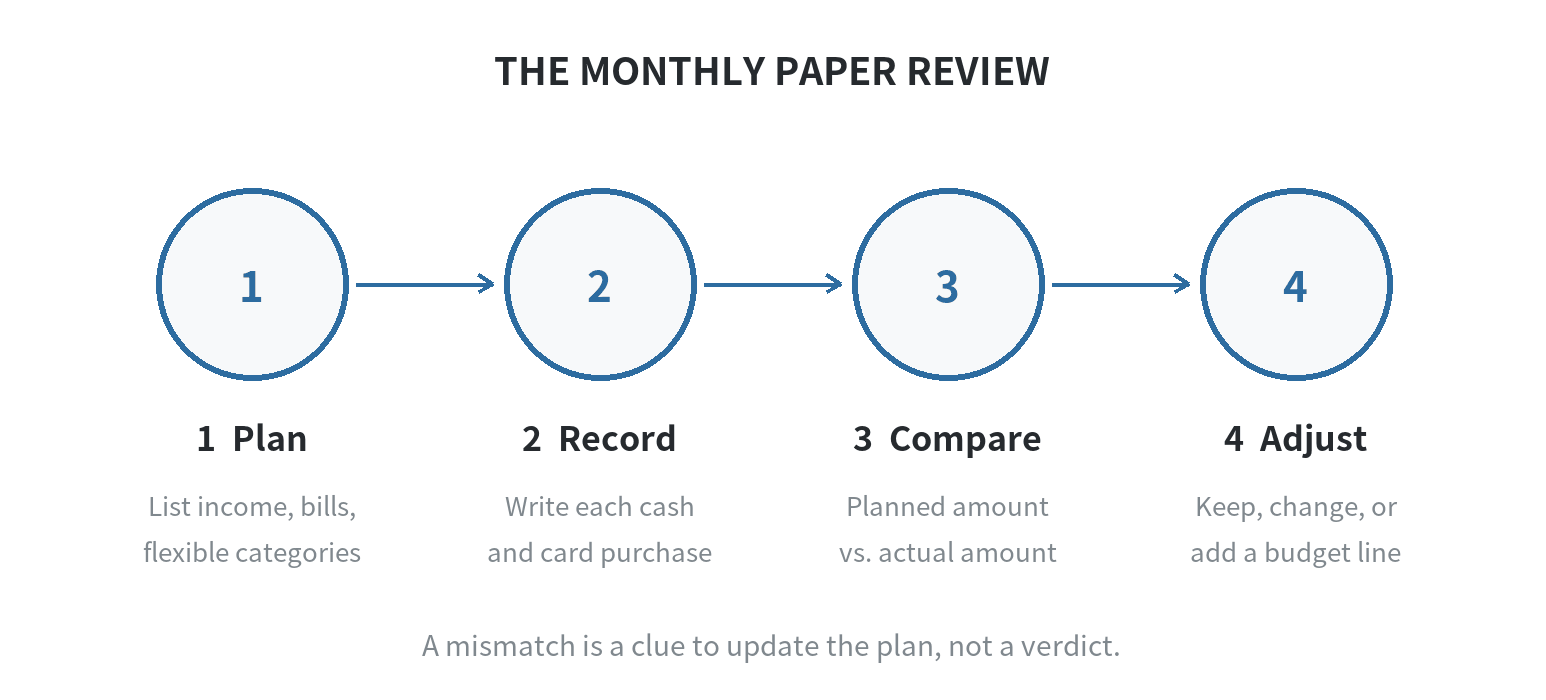
At month-end, compare each planned line with the amount you recorded. A difference is information: perhaps a bill changed, a seasonal cost arrived, or the plan left out something you bought. Note the reason in a few words. If groceries ran over because you hosted family, that may be a one-time event; if the category misses the mark month after month, change the next plan to match the records or make a specific spending adjustment.
Check the calendar as well as the totals. Mark each payday and due date, then note which money is meant for which bills. This can expose a timing problem that a monthly total hides. CFPB’s bill-calendar and cash-flow resources are built around tracking dates as well as amounts (checked September 30, 2026). When a payment date is the issue, contact the biller to ask what options it offers before assuming a change is available.
Keep the working record simple: planned amount, actual amount, and one note for a surprise. Carry forward only useful information. If a method takes longer to maintain than to understand, remove categories that do not help you make a decision. A paper budget is still useful when the figures are estimates, as long as you label them, update them when a bill arrives, and do not treat an estimate as cash already in the account.
If you want a place to direct a future surplus, the site’s emergency-fund planning article discusses setting a savings target. For this budget, keep the task immediate: write down the next bill, the next paycheck, and what must remain available between them.
FAQ
Can I budget with cash only if I also use a debit card?
Yes. Keep one ledger for both cash and card purchases, and mark the payment method beside each entry. Reconcile card entries with your statement so an unrecorded purchase does not make the paper category look larger than the money still available.
What should I do if my income changes from week to week?
Build required bills around income you can rely on, then record variable earnings when they arrive. Consumer.gov suggests using last year’s income divided by twelve for a monthly estimate when a person is not paid monthly; for a week-to-week plan, keep a running record of deposits and adjust the plan as actual income comes in (checked September 30, 2026).
How do I keep receipts from becoming a pile?
Choose a single container and empty it during your scheduled review. Transfer each receipt to the ledger, then recycle or discard it unless it documents a return, warranty, tax record, or another reason you need to retain it.
What if the budget is negative before the month starts?
First verify the income and bill amounts against current records. Then separate required payments from flexible lines and mark the exact gap. Consumer.gov advises looking for expenses that can change when expenses exceed income (checked September 30, 2026); if the gap involves a bill you cannot pay, contact the provider or a qualified nonprofit counselor to discuss available options.
Last updated: 2026-09