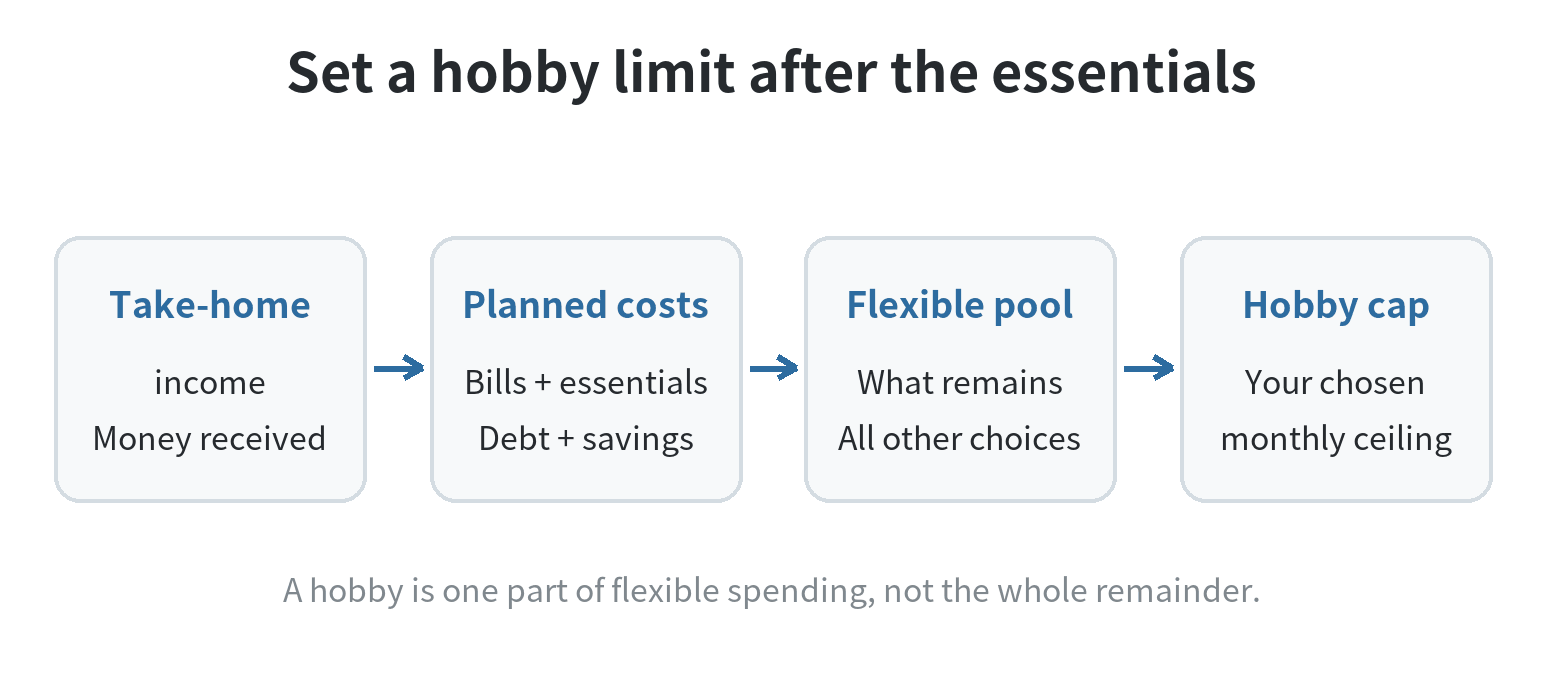
A hobby belongs in your budget when you give it a clear limit that fits after bills, essentials, and the goals you already fund. Start with your take-home pay and actual spending, choose a monthly amount you can use without borrowing or skipping a bill, then keep hobby costs inside that amount. That turns “Should I feel bad about this?” into a more useful question: “Does this fit the plan I chose?”
Find the money that is actually available
Use take-home pay, the amount that reaches your account, rather than gross salary. Consumer.gov’s budget instructions say to list income and expenses, subtract expenses from income, then use the result to guide changes. The CFPB likewise advises comparing spending categories with monthly take-home pay and checking whether the leftover amount matches what remains in your account. Consumer.gov’s budgeting steps and the CFPB’s spending assessment were checked September 30, 2026.
Make one list of recurring bills and essentials, another for irregular costs, and a third for savings or debt payments you have already decided to make. Include expenses that do not arrive monthly: the CFPB specifically names seasonal and recreational costs, gifts, vacations, and other less frequent spending as items to catch by looking across several months of records. If you leave those out, a hobby limit can look comfortable on paper and collide with a real bill later.
What remains is the pool for flexible spending, not a required hobby allowance. You can decide that more of it goes to hobbies, dining out, or another priority. A hobby budget does not have to follow a universal percentage; the right ceiling is the amount that fits your own obligations and choices.
Use one month of real numbers
Suppose your take-home pay is $3,400 in a sample month. Your rent and utilities are $1,350, groceries and household basics are $520, transport and insurance are $410, debt payments are $260, and planned savings are $300. Those lines total $2,840, leaving $560 for all flexible spending—not just hobbies. These are example figures, not a recommended household budget.
Now decide what else must come from that $560. If you set aside $180 for meals out and $100 for clothing or gifts, $280 remains. You might assign $150 to hobbies and leave $130 unassigned for a cushion or another choice. If you prefer a hobby limit of $220, reduce another flexible line or revisit an expense you can genuinely change; do not pretend the extra $70 is available if it would push the plan below zero.
Write the result as a sentence: “This month I can spend up to $150 on hobbies after bills, essentials, debt payments, and savings.” The sentence makes the limit concrete, while “I should spend less” gives you nothing to track. If the math leaves no flexible amount, pause new hobby spending, use supplies already on hand, or make a future hobby fund part of a later plan after the shortfall is addressed.
Count the full cost of doing the hobby
Track more than the obvious purchase. For a hobby such as drawing, costs may include paper, tools, classes, event fees, and travel. For a monthly class, include the fee and any required materials. Use receipts and account transactions to identify what you actually spend; the CFPB suggests reviewing checking and credit-card history and recording purchases when you need a clearer picture.
If your activity has a busy season, separate the steady cost from the occasional spike. A gardener might set one line for routine supplies and another for the spring plant order; a runner might separate normal outings from an annual race. The CFPB recommends looking across several months to catch recreational and seasonal expenses that do not appear in every month. Its spending assessment was checked September 30, 2026.
Keep recurring costs separate from occasional purchases. A membership or lesson that renews automatically occupies room in every month, while a one-time tool purchase competes with that month’s other flexible plans. If you use a credit card, record the purchase when you make it and reserve the cash to pay the statement; a card’s available limit does not increase the hobby budget.
For equipment, ask three questions before buying: What part of the hobby does it let me do? Do I already own something that serves the same purpose? What other cost—materials, storage, upkeep, or a class—comes with it? You can also set a waiting period that suits your own spending habits, borrow or rent where practical, or choose a lower-cost version of the activity. These are options for protecting your chosen cap, not tests of whether the hobby is worthwhile.
Save gradually for a larger hobby expense
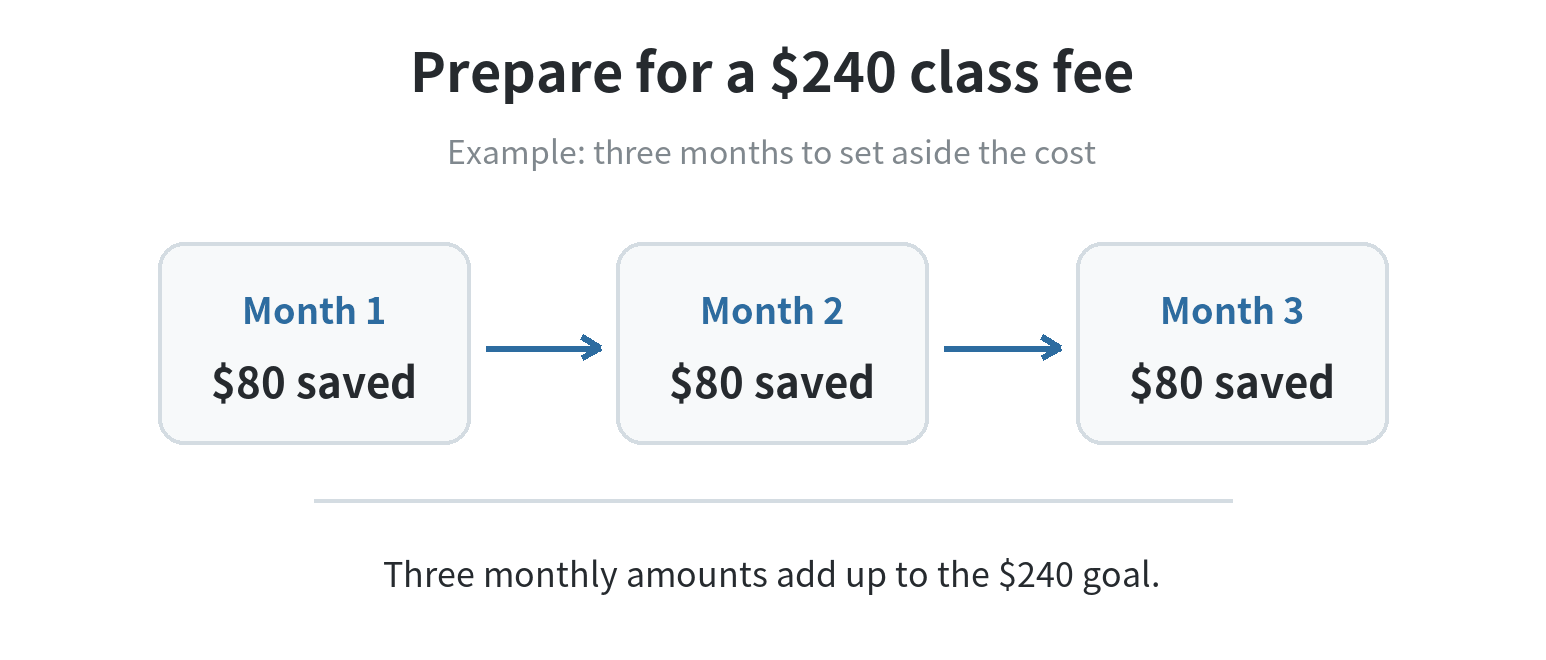
A class, convention, instrument, or race entry may cost more than one month’s hobby limit. Treat it as a planned expense: decide whether it fits your priorities, calculate the amount still needed, and divide that amount across the months before the due date. For example, if a class costs $240 and you have three months to prepare, setting aside $80 each month covers the fee by the time it is due. That arithmetic is an illustration; use the actual fee and timeline you face.
Keep the money in a separate savings space or mark it in your budget so you do not count it twice. When the event date changes or a new bill arrives, update the plan rather than relying on the old target. Consumer.gov describes a budget as something to use every month: plan at the start, record spending, review what happened, and use that information for the next month. Its budgeting guidance was checked September 30, 2026.
If saving the amount would require missing a bill, carrying new debt, or taking money from a priority you are not willing to change, choose a later date, a less expensive option, or skip that expense. The hobby can remain part of your life without every upgrade or event fitting this month.
Adjust the limit without turning it into a verdict
At month-end, compare the hobby limit with actual purchases and your bank balance. Consumer.gov advises recording what you spend and using the month’s information to plan the next one; the CFPB also says to revisit budget figures when the account balance does not match the budget’s expected leftover. Consumer.gov and the CFPB were checked September 30, 2026.
If you spent more than planned, identify the reason before changing the number. A one-off event may belong in a future sinking fund; repeated overspending may mean the original cap was too low or that you need a separate limit for supplies and outings. If you stayed under, leave the difference available, move it toward a larger hobby goal, or assign it elsewhere. Do not raise next month’s limit automatically if another bill or savings goal needs the money.
When income changes, rebuild the whole plan from the new take-home amount rather than adjusting the hobby line in isolation. If money is tight, a temporary pause is a budget choice, not proof that the hobby was irresponsible. If the numbers support it, spending on a pastime can be one of the priorities you deliberately make room for.
FAQ
Should I keep a hobby budget in cash or in a separate account?
Use whichever method makes the remaining amount easy for you to see. A separate account, a labeled savings bucket, or a note in a spreadsheet can all show the same limit; the key is not counting money assigned to bills or another goal.
What if my hobby costs change from month to month?
Set a monthly ceiling for routine spending and a separate target for known larger costs. Record variable purchases as they happen, then use the next month’s plan to account for seasonal events or supplies you know are coming.
Can I use a credit card for hobby purchases?
You can include a card purchase in the hobby category, but count it when you make it and reserve money for the bill. If paying the balance would require borrowing or cutting a priority you chose, the purchase is above the current limit.
Last updated: 2026-09