
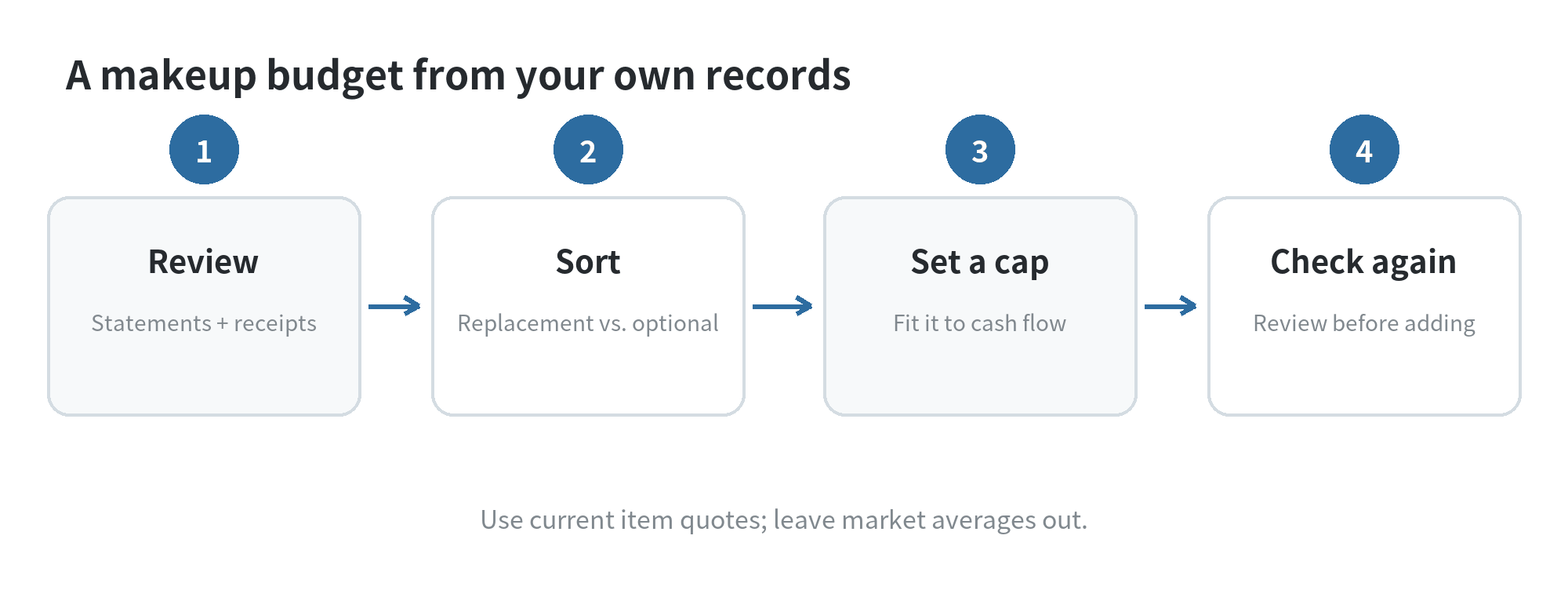
A makeup budget works best when it starts with what you already spend, then gives each future purchase a place in your monthly plan. Review your statements and receipts, list the products you replace, and set a monthly limit that fits after bills, savings, and other priorities. There is no useful universal price range for a makeup routine: your own product list and current quotes will give you a better number.
Start with a month of real purchases
Use a checking account or card statement, digital receipts, and paper receipts to find makeup purchases. The Consumer Financial Protection Bureau’s cash-flow budget tool says to track income, resources, and expenses for at least one month before building a cash-flow budget (checked October 1, 2026). That gives you a starting record; if you shop infrequently, keep adding purchases until the list reflects a full replacement cycle.
Record the date, item, amount paid, and whether it replaced something you had finished or added a new option. Separate makeup from toiletries, hair care, and skin care. If one receipt combines categories, use the itemized receipt or order history rather than guessing at the split.
Include purchases made with gift cards or store credit in your product history, but do not count them as new cash outflow if the money was already set aside earlier. The goal is to see both how many products enter your collection and how much leaves your current month’s spending account.
If one receipt includes several items, keep the receipt total and also record each makeup item separately. That makes it easier to spot a month when you stocked up instead of replacing one product. Mark backups as inventory already owned; otherwise a later review can mistake them for products you still need. When an unusual event or a large restock makes one month look different, note the reason instead of treating that month as your automatic monthly target.
Sort by the job each product does
A category list prevents a single total from hiding what is driving spending. Keep the groups simple enough to maintain. You might use complexion, eyes, lips, tools, and occasion makeup, or choose labels that match your routine. Separate replacements from experiments so you can tell whether the budget supports essentials, new looks, or both.
Next to each product, note whether you use it weekly, occasionally, or only for a specific event. Treat those labels as your own observations, not as a rule for how often anyone should wear makeup. An unused shade still counts as money spent, even if it remains in good condition.
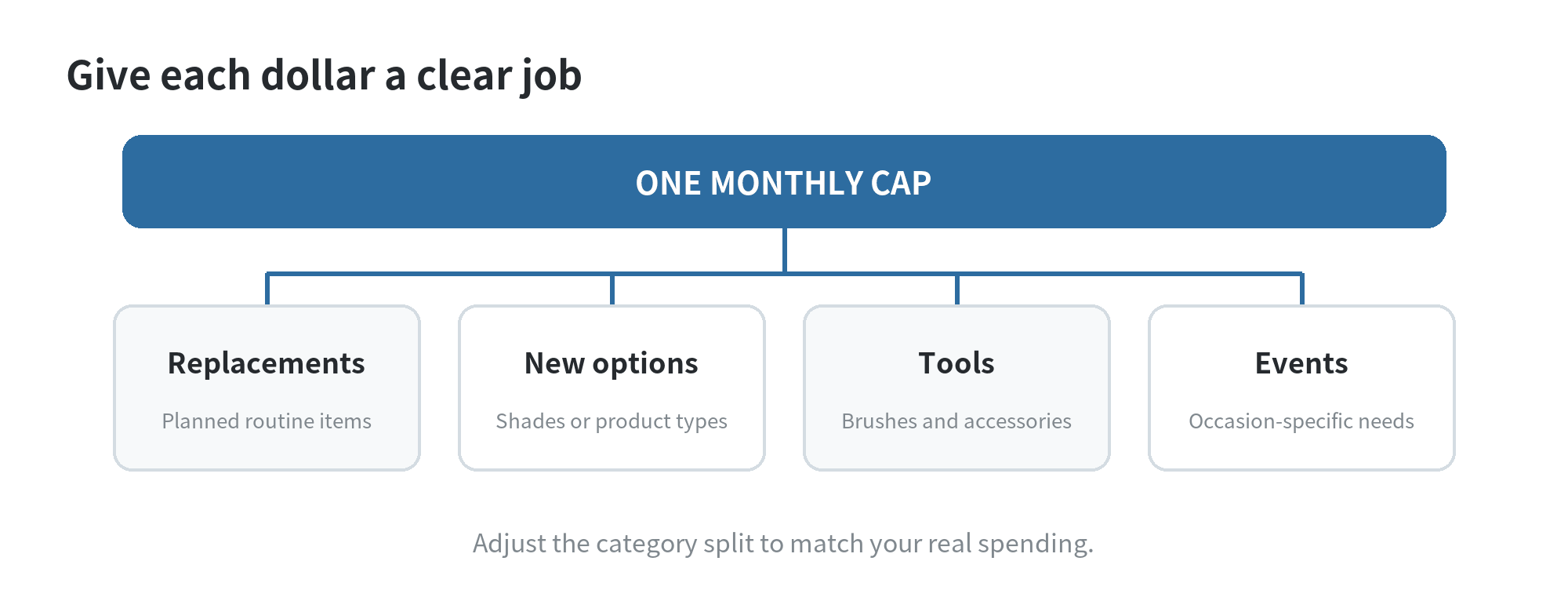
Set a limit for each group only if that split helps you make decisions. For instance, a person who mainly replaces mascara and foundation may prefer a larger replacement allowance and a smaller color-experiment allowance. Someone who wears makeup for performances or events may keep a separate event line. The categories should describe your spending, not impose a particular routine.
| Budget line | What to include | Question to ask |
|---|---|---|
| Planned replacements | Items you use regularly and expect to replace | Is this item nearly finished, or am I stocking up early? |
| New options | A different shade, formula, or product type | What current item would this add to? |
| Tools and accessories | Brushes, sponges, sharpeners, and storage | Can I use or care for a tool I already own? |
| Events | Products bought for a planned occasion | Can this be included in the event’s existing budget? |
Choose a cap that fits the rest of your cash flow
Set the makeup amount after you list take-home income, fixed bills, minimum debt payments, savings you have committed to, and flexible everyday costs. The CFPB worksheet carries each week’s ending balance into the next week, which helps expose timing problems a monthly total can hide. If rent and other bills leave little room in one week, a monthly allowance may need to be divided across pay periods.
Here is a made-up example, not a typical-spending figure: assume you decide that $45 per month is comfortable. You could reserve $30 for replacements and $15 for optional additions. If a needed replacement costs $36 in one month, the replacement line is short by $6. You could cover that difference from the optional line, leaving $9 for additions, or wait until the replacement balance covers the item. Choose the option that keeps the overall cap intact.
For an irregular purchase, divide the expected cost across the months before the event and set that amount aside if your cash flow allows. This makes the event visible before it arrives instead of letting it appear as a surprise in one month.
Check the timing as well as the total. A monthly amount can appear affordable on paper while several bills fall due before payday. Keep the makeup amount in the week or pay period when you expect to spend it, and leave it unspent until then. If your income changes, reset the amount from cash that is available after that period’s bills rather than relying on a future paycheck.
To choose your own amount, start with the total you actually spent during your review period. Compare that number with what remains after required expenses and savings. If your spending record is higher than the available amount, decide which category to reduce, pause optional additions, or extend the time between planned purchases. Do not put an expected refund or discount into the budget until it is confirmed.
Get your own price instead of relying on an average
Cosmetic prices vary by product, size, seller, and date, so an online average may not match the exact item you use. Write down the specific product or an acceptable substitute, then check the current item price, shipping, and tax in the seller’s checkout estimate or ask the seller for a quote. Save the date and total. Repeat this for each planned replacement; that creates a usable estimate without treating one brand or one retailer as the market standard.
Compare the price per unit only when package sizes are comparable and you expect to use the full quantity. A lower unit price does not save money if you purchase more than you can use or if it does not replace something on your list. If you are considering a new item, add its full expected cost to the optional category before committing to it.
Before counting on a return to recover the cost of an item that did not work for you, check the seller’s policy and keep the receipt. The Federal Trade Commission’s consumer guidance says to review the return deadline and gather purchase documents such as receipts or statements before contacting a seller (checked October 1, 2026). A return is not a budget credit until the seller accepts it and the credit appears.
Use a short pause for unplanned additions
When a product catches your attention, add it to a note instead of changing the budget immediately. Write down its full price, the category it belongs in, and what it would replace or add. Look at the note during your next budget review. If the item still fits under the cap and does not crowd out a planned replacement, move it into the month’s list.
For a limited-time offer, compare the amount due today with the amount you had planned to spend, including shipping and tax. A promotion can lower the price of an item you already intend to replace; it does not create room for an extra purchase by itself. If the offer ends before your planned review, let it pass rather than treating urgency as a new budget category.
Keep the purchase record after the purchase. If your total repeatedly exceeds the cap, look at the line items and change the plan: perhaps a category is too small, a product is bought before the old one is used, or optional additions are taking the replacement money. Adjust the limit to your real cash flow instead of carrying an amount that your budget cannot support.
FAQ
Should makeup go under personal care or discretionary spending?
Use the category that makes your monthly decisions clearest. If you need certain products as regular replacements, separate them from optional additions so you can see both amounts without treating every item as the same kind of expense.
How can I budget for makeup when my income changes each month?
Use the cash already available after required bills as your limit, and keep the purchase list flexible. A weekly or pay-period cash-flow view can show when money is available; the CFPB cash-flow worksheet offers a way to carry balances from one week to the next.
Should I include makeup gifts in my monthly budget?
Put gifts in the category you use for gift spending, then record the product in your makeup inventory if you want to track what you own. This keeps the cost visible in the month it was paid without confusing gifts with your routine replacement allowance.
How do I plan for a one-time event makeup expense?
List the event’s expected products and current quoted total before the event month, then assign the expense to your event or occasion budget. If the total does not fit, narrow the list or use a product you already own.
Last updated: 2026-10