Pay yourself first by choosing a savings amount your bills can support, then moving it to savings when your paycheck arrives. The useful order is not “save a fixed percentage no matter what”; it is to map your due dates, choose a repeatable amount, and automate that amount while keeping enough in checking for bills before the next payday.
Start with the money your paycheck has already promised
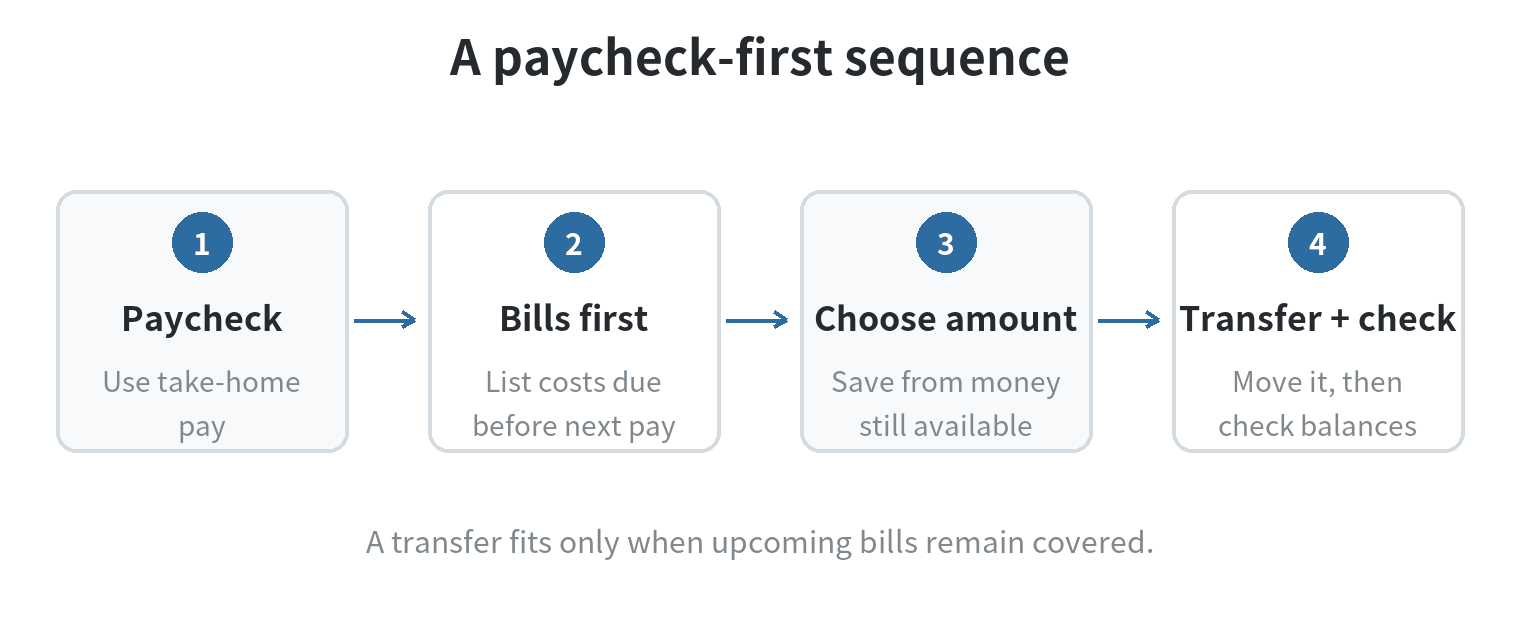
Use take-home pay, not gross salary. List the bills due before your next paycheck, essential spending for that stretch, and any minimum debt payments. Put their due dates beside the amounts. The CFPB’s cash-flow guidance explains that the timing of income and expenses affects when money runs short; the FDIC’s Money Smart savings guide likewise has you account for changes in income and upcoming expenses.
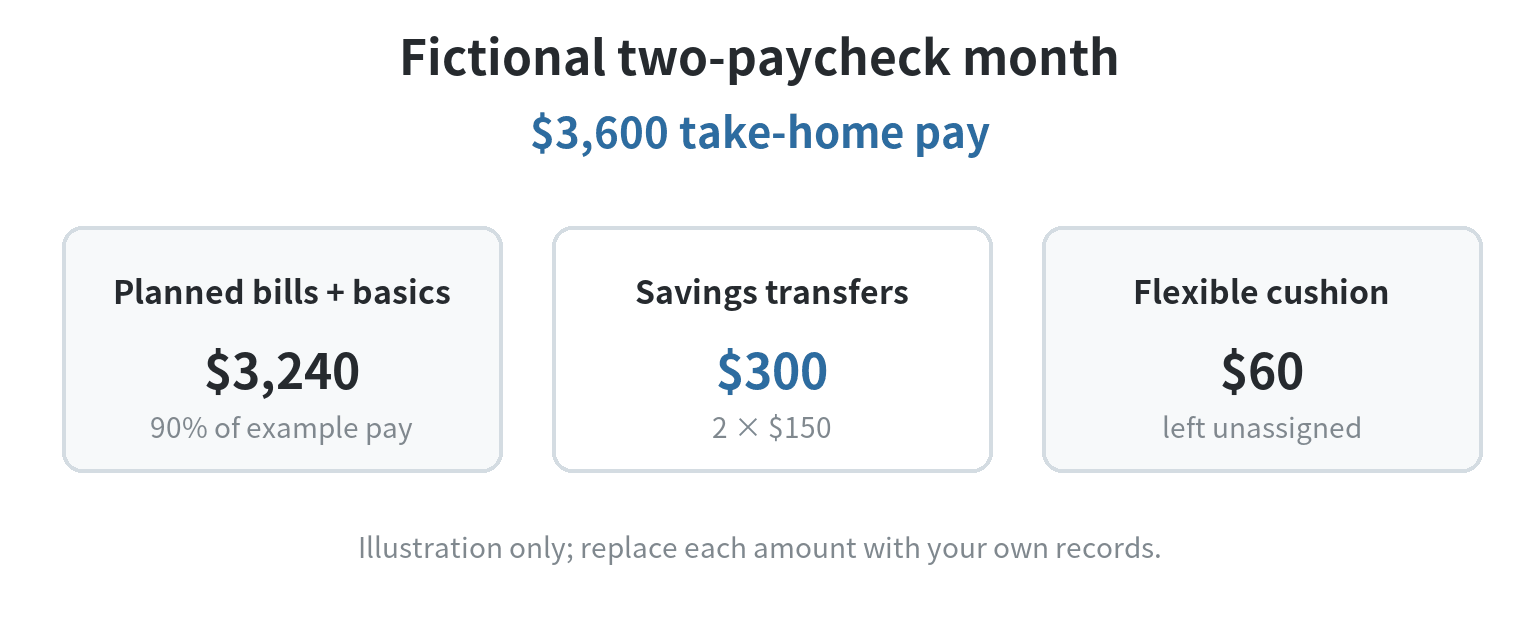
Here is a fictional example to show the arithmetic. A worker brings home $1,800 twice a month, or $3,600 in a two-paycheck month. Rent is $1,450; utilities, groceries, transportation, insurance, minimum debt payments, and other recurring costs total $1,790. Those planned costs leave $360 for saving and flexible spending. If the worker starts by moving $150 from each check, $300 goes to savings over the month, while $60 remains unassigned for small changes in spending. These are sample numbers, not a recommended savings rate. The cash-flow approach follows the CFPB’s income-and-expense timing guidance; the amounts are invented for this example.
Replace every figure with your own statements and bill dates. If the $60 cushion would not cover a bill that falls before the next paycheck, lower the transfer. A transfer that forces you to borrow the same money back is too large for the current calendar.
Choose a goal, then calculate the deposit
Give the savings line a job: a starter cash reserve, a car repair fund, a move, or another cost you have chosen. Write down the target and the date you want the money available. For a dated goal, subtract what you have already saved, then divide the remaining amount by the number of paychecks before the due date. The FDIC’s goal worksheet uses the same idea: amount still needed divided by the time available. The CFPB recommends setting a specific savings goal and choosing a contribution system you can maintain.
For example, if your goal is $900 and you have saved $300, the remaining $600 divided across 12 upcoming paychecks is $50 per check. The FDIC savings worksheet uses the amount-needed-over-time calculation; these example amounts simply demonstrate it. If the result does not fit after bills, extend the date or choose a smaller contribution. The calculation tells you what the goal requires; your cash-flow list tells you whether the schedule fits.
Keep planned costs distinct from surprise costs. A known annual premium or school expense can have its own sinking-fund line and due date. Check past bills and notices, write down the amount and when it is due, then divide the amount you need by the paychecks remaining before payment. The FDIC’s guide to periodic expenses and savings goals provides worksheets for these inputs. An emergency reserve is for costs you did not plan for. If you want another way to sort a savings goal for unexpected costs, see our guide to building an emergency fund. For regular spending categories, our shared household budget guide shows how to separate shared costs from personal lines.
| What you know | What to do |
|---|---|
| A goal amount and a due date | Subtract existing savings, then divide by paychecks before the date. |
| A recurring bill with a changing amount | Use the latest bill as a starting point and leave room for the next amount. |
| Income that changes from check to check | Set essentials first; decide on a transfer after each check clears. |
| A checking balance that gets tight before payday | Reduce or delay the transfer and map bill dates again. |
Put the transfer where your cash flow can handle it
If your employer permits split direct deposit, you can ask whether a set portion of each check can go to savings. Another option is a recurring transfer from checking after payday. The CFPB describes both approaches; the FDIC guide also includes a worksheet for planning contributions from income. Availability and minimum transfer amounts depend on your employer or financial institution, so check their terms.
Match the date to when the money is usable, not simply the date printed on your pay schedule. If rent or a large payment is due first, keep that money in checking and schedule savings after it clears. Write the transfer and bill dates on one calendar. CFPB advises monitoring your checking balance around automatic transfers because an insufficient balance can lead to an overdraft fee; the FDIC also asks savers to consider the advantages and disadvantages of where they hold savings.
Keep a checking cushion that reflects your actual timing. It might be a fixed amount, or the total of bills due before your next deposit. The point is to avoid treating money already assigned to rent, utilities, or groceries as available to save. A separate savings account can make the goal easier to track, but compare account terms and access before choosing where to hold it.
Adjust the plan when a check is smaller
With irregular income, do not promise the same transfer if a smaller check would leave a bill uncovered. First cover expenses due before the next expected income. Then move the amount that remains available toward the savings goal. In a stronger month, you can choose whether some extra belongs in savings after upcoming bills are accounted for. CFPB’s savings guide describes cash-flow planning and one-time income as options for people whose pay changes; the FDIC worksheet also prompts savers to list possible income decreases and periodic expenses.
If one check is smaller than planned, recalculate instead of trying to force the old transfer through. Note what remains after bills due before the next check, make a smaller transfer only if money remains, and revise the goal date if needed. If the deposit arrives late or a bill posts early, delay the transfer until the deposit clears and check the balance again. This keeps a missed schedule visible in the budget instead of hiding it with a transfer that later needs to be reversed.
At the end of a pay period, compare the transfer you planned with what actually left checking. Record any bill that posted earlier than expected, any cost you left out, and the balance you want available before the next deposit. Use those notes to adjust the next transfer, rather than judging the plan by whether you reached a round-number savings target. The CFPB recommends checking savings progress and account balances, while the FDIC guide has worksheets for income changes and scheduled expenses.
If your pay arrives weekly or every other week, count the deposits that fall before the goal date instead of converting the goal to a monthly amount by habit. If the goal has no firm deadline, choose an amount that fits after bills and revisit it when income or expenses change. The FDIC goal worksheet lets you work with days, weeks, months, or years; the CFPB’s savings guidance describes choosing a contribution amount and schedule that suit your cash flow.
Review the plan when rent, insurance, debt payments, or pay timing changes. If the checking balance repeatedly falls short, pause the scheduled transfer and rebuild the calendar from current statements. If the amount works across several pay cycles, keep it in place; raise it only after checking that the next round of bills still fits.
Paying yourself first is a sequence: make a realistic plan, reserve what the next bills require, and move a chosen amount toward a named goal. A small transfer that fits your real pay calendar is easier to keep than an ambitious one that must be reversed.
FAQ
Should savings come before credit card payments?
Keep required minimum payments in the bill plan before setting an automatic savings amount. If you are weighing extra debt payments against savings, compare the due dates and terms on your own accounts before assigning money beyond those minimums.
What if my paycheck arrives on a different date than expected?
Use the date funds actually become available in your account. Set the transfer after the deposit clears, and update your bill calendar if the pay date shifts.
Can I use one savings account for several goals?
Yes. Track each goal as a separate line in a worksheet or budget, then record how much of the account balance belongs to each one. Check the account’s terms if you are considering separate accounts.
Last updated: 2026-10.